---
title: "Alabama Window Tint Laws: The 32% Rule by Window"
canonical: "https://carglassfix.com/alabama-window-tint-laws/"
author: "Garrett Ross"
published: "2026-11-08T15:00:00+00:00"
modified: "2026-11-08T00:25:01+00:00"
language: "en-US"
site: "CarGlassFix"
description: "Alabama window tint laws: 32% light on every side window and the rear glass, 20% max reflectance, windshield top 6 inches only. Exemptions and fines."
categories: "Window Tint"
attribution: "CarGlassFix (https://carglassfix.com/)"
---
# Alabama Window Tint Laws: The 32% Rule by Window
Short answer
Alabama window tint laws require every side window and the rear windshield to let through at least 32% of light, with reflectance of 20% or less and a measurement tolerance of at least 3%. The windshield may carry only a transparent item that is not red or amber on its uppermost 6 inches.
## Key takeaways
- Alabama uses one 32% light transmission limit for the front side windows, the rear side windows and the rear windshield (Ala. Code 32-5C-2(a)(2)).
- Window film may not raise light reflectance above 20%, which rules out most mirror films on any window.
- An officer must carry a light meter before stopping a driver and must measure the window before a tint charge.
- ALEA grants medical exemptions on a written statement from a physician licensed in Alabama and issues a numbered windshield decal.
- A first conviction carries a fine of up to $100, up to 10 days in jail, or both (Ala. Code 32-5C-7).
## Alabama window tint limits by window
Alabama sets one limit for aftermarket film: at least 32% light transmission on every side window and the rear windshield. The rule sits in Chapter 5C of Title 32 of the Code of Alabama, sections 32-5C-1 to 32-5C-7. Section 32-5C-2 bans material on the rear windshield or side windows that cuts light “to less than 32 percent” or raises reflectance “to more than 20 percent”. The statute names no separate number for SUVs, vans or pickups. The Alabama Law Enforcement Agency (ALEA) adds a note for multipurpose vehicles, covered in its own section below. The windshield has a stricter rule: no light-reducing material at all, except a transparent strip in the top 6 inches.
| Window | Sedan | SUV, van, pickup |
| --- | --- | --- |
| Windshield | No tint, except a transparent item, not red or amber, on the uppermost 6 inches | Same |
| Front side windows | 32% light or more, 20% reflectance or less | Same |
| Rear side windows | 32% light or more, 20% reflectance or less | Aftermarket film: 32% in the statute. ALEA: darker glass as the maker allows under federal law, with two outside mirrors |
| Rear windshield | 32% light or more, 20% reflectance or less | Same as rear side windows |
| Tolerance | At least 3% (32-5C-2(a)(2)) | Same |
| Proof of compliance | Label visible from outside the vehicle (32-5C-6) | Same |
## How Alabama measures the 32% limit
Alabama measures the light that passes through the finished window, so the film and the glass count together. Section 32-5C-1 defines light transmission as the share of light “allowed to pass through a surface” compared with the light falling on it. The 32% figure is therefore a meter reading of the tinted window, not the shade printed on the film box.
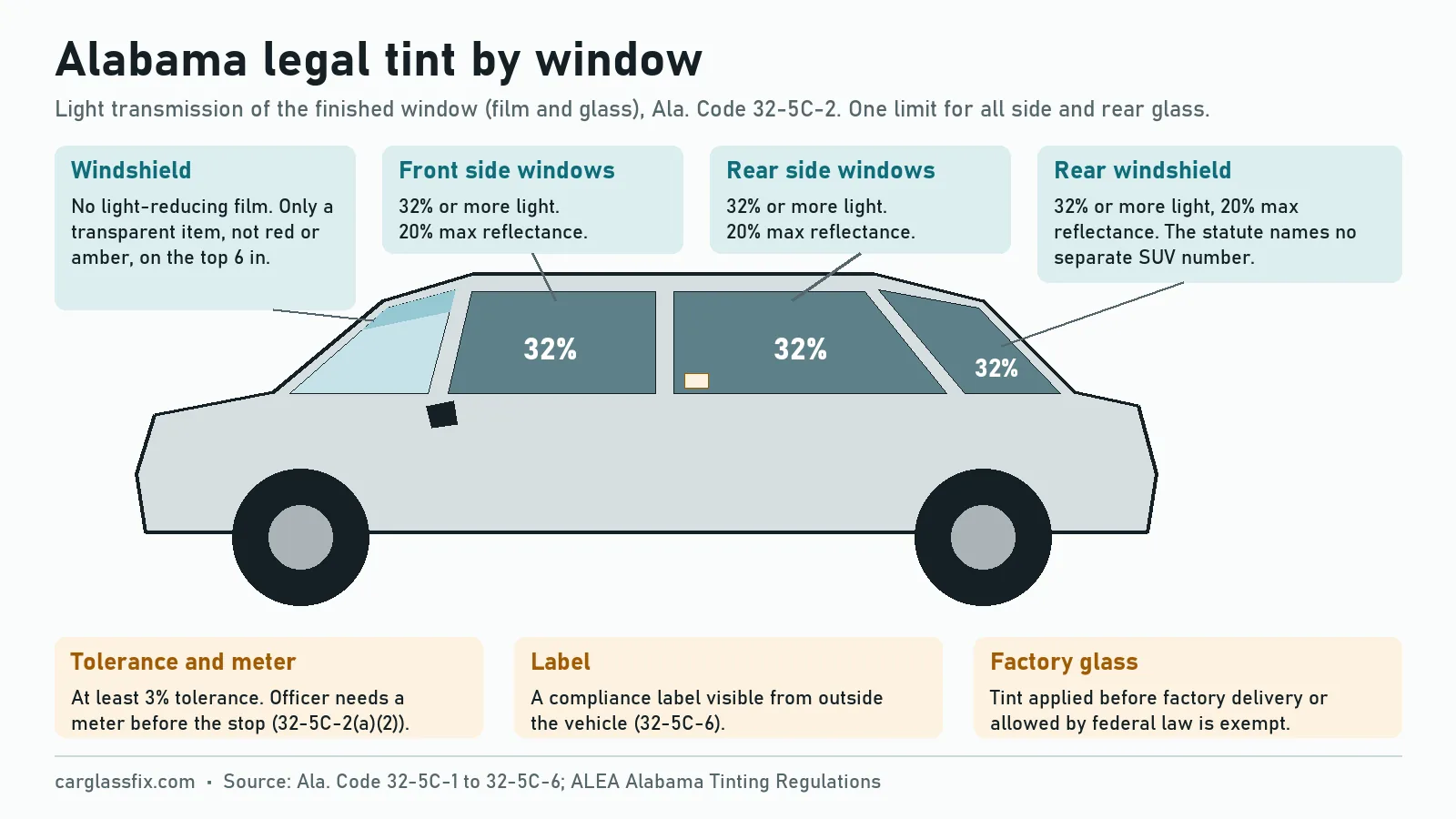
*Source: Ala. Code 32-5C-1 to 32-5C-6 and the ALEA Alabama Tinting Regulations page. Diagram: CarGlassFix.*
Factory glass already blocks some light, so a film sold as 35% can read below 32% once it is on the window. Our [how to measure window tint](https://carglassfix.com/how-to-measure-window-tint/) guide shows the glass-times-film math. Alabama also writes its enforcement method into the statute. The light “shall be measured with a device or instrument” before a person may be charged, and “the officer shall be equipped with such a meter before stopping the driver.” A [window tint meter](https://carglassfix.com/window-tint-meter/) gives the same kind of reading. The statute grants a “measurement tolerance of at least 3 percent” but does not spell out how it is applied. ALEA’s own summary describes the rule as 32% “with a 3% tolerance”. The 20% reflectance cap applies to the same windows, so [mirror tint on a car](https://carglassfix.com/can-you-put-mirror-tint-on-a-car/) is limited in Alabama.
## Windshield tint in Alabama: the top 6 inches
An Alabama windshield may not carry any material that reduces light, except a transparent item on its uppermost 6 inches. Section 32-5C-2(a)(1) bans material or glazing on the front windshield “which reduces light transmission through the front windshield.” Section 32-5C-3(4) then exempts “any transparent item which is not red or amber in color” placed on the top 6 inches. Alabama does not use the AS-1 line for this rule. The measure is a fixed 6 inches from the top edge of the glass. The statute sets no light transmission number for the strip; it must simply be transparent. Red and amber are the only colors the statute names, and only for this strip.
Other windshield items follow separate exceptions. Signs or stickers are allowed in a seven-inch square in a lower corner of the front or rear windshield. Stickers required by federal, state or local law are allowed too. For the general rules, read [can you have stickers on your windshield](https://carglassfix.com/can-you-have-stickers-on-your-windshield/) and [is it illegal to have tint on a windshield](https://carglassfix.com/is-it-illegal-to-have-tint-on-windshield/).
## Do SUVs, vans and pickups get darker tint in Alabama
The Alabama statute gives SUVs, vans and pickups the same 32% limit as sedans, but factory-darkened glass is exempt. Section 32-5C-3(6) excludes any vehicle whose windows “have been tinted or darkened before factory delivery or permitted by federal law or regulation.” That covers the factory privacy glass many SUVs carry behind the driver. See [what is privacy glass on a car](https://carglassfix.com/what-is-privacy-glass-on-a-car/) for how it differs from film.
ALEA’s tinting page describes multipurpose passenger vehicles in looser terms. It says that behind the driver “darker tinting is permitted as allowed by the manufacturer of the vehicle by Federal Law.” It also says outside mirrors on each side are required when the darker tint is installed. The page adds that the manufacturer decides whether a vehicle is a multipurpose vehicle. Neither the statute nor ALEA gives a percentage for aftermarket film darker than 32% on an SUV. Many tint sites state “any darkness” for SUV rear windows as if the statute said so. A driver who wants film darker than 32% behind the driver of an SUV should ask ALEA first.
## How the Alabama tint law changed, and what older pages get wrong
Alabama’s 32% and 20% limits are older than the statute itself. A Department of Public Safety rule, 760-X-1-.17, filed November 14, 1990, set the same two numbers “from and after March 1, 1991.” That rule’s factory-tint exemption did not cover “those windows to the right and left of the driver.” It had no tolerance and no meter clause.
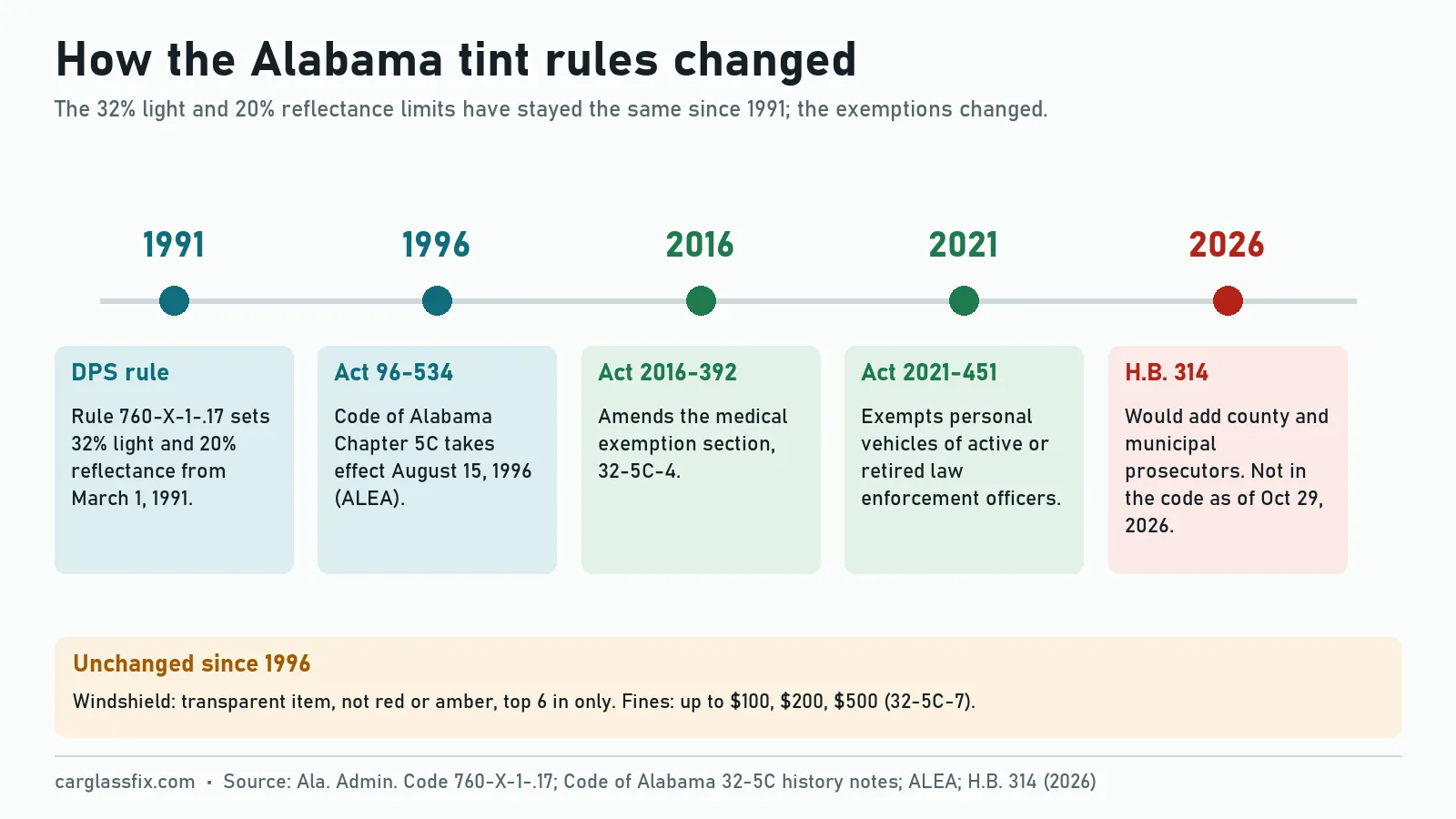
*Sources: Ala. Admin. Code 760-X-1-.17, Code of Alabama 32-5C-2 and 32-5C-4 history notes, ALEA, H.B. 314 (2026) as introduced. Diagram: CarGlassFix.*
Act 96-534, effective August 15, 1996, put the limits into Chapter 5C. Act 2016-392 amended the medical exemption in 32-5C-4. Act 2021-451 exempted personal vehicles of active or retired law enforcement officers, who must carry law enforcement identification. In 2026, H.B. 314 would have added county and municipal prosecutors to that exemption. The current code text, checked October 29, 2026, has no prosecutor clause. Some older pages are wrong on details. One aggregator says all tint colors are permitted, but the windshield strip may not be red or amber. The same page says a sticker goes on each tinted window; the statute requires a label visible from outside the vehicle.
## Alabama medical exemption for window tint
Alabama’s medical exemption comes from ALEA, on an application backed by a written statement from a physician licensed to practice medicine in Alabama. Section 32-5C-4(a) covers a person “required for medical reasons to be shielded from the direct rays of the sun.” The exemption can apply to a vehicle the person owns or one in which the person is a “habitual passenger.” ALEA may attach its own conditions and limits. For light-sensitive porphyria, the exemption covers every area of the windshield and windows that the physician prescribes in the statement.
The steps below follow the statute and the ALEA tinting page.
## How to get an Alabama medical tint exemption
1. ### See an Alabama-licensed physician
The written statement must come from a physician licensed to practice medicine in Alabama (32-5C-4(a)).
2. ### Apply to ALEA
Send the application with the statement to the ALEA Driver License Division, Medical Records Unit, P.O. Box 1471, Montgomery, AL 36102.
3. ### Receive the decal
ALEA issues a decal with a unique identification number to each person granted an exemption (32-5C-4(c)).
4. ### Place it on the windshield
The decal goes on the windshield of each vehicle the exempt person operates.
The statute lets ALEA charge a fee for each decal; ask the Medical Records Unit for the current fee and conditions.
## Compliance labels and installer rules in Alabama
Every Alabama vehicle with light-reducing film must display a label visible from the outside showing that the windows meet the limits. Section 32-5C-6 sets that rule and adds that no person shall install material that breaks the 32% or 20% limits. The label system starts with the film maker. Section 32-5C-5 requires each manufacturer to apply to the director for approval and registration of its film and its label before shipping the film into Alabama.
The director approves only film that, once applied, does not reduce light or raise reflectance beyond the limits. The manufacturer must supply approved labels, placement instructions and a notice that improper installation is a violation of state law. Altering or copying an approved label is unlawful. ALEA’s page says the stickers “must be affixed by a tinting dealer.” A shop that installs illegal film breaks the same chapter as the driver, and 32-5C-7 sets the penalty for “a person who violates this chapter.” Before choosing a shade, the [window tint simulator](https://carglassfix.com/window-tint-simulator/) previews how dark 32% looks.
## Alabama tint ticket fines and who is exempt
An Alabama tint violation is a misdemeanor with a fine of up to $100 for a first conviction. Section 32-5C-7 also allows up to 10 days in jail, or both the fine and jail. A second conviction for an offense within one year of the first raises the limits to $200 and 30 days. A third or later conviction within one year allows up to $500 and three months. Court costs are not part of these figures and differ by court.
Several vehicles fall outside the limits. Section 32-5C-3(7) exempts “any motor vehicle not registered in this state,” so visitors follow their home state’s rule. Factory tint and glass permitted by federal law are exempt under 32-5C-3(6). Personal vehicles of active or retired law enforcement officers are exempt under 32-5C-2(b). Compare other states in [what car window tint is legal](https://carglassfix.com/what-car-window-tint-is-legal/).
Alabama tint rules can change in any legislative session. Check the current Code of Alabama Chapter 5C or the ALEA tinting page before you tint. This article is general information, not legal advice.
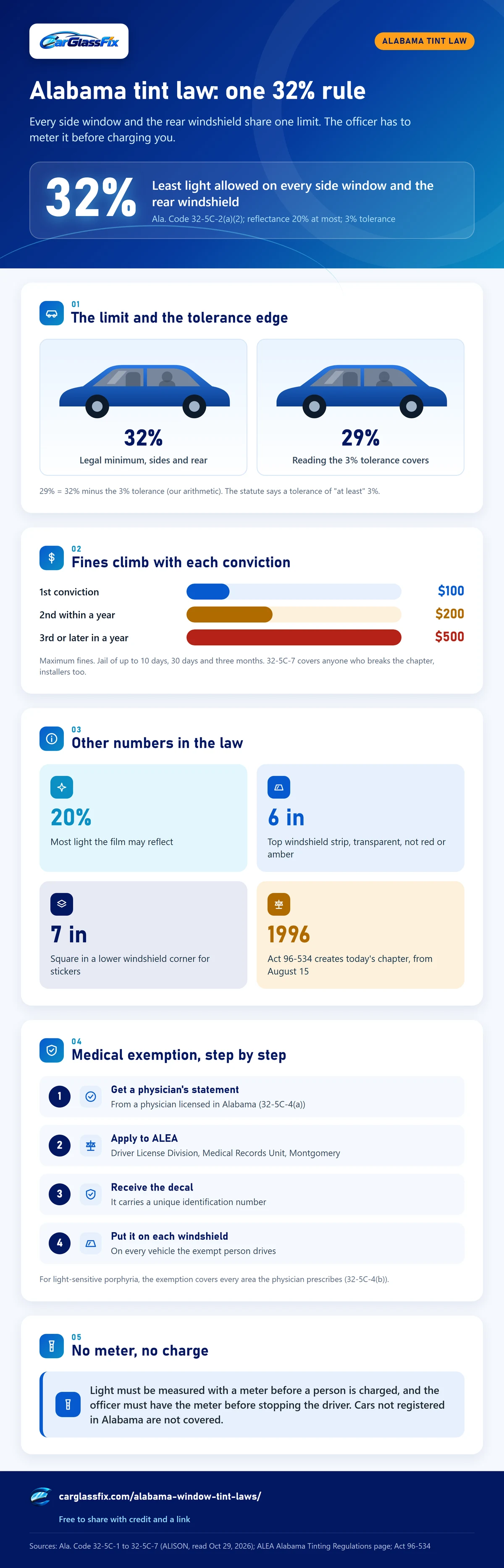
*CarGlassFix infographic. Sources: Ala. Code 32-5C-1 to 32-5C-7 (read October 29, 2026); ALEA Alabama Tinting Regulations page; Act 96-534.*
**Share this infographic.** Free to use on your site under CC BY 4.0: keep the credit and the link to this page. Copy the code below.

Infographic: CarGlassFix
## Frequently asked questions
### How much is an illegal tint ticket in Alabama?
The statute sets a fine of up to $100, up to 10 days in jail, or both for a first conviction. Repeat convictions within one year allow up to $200 and then up to $500 (Ala. Code 32-5C-7), plus any court costs.
### Is 20% tint legal in Alabama?
A 20% reading is below the 32% limit, so it is not legal on the side windows or the rear windshield of a car. It is legal only where a medical exemption allows it or on glass the vehicle maker darkened before delivery.
### Is 35% tint legal in Alabama?
A window that reads 35% with film and glass together meets the 32% limit. A film labelled 35% can read lower on tinted factory glass, so the finished window should be measured.
### What’s darker, 35 or 50 tint?
A 35% tint is darker because it lets through 35% of visible light, against 50% for the lighter film. The [window tint percentage chart](https://carglassfix.com/window-tint-percentage-chart/) shows each shade side by side.
### Can police check my tint without a meter in Alabama?
No. Section 32-5C-2(a)(2) says the officer must be equipped with a light meter before stopping the driver, and the light must be measured before a person is charged.
## Sources
- [Code of Alabama 32-5C-1, Definitions](https://alison.legislature.state.al.us/code-of-alabama?section=32-5C-1) (checked 29 October 2026)
- [Code of Alabama 32-5C-2, Prohibitions; Exceptions](https://alison.legislature.state.al.us/code-of-alabama?section=32-5C-2) (Act 2021-451; checked 29 October 2026)
- [Code of Alabama 32-5C-3, Exceptions](https://alison.legislature.state.al.us/code-of-alabama?section=32-5C-3) (checked 29 October 2026)
- [Code of Alabama 32-5C-4, Medical Exemptions](https://alison.legislature.state.al.us/code-of-alabama?section=32-5C-4) (Act 2016-392; checked 29 October 2026)
- [Code of Alabama 32-5C-5, Approval of Materials; Labels](https://alison.legislature.state.al.us/code-of-alabama?section=32-5C-5) and [32-5C-6, Display of Labels](https://alison.legislature.state.al.us/code-of-alabama?section=32-5C-6) (checked 29 October 2026)
- [Code of Alabama 32-5C-7, Penalties](https://alison.legislature.state.al.us/code-of-alabama?section=32-5C-7) (checked 29 October 2026)
- [Alabama Law Enforcement Agency: Alabama Tinting Regulations](https://www.alea.gov/resources/laws/alabama-tinting-regulations) (checked 29 October 2026)
- [Alabama Administrative Code 760-X-1-.17, Regulation on Window Tinting](https://admincode.legislature.state.al.us/api/rule/760-X-1-.17) (filed 14 November 1990; checked 29 October 2026)
- [Alabama H.B. 314, 2026 Regular Session, as introduced](https://alison.legislature.state.al.us/files/pdf/SearchableInstruments/2026RS/HB314-int.pdf) (checked 29 October 2026)