---
title: "Connecticut Window Tint Laws: The 35% Rule by Window"
canonical: "https://carglassfix.com/connecticut-window-tint-laws/"
author: "Garrett Ross"
published: "2026-11-11T09:00:00+00:00"
modified: "2026-11-08T00:25:18+00:00"
language: "en-US"
site: "CarGlassFix"
description: "Connecticut tint law: side and rear windows need 35% light with the glass, plus or minus 3%. Rear glass is free with two mirrors. Windshield rule, sticker."
categories: "Window Tint"
attribution: "CarGlassFix (https://carglassfix.com/)"
---
# Connecticut Window Tint Laws: The 35% Rule by Window
Short answer
Connecticut window tint laws require the side windows and the rear window to pass at least 35% of light, plus or minus 3%, with film and glass measured together. The rear window may be any darkness with outside mirrors on both sides. Windshield tint must stay above a line 29 inches over the driver’s seat.
## Key takeaways
- Every side window on a Connecticut sedan must read at least 35% light transmission, plus or minus 3%, measured with the glass (Conn. Gen. Stat. 14-99g(c)).
- SUVs, vans, pickups and other multipurpose passenger vehicles may have any darkness behind the driver, but only with outside mirrors on both sides.
- Windshield film is allowed only on the top part, with its bottom edge at least 29 inches above the driver’s seat, and it may not be red or amber.
- Each window tinted after factory delivery on a 1994 or later vehicle needs a self-destructing compliance sticker of 1 square inch or less in its lower left corner.
- A medical exemption on DMV Form E-220 can allow tint between 20% and 32%, validated at the Wethersfield DMV inspection lane.
## Connecticut window tint limits by window
Connecticut allows 35% light transmission, plus or minus 3%, on every side window and on the rear window, with two exceptions for the glass behind the driver. The law is Connecticut General Statutes 14-99g. It starts with a ban on any material that reduces light through the windshield or windows, then lists the cases where film is allowed. Subsection (c)(1) covers the front side windows and wing vents. Subsection (c)(5) covers the side windows behind the driver and the rearmost window. Subsection (c)(10) frees the rearmost window on any vehicle with outside mirrors on both sides. Subsection (c)(6) frees all windows behind the driver on trucks, buses and multipurpose passenger vehicles, again only with those mirrors. The table shows how that works out for a sedan and for an SUV, van or pickup.
| Window | Sedan | SUV, van, pickup |
| --- | --- | --- |
| Windshield | Top part only; bottom edge at least 29 in above the driver’s seat; not red or amber | Same |
| Front side windows | 35% light or more, plus or minus 3%; reflectance 27%, plus or minus 3% | Same |
| Side windows behind the driver | 35% light or more, plus or minus 3%; reflectance 21%, plus or minus 3% | Any darkness with outside mirrors on both sides; otherwise 35% |
| Rear window | Any darkness with outside mirrors on both sides; otherwise 35% | Any darkness with outside mirrors on both sides; otherwise 35% |
| Finish and color | No mirror-like film on side or rear windows; red and amber banned on the windshield strip | Same |
| Measured as | Film and glass together | Same |
## How Connecticut measures the 35% limit
Connecticut measures the finished window, so the 35% figure applies to film and factory glass together. Subsection (a)(1) defines light transmission as the share of light that passes through the product or material “including the glazing”. Factory glass already blocks some light, so a film sold as 35% usually reads lower once it is installed.
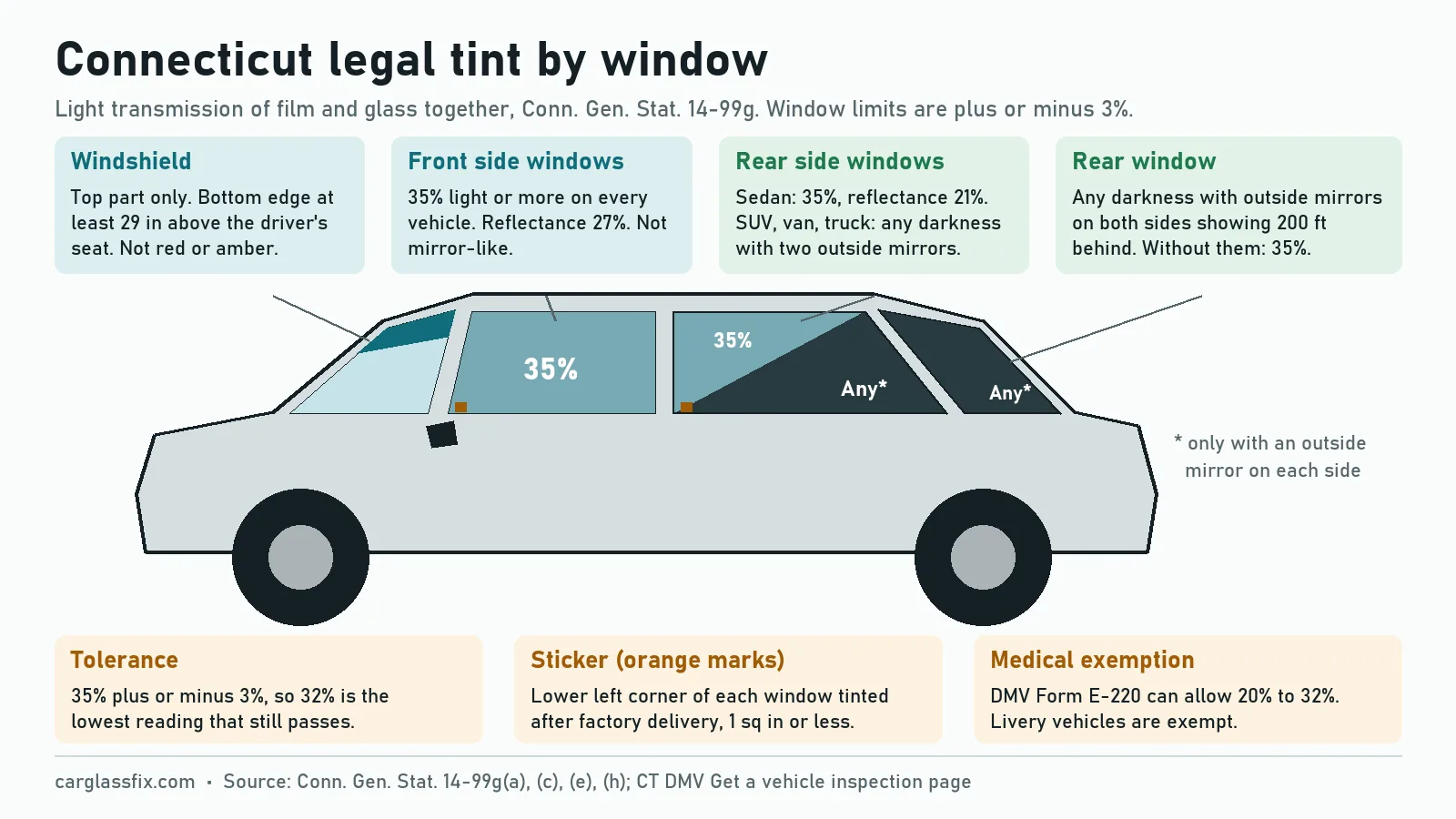
*Limits from Conn. Gen. Stat. 14-99g and the CT DMV vehicle inspection page. Diagram: CarGlassFix.*
The statute writes each limit as “thirty-five per cent plus or minus three per cent”. The DMV page repeats it as “no less than 35 percent, plus or minus three percent”. In practice a reading of 32% is the lowest a window can show and still pass. The DMV medical band starts at that same 32% figure. Reflectance is also capped. Front side film may reflect 27%, and film behind the driver 21%, each plus or minus 3%. Our guide on [how to measure window tint](https://carglassfix.com/how-to-measure-window-tint/) shows the glass-times-film math. A [window tint meter](https://carglassfix.com/window-tint-meter/) reads the net figure that an inspector sees. The [window tint percentage chart](https://carglassfix.com/window-tint-percentage-chart/) shows how dark 35% looks next to 20% or 5%.
## Windshield tint in Connecticut: the 29-inch seat rule
Connecticut allows transparent film only on the topmost part of the windshield, and its bottom edge must sit at least 29 inches above the undepressed driver’s seat. That is subsection (c)(11). The statute also fixes how to take the measurement. The point is 5 inches in front of the bottom of the backrest. The seat must be in its rearmost and lowest position, and the vehicle must stand on a level surface. The film may not be red or amber. The statute names no light percentage for this strip.
Connecticut does not use the AS-1 line in its tint law. Several tint sites state an AS-1 rule for Connecticut, and that wording does not appear in 14-99g. Stickers are a separate allowance. Subsection (c)(4) lets drivers place stickers in a 7-inch square in the lower corner farthest from the driver, or a 5-inch square in the lower corner nearest the driver. For how other states treat the windshield, read [is it illegal to have tint on a windshield](https://carglassfix.com/is-it-illegal-to-have-tint-on-windshield/).
## SUVs, vans, trucks and the dual mirror condition
Windows behind the driver on an SUV, van, pickup, truck or bus may be any darkness, but only when the vehicle has outside mirrors on the left and right sides. Subsection (c)(6) requires those mirrors to show the driver the highway for at least 200 feet to the rear. The exemption covers any truck, motor bus, trailer, mobile manufactured home or multipurpose passenger vehicle. The statute borrows the federal definition in 49 CFR 571.3. That rule defines a multipurpose passenger vehicle as one designed to carry 10 persons or less, built on a truck chassis or with special features for occasional off-road use.
The DMV tells owners to check the manufacturer’s certification label in the driver’s door jamb. If that label says MPV, the windows behind the driver may be tinted “as dark as desired” with both side mirrors. A sedan gets a narrower break. Subsection (c)(10) frees only its rearmost window, and its rear side windows stay at 35%. Vehicles in livery service, as defined in section 13b-101, are exempt from the tint rules altogether under subsection (h). The DMV frequently asked questions answer lists the MPV exemption without the mirror condition, so the statute text is the safer guide.
## Connecticut medical exemption for window tint
Connecticut grants medical tint exemptions through the Department of Motor Vehicles, on written application backed by a Connecticut-licensed physician or optometrist. Subsection (b) exempts a person “required for medical reasons to be shielded from direct rays of the sun”. It also covers the owner of a vehicle in which that person usually rides. The statute itself sets no lower limit. The DMV sets one in practice.
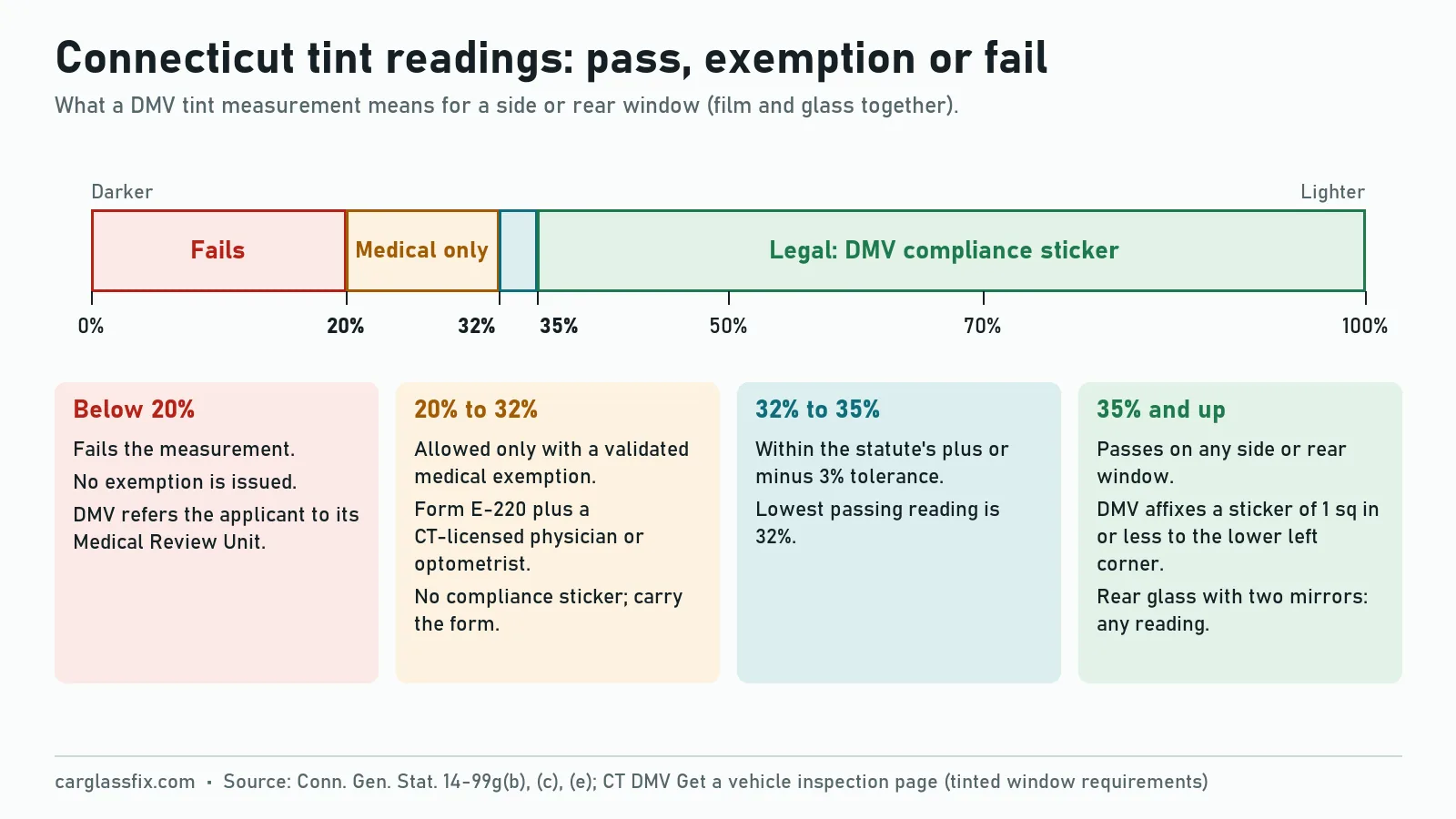
*Bands from Conn. Gen. Stat. 14-99g(b) and (c) and the CT DMV vehicle inspection page. Diagram: CarGlassFix.*
The DMV says a medical exemption may be granted where tint must be “between 32 percent and not less than 20 percent”. A window that reads below 20% fails the measurement and gets no exemption. The DMV then refers the applicant to its Medical Review Unit. The steps below follow the DMV inspection page.
## How to get a Connecticut medical exemption for window tint
1. ### Get Form E-220
Request the DMV application and special permit for exemption from tinted window requirements.
2. ### Add medical documentation
A physician or optometrist licensed in Connecticut must support the application in writing (14-99g(b)).
3. ### Bring the vehicle to Wethersfield
The DMV Commercial Vehicle Safety Division validates the form after the vehicle passes tint measurement at the Wethersfield inspection lane.
4. ### Carry the validated form
Keep it in the vehicle at all times. Exempted vehicles do not get compliance stickers.
## The DMV tint sticker and inspection lane
Every Connecticut vehicle with after-market tint must be tested by the DMV and carry a compliance sticker that the DMV applies. The DMV page says the sticker “must be affixed to the window by the DMV”. Subsection (e) applies to vehicles made and sold on or after January 1, 1994 with any window tinted after factory delivery. Each such window needs a sticker in its lower left corner, legible from outside. The sticker must be pressure-sensitive and “self-destructive upon removal”, and no larger than 1 square inch. Film makers must register their film and sticker with the Commissioner of Motor Vehicles before selling the material in the state.
The DMV runs courtesy tint checks at a DMV inspection lane, and its page names the Wethersfield lane for owners who want to verify their film. A vehicle that fails a voluntary check receives a warning ticket. A police warning ticket for tint must be cleared at a DMV inspection lane, and a licensed dealer or repairer cannot clear it. Subsection (i) adds a rule for shops. Each tint business must post a sign with the limits in letters at least 3 inches high, the penalties and real film samples. To preview 35% on your own car first, try the [window tint simulator](https://carglassfix.com/window-tint-simulator/).
## Penalty for illegal tint in Connecticut
Illegal tint in Connecticut is an infraction for each offense under subsection (f), and the statute does not state a dollar amount. The same subsection sets a fix-it duty. A driver cited for illegal film must remove it and report within 60 days to the police department that issued the complaint. There the vehicle is inspected to show compliance. A driver who skips that step and is cited again faces impoundment of the vehicle, after notice and a chance for a hearing.
Older rules still matter for some cars. Subsection (g) required owners of after-factory tinted vehicles to bring them to the DMV for stickers by July 1, 1996. Subsection (d) bans the sale or delivery in the state of any vehicle whose glass exceeds the limits, on and after that same date. The text read for this page is a FindLaw copy marked current as of January 1, 2025, because the General Assembly site did not respond. Neighbouring states differ. See [Massachusetts window tint laws](https://carglassfix.com/massachusetts-window-tint-laws/), or compare every state in [what car window tint is legal](https://carglassfix.com/what-car-window-tint-is-legal/). Rules change, so check the current statute or the Connecticut DMV before you tint. This page is not legal advice.
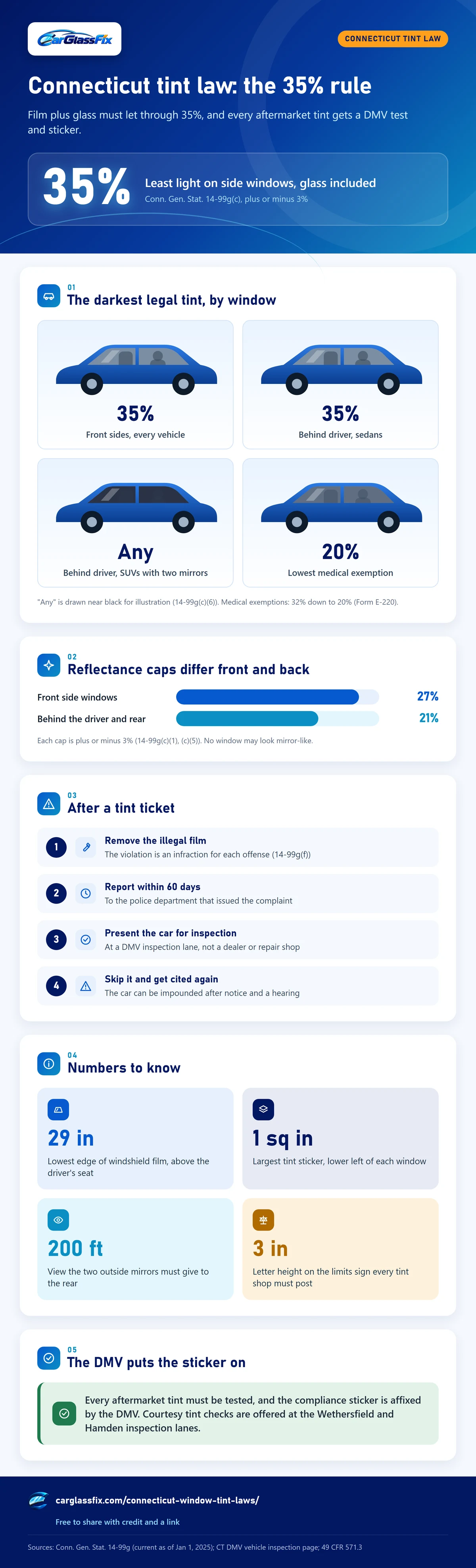
*CarGlassFix infographic. Sources: Conn. Gen. Stat. 14-99g (current as of January 1, 2025); CT DMV vehicle inspection page; 49 CFR 571.3.*
**Share this infographic.** Free to use on your site under CC BY 4.0: keep the credit and the link to this page. Copy the code below.

Infographic: CarGlassFix
## Frequently asked questions
### Is 20% tint legal in Connecticut?
A 20% reading is illegal on any side window of a sedan without a medical exemption, because the limit is 35% plus or minus 3%. It is legal on the rear window with two outside mirrors, and behind the driver on an SUV, van or truck with those mirrors.
### Where can I find a Connecticut tint exemption form?
The form is DMV Form E-220, the application and special permit for exemption from tinted window requirements, linked from the CT DMV vehicle inspection page. The DMV validates it after the vehicle passes tint measurement at the Wethersfield inspection lane.
### Is 20% tint darker than 35%?
Yes. A 20% film lets through 20% of visible light, while a 35% film lets through 35%, so 20% looks darker. The [window tint percentage chart](https://carglassfix.com/window-tint-percentage-chart/) shows both shades side by side.
### Is 5% tint legal on the back window in Connecticut?
Yes, if the vehicle has outside mirrors on both sides that show the road at least 200 feet behind. Without those mirrors, the rear window must meet the same 35% limit as the side windows.
### Does factory tint need a sticker in Connecticut?
No. The sticker rule in 14-99g(e) applies only to windows tinted or darkened after factory delivery. Factory glass still has to meet the light and reflectance limits.
## Sources
- [Connecticut General Statutes 14-99g, Tinted or reflectorized windows (FindLaw copy, current as of 1 January 2025)](https://codes.findlaw.com/ct/title-14-motor-vehicles-use-of-the-highway-by-vehicles-gasoline/ct-gen-st-sect-14-99g/) (checked 29 October 2026)
- [Connecticut General Assembly: Chapter 246, Motor Vehicles (official text)](https://www.cga.ct.gov/current/pub/chap_246.htm) (did not respond on 29 October 2026)
- [Connecticut DMV: Get a vehicle inspection (tinted window requirements, medical exemption, warning tickets)](https://portal.ct.gov/dmv/vehicle-services/get-vehicle-inspection) (checked 29 October 2026)
- [Connecticut DMV Form E-220, Application and special permit for exemption from tinted window requirements](https://www.dmvct.state.ct.us/E220.aspx)
- [49 CFR 571.3, Definitions (multipurpose passenger vehicle)](https://www.law.cornell.edu/cfr/text/49/571.3) (checked 29 October 2026)