---
title: "Factory Tint Percentage: VLT by Window and Net Calculator"
canonical: "https://carglassfix.com/factory-tint-percentage/"
author: "Garrett Ross"
published: "2026-11-04T12:00:00+00:00"
modified: "2026-11-04T08:07:10+00:00"
language: "en-US"
site: "CarGlassFix"
description: "Factory tint is 70% or lighter on front glass and about 20% on privacy glass. Check typical VLT by window and the net result with film. Measure to confirm."
categories: "Window Tint"
attribution: "CarGlassFix (https://carglassfix.com/)"
---
# Factory Tint Percentage: VLT by Window and Net Calculator
Short answer
Factory tint percentage is 70% VLT or lighter on windshields and front side windows, and NHTSA described factory-tinted glass as about 80% in 1985. Rear privacy glass on SUVs, pickups and vans is darker, with GM listing a nominal 20%. No public table lists factory tint by model, so measure your own glass.
## Key takeaways
- FMVSS 205 requires new passenger car glass to transmit at least 70% of light, and NHTSA gave about 80% as typical for factory tint in 1985.
- GM lists rear privacy glass at a nominal 20%, and glass maker AGC lists a privacy range of 4.5% to 40%.
- No public source lists factory tint percentage by make and model.
- You can tint over factory tint, and the net VLT is the glass figure multiplied by the film figure.
- 35% film on 80% glass gives 28%, and 35% film on 20% privacy glass gives 7%.
VehiclePassenger carSUV, pickup or van Glass positionWindshield, below AS-1 lineWindshield shade bandFront side windowsRear side or quarter windowsRear window Glass typeClear lookLight green (solar)Dark gray or black (privacy) Film to addNo film70% film50% film35% film20% film15% film5% film
No public table lists factory VLT by model, so these are typical figures, not your car’s reading. Sources checked October 31, 2026. [Measure the window](https://carglassfix.com/how-to-measure-window-tint/) for the real number. General information, not legal advice. Your state’s limit is in the [tint law checker](https://carglassfix.com/what-car-window-tint-is-legal/).
## What factory tint percentage means
Factory tint percentage is the share of visible light the bare glass lets through, called VLT. A higher number means lighter glass. Clear windows pass about 90% of light, according to a 1985 NHTSA letter. The same letter puts factory-equipped tinted windows at about 80%.
Factory tint is part of the glass. Madico says the dyes and pigments are mixed into the glass during manufacturing, so there is no film layer. A window that came dark from the factory stays dark after any film is removed.
The tool above gives typical figures by position and glass type. Those figures describe classes of glass, and they do not describe your exact car. The 80% figure dates from 1985, and we found no newer federal figure. The IWFA says factory glass may be as dark as 70%, although most is slightly lighter. Our [window tint percentage chart](https://carglassfix.com/window-tint-percentage-chart/) explains what each number looks like.
## Factory tint percentage by glass position
Factory tint percentage depends on the position of the glass and the type of vehicle. Glass in front of and beside the driver must stay at 70% or lighter. Glass behind the driver on SUVs, pickups and vans can be much darker.
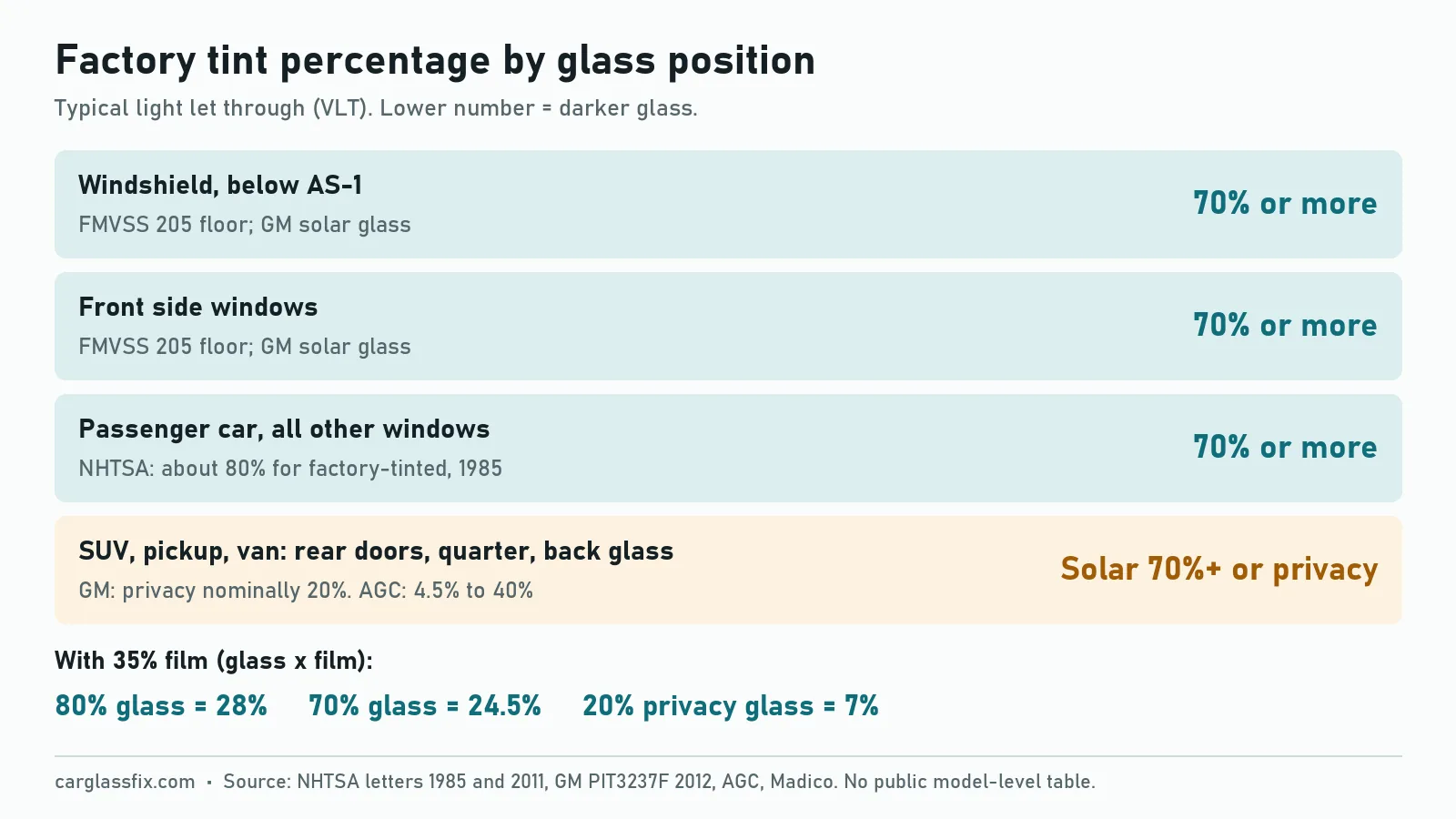
*Source: NHTSA letters, GM PIT3237F, AGC and Madico. Diagram: CarGlassFix.*
**Share this infographic.** Free to use on your site under CC BY 4.0: keep the credit and the link to this page. Copy the code below.

Infographic: CarGlassFix
| Glass position | Typical VLT | Source |
| --- | --- | --- |
| Windshield below the AS-1 line | 70% or more | NHTSA 2011 letter; GM PIT3237F |
| Windshield shade band above the AS-1 line | No federal limit | NHTSA 2011 letter |
| Front side windows | 70% or more | IWFA on FMVSS 205; GM PIT3237F |
| Passenger car, rear side and rear window | 70% or more, about 80% typical in 1985 | NHTSA 1985 letter |
| SUV, pickup or van, rear side, quarter and back glass, solar | 70% or more | GM PIT3237F |
| SUV, pickup or van, rear side, quarter and back glass, privacy | Nominal 20%, makers range from 4.5% to 40% | GM PIT3237F; AGC |
The rear glass gap comes from the federal rule itself. The IWFA says FMVSS 205 covers all passenger cars, while on trucks and multipurpose vehicles it applies only to front side windows if the vehicle has two outside mirrors. That is why so many SUVs have dark rear glass. Read [what privacy glass is](https://carglassfix.com/what-is-privacy-glass-on-a-car/) for more on this glass type.
## There is no public factory tint table by model
No public source lists factory tint percentage by make, model and year. The federal documents, automaker bulletins and glass maker pages checked for this guide give no such table. A chart that claims exact figures per model needs a named source, so treat one without a source as owner reports.
The closest public document is GM’s bulletin PIT3237F from October 2012. It covers many GM cars, SUVs and trucks, from model years around 1999 to 2013. It gives one rule for all of them: solar glass at 70% or more, and privacy glass at a nominal 20%. Nominal means a design target, so one window can read above or below it.
AGC shows why one number cannot cover every brand. It says privacy glass light transmission is chosen per car line, from 4.5% to 40% under ISO 9050. Two SUVs with dark rear glass can therefore differ by a wide margin. A single typical figure for privacy glass is a starting point for the math, and a meter reading replaces it.
## How to find your car’s factory tint percentage
A tint meter gives the only figure that applies to your car. Glass color narrows the answer first. GM says light green glass is solar glass, and dark gray or black glass is privacy glass.
## How to find your factory tint percentage
1. ### Check the glass color
Light green points to solar glass, and dark gray or black points to privacy glass, according to GM.
2. ### Rule out film
Ask a shop to confirm there is no film on the glass, because a reading on filmed glass is a net figure.
3. ### Find a meter
The IWFA says hand-held light meters are available at a reasonable price, and that shops should have them.
4. ### Read each position
Measure front side, rear side and back glass, because privacy glass can differ from the front glass by a wide margin.
5. ### Record the numbers
Use your readings in the tool’s math instead of the typical figures.
Fixed glass and windshields need a two-piece meter, because a one-piece meter clamps over a lowered window edge. Our guide to the [window tint meter](https://carglassfix.com/window-tint-meter/) compares both kinds. The full method, including options with no meter, is in [how to measure window tint](https://carglassfix.com/how-to-measure-window-tint/). Take each reading on clean glass, and write down which window it came from, since rear glass and front glass often differ. A reading is the figure to trust over any chart.
## Can you tint over factory tint
You can tint over factory tint, because film bonds to the inside of the glass and factory color sits within it. The net result is darker than either layer. Madico gives the rule: multiply the existing level by the new film’s percentage. Its example is 70% glass with 50% film, which gives 35%.
| Film | On 80% glass | On 70% glass | On 20% privacy glass |
| --- | --- | --- | --- |
| 70% | 56% | 49% | 14% |
| 50% | 40% | 35% | 10% |
| 35% | 28% | 24.5% | 7% |
| 20% | 16% | 14% | 4% |
| 5% | 4% | 3.5% | 1% |
The arithmetic in this table is ours. It is a planning estimate, because the IWFA notes that film VLT is tested and reported on clear glass. A reading on the finished window settles the matter. Film also adds heat and UV control that the glass alone may lack, and the guide to [layering car window tint](https://carglassfix.com/can-you-layer-car-window-tint/) covers adding film over existing film.
## Factory tint and state tint limits
Most state limits apply to the net reading, which means the film and the glass together. The IWFA says most state laws use a net VLT figure, because film is almost impossible to measure once it is installed. A 35% film can therefore read below a 35% limit on normal factory glass.
Texas and Florida show how this works. Texas measures film in combination with the original window glass. Florida’s 28% front side limit is tested with the material on the glass of the specific vehicle. Using the 1985 NHTSA figure, 35% film on 80% glass lands exactly on 28%, with no margin for a darker pane.
The tool flags when film takes a front window under the 70% factory floor, and that flag is about glass rules. Your state’s limit is a separate figure. Check it in the [state tint law checker](https://carglassfix.com/what-car-window-tint-is-legal/), because rules vary by window and vehicle type. This page is general information, not legal advice.
## Frequently asked questions
### What percent is factory tint?
Front glass is 70% VLT or lighter. NHTSA described factory-tinted windows as about 80% in 1985. Rear privacy glass is nominally 20% on GM vehicles, and AGC lists 4.5% to 40% across car lines.
### Is factory tint 20 percent?
Only on privacy glass, and only as a nominal figure. GM lists privacy glass at nominally 20%. Front side windows must stay at 70% or lighter on new vehicles.
### Can you tint over factory tint?
Yes. Multiply the two figures for the net VLT. For example, 20% film on 80% glass gives 16%, and 20% film on 20% privacy glass gives 4%.
### What does 35 tint over factory tint look like?
35% film gives about 28% on 80% glass and about 7% on 20% privacy glass. The [window tint simulator](https://carglassfix.com/window-tint-simulator/) previews a shade on a car.
### Can you remove factory tint?
No. Madico says factory tint is mixed into the glass during manufacturing and cannot be removed. Only film added later comes off.
## Sources
- [NHTSA interpretation 1985-03.16](https://www.nhtsa.gov/interpretations/1985-0316) (letter 11 July 1985, read in browser 31 October 2026)
- [NHTSA interpretation 11-000697](https://www.nhtsa.gov/interpretations/11-000697trooperkile205) (letter 10 May 2011, read in browser 31 October 2026)
- [49 CFR 571.205, FMVSS 205](https://www.law.cornell.edu/cfr/text/49/571.205) (read 31 October 2026)
- [GM Preliminary Information PIT3237F](https://static.nhtsa.gov/odi/tsbs/2012/SB-10073947-0699.pdf) (October 2012, read 31 October 2026)
- [AGC Automotive: privacy glass](https://www.agc-automotive.com/products-and-solutions/privacy-glass) (read 31 October 2026)
- [Madico: factory tinted glass and aftermarket tint](https://madico.com/blog/automotive/the-differences-between-factory-tinted-glass-aftermarket-window-tint) (read 31 October 2026)
- [Madico: mastering tint percentage guide](https://madico.com/blog/automotive/mastering-tint-percentage-guide) (read 31 October 2026)
- [IWFA Automotive Education Guide 2026](https://iwfa.com/wp-content/uploads/2026/01/Automotive-Education-Guide-2026.pdf) (read 31 October 2026)
- [37 Tex. Admin. Code 21.3](https://www.law.cornell.edu/regulations/texas/37-Tex-Admin-Code-SS-21-3) (checked 24 October 2026)
- [Fla. Stat. 316.2953](https://www.flsenate.gov/Laws/Statutes/2025/316.2953) (checked 24 October 2026)