---
title: "Hawaii Window Tint Laws: Legal Limits by Window"
canonical: "https://carglassfix.com/hawaii-window-tint-laws/"
author: "Garrett Ross"
published: "2026-11-16T09:00:00+00:00"
modified: "2026-11-12T14:21:42+00:00"
language: "en-US"
site: "CarGlassFix"
description: "Hawaii tint law: front side windows need 35% light, plus or minus 6%, with the glass. Rear windows may be any shade with two mirrors under Act 129 of 2025."
categories: "Window Tint"
attribution: "CarGlassFix (https://carglassfix.com/)"
---
# Hawaii Window Tint Laws: Legal Limits by Window
Short answer
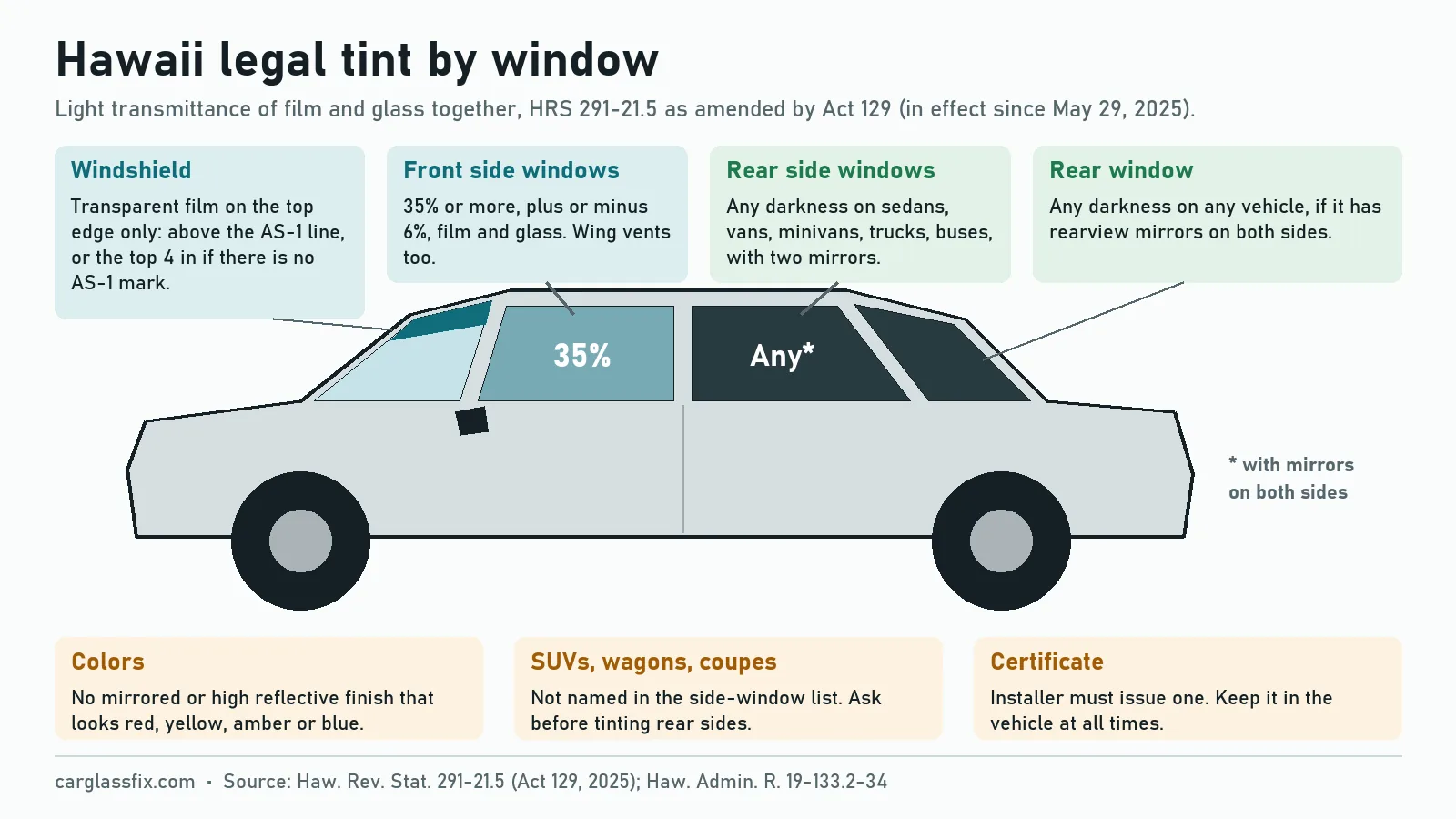
Hawaii window tint laws require front side windows to pass at least 35% of light, plus or minus 6%, with film and glass. Rear windows, and side windows behind the driver on sedans, vans, minivans, trucks and buses, may be any darkness with mirrors on both sides. Windshield film must stay above the AS-1 line or the top 4 inches.
## Key takeaways
- The legal tint percentage in Hawaii is 35%, plus or minus 6%, for the front side windows and wing vents, measured with the glass (HRS 291-21.5(e)(7) and (8)).
- Act 129, approved on May 29, 2025, freed sedan rear side and rear windows from the 35% limit, as long as the car has rearview mirrors on both sides.
- The side-window exemption names sedans, vans, minivans, trucks and buses; it does not name SUVs, wagons, hatchbacks or coupes.
- Film with a mirrored or high reflective finish that looks red, yellow, amber or blue from outside is banned.
- An owner with illegal tint faces a fine of $300 to $550 per offense, and the yearly safety inspection includes a tint meter test.
## Hawaii window tint limits by window
Hawaii allows 35% tint on the front side windows and any darkness on the rear windows, with conditions. The rule is Hawaii Revised Statutes 291-21.5, as amended by Act 129 of 2025 (H.B. 226 CD1). The statute bans sun screening devices on any glazing and then lists exemptions in subsection (e). Each limit in the table is one of those exemptions. Film that fits no exemption is illegal on that window. The front side limit is the same for every vehicle type. The rear limits depend on two things: the vehicle type named in (e)(9) and the presence of rearview mirrors on both sides. The statute gives no number for a rear window without two mirrors, so the table shows no exemption there. Hawaii sets no numeric reflectance limit; it bans reflective finishes by color instead, as explained in [can you put mirror tint on a car](https://carglassfix.com/can-you-put-mirror-tint-on-a-car/).
| Window | Sedan | SUV, van, pickup |
| --- | --- | --- |
| Windshield | Transparent film on the top edge only, above the AS-1 line, or no lower than 4 in from the top if the glass has no AS-1 mark | Same |
| Front side windows and wing vents | 35% or more, plus or minus 6%, film and glass together | Same |
| Side windows behind the driver | Any darkness with mirrors on both sides | Vans, minivans, trucks: any darkness with mirrors on both sides. SUVs are not named in the list |
| Rear window | Any darkness with mirrors on both sides | Any darkness with mirrors on both sides |
| Colors | No mirrored or high reflective finish that looks red, yellow, amber or blue | Same |
## How Hawaii measures the 35% limit
Hawaii measures the film and the window glass together, so 35% is the reading of the finished window, not the rating on the film box. Subsections (e)(7) and (e)(8) cover devices that, “when used in conjunction with the glazing material,” reach 35% light transmittance “plus or minus six per cent.” Act 129 rewrote (e)(8) so that it names “front side windows and wing windows” adjacent to the driver.
*Source: Haw. Rev. Stat. 291-21.5 as amended by Act 129 (2025); Haw. Admin. R. 19-133.2-34. Diagram: CarGlassFix.*
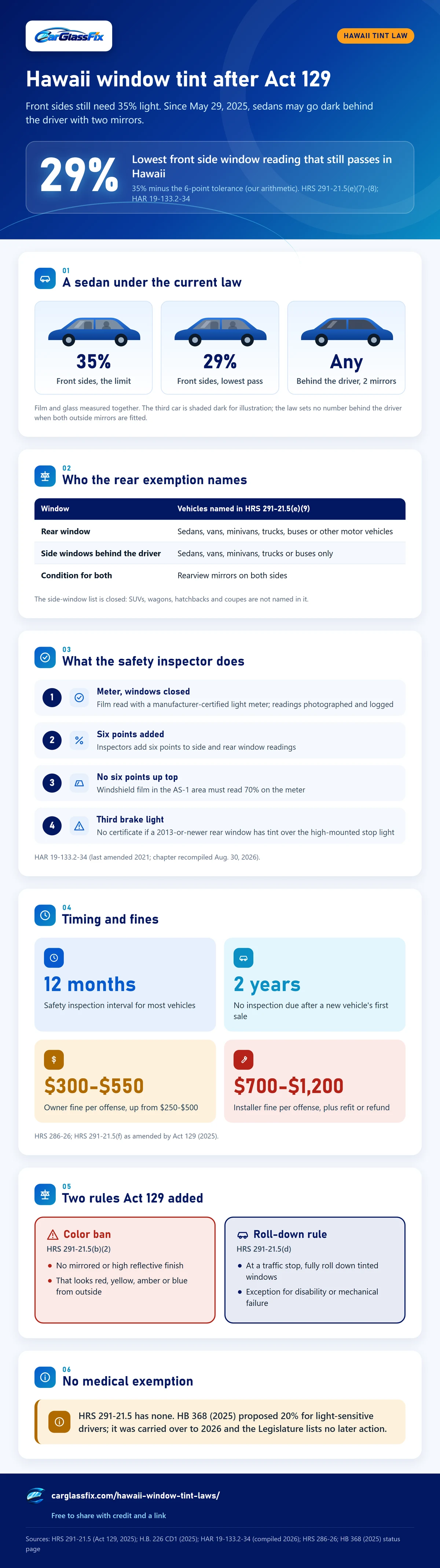
Factory glass already blocks some light, so a film sold as 35% reads darker once it sits on the glass. Our guide on [how to measure window tint](https://carglassfix.com/how-to-measure-window-tint/) shows the glass-times-film math. The [window tint percentage chart](https://carglassfix.com/window-tint-percentage-chart/) shows how dark 35% looks next to other shades. The inspection rule, Hawaii Administrative Rules 19-133.2-34, says inspectors add six percentage points to the meter reading on the side and rear windows. A front side window that reads 29% on the meter therefore meets the 35% standard at inspection. A [window tint meter](https://carglassfix.com/window-tint-meter/) gives the net reading an inspector or officer sees.
## Windshield tint in Hawaii: the AS-1 line or 4 inches
A Hawaii windshield may carry transparent film only along its top edge, down to the AS-1 line. If the glass has no AS-1 mark in the upper left or right margin, the film may reach no lower than 4 inches below the top. Subsection (e)(6) says to measure “from the middle point of the bottom edge of the top windshield moulding.” The AS-1 line is a marking etched near the top corners of the glass; see [the AS-1 line on a windshield](https://carglassfix.com/as1-line-on-windshield/) to find it.
Subsection (e)(11) also allows transparent material on the AS-1 area itself if it meets Federal Motor Vehicle Safety Standard 205. The inspection rule puts a number on that. Film in the AS-1 area “must have 70% light transmittance as indicated by the meter,” and inspectors may not add six points there. A dark film cannot reach that reading. Signs and stickers are limited to a 7-inch square in the lower corner farthest from the driver and a 5-inch square in the corner nearest the driver. For other states, read [is it illegal to have tint on a windshield](https://carglassfix.com/is-it-illegal-to-have-tint-on-windshield/).
## What Act 129 changed in 2025
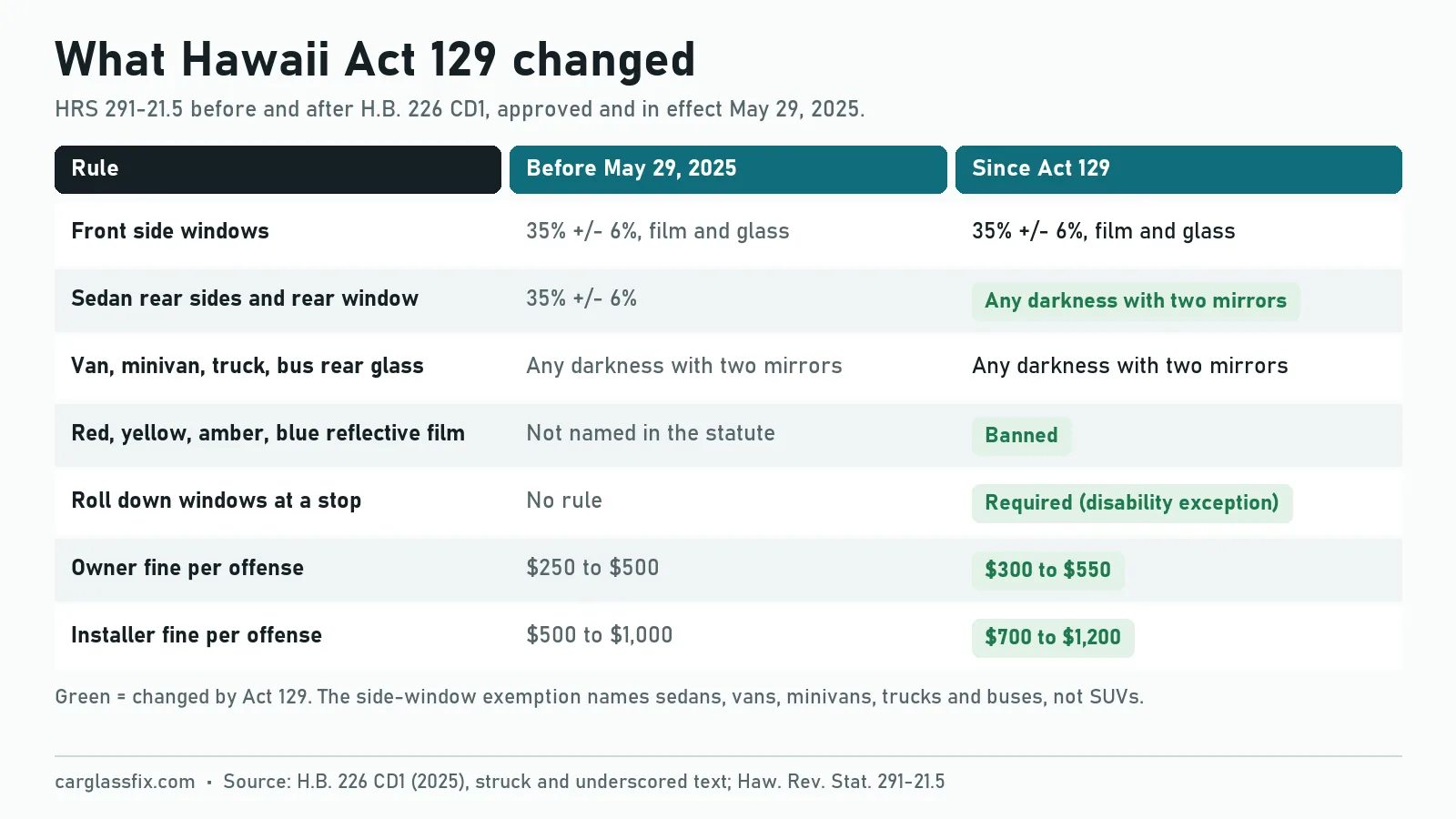
Act 129 freed sedan rear side and rear windows from the 35% limit and raised the fines. The governor approved H.B. 226 CD1 on May 29, 2025, as Act 129, and it took effect on approval. Before that date, (d)(8) applied the 35% standard to side windows “to the rear of the driver” and to rear windows. Only vans, minivans, trucks and buses with two mirrors were exempt under the old (d)(9).
*Source: H.B. 226 CD1 (2025), enacted as Act 129, struck and underscored text; Haw. Rev. Stat. 291-21.5. Diagram: CarGlassFix.*
The act made five other changes. It added the ban on mirrored or high reflective finishes that look red, yellow, amber or blue. It added the rule that occupants must roll down tinted windows at a traffic stop. It raised the owner fine from $250 to $500 to $300 to $550, and the installer fine from $500 to $1,000 to $700 to $1,200. It made a missing installer certificate prima facie evidence of installer noncompliance. It let the Department of Transportation adopt rules on color and reflectivity. Section 4 says the act does not affect penalties incurred before it took effect. Several pages in the current search results still show the old fines and the old 35% rear limit for sedans.
## Which vehicles get the rear tint exemption
Subsection (e)(9) has two lists, and they are not the same. The rear window list covers “sedans, vans, minivans, trucks, buses, or other motor vehicles.” The words “or other motor vehicles” make the rear window exemption reach any vehicle with mirrors on both sides. The side window list covers only “sedans, vans, minivans, trucks, or buses.” It does not name SUVs, station wagons, hatchbacks or coupes, and it has no catch-all phrase.
Section 291-21.5 does not define “truck” or “sedan,” so the text does not say whether an SUV counts as a truck. News coverage of the bill reported that SUVs already had the exemption; its sponsor, Rep. Darius Kila, said sedans had been left out “while trucks, vans, and SUVs benefit.” The statute text itself does not say that. An SUV, wagon or coupe owner who wants dark rear side windows should ask the inspection station or the county before tinting. Both the side and rear exemptions need rearview mirrors on both sides. The exemption applies only while both outside mirrors are fitted.
## The tint check at the Hawaii safety inspection
Every Hawaii safety inspection includes a tint test. Subsection (c) says an inspection required under section 286-26 “shall include a test” of the glazing and any sun screening devices. Section 286-26 requires most cars, SUVs and light trucks to be certified every 12 months. A vehicle needs no inspection within two years of the date it was first sold. Taxis, buses, mopeds and rental vehicles two years or older must be certified every year, with no two-year grace period.
The inspection rule sets out how the test works. Inspectors read aftermarket film with a light transmittance meter certified by its maker. Each station must make sure its meters stay within plus or minus 6%. The meter readings are photographed and recorded in the inspection database, and the photos are taken with the windows closed. No certificate is issued if a rear window on a 2013 or newer model has aftermarket tint over the area where the high-mounted stop light shines. The rule was last amended in 2021, before Act 129, and the chapter was recompiled on August 30, 2026. Act 129 told the Department of Transportation to notify all inspection stations of the changes within 90 days.
## Is there a medical exemption for tint in Hawaii?
Hawaii has no medical exemption for window tint. Section 291-21.5 lists its exemptions in subsection (e), and none is based on a medical condition. A doctor’s letter therefore does not make a darker front side window legal in Hawaii. The only health-related wording in the section is in the traffic stop rule. It excuses people “unable to do so due to physical disability” from rolling down their windows, provided the driver cooperates by other means.
A medical exemption has been proposed. H.B. 368 of 2025 would have allowed 20% film for people with light sensitivity of the eyes or skin due to a medical condition. It required documentation from a physician licensed under chapter 453, “updated every two years.” The Legislature’s status page shows H.B. 368 carried over to the 2026 session, with no later action listed. Drivers with light sensitivity can use the rear exemption, which already allows any darkness behind the driver on most vehicles with two mirrors.
## Fines, the installer certificate and traffic stops
An owner whose vehicle has illegal tint can be fined $300 to $550 for each offense under 291-21.5(f)(1). An installer of non-compliant film can be fined $700 to $1,200 for each offense. The installer must also refit compliant film free of charge or pay another installer’s cost.
The installer must give the owner a certificate that the film complies with the law. The statute says “the certificate shall be stored in the motor vehicle at all times.” If no certificate is in the car at the time of a citation, that is prima facie evidence that the installer did not comply. Subsection (d) adds a separate rule. Drivers and passengers of vehicles with applied tint must fully roll down their windows when an officer stops them, and failure may be cited as a noncriminal traffic infraction. The statute sets no amount for that infraction. Before choosing a shade, try the [window tint simulator](https://carglassfix.com/window-tint-simulator/), and compare other states in [what car window tint is legal](https://carglassfix.com/what-car-window-tint-is-legal/).
Hawaii tint rules can change in any legislative session. Check the current HRS 291-21.5 on the Hawaii State Legislature site or ask your county motor vehicle office before you tint. This article is general information, not legal advice.
*CarGlassFix infographic. Sources: HRS 291-21.5 as amended by Act 129 (2025), H.B. 226 CD1, HAR 19-133.2-34 (compiled Aug. 30, 2026), HRS 286-26, HB 368 (2025) status page.*
**Share this infographic.** Free to use on your site under CC BY 4.0: keep the credit and the link to this page. Copy the code below.

Infographic: CarGlassFix
## Frequently asked questions
### What is the darkest tint you can have in Hawaii?
On the front side windows, the darkest legal tint is 35% with film and glass together, plus or minus 6%. The rear window, and the side windows behind the driver on sedans, vans, minivans, trucks and buses, may be any darkness if the vehicle has rearview mirrors on both sides.
### Is 20% tint legal on a truck in Hawaii?
A 20% film is legal on a truck’s side windows behind the driver and on its rear window, if the truck has mirrors on both sides. It is illegal on the front side windows, which must reach 35%, plus or minus 6%.
### Is 5% tint all around legal in Hawaii?
No. A 5% film is illegal on the front side windows and on the windshield. It is legal only on the windows that subsection (e)(9) exempts, and only with rearview mirrors on both sides.
### Does Hawaii allow a medical exemption for window tint?
No. HRS 291-21.5 has no medical exemption, so a physician’s letter does not allow darker front side windows. A 2025 bill, H.B. 368, proposed one; it was carried over to 2026, and the Legislature lists no later action.
### Do I have to roll down tinted windows at a traffic stop in Hawaii?
Yes. Since Act 129, drivers and passengers of vehicles with applied tint must fully roll down their windows when stopped by an officer. People unable to do so because of a physical disability or a mechanical failure are excused if the driver cooperates by other means.
## Sources
- [Hawaii Revised Statutes 291-21.5, Regulation of motor vehicle sun screening devices; penalty](https://codes.findlaw.com/hi/division-1-government/hi-rev-st-sect-291-21-5/) (consolidated text with the Act 129 changes; checked 29 October 2026)
- [H.B. 226 H.D. 3 S.D. 1 C.D. 1, Relating to Windshield Tinting (2025), enacted as Act 129](https://web.archive.org/web/20260415141023/https://data.capitol.hawaii.gov/sessions/session2025/bills/HB226_CD1_.HTM) (archived copy of the official text; checked 29 October 2026)
- [Session Laws of Hawaii 2025, Act 129](https://data.capitol.hawaii.gov/sessions/sessionlaws/Years/SLH2025/SLH2025_Act129.pdf)
- [Conference Committee Report No. 81 on H.B. 226 (2025)](https://data.capitol.hawaii.gov/sessions/session2025/CommReports/HB226_CD1_CCR81_.HTM)
- [Hawaii Administrative Rules chapter 19-133.2 (compiled August 30, 2026), including 19-133.2-34, Inspection of glazing materials](https://hidot.hawaii.gov/highways/files/2026/09/HAR-19-133.2-FINAL-signed-by-LT-GOV-on-2026-08-30.pdf) (Hawaii DOT; checked 12 November 2026)
- [Hawaii Revised Statutes 286-26, Certificate of inspection](https://codes.findlaw.com/hi/division-1-government/hi-rev-st-sect-286-26/) (checked 29 October 2026)
- [Civil Beat bill tracker: H.B. 226 (Act 129, 29 May 2025)](https://civilbeat.digitaldemocracy.org/bills/hi_20250hb226) and [Hawaii State Legislature: H.B. 368 status (carried over to 2026)](https://www.capitol.hawaii.gov/session/measure_indiv.aspx?billtype=HB&billnumber=368&year=2026)
- [Spectrum News Hawaii: Bill would extend tinting standards to sedans (20 May 2025)](https://spectrumlocalnews.com/hi/hawaii/news/2025/05/20/bill-would-allow-sedans-to-be-tinted-the-same-as-other-vehicles)