---
title: "Heat Gun for Tinting Windows: Settings, Distance, Risks"
canonical: "https://carglassfix.com/heat-gun-for-window-tint/"
author: "Garrett Ross"
published: "2026-11-28T09:33:00+00:00"
modified: "2026-11-26T09:16:34+00:00"
language: "en-US"
site: "CarGlassFix"
description: "A heat gun for tinting windows shrinks film to curved glass. See maker settings (Wagner Low/Med, TeckWrap 140-194°F), nozzle distance and glass risks."
categories: "Window Tint"
attribution: "CarGlassFix (https://carglassfix.com/)"
---
# Heat Gun for Tinting Windows: Settings, Distance, Risks
Short answer
A heat gun for tinting windows shrinks flat tint film so it lies smooth on curved glass. Wagner lists window tint under its Low or Low/Medium heat settings. TeckWrap gives 140 to 194°F (60 to 90°C) for shrinking rear window film, with the nozzle 4 to 8 inches away and always moving.
*As an Amazon Associate, CarGlassFix earns from qualifying purchases. Amazon links on this page open a product search on Amazon. They are not products we tested.*
## Key takeaways
- Wagner’s Furno 500 manual lists applying and removing window tint under Low/Med heat and says to keep the gun in motion at least 2 inches from the surface.
- TeckWrap gives 60 to 90°C (140 to 194°F) for shrinking rear window film and a nozzle distance of 4 to 8 inches.
- Avery Dennison says tint film shrinks in one direction only, across the width of the roll, and that heating film bunched the other way burns it.
- DeWalt’s heat gun manual says not to direct the airflow straight at glass, because the glass may crack.
- Gila’s DIY method needs no heat gun: it covers a compound-curved rear window with strips of film.
## What a heat gun does when tinting windows
A heat gun shrinks flat tint film until it matches the curve of the glass. Tint film is polyester. The International Window Film Association (IWFA) calls polyester film the backbone of the window film industry. A flat polyester sheet cannot follow glass that curves in two directions. Gila, a DIY film brand of Eastman Performance Films, says one piece of film cannot stretch to cover a compound-curved window. Hot air solves that. Film makers call the step heat shrinking, and Hexis calls it thermoforming.
The shrinking happens on the outside of the car. Hexis says to cut and thermoform the film on the outside of the windows, then apply it to the inside. Avery Dennison’s 2026 bulletin describes the same order. The film lies on the outer glass with its liner facing out. The heat gun shapes it there. The shaped film then goes onto the wet inside glass.
Film makers name the heat gun for four jobs in total. The table lists each one.
| Job | Where the heat goes | What the maker says | Source |
| --- | --- | --- | --- |
| Shrink film to curved glass | Film lying on the outside of the glass | Heat uniformly and squeegee out the tunnels that form | Avery Dennison IB 7.1, Hexis |
| Settle small tunnels after fitting | Edges of the installed film | Carefully heat the tunnel and smooth it with a squeegee | Hexis |
| Help the film grab the glass | Installed film after squeegeeing | A heat gun can help evaporate moisture and increase initial tack | Avery Dennison TB 5.0 |
| Loosen old film for removal | A corner of the old film | Slightly heat the film and do not overheat one spot | Avery Dennison IB 7.1 |
This page covers the tool only. The full fitting process is in [how to install car window tint](https://carglassfix.com/how-to-install-car-window-tint/).
## Heat gun temperature and distance for window tint
Published guidance puts window tint at the low end of a heat gun’s range, with the nozzle several inches from the film. No single number applies to every gun, because makers rate the air leaving the nozzle and film makers describe the film itself.
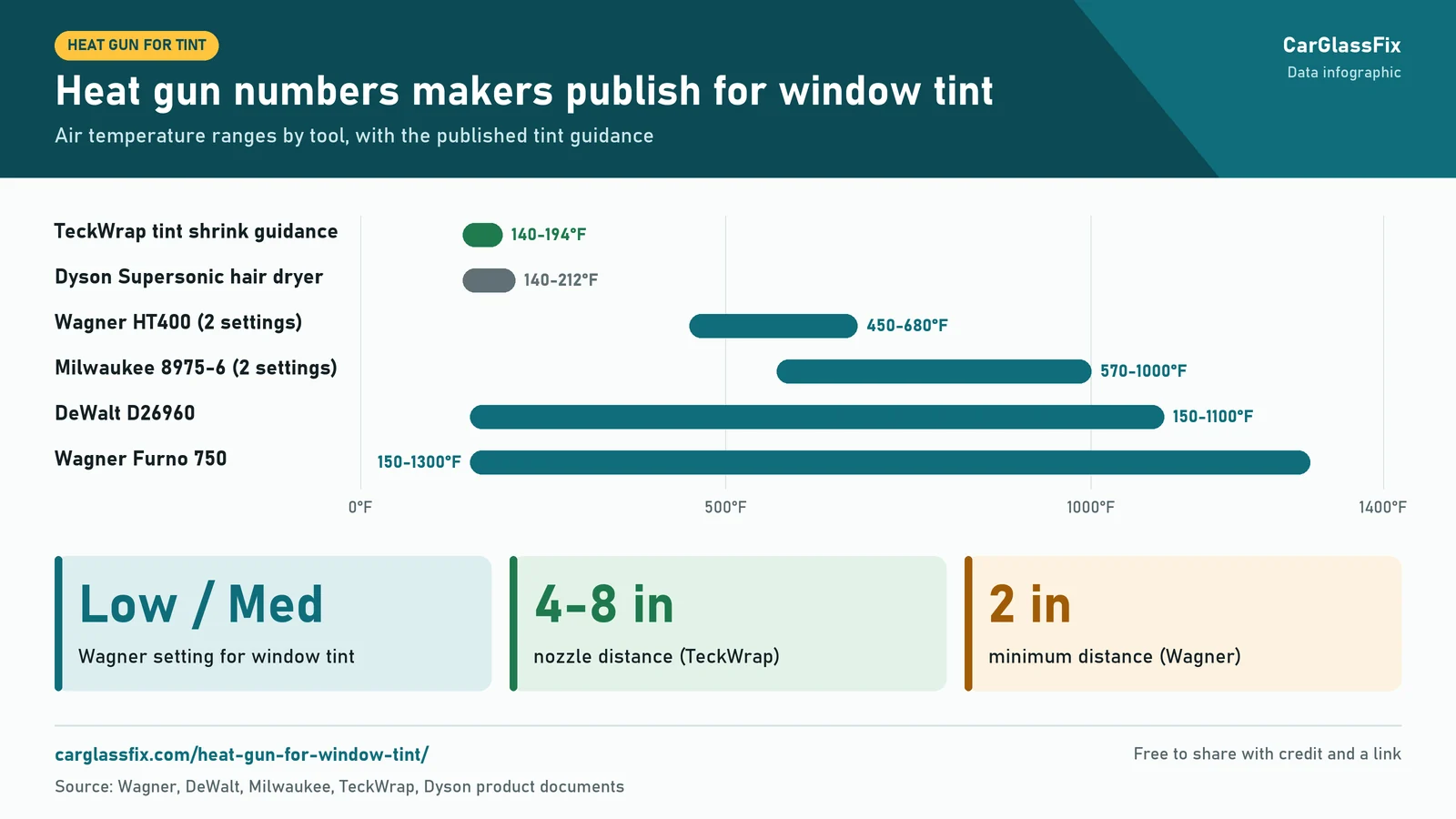
*Temperature ranges from Wagner, DeWalt, Milwaukee, TeckWrap and Dyson product documents. Diagram: CarGlassFix.*
### What heat gun makers publish
Heat gun makers publish a setting for window tint, and on variable guns it sits at the low end. Wagner’s HT400 support page lists applying and removing window tint under Low/High with the flare nozzle. The HT400 has two settings, 450°F and 680°F. Wagner’s Furno 500 manual lists the same job under LOW/MED with no nozzle tip. Its Furno 750 support page also says Low/Med, where Low is 150 to 700°F and Medium is 700 to 1000°F. TeckWrap, a wrap film maker that sells its own heat gun, gives a film figure. Its product page says low heat, 60 to 90°C, for shrinking rear window film. That equals 140 to 194°F.
### What film makers publish
Film makers publish technique and leave the temperature to the installer. Avery Dennison’s 2026 bulletin says to heat the film uniformly and to adjust the heat temperature and speed. It gives no degree figure. Hexis repeats one line through its guide: use the heat gun with reason so as not to burn the film. The film’s reaction is the gauge in both documents. Small tunnels rise in the film as it warms, and the installer smooths them flat.
### Distance from the film
Published distances run from 2 inches to 8 inches. Wagner’s Furno 500 manual says to keep the gun in motion and at least 2 inches from the surface. TeckWrap says to hold the nozzle 4 to 8 inches from the surface and keep the gun moving. Avery Dennison gives no measurement. Its bulletin says not to hold the gun too close for too long in one spot.
| Source | Setting or temperature for tint | Distance | Motion |
| --- | --- | --- | --- |
| Wagner Furno 500 manual | LOW/MED; start at the lowest temperature and raise it | At least 2 inches | Always in motion |
| Wagner Furno 750 support page | Low/Med (150 to 1000°F) | Not stated | Not stated |
| Wagner HT400 support page | Low/High (450°F or 680°F), flare nozzle | Not stated | Not stated |
| TeckWrap heat gun page | Low heat, 60 to 90°C (140 to 194°F) | 4 to 8 inches | Keep the gun moving |
| Avery Dennison IB 7.1 | Adjust the heat temperature and speed | Not too close for too long | Keep slowly moving |
| Hexis application guide | Use the heat gun with reason | Not stated | Not stated |
The sources agree on the method. Start low, keep the nozzle back, and raise the heat only if the film does not react. DeWalt’s manual gives the same rule for any job: start with a low temperature setting and increase it gradually.
## How heat shrinking tint film works
Heat shrinking works in one direction only, so the film has to be laid the right way before the heat gun is switched on. Avery Dennison says its film can only be shrunk across the width of the roll. The length of the roll therefore runs side to side on the glass. Excess film then gathers into narrow ridges that run from top to bottom. Avery Dennison calls them tunnels or channels. Hexis says the tunnels should always form vertically. The heat gun shrinks each tunnel, and a squeegee presses it flat.
### Wet shrinking and dry shrinking
The two methods differ in what sits between the film and the outer glass. Avery Dennison shrinks side window film wet, on glass sprayed with slip solution. It shrinks rear window film dry. The glass is wiped with a polish that leaves a residue, except along an H pattern that is cleaned. The film grips the clean H and floats over the rest. Hexis uses a liquid of 70% detergent and 30% water on the rear window. It is sprayed three times at most and wiped to a very slight soapy film.
### Order of work
The makers give the order below for a curved rear window. Avery Dennison’s 2018 European bulletin shrinks the lower half of the film first and the upper half second.
## How to use a heat gun to shrink tint film
1. ### Lay the film the right way
Put the film on the outside glass, liner facing out, with the length of the roll running side to side (Avery Dennison).
2. ### Anchor the film
Squeegee the film along the cleaned H pattern so it cannot move (Avery Dennison).
3. ### Gather the tunnels
Smooth the film so the excess forms vertical tunnels, and split a large tunnel into smaller ones.
4. ### Start on low heat
Begin at the lowest setting in the range and raise it only if the film does not react (Wagner).
5. ### Heat one tunnel at a time
Keep the gun slowly moving and never hold it close to one spot (Avery Dennison).
6. ### Press the film flat
Squeegee each shrunk tunnel from the center toward the top or bottom edge (Avery Dennison).
7. ### Shrink the whole sheet
Work the lower half, then the upper half, until no tunnel is left (Avery Dennison TB 5.0).
Avery Dennison’s bulletin says to gently felt squeegee the tunnels out of the film. Stores sell the tool as a [felt-edge squeegee](https://www.amazon.com/s?k=felt+edge+squeegee+for+window+tint&tag=carglassfix-20). Hexis presses the warmed film onto the glass with a thumb. The bulletins print no temperature for the film in this step.
## What kind of heat gun to use for window tint
A heat gun for window tint needs a low setting that is actually low, and guns differ widely on that point. Two designs are sold. A dual-temperature gun has two fixed settings. A variable-temperature gun steps or dials through a range. The table compares published specifications for six guns.
| Heat gun | Type | Published temperature | Maker’s note |
| --- | --- | --- | --- |
| Wagner HT400 | Two settings | 450°F and 680°F | Window tint listed under Low/High, flare nozzle |
| Milwaukee 8975-6 | Two settings | 570°F and 1000°F | 14.8 CFM maximum air volume, 1.8 lb |
| DeWalt D26960 | Variable, LCD | 150 to 1100°F in 50°F steps | Two airflow speeds; tint is not in its application table |
| Wagner Furno 500 | Variable, digital | About 150°F to 1200°F | Window tint listed under LOW/MED |
| Wagner Furno 750 | Variable, three ranges | 150 to 1300°F | Window tint listed under Low/Med |
| TeckWrap TW-HG | Variable, stepless | 100 to 650°C (212 to 1202°F) | Sold for vinyl wrap, PPF and tint |
### Why the low setting matters
The lowest setting decides how much margin a beginner has. The low setting on Milwaukee’s 8975-6 is 570°F. The DeWalt D26960 and the Wagner Furno 500 start near 150°F. Wagner’s manual tells users to start at the lowest temperature in the range and raise it until the result is right. A wide range makes that possible. A [variable-temperature heat gun](https://www.amazon.com/s?k=variable+temperature+heat+gun&tag=carglassfix-20) gives the most steps between cold film and burned film. A two-setting gun leaves distance and speed as the only controls.
### Airflow, nozzle and cord
Airflow and nozzle shape change how the heat lands on the film. DeWalt’s D26960 has two airflow speeds, 8.8 and 17.7 cubic feet per minute. Wagner’s HT400 page pairs window tint with the flare nozzle, which spreads the air. Its Furno 500 manual lists the job with no tip. The cord also matters on a car. Avery Dennison says to drape the heat gun lead over a shoulder so it does not drag on the vehicle.
## Heat gun vs hair dryer vs steamer
A heat gun is the tool film makers name for shrinking, a steamer is the tool they name for rear-window removal, and a hair dryer appears only for clearing haze. The three tools deliver heat at different levels and in different forms.
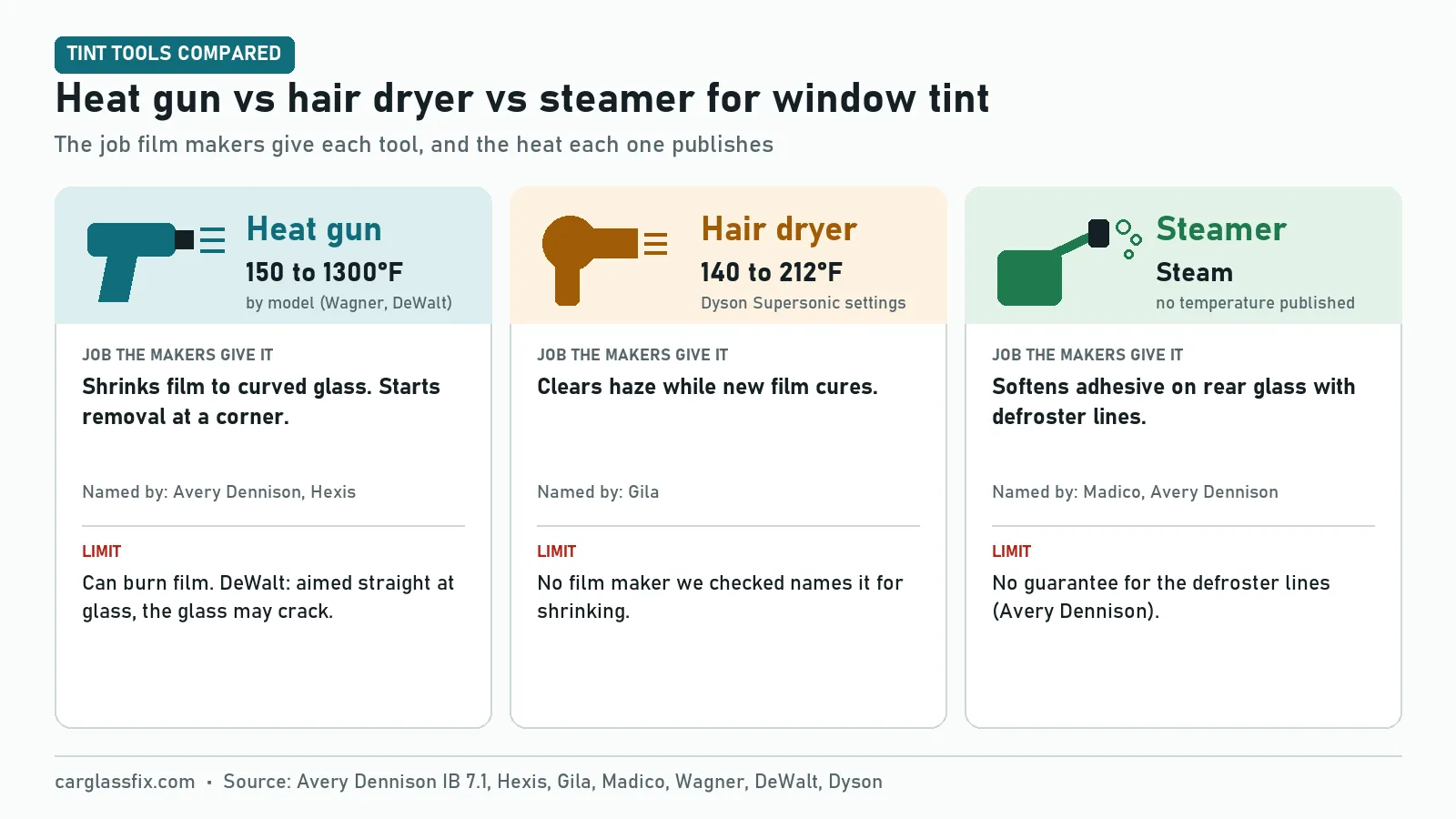
*Tool roles from Avery Dennison, Hexis, Gila and Madico documents. Temperatures from Wagner and Dyson. Diagram: CarGlassFix.*
| Tool | Published heat | Job the makers give it | Limit |
| --- | --- | --- | --- |
| Heat gun | About 150°F to 1300°F, by model | Shrinking film, settling tunnels, starting removal at a corner | Can burn film and overheat glass |
| Hair dryer | Dyson Supersonic: 140°F, 176°F and 212°F settings | Clearing haze while film cures (Gila) | No film maker we checked names it for shrinking |
| Steamer | Makers we checked print no temperature | Softening adhesive on rear glass with defroster lines (Madico, Avery Dennison) | No guarantee for the defroster lines (Avery Dennison) |
### Hair dryer
A hair dryer runs far cooler than a heat gun. Dyson lists three heat settings for its Supersonic dryer: 140°F, 176°F and 212°F. The lowest setting on Wagner’s HT400 heat gun is 450°F. Film makers do not name a hair dryer for shrinking. Avery Dennison’s tool list calls for a professional heat gun. Gila gives the hair dryer one job. Its instructions say haze in new film clears with time or with heat from the sun or a hair dryer.
### Steamer
A steamer is a removal tool. Madico recommends a steamer to soften the adhesive on rear windows. Avery Dennison says typical steamers are used to heat and soften the adhesive bond on glass with demister bars. It adds that no guarantee can be given for those bars. Madico’s tool catalog lists a Jiffy Steamer as its film remover. A [handheld fabric steamer](https://www.amazon.com/s?k=handheld+fabric+steamer&tag=carglassfix-20) is a smaller tool of the same kind.
### Heat gun for window tint removal
A heat gun loosens old film at a corner so it can be peeled. Avery Dennison’s bulletin says to start at a corner of the window and slightly heat the film. It warns against locally overheating the film or the glass. Wagner’s tables give removing window tint the same settings as applying it. The peel itself, the glue and the defroster rules are covered in [how to remove car window tint](https://carglassfix.com/how-to-remove-car-window-tint/).
## Heat gun mistakes that damage film or glass
The makers’ warnings share one cause: too much heat in one place. The film, the glass and the parts around the window each fail in their own way.
### Burning the film
Film burns when heat is held still or aimed at film bunched the wrong way. Avery Dennison says film that bunches along the length of the roll will burn if someone tries to shrink it. Its bulletin also warns against holding the gun too close for too long in one spot. Wagner’s manual says to keep the gun in constant motion and not to stop or dwell in one spot. A creased or rippled sheet has its own checks in [how to fix rippled car window tint](https://carglassfix.com/how-to-fix-rippled-car-window-tint/).
### Cracking the glass
Glass can crack when one area is heated much more than the rest. DeWalt’s heat gun manual says not to direct the airflow directly on glass, because the glass may crack. Wagner’s manual says to always protect glass when working near windows. Pilkington’s thermal stress bulletin explains the cause for ordinary annealed building glass. A hot center pushes against a cool edge. The edge stress rises about 50 psi for every degree Fahrenheit of difference. Pilkington says the probability of breakage becomes significant above 2,000 to 3,000 psi.
Car glass differs by window. The IWFA says tempered glass is used in almost all vehicle windows except the windshield. It calls tempered glass very resistant to cracking from thermal stress. A windshield is laminated, and the IWFA says most laminated layers in vehicles are annealed glass. Annealed glass is subject to thermal stress fracture. The differences are explained in [laminated vs tempered glass in cars](https://carglassfix.com/laminated-glass-vs-tempered-glass/). Cold glass adds risk, as covered in [can cold weather crack a windshield](https://carglassfix.com/can-cold-weather-cause-windshield-crack/).
### Heating the parts around the window
Hot air also reaches trim, seals and printed lines. Avery Dennison says to cover door trim, upholstery and electronic components before work starts. Rear glass carries printed heater lines on the inside, described in [what a rear windshield defroster is](https://carglassfix.com/what-is-rear-windshield-defroster/). Avery Dennison says to take extra care when film comes off those lines.
| Mistake | Result | Source |
| --- | --- | --- |
| Shrinking film bunched along the roll’s length | Burned film | Avery Dennison IB 7.1 |
| Holding the gun close to one spot | Local overheating of film or glass | Avery Dennison, Wagner |
| Aiming the airflow straight at bare glass | Glass may crack | DeWalt manual |
| Starting on a high setting | No margin before the film burns | Wagner, DeWalt: start low |
| Letting the cord drag on the car | Contact with the vehicle surface | Avery Dennison IB 7.1 |
## Can you tint windows without a heat gun?
Yes, window tint can be installed without a heat gun on flat glass, and with strips on curved glass. Gila’s tool list for a side window has no heat gun. It names application solution, a squeegee, a knife and a razor blade. For a compound-curved rear window, Gila cuts the film into strips, because one piece cannot stretch over the curve. Avery Dennison lists pre-cut film as installed with or without heat shrinking. The choice depends on the glass. A flat or gently curved side window takes film without shrinking. A rear window that curves in two directions takes one heat-shrunk piece or several strips.
The film makers we read describe heat on fresh film only. Hexis heats small tunnels right after fitting. Avery Dennison’s 2018 bulletin uses the gun during squeegeeing to help evaporate moisture. Neither document describes reheating old, bonded film. Bubbles that appear later are covered in [how to fix bubbles in car window tint](https://carglassfix.com/how-to-fix-car-window-tint-bubbles/). Haze in the first days is part of curing. The wait and the care rules are in [what to do after tinting car windows](https://carglassfix.com/what-to-do-after-tinting-car-windows/).
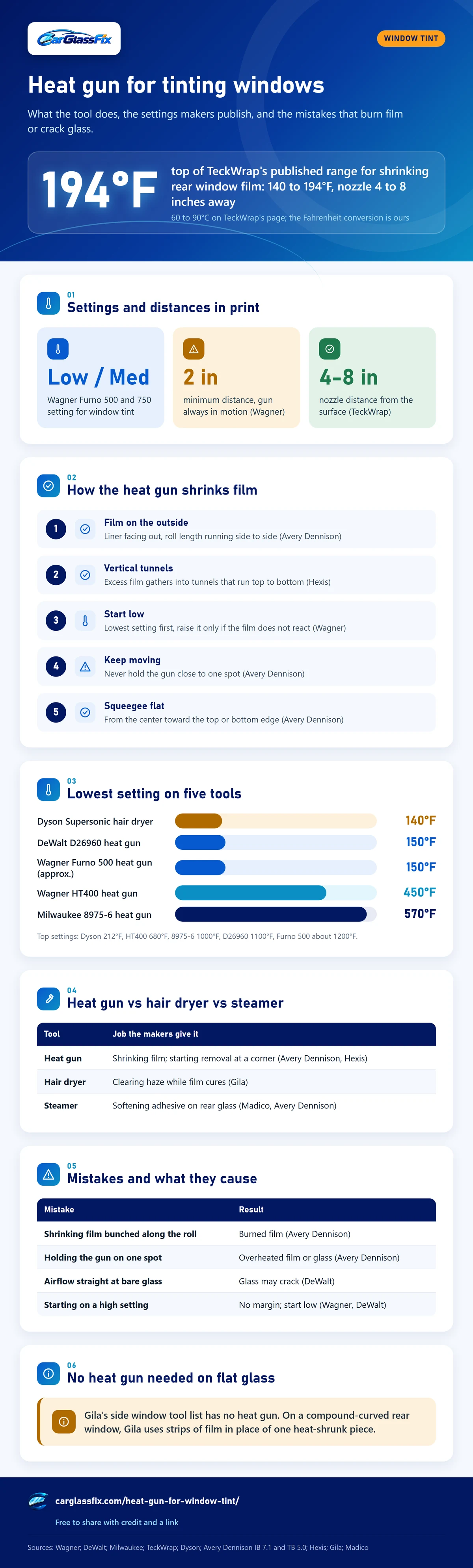
*CarGlassFix infographic. Sources: Wagner, DeWalt, Milwaukee, TeckWrap, Dyson, Avery Dennison IB 7.1 and TB 5.0, Hexis, Gila, Madico, IWFA, Pilkington ATS-123.*
**Share this infographic.** Free to use on your site under CC BY 4.0: keep the credit and the link to this page. Copy the code below.

Infographic: CarGlassFix
## Frequently asked questions
### Should you use a heat gun on window tint?
Yes, for shrinking film to curved glass before it is installed. Avery Dennison and Hexis both shape the film with a heat gun on the outside of the window. Keep the gun moving and start on a low setting, as Wagner’s manual says.
### What kind of heat gun do I need for window tint?
A gun with a low setting and steady control. Wagner lists window tint under Low or Low/Med, and its Furno 500 starts at about 150°F. A dual-temperature gun also works, but its low setting can be 450°F or more.
### What temperature should a heat gun be for window tint?
TeckWrap gives 60 to 90°C (140 to 194°F) for shrinking rear window film. Wagner gives a setting, Low or Low/Med, with no single number. Avery Dennison and Hexis print no temperature and say only to avoid overheating one spot.
### Can I use a heat gun to get bubbles out of tint?
Only on fresh film. Hexis says small tunnels found right after fitting can be carefully heated and smoothed with a squeegee. For bubbles in cured film, see [how to fix bubbles in car window tint](https://carglassfix.com/how-to-fix-car-window-tint-bubbles/).
### Can a hair dryer shrink window tint?
No film maker we checked names a hair dryer for shrinking. Dyson lists 212°F as the top setting on its Supersonic dryer, while the low setting on Wagner’s HT400 heat gun is 450°F. Gila names a hair dryer only for clearing haze while film cures.
## Sources
- [Avery Dennison, Instructional Bulletin IB 7.1, Automotive Window Film installation (January 15, 2026)](https://graphics.averydennison.com/content/dam/averydennison/graphics/ap/en/Instructional-Bulletins/ib-7.1-automotive-window-film-installation.pdf)
- [Avery Dennison, Technical Bulletin 5.0, Application Instructions for Automotive Window Film (2018, Europe)](https://graphics.averydennison.com/content/dam/averydennison/graphics/eu/en/technical-bulletins/window-film/TB%205.00%20Application%20Instructions%20for%20Avery%20Dennison%20Automotive%20Window%20Film%20ENG.pdf)
- [Hexis, Application Guide FPP.FPS.002 A, Automotive Films: installation and removal method](https://hexis-graphics.com/documents/fichespose/document_usa/fps_film_solaire_vehicule_FPP_anglais.pdf)
- [Wagner, Furno 500 owner’s manual (Form 0503749G)](https://www.wagnerspraytech.com/wp-content/uploads/2023/08/0503749G_Furno500.pdf)
- [Wagner, Furno 500 product support](https://www.wagnerspraytech.com/support-pages/furno-500-product-support/)
- [Wagner, Furno 750 product support](https://www.wagnerspraytech.com/product-support-furno-750/)
- [Wagner, HT400 product support](https://www.wagnerspraytech.com/?p=12053)
- [DeWalt, D26950 and D26960 heat gun instruction manual (2009)](https://images.thdstatic.com/catalog/pdfImages/bf/bfee0199-3cd3-4c72-8ffb-b15efff85e84.pdf)
- [Milwaukee Tool, 8975-6 Dual Temperature Heat Gun](https://www.milwaukeetool.com/products/details/dual-temperature-heat-gun/8975-6)
- [TeckWrap, Standard Heat Gun TW-HG](https://teckwrap.com/products/teckwrap-standard-heat-gun)
- [Dyson, Supersonic hair dryer features](https://www.dyson.com/campaigns/hair-care/dyson-supersonic-features)
- [Gila, Automotive Window Tint FAQ](https://www.gilafilms.com/en/automotive-window-tint/faq/)
- [Gila, adhesive tint installation instructions for side roll-down windows (September 2023)](https://www.gilafilms.com/content/dam/eastman/performance-films/gila-films/documents/installation-instructions/side-roll-down-windows-install-instructions.pdf)
- [Madico, How to Remove Automotive Window Tint Adhesive](https://madico.com/dealers/madicou/article/training/how-to-remove-automotive-window-tint-adhesive)
- [International Window Film Association, Automotive Education Guide 2026](https://iwfa.com/wp-content/uploads/2026/01/Automotive-Education-Guide-2026.pdf)
- [Pilkington North America, Technical Bulletin ATS-123, Thermal Stress (January 14, 2013)](https://www.pilkington.com/-/media/pilkington/site-content/usa/window-manufacturers/technical-bulletins/ats123thermalstress20130114.pdf)