---
title: "Kansas Window Tint Laws: 35% on Every Side and Rear Window"
canonical: "https://carglassfix.com/kansas-window-tint-laws/"
author: "Garrett Ross"
published: "2026-11-13T15:00:00+00:00"
modified: "2026-11-08T00:26:59+00:00"
language: "en-US"
site: "CarGlassFix"
description: "Kansas tint law: 35% total light, film plus glass, on every side and rear window of cars and SUVs; nonreflective only; windshield above AS1. Medical rule."
categories: "Window Tint"
attribution: "CarGlassFix (https://carglassfix.com/)"
---
# Kansas Window Tint Laws: 35% on Every Side and Rear Window
Short answer
Kansas window tint laws require at least 35% total light transmission, film and glass together, on the front side windows, the rear side windows and the rear window of cars and SUVs alike. All film must be nonreflective. Windshield film may run only along the top, not below the AS1 line, and may not be red, yellow or amber.
## Key takeaways
- K.S.A. 8-1749a(a)(3) sets one floor of 35% total light transmission, and the statute does not split it by window or by vehicle type.
- Light transmission counts the film and the safety glass together (K.S.A. 8-1749b(b)), and the Kansas Highway Patrol counts the manufacturer’s tint as part of the 35%.
- The only medical option is clear UV film with at least 78% light transmittance plus a signed statement from a licensed physician or optometrist, added by Senate Bill 63 in 2019.
- Driving with illegal film is a misdemeanor (8-1749a(h)), and installing it is a class C misdemeanor (8-1749c), with a class C fine of up to $500 under K.S.A. 21-6611.
## Kansas window tint limits by window
Kansas allows tint on every side and rear window as long as the window still passes at least 35% of light. The rule sits in K.S.A. 8-1749a, which the Kansas Office of Revisor of Statutes shows as last amended in 2019. Subsection (a)(3) says the total light transmission “shall not be less than 35%” when a sun screening device is used with other existing sun screening devices. The statute names no window for this number. It also gives no separate figure for SUVs, vans or pickups. So a sedan and a full-size SUV face the same 35% floor on the front doors, the rear doors and the back glass. Many states let multipurpose vehicles go darker behind the driver, and Kansas does not. The Kansas Highway Patrol (KHP) reads the law the same way. Its consumer equipment page applies 35% to the windows beside the driver, the windows behind the driver and the rear window.
| Window | Sedan | SUV, van, pickup |
| --- | --- | --- |
| Windshield | Film along the top only, not below the AS1 line; nonreflective; not red, yellow or amber | Same |
| Front side windows (right and left of the driver) | 35% total light or more; nonreflective | Same |
| Side windows behind the driver | 35% total light or more; nonreflective | Same |
| Rear window | 35% total light or more; nonreflective | Same |
| Measured as | Film plus the safety glass | Same |
| Tolerance | None stated in the statute | None stated |
| Headlamps | No film that is highly reflective or nontransparent when the lamps are off | Same |
## How Kansas measures the 35% limit
Kansas measures the finished window, so the 35% is the reading through film and glass together, not the number printed on the film box. K.S.A. 8-1749b(b) defines light transmission as the share of light that passes through the product “including any safety glazing material”. KHP puts it in plain terms. Its page says the windows must pass 35% “when used in conjunction with the manufacturer’s tint and glazing materials”.
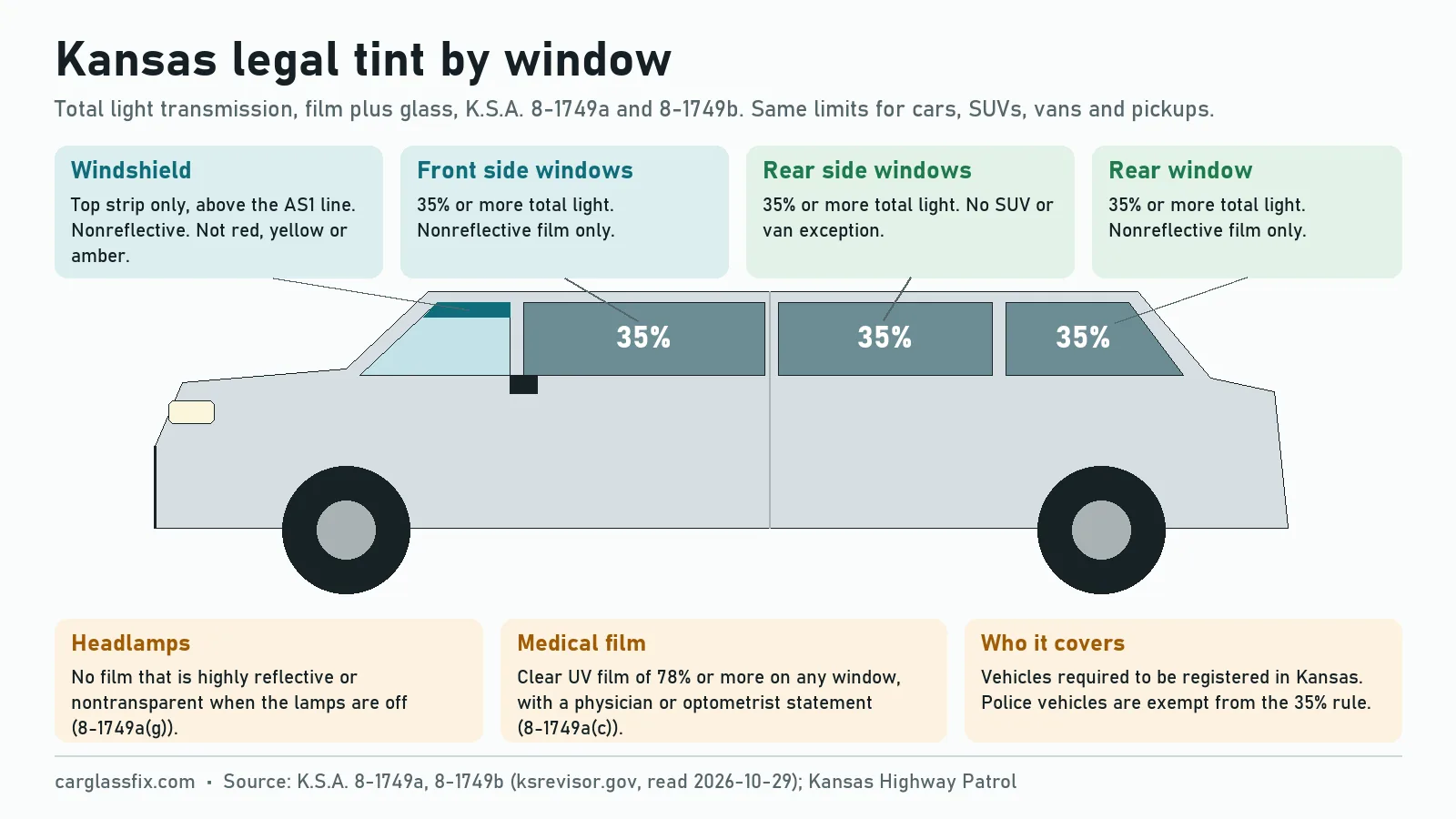
*Source: K.S.A. 8-1749a and 8-1749b (ksrevisor.gov, read 2026-10-29) and the Kansas Highway Patrol consumer equipment page. Diagram: CarGlassFix.*
Side glass already blocks some light before any film goes on. A film labelled 35% will therefore read below 35% once it sits on the glass. Our guide on [how to measure window tint](https://carglassfix.com/how-to-measure-window-tint/) shows the glass-times-film math. The [window tint percentage chart](https://carglassfix.com/window-tint-percentage-chart/) shows how dark each shade looks from outside. Factory privacy glass is a gap in the text. The statute regulates a “sun screening device”, which 8-1749b(a) defines as film or a device used with safety glazing, and it says nothing about glass tinted at the factory. Once film goes over that glass, the KHP wording counts the factory tint in the total. The statute also states no tolerance.
## Windshield, color and reflective film rules in Kansas
A Kansas windshield may carry film only along the top, and the film may not reach below the AS1 line. K.S.A. 8-1749a(a)(1) adds that windshield film must be nonreflective and may not be red, yellow or amber. The statute gives no inch figure and no light percentage for this strip. KHP notes that every windshield must carry an AS1 marking, which reflects the class of safety glazing. You can learn to find it on [the AS-1 line on a windshield](https://carglassfix.com/as1-line-on-windshield/).
Reflective film is banned on every window. Subsection (a)(2) requires nonreflective film on the side wings, the windows beside the driver, the windows behind the driver and the rear window. Section 8-1749b(d) defines nonreflective as “designed to absorb light rather than to reflect it”. KHP calls this mirrored tint and says it is forbidden on all Kansas-registered vehicles. The color ban is written only into the windshield clause. The KHP page lists “red or amber” for the windshield and leaves out yellow, but the statute names all three. Headlamp film is covered too: subsection (g) bans headlamp covers that are highly reflective or nontransparent when the lamps are off. For other states’ windshield rules, see [is it illegal to have tint on a windshield](https://carglassfix.com/is-it-illegal-to-have-tint-on-windshield/).
## Who the Kansas tint law covers
The Kansas tint rules apply to motor vehicles required to be registered in Kansas that are driven on Kansas highways. That scope is the first line of 8-1749a(a). A car registered in another state is outside that wording. The Kansas City metro area spans two states, and Missouri sets its own rules; see [Missouri window tint laws](https://carglassfix.com/missouri-window-tint-laws/). Oklahoma uses a different floor, covered in [Oklahoma window tint laws](https://carglassfix.com/oklahoma-window-tint-laws/).
Law enforcement vehicles are exempt from the 35% floor under subsection (b). Before July 1, 2019, that exemption covered only police vehicles “clearly identified” by words or symbols on the outside. Subsection (f) keeps labels, stickers and informational signs that state law requires or permits. A used vehicle titled in another state gets a KHP check before it can receive a Kansas title (K.S.A. 8-116a(b)). That statute describes a check of the vehicle identification number and of possible fraud, not a tint test. Buying from a dealer does not shift the duty. The Parsons Police Department told drivers in 2020 that it is “the responsibility of the vehicle’s new owner” to meet the law.
## Kansas medical exemption: clear UV film only
Kansas has no medical permit for darker tint; its only medical rule allows clear UV-blocking film with a signed statement. Subsection 8-1749a(c) lifts the window rules for a “clear, colorless and transparent material” that meets five conditions. A doctor’s note does not make 20% or 5% tint legal. The exemption has no state form, no application and no agency.
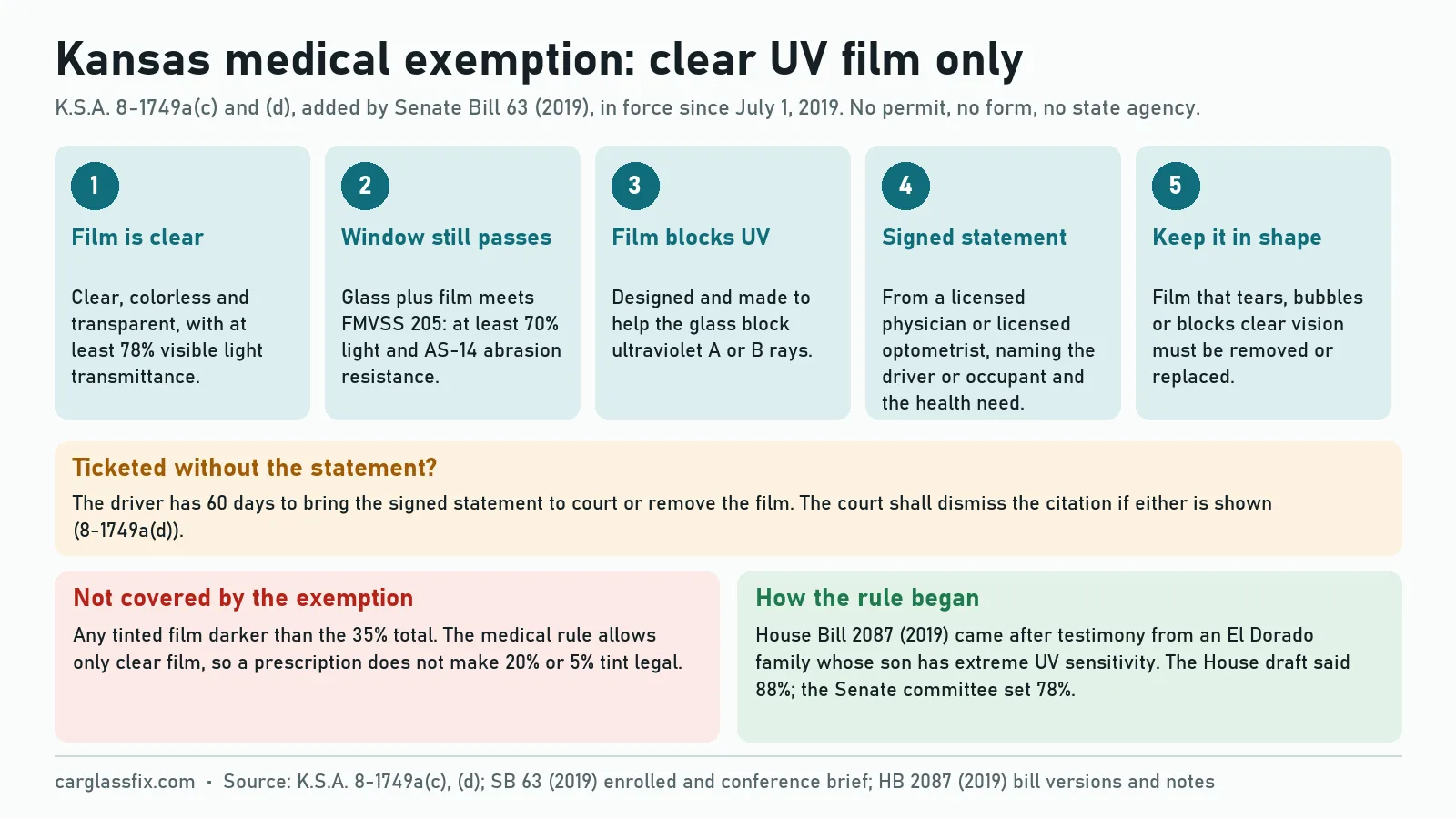
*Source: K.S.A. 8-1749a(c) and (d); Senate Bill 63 (2019) enrolled text and conference committee brief; House Bill 2087 (2019) bill versions and supplemental note. Diagram: CarGlassFix.*
The statement must come from a licensed physician or a licensed optometrist. The statute lists these conditions.
## How the Kansas clear medical film exemption works
1. ### Choose qualifying film
The film must be clear, colorless and transparent with a minimum visible light transmittance of 78% (8-1749a(c)(1)).
2. ### Check the finished window
The glass with film must still meet FMVSS 205, including 70% light transmittance and AS-14 abrasion resistance (8-1749a(c)(2)).
3. ### Use UV-blocking film
The film must be designed and made to help the glass block ultraviolet A or B rays (8-1749a(c)(3)).
4. ### Get a signed statement
A licensed physician or optometrist must identify the driver or occupant with reasonable specificity and state that the film is necessary to safeguard that person’s health (8-1749a(c)(4)).
5. ### Keep the film in good shape
Film that tears, bubbles or blocks clear vision must be removed or replaced (8-1749a(c)(5)).
6. ### Answer a citation within 60 days
A driver cited for not having the statement has 60 days to produce it in court or remove the film, and the court shall then dismiss the citation (8-1749a(d)).
## Tint tickets and penalties in Kansas
Driving with film that breaks 8-1749a is a misdemeanor, and installing it is a class C misdemeanor. Subsection (h) gives the driver offense no class. K.S.A. 8-2116(b) says a misdemeanor under the Uniform Act Regulating Traffic on Highways is class C unless another statute says otherwise. A second offense within one year becomes class B, and a third becomes class A. K.S.A. 21-6602 sets the jail limits at one month for class C, six months for class B and one year for class A. K.S.A. 21-6611 caps the fines at $500, $1,000 and $2,500. These are maximums, and the court sets the actual sentence. Section 8-1749a is not in the uniform fine schedule of K.S.A. 8-2118, so there is no fixed ticket amount to pay by mail. Section 8-1749c makes “any person who installs” non-compliant film guilty of a class C misdemeanor, and that wording does not exclude owners who tint their own car. The Parsons Police Department says its officers use tint meters at traffic stops; a [window tint meter](https://carglassfix.com/window-tint-meter/) explains how they read. A Kansas appeals court held in State v. Kirk (2008) that a tint violation gave reasonable suspicion for a stop.
## How the Kansas tint law changed, and what other sites get wrong
The 35% rule dates from 1987, and the last change came in 2019. The 1987 act (L. 1987, ch. 48) wrote the sun screening definitions in 8-1749b and the installer offense in 8-1749c. A 2010 Senate bill shows that the old text called for warning citations only from July 1, 1987 to January 1, 1988. Senate Bill 63 took effect July 1, 2019. Its tint section came from House Bill 2087, which followed testimony from an El Dorado family whose son has a rare genetic disorder that makes him extremely sensitive to UV rays. The House draft said 88%; the Senate committee set 78%. The final bill also added the 60-day dismissal. The Revisor’s 2026 list of amended statutes does not include 8-1749a.
Several ranking pages get Kansas wrong. Some shop pages allow any darkness behind the driver or a 5-inch windshield strip. Bing’s AI answer says dual mirrors are needed with a tinted rear window, that a state agency approves medical tint, and that film must be certified for Kansas. The statute says none of this. For the rules in every state, see [what car window tint is legal](https://carglassfix.com/what-car-window-tint-is-legal/). Rules change, so check the current statute or ask the Kansas Highway Patrol. This page is not legal advice.
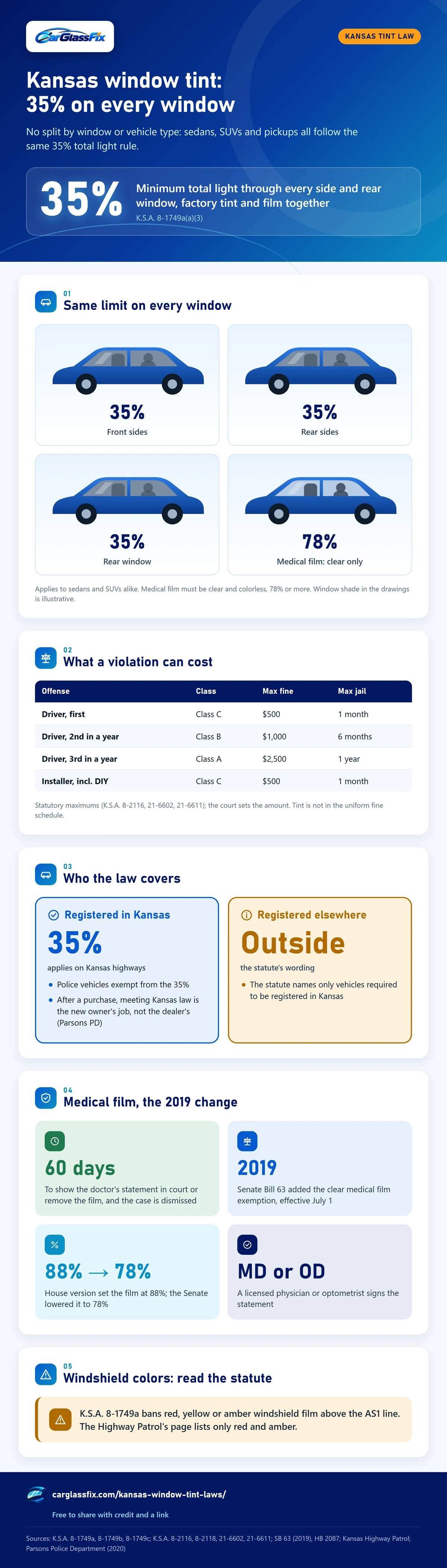
*CarGlassFix infographic. Sources: K.S.A. 8-1749a to 8-1749c, 8-2116, 21-6602, 21-6611, SB 63 (2019), Kansas Highway Patrol, Parsons Police Department.*
**Share this infographic.** Free to use on your site under CC BY 4.0: keep the credit and the link to this page. Copy the code below.

Infographic: CarGlassFix
## Frequently asked questions
### Is 20% tint legal in Kansas?
No. A window with 20% tint lets through less than the 35% total light that K.S.A. 8-1749a(a)(3) requires, and the rule covers every side and rear window on cars and SUVs. A medical statement does not change that, because the medical rule allows only clear film of 78% or more.
### Is 20% window tint darker than 35%?
Yes. The percentage is the share of light that gets through, so 20% passes less light than 35% and looks darker. The [window tint simulator](https://carglassfix.com/window-tint-simulator/) previews both shades on a car.
### Is it legal to put tint on headlights in Kansas?
Not if the film is highly reflective or nontransparent when the lamps are off. K.S.A. 8-1749a(g) bans those covers on vehicles required to be registered in Kansas, and KHP says tinted headlamp covers are prohibited.
### Can I tint my car windows myself in Kansas?
You can, but the film must meet the same 35% and nonreflective rules. K.S.A. 8-1749c makes any person who installs non-compliant film guilty of a class C misdemeanor, and the wording does not exempt owners.
### Do Kansas tint laws apply to out-of-state cars?
K.S.A. 8-1749a applies to motor vehicles required to be registered in Kansas. A vehicle properly registered in another state falls under its home state’s rules. A new resident who must register in Kansas has to meet the 35% rule.
## Sources
- [K.S.A. 8-1749a, One-way glass and sun screening devices](https://www.ksrevisor.gov/statutes/chapters/ch08/008_017_0049a.html) (Kansas Office of Revisor of Statutes, checked 2026-10-29)
- [K.S.A. 8-1749b, Sun screening devices; definitions](https://www.ksrevisor.gov/statutes/chapters/ch08/008_017_0049b.html) (checked 2026-10-29)
- [K.S.A. 8-1749c, Unlawful installation of sun screening device](https://www.ksrevisor.gov/statutes/chapters/ch08/008_017_0049c.html) (checked 2026-10-29)
- [K.S.A. 8-2116, Classification of violations](https://www.ksrevisor.gov/statutes/chapters/ch08/008_021_0016.html) (checked 2026-10-29)
- [K.S.A. 8-2118, Uniform fine schedule](https://www.ksrevisor.gov/statutes/chapters/ch08/008_021_0018.html) (checked 2026-10-29)
- [K.S.A. 21-6602, Classification of misdemeanors](https://www.ksrevisor.gov/statutes/chapters/ch21/021_066_0002.html) (checked 2026-10-29)
- [K.S.A. 21-6611, Fines](https://www.ksrevisor.gov/statutes/chapters/ch21/021_066_0011.html) (checked 2026-10-29)
- [K.S.A. 8-116a, Vehicle identification number check by the highway patrol](https://www.ksrevisor.gov/statutes/chapters/ch08/008_001_0016a.html) (checked 2026-10-29)
- [2026 Composite Listing of New, Amended and Repealed Statutes](https://www.ksrevisor.gov/rpts/2026NewAmendsAndRepealsKSAOrder.pdf) (Kansas Revisor of Statutes, August 13, 2026)
- [Senate Bill 63 (2019), bill history, enrolled text and conference committee brief](https://kslegislature.gov/li_2020/b2019_20/measures/sb63/) (Kansas Legislature)
- [House Bill 2087 (2019), bill versions and supplemental note](https://kslegislature.gov/li_2020/b2019_20/measures/hb2087/) (Kansas Legislature)
- [Senate Bill 579 (2010), as amended by Senate Committee](https://kslegislature.org/historical_data/bills/2010/2010_S_Bill_579.pdf) (Kansas Legislature)
- [Consumer Equipment: Window Tint Regulations](https://kansashighwaypatrol.gov/about-us/facts-faqs/consumer-equipment/) (Kansas Highway Patrol)
- [Kansas Highway Patrol FAQs: window tint on commercial vehicles](https://kansashighwaypatrol.gov/faqs/)
- [Parsons Police Reminds Vehicle Owners of Kansas Window Tint Law](https://www.parsonspdks.gov/press-releases/parsons-police-reminds-vehicle-owners-of-kansas-window-tint-law) (Parsons Police Department, May 15, 2020)