---
title: "Massachusetts Window Tint Laws: 35% on Every Window"
canonical: "https://carglassfix.com/massachusetts-window-tint-laws/"
author: "Garrett Ross"
published: "2026-11-04T09:00:00+00:00"
modified: "2026-11-04T08:06:27+00:00"
language: "en-US"
site: "CarGlassFix"
description: "Massachusetts tint law: 35% light on all side windows and the rear window, windshield strip in the top 6 inches. Inspection test, RMV waiver, $250 fine."
categories: "Window Tint"
attribution: "CarGlassFix (https://carglassfix.com/)"
---
# Massachusetts Window Tint Laws: 35% on Every Window
Short answer
Massachusetts window tint law allows 35% visible light transmittance or more on the front side windows, the rear side windows and the rear window, and the rear window also needs two outside mirrors. The windshield may carry only transparent material in the uppermost 6 inches, above the AS-1 line. The same limits apply to cars, SUVs, vans and pickups.
## Key takeaways
- Massachusetts sets one limit, 35%, for all five pieces of glass behind the windshield, under M.G.L. c. 90, 9D(4), with no separate rule for SUVs or vans.
- The statute says reflectance of 35% or less “or” transmittance of 35% or more; the annual inspection tests transmittance only and fails any window that reads under 35%.
- The windshield may have transparent material only in the uppermost 6 inches, and the inspection rejects tint below the AS-1 line.
- A tinted glass waiver from the RMV Medical Affairs office allows darker side and rear windows for a driver certified by a physician as photophobic or photosensitive.
- The statute sets a fine of not more than $250, and a third conviction brings a license suspension of up to 90 days.
## Massachusetts window tint limits by window
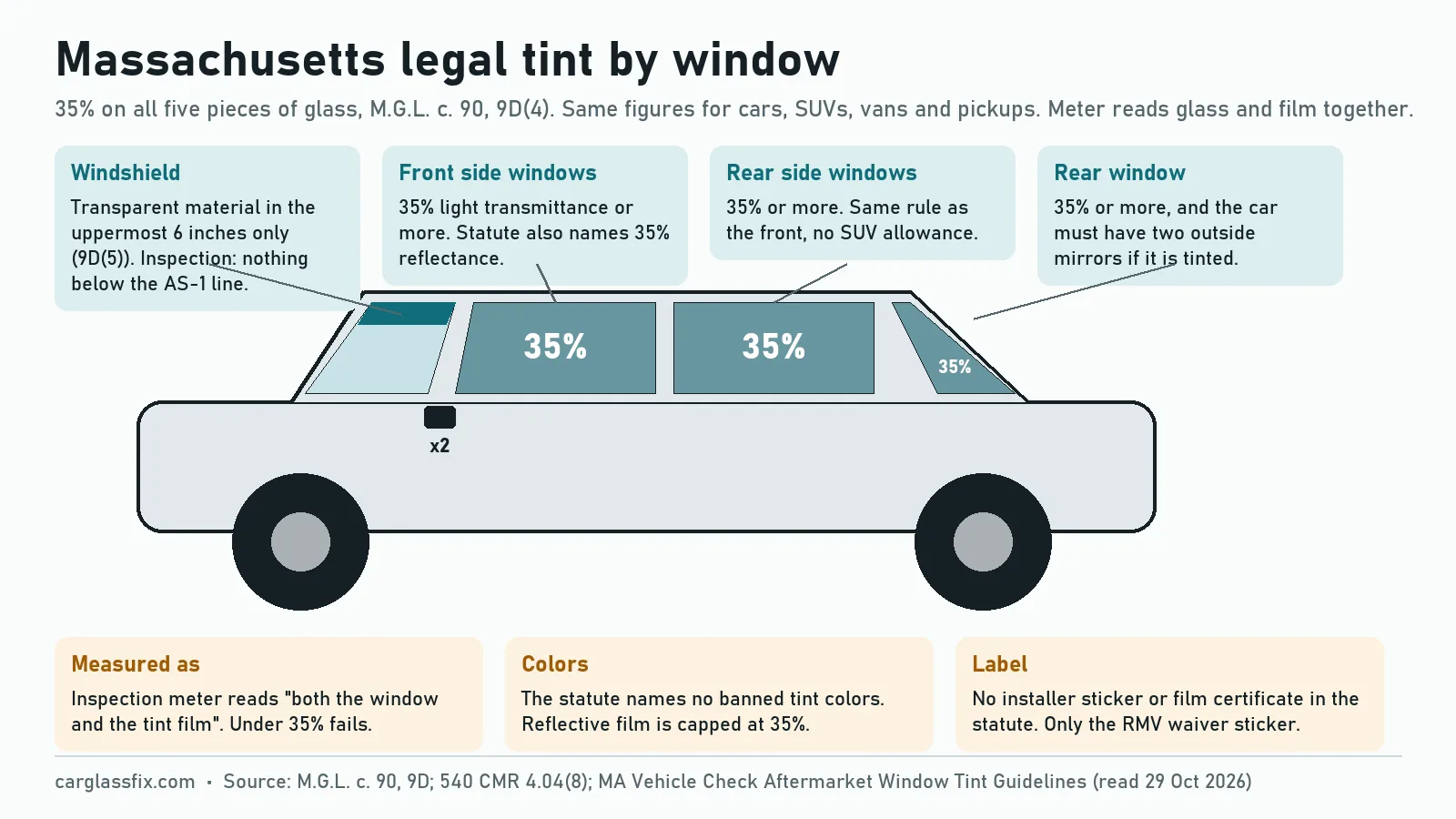
Massachusetts allows aftermarket film on five windows, and each of them must keep visible light transmittance at 35% or more. The rule is M.G.L. c. 90, Section 9D. The section first bans any “nontransparent or sunscreen material, window application, reflective film or nonreflective film” that makes the windshield, the front side windows, the rear side windows or the rear window “in any way nontransparent or obscured”. It then lists exceptions, and exception (4) is the one tint shops work to. The statute draws no line between a sedan and a multipurpose vehicle, so a pickup, van or SUV gets the same 35% on its rear glass as a sedan. The rear window carries one extra condition: the vehicle must have “two outside mirrors, one on each side, adjusted so that the driver has a clear view of the highway behind the vehicle”. The state inspection regulation, 540 CMR 4.04(8)(g), repeats the mirror rule for any rear window with aftermarket tint.
| Window | Sedan | SUV, van, pickup |
| --- | --- | --- |
| Windshield | Transparent material in the uppermost 6 inches only; at inspection, nothing below the AS-1 line | Same |
| Front side windows | 35% light transmittance or more (statute also allows 35% reflectance or less) | Same |
| Rear side windows | 35% or more | Same |
| Rear window | 35% or more, and two outside mirrors | Same |
| Measured as | Inspection meter reads the window and the film together | Same |
| Tolerance | None in the statute, the regulation or the inspection guideline | Same |
## What the statute says and what the inspection tests
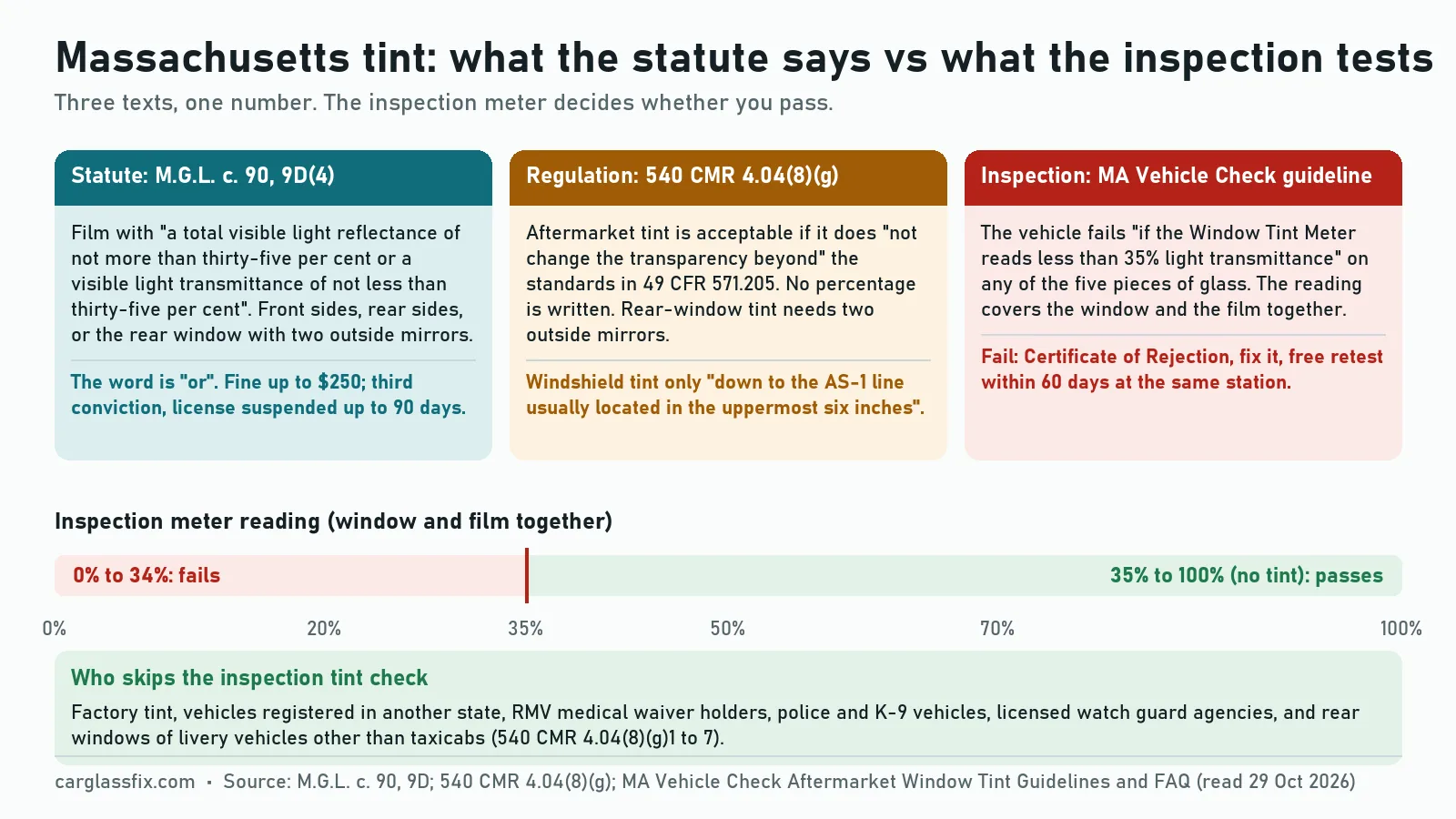
The statute and the inspection program describe the 35% limit in different words, and the inspection meter is the test drivers meet each year. Exception (4) of Section 9D allows material “which has a total visible light reflectance of not more than thirty-five per cent or a visible light transmittance of not less than thirty-five per cent”. The connector is “or”. Read literally, a film that reflects 35% or less would qualify even if it passed less than 35% of light.
*Source: M.G.L. c. 90, 9D; 540 CMR 4.04(8); MA Vehicle Check Aftermarket Window Tint Guidelines. Diagram: CarGlassFix.*
**Share this infographic.** Free to use on your site under CC BY 4.0: keep the credit and the link to this page. Copy the code below.

Infographic: CarGlassFix
The regulation differs again. 540 CMR 4.04(8)(g) accepts aftermarket tint that does “not change the transparency beyond that of the standards set forth in 49 CFR Part 571.205”, and it names no percentage at all. The inspection guideline settles it in practice. A vehicle fails “if the Window Tint Meter (which is the measuring device used by the inspector) reads less than 35% light transmittance”, and the reading covers “both the window and the tint film”. Factory glass absorbs light, so a 35% film can read below 35% once installed. The [how to measure window tint](https://carglassfix.com/how-to-measure-window-tint/) guide shows the glass-times-film math, and a [window tint meter](https://carglassfix.com/window-tint-meter/) gives the reading an inspector sees. None of the three texts sets a tolerance.
## Windshield tint in Massachusetts: the uppermost 6 inches
Massachusetts allows windshield material only in a strip at the top, and the statute limits that strip to the uppermost 6 inches. Exception (5) permits “any transparent material limited to the uppermost 6” along the top of the windshield, provided such strip does not encroach upon the driver’s direct forward viewing area” as defined in the Federal Motor Vehicle Safety Standards. The statute says “transparent”, so a dark visor strip does not fit the exception on its wording. The inspection regulation adds the AS-1 mark: “The windshield may only be tinted down to the AS-1 line usually located in the uppermost six inches of the windshield.”
The inspection guideline states the fail condition both ways. Tint “lower than 6″ from the top of the windshield, or lower than the AS1 markings located on the left or right side of the windshield” rejects the vehicle. See [the AS-1 line on a windshield](https://carglassfix.com/as1-line-on-windshield/) to find the mark on your glass. The RMV says the same on its waiver page: “Windshields may not be tinted below the AS-1 line (upper most six inches)”, and the medical waiver does not change that. For how other states treat the windshield, read [is it illegal to have tint on a windshield](https://carglassfix.com/is-it-illegal-to-have-tint-on-windshield/).
## How the annual inspection checks window tint
Every Massachusetts inspection includes a tint check on the five pieces of glass behind the windshield, and a car that fails gets a Certificate of Rejection instead of a sticker. The Massachusetts Vehicle Check guideline lists the five windows: the driver’s window, the passenger’s window, the two side windows behind them and the rear windshield. The inspector holds a window tint meter on each one, and any reading under 35% fails the vehicle. A tinted rear window without two outside mirrors, or a windshield item that obstructs the operator’s vision, also fails.
*Sources: M.G.L. c. 90, 9D; 540 CMR 4.04(8)(g); MA Vehicle Check Aftermarket Window Tint Guidelines and Motorist FAQ. Diagram: CarGlassFix.*
Under 540 CMR 4.04(2)(f), a vehicle “determined not to meet all inspection requirements shall be issued a Certificate of Rejection”. The program’s FAQ says the vehicle “must be repaired and pass its re-test within 60 days of the initial inspection”, with “one free re-test within 60 days at the station that initially inspected” it. A different station charges again. The fix is film removal or a lighter film; the [window tint percentage chart](https://carglassfix.com/window-tint-percentage-chart/) shows which shades sit above 35%. One gap exists: for a vehicle registered in another state and inspected in Massachusetts, “any type of window tinting is exempted from the Commonwealth’s window tint regulations”.
## Massachusetts tinted glass waiver for medical conditions
Massachusetts lets a driver certified as light sensitive apply to the RMV for a tinted glass waiver that allows darker side and rear windows. Exception (8) of Section 9D covers “special window treatment or application determined necessary by a licensed physician” for an owner or operator “who is determined to be light or photosensitive”. The statute routes the application to the medical advisory board and requires “a written attestation of a physician licensed to practice in this commonwealth”. When the exemption is granted, the registrar issues “a sufficiently noticeable sticker” for “the side window immediately adjacent to the operator” and keeps a record of it. The RMV page describes the current process.
## How to apply for a Massachusetts tinted glass waiver
1. ### Get a physician’s certification
The owner or operator needs signed certification from a physician that they are photophobic or photosensitive. The physician must be licensed in Massachusetts.
2. ### Check the vehicle qualifies
The RMV lists a private passenger vehicle that the diagnosed person owns, or on which that person is listed as an operator on the insurance policy.
3. ### Mail the original application
Send the completed Application for Tinted Glass Waiver to Registry of Motor Vehicles, Medical Affairs, PO Box 55889, Boston, MA 02205. The RMV accepts no photocopies or faxes.
4. ### Keep the waiver and new registration in the car
Waivers issued after January 16, 2025 come with a new registration that reads “Vehicle with Tinted Glass Waiver”. Discard the old registration and keep the new one with the waiver.
The waiver applies to “the front side windows, rear side windows, and/or rear window of vehicles only”. A lost waiver is replaced after a signed, notarized letter stating it is no longer in the applicant’s possession. Inspection stations treat a vehicle “for which a medical exemption has been issued” as exempt from the tint check.
## How much is a tint ticket in Massachusetts
A Massachusetts tint violation carries a fine of not more than $250 under the statute, and repeat convictions add a license penalty. The last paragraph of Section 9D reads: “Violations of any provisions of this section shall be punishable by a fine of not more than two hundred and fifty dollars.” On “a third or subsequent conviction”, the registrar suspends the operator’s license “for a period not to exceed ninety days”. Reddit threads quote the fine “per window” and a five-figure penalty for shops; neither figure appears in the statute. The same paragraph applies to anyone who would “manufacture, sell, offer for sale or trade, equip or operate” a vehicle in violation of the section, so an installer can be fined as well as a driver. The section adds that nothing in it “shall be construed to prohibit the manufacture or sale of reflective or nonreflective film”, so film itself stays legal to sell. The statute sets no court costs and names no fix-it option; a police citation and an inspection fail are separate events, and a driver can meet both in one year.
## Exemptions and what older pages get wrong
Several claims on ranking pages have no source in the law. A Bing AI answer checked for this page said red and amber tint are prohibited and that “a compliance sticker is required”. Section 9D names no colors, no installer label, no film certification and no tolerance; the only sticker it mentions is the medical waiver sticker. The statute exempts factory glass built to 49 CFR 571.205, vehicles registered in another state, law enforcement and licensed watch guard agencies, K-9 vehicles, and the rear windows of public livery vehicles other than taxicabs. The regulation repeats that list for inspections. Before choosing a shade, preview it in the [window tint simulator](https://carglassfix.com/window-tint-simulator/), and compare other states in [what car window tint is legal](https://carglassfix.com/what-car-window-tint-is-legal/).
Tint rules change, and Massachusetts bills are filed every session. Check the current text of M.G.L. c. 90, Section 9D, or the RMV, before you tint. This article is general information, not legal advice.
## Frequently asked questions
### What is the darkest legal tint in Massachusetts?
The darkest legal tint reads 35% light transmittance on the inspector’s meter, with the glass and film measured together, on every side window and the rear window. There is no darker allowance for SUVs, vans or pickups.
### Is 20% tint legal in Massachusetts?
No. A window that reads 20% is below the 35% minimum in M.G.L. c. 90, 9D(4), and it fails the annual inspection, which rejects any reading under 35%. Only a vehicle with an RMV tinted glass waiver may run darker side or rear windows.
### Did the Massachusetts window tint law change for 2026?
The statute read for this page, dated May 2026 on the Legislature’s site, still carries the 35% figure, the 6-inch windshield strip and the $250 fine. The inspection regulation, 540 CMR 4.04, was last amended effective January 3, 2025, and it kept the AS-1 windshield rule.
### Is it hard to get a tint exemption in Massachusetts?
The RMV requires a Massachusetts-licensed physician’s certification that the owner or operator is photophobic or photosensitive, an original mailed application and a private passenger vehicle the person owns or is insured to drive. The RMV publishes no approval rate.
### Is 35% tint darker than 50%?
Yes. A 35% film passes 35% of visible light and a 50% film passes 50%, so 35% is the darker of the two. The [window tint percentage chart](https://carglassfix.com/window-tint-percentage-chart/) shows the shades side by side.
## Sources
- [Massachusetts General Laws, Chapter 90, Section 9D: Windshields and windows obscured by nontransparent materials](https://malegislature.gov/Laws/GeneralLaws/PartI/TitleXIV/Chapter90/Section9D) (archived copy of 17 May 2026 read; checked 29 October 2026)
- [540 CMR 4.04, Procedures for Inspection of Non-commercial Motor Vehicles](https://www.law.cornell.edu/regulations/massachusetts/540-CMR-4-04) (amended effective 3 January 2025; checked 29 October 2026)
- [Massachusetts Vehicle Check: Aftermarket Window Tint Guidelines (PDF, 1 October 2017)](https://www.mavehiclecheck.com/s/Stations_Aftermarket-Window-Tint-Guidelines-1012017.pdf) (checked 29 October 2026)
- [Massachusetts Vehicle Check: Motorist FAQs](https://www.mavehiclecheck.com/motorists-faqs) and [Inspection Information by Vehicle Type](https://www.mavehiclecheck.com/stations-inspection-info) (checked 29 October 2026)
- [Mass.gov, Registry of Motor Vehicles: Apply for a tinted glass waiver for your vehicle](https://www.mass.gov/how-to/apply-for-a-tinted-glass-waiver-for-your-vehicle) (checked 29 October 2026)
- [49 CFR 571.205, Glazing materials](https://www.law.cornell.edu/cfr/text/49/571.205) (checked 29 October 2026)