---
title: "Montana Window Tint Laws: 24% Front, 14% Rear by Window"
canonical: "https://carglassfix.com/montana-window-tint-laws/"
author: "Garrett Ross"
published: "2026-11-17T15:00:00+00:00"
modified: "2026-11-08T00:27:26+00:00"
language: "en-US"
site: "CarGlassFix"
description: "Montana window tint laws: front sides need 24% light, sedan rear windows 14%, and SUVs, vans and buses have no rear limit. Waiver and penalty rules inside."
categories: "Window Tint"
attribution: "CarGlassFix (https://carglassfix.com/)"
---
# Montana Window Tint Laws: 24% Front, 14% Rear by Window
Short answer
Montana window tint laws require at least 24% light transmission on front side windows and at least 14% on a sedan’s back side and rear windows. Multipurpose vehicles, vans and buses have no limit behind the front seat. Windshield material below the AS-1 line must be clear, and reflectance may not exceed 35% where limits apply.
## Key takeaways
- Montana’s darkest legal front side reading is 24% light transmission, and the same section caps luminous reflectance at 35% (Mont. Code Ann. 61-9-405(4)(b)).
- A sedan needs 14% on the rear window and the side windows behind the front seat, while a multipurpose vehicle, van or bus has no limit there.
- The limits apply only to a vehicle “required to be registered in this state,” so a nonresident’s properly registered personal car falls outside them.
- A written waiver can come from the Montana Highway Patrol or a local law enforcement agency, and a medical waiver rests on an affidavit from a physician, physician assistant or advanced practice registered nurse.
- Illegal tint is a misdemeanor for the owner or operator and for the installer, with a fine of up to $500, up to 6 months in county jail, or both.
## Montana window tint limits by window
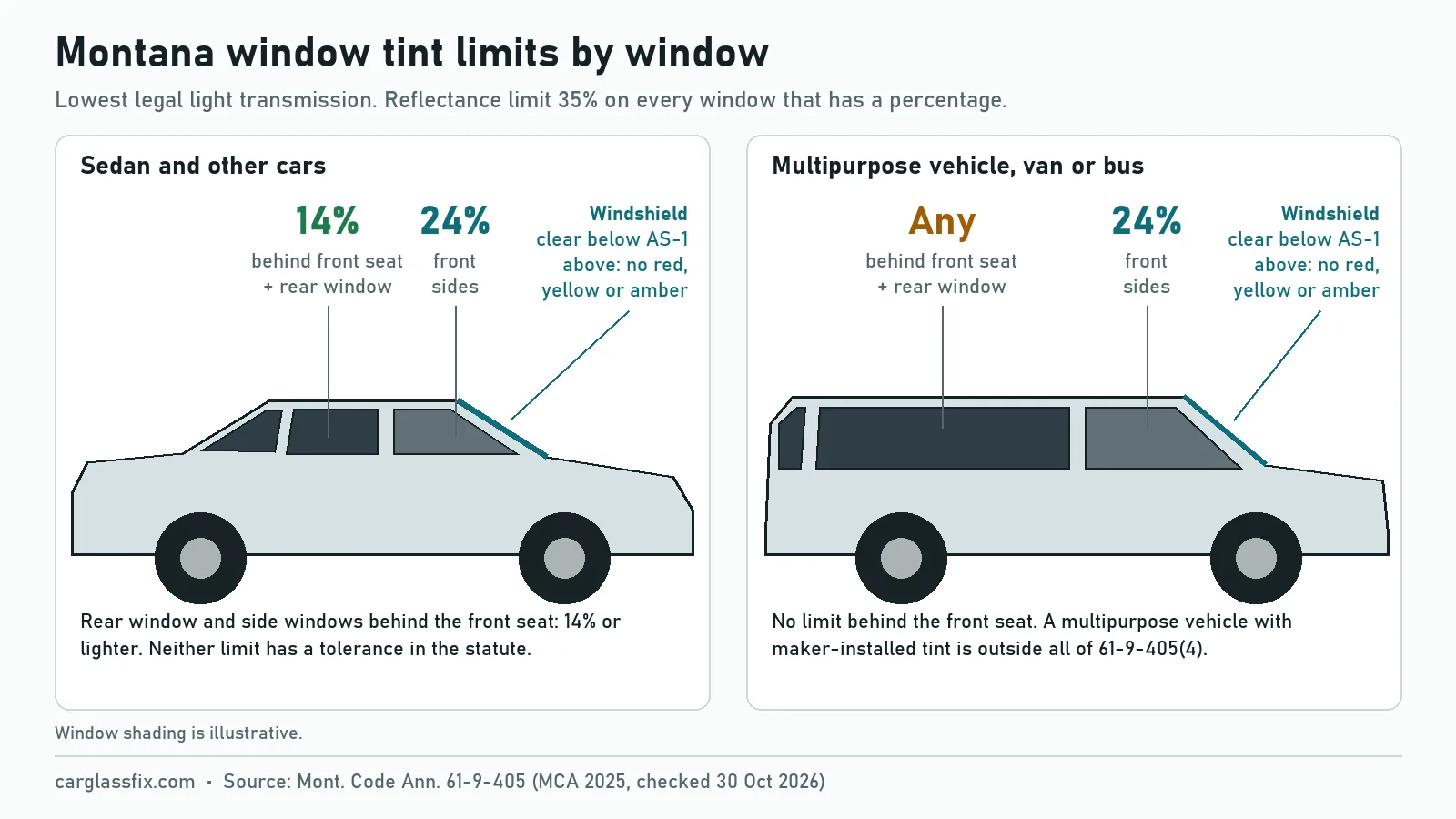
Montana sets a 24% minimum on front side windows and a 14% minimum on a sedan’s back side and rear windows. The rules sit in Montana Code Annotated 61-9-405(4). The statute is written as a list of violations. A front side window breaks the law when its light transmission is “less than 24%,” so a reading of exactly 24% passes. The 14% line works the same way. Luminous reflectance has its own test, and a window fails when it reflects “more than 35%.” The rear limit turns on vehicle type. The table uses the statute’s groups, and the multipurpose section below explains which SUVs and pickups belong in the right column.
| Window | Sedan | SUV, van, pickup (multipurpose vehicle, van or bus) |
| --- | --- | --- |
| Windshield below the AS-1 line | Clear and transparent material only | Same |
| Windshield above the AS-1 line | Any material except red, yellow or amber | Same |
| Front side windows | 24% light or more, 35% reflectance or less | Same |
| Side windows behind the front seat | 14% light or more, 35% reflectance or less | No limit |
| Rear window | 14% light or more, 35% reflectance or less | No limit |
| Tolerance | None stated | None stated |
| Dual mirrors or film label | Not mentioned in 61-9-405, 61-9-428 or 61-9-429 | Same |
## How Montana measures light and reflectance
Montana compares the light that passes “through the sunscreening or transparent material” with the total light falling on the window. That is the definition of light transmission in 61-9-405(5)(b). The statute never uses the phrases “film alone” or “film and glass.” Subsection (6) does settle the common factory-tint question. It applies the limits to tinted windows, “including windows with less than 100% light transmission to which additional sunscreening material has been applied.”
*Source: Mont. Code Ann. 61-9-405(4) and (7), MCA 2025. Diagram: CarGlassFix.*
The safe reading is to judge the finished window, because glass blocks some light before film goes on. A film sold as 24% will usually read darker once it sits on the glass. Our [how to measure window tint](https://carglassfix.com/how-to-measure-window-tint/) guide shows that math, and the [window tint percentage chart](https://carglassfix.com/window-tint-percentage-chart/) shows how each shade looks. The three tint sections state no tolerance, so a 23% reading is below the number on its face. A [window tint meter](https://carglassfix.com/window-tint-meter/) gives a reading for the whole window. Luminous reflectance is defined the same way, as light “reflected outward” compared with the light falling on the window.
## Which vehicles count as multipurpose vehicles in Montana
A Montana multipurpose vehicle is designed to carry 10 or fewer passengers and is built on a truck chassis or “with special features for occasional off-road use.” That definition is in 61-9-405(5)(d). Pickups and body-on-frame SUVs fit the truck-chassis words. Vans and buses are named separately in the exception, so they need no definition test. Crossovers are the gray area, since many are built on car platforms. The statute lists no models and does not explain “special features,” and no Montana agency source we could open does either. A crossover owner who wants a reading below 14% should get an answer from the Montana Highway Patrol first.
The exception in (4)(c) closes the whole clause, so our reading is that it lifts the 35% reflectance test behind the front seat too, along with the 14% test. Some websites still list 35% for SUV back side windows. Subsection (7) goes further for factory glass. A multipurpose vehicle “equipped with tinted windows that were installed by the manufacturer” is outside all of subsection (4). Sedans get no such factory exemption. Campers, motor homes and pickup covers have one more rule, because their windows must meet the federal glazing standard, 49 CFR 571.205.
## Windshield tint in Montana: the AS-1 line rule
Montana allows only clear and transparent sunscreening material below the AS-1 line. Above that line, the material may not be red, yellow or amber. Those two tests in 61-9-405(4)(a) are the whole windshield rule. The statute sets no light percentage for the top strip, no inch measurement and no reflectance limit for the windshield. It also has no fallback for glass without a visible mark, unlike the 6-inch line in [Idaho window tint laws](https://carglassfix.com/idaho-window-tint-laws/). To find the mark on your glass, read [the AS-1 line on a windshield](https://carglassfix.com/as1-line-on-windshield/).
The color ban appears only in the windshield paragraph. The front side and rear paragraphs name no colors. A clear film below the line fits the words “clear and transparent,” so a colorless UV film is not barred by this paragraph. Montana’s general view rule still applies. Subsection (2)(a) bars a “nontransparent material” that materially obstructs the driver’s clear view of the highway. For the rule across other states, see [is it illegal to have tint on a windshield](https://carglassfix.com/is-it-illegal-to-have-tint-on-windshield/).
## Who the Montana tint limits do not cover
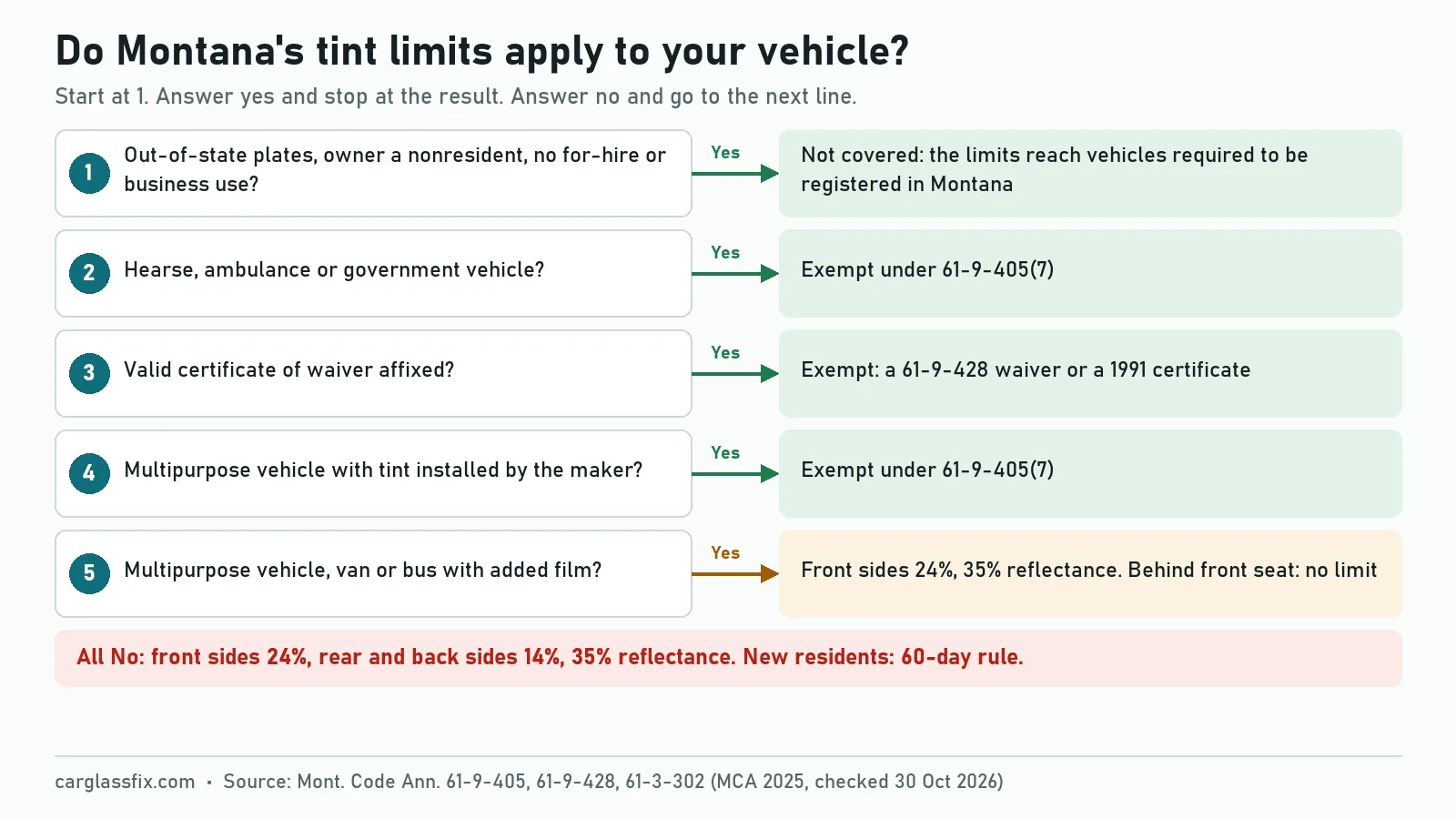
The Montana limits cover only a motor vehicle “required to be registered in this state,” and several vehicle classes are exempt. A nonresident’s car that is properly registered at home and carries valid plates is exempt from Montana registration under 61-3-302(2) when it is not used for hire or business here. On our reading, a visitor’s tint therefore falls outside 61-9-405(4), though the general clear-view rule still applies.
*Source: Mont. Code Ann. 61-9-405, 61-9-428 and 61-3-302, MCA 2025. Diagram: CarGlassFix.*
New residents have a clock. A person who has lived in Montana for “more than 60 consecutive days” counts as a resident for registration, and the vehicle must be registered before further use here. Tint that was legal elsewhere must then meet Montana’s numbers. An out-of-state vehicle used for hire or in a business here may also need Montana registration under 61-3-701. Subsection (7) exempts hearses, ambulances and government vehicles. It also keeps a grandfather clause, which requires the department to issue a certificate of waiver for a vehicle registered here on October 1, 1991 with film that the law then banned.
## How to get a Montana tint waiver
A Montana tint waiver comes from the Montana Highway Patrol or a local law enforcement agency under 61-9-428. The agency “may grant” one, so approval is not automatic. The section allows a waiver for safety, for security or for medical reasons. The affidavit requirement attaches to the medical reason. The section names no form, fee or fixed length, so ask the agency what it requires.
## How to get a Montana window tint waiver
1. ### Get the affidavit
For a medical waiver, a licensed physician, licensed physician assistant or advanced practice registered nurse signs an affidavit.
2. ### Apply to an agency
Take the request to the Montana Highway Patrol or your local law enforcement agency.
3. ### Check the written waiver
It must identify the vehicle, and list the issue date, the owner’s name, the reason, the effective dates and the granting officer’s signature.
4. ### Affix it to the vehicle
Subsection 61-9-405(7) exempts a vehicle to which a “currently valid certificate of waiver is affixed.”
5. ### Watch the end date
The agency keeps its copy until the waiver expires, and the waiver covers only the vehicle it identifies.
The statute lists no qualifying medical conditions, so the affidavit and the agency’s decision carry the request. Only a law enforcement officer can grant the waiver. A tint shop’s receipt or a film label does not stand in for it, and a shop that installs out-of-limit film for a vehicle without one faces its own charge.
## Montana tint ticket: fine, jail limit and how stops happen
A Montana tint violation is a misdemeanor with a fine of up to $500, up to 6 months in county jail, or both. Section 61-9-429 covers a person who owns or operates the vehicle. It also covers a person who applies film that puts a window out of limits, so tint shops carry their own risk. Both offenses are “punishable as provided in 46-18-212,” which sets “a fine not to exceed $500.” These are maximums, and the court sets the sentence. The lower $10 to $100 first-conviction range in 61-9-511 is for chapter 9 violations with no other penalty, and tint has its own.
The tint sections set no inspection step and no fix-it period. Dark glass can also lead to a stop for a different reason. In State v. Henderson (1998), an officer could not read a temporary registration sticker through a tinted rear window. The Montana Supreme Court held that this gave particularized suspicion that the vehicle was not properly registered. The opinion does not rest on 61-9-405, and the sticker turned out to be valid. Buyers of newly tinted cars on temporary tags should keep that in mind.
## How the Montana tint law changed, and what other pages get wrong
Section 61-9-405 was amended for tinting by Chapter 777 of the 1991 laws, and the numbers match in the codes we compared from 1995 to 2025. The 1995 code exempted factory tint “of the type and specifications” the maker installed, and the 1997 code cut that to windows “installed by the manufacturer.” Chapter 242 of the 2007 laws changed only the waiver section, adding physician assistants and advanced practice registered nurses. The 2025 edition is the latest code, and the Montana Legislature holds regular sessions in odd-numbered years.
A Bing AI answer checked for this page said fines run $25 to $100 with a 30-day correction period, and it put these limits on all vehicles. The statute supports none of that. The same answer said the medical proof is carried in the vehicle; the statute says affixed. Other pages add a dual-mirror rule, a “top 6 inches” windshield limit or a non-reflective windshield rule, none of which appear in these sections. Before you choose a shade, try the [window tint simulator](https://carglassfix.com/window-tint-simulator/), and compare states in [what car window tint is legal](https://carglassfix.com/what-car-window-tint-is-legal/).
Montana tint rules can change with any legislative session. Check the current Montana Code Annotated or ask the Montana Highway Patrol before you tint. This article is general information, not legal advice.
*CarGlassFix infographic. Sources: MCA 2025 61-9-405, 61-9-428, 61-9-429 and 46-18-212.*
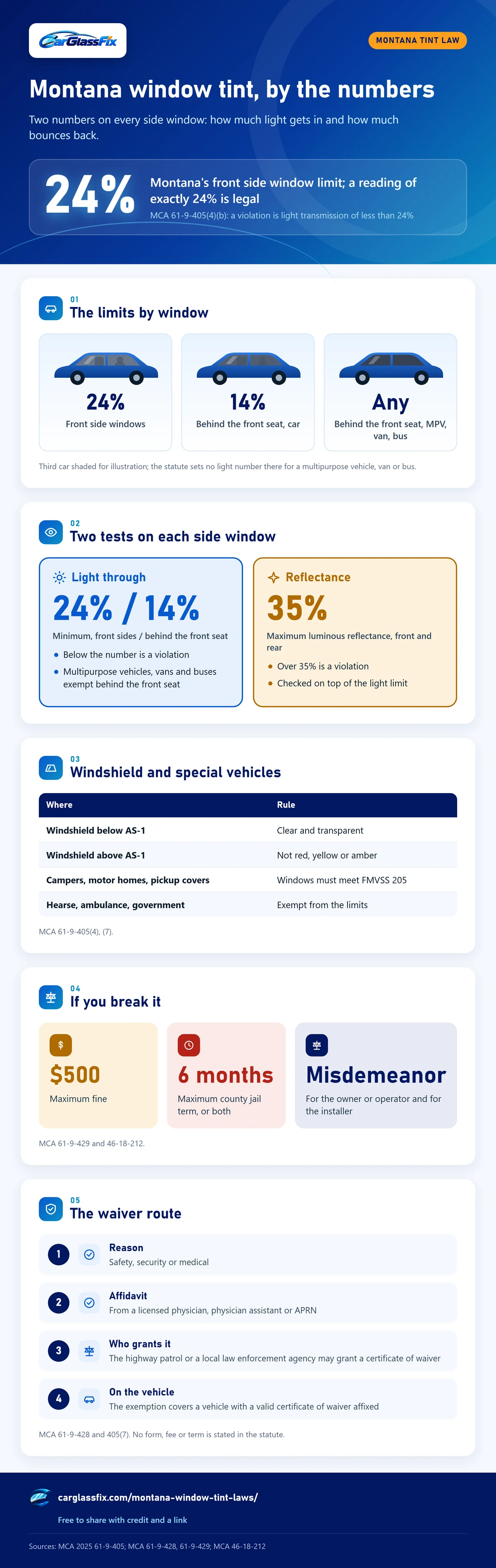
**Share this infographic.** Free to use on your site under CC BY 4.0: keep the credit and the link to this page. Copy the code below.

Infographic: CarGlassFix
## Frequently asked questions
### Is 20% tint legal in Montana?
A 20% reading is illegal on front side windows, which need at least 24%, unless a waiver applies. It is legal behind the front seat on a sedan, where the limit is 14%, and on a multipurpose vehicle, van or bus, which has no limit there.
### Is 5% tint legal in Montana?
A 5% reading is legal only behind the front seat on a multipurpose vehicle, van or bus, or on a vehicle with a valid waiver. It is illegal on all front side windows and on a sedan’s back side and rear windows.
### How dark is 25 percent tint, and is it legal in Montana?
A 25% tint passes 25% of visible light, which clears Montana’s 24% front side limit by one point if the finished window reads 25%. Film on glass often reads lower, so check the [window tint percentage chart](https://carglassfix.com/window-tint-percentage-chart/) and measure after installing.
### Do I have to remove my tint if I move to Montana?
You must meet Montana’s limits once the vehicle is required to be registered here. A person living in Montana for more than 60 consecutive days counts as a resident for registration under 61-3-302.
### Is a doctor’s note enough for dark tint in Montana?
No. The note alone does not exempt the vehicle. Montana requires a written waiver from the highway patrol or a local law enforcement agency, based on a signed affidavit for medical reasons, and the certificate must be affixed to the vehicle.
## Sources
- [Mont. Code Ann. 61-9-405, window tinting and sunscreening](https://mca.legmt.gov/bills/mca/title_0610/chapter_0090/part_0040/section_0050/0610-0090-0040-0050.html) (MCA 2025, checked 30 October 2026)
- [Mont. Code Ann. 61-9-428, waiver and conditions](https://mca.legmt.gov/bills/mca/title_0610/chapter_0090/part_0040/section_0280/0610-0090-0040-0280.html) (MCA 2025, checked 30 October 2026)
- [Mont. Code Ann. 61-9-429, penalty](https://mca.legmt.gov/bills/mca/title_0610/chapter_0090/part_0040/section_0290/0610-0090-0040-0290.html) (MCA 2025, checked 30 October 2026)
- [Mont. Code Ann. 46-18-212, when no penalty is specified](https://mca.legmt.gov/bills/mca/title_0460/chapter_0180/part_0020/section_0120/0460-0180-0020-0120.html) (MCA 2025, checked 30 October 2026)
- [Mont. Code Ann. 61-9-511, violation of chapter](https://mca.legmt.gov/bills/mca/title_0610/chapter_0090/part_0050/section_0110/0610-0090-0050-0110.html) (MCA 2025, checked 30 October 2026)
- [Mont. Code Ann. 61-3-302, residents and exempt vehicles](https://mca.legmt.gov/bills/mca/title_0610/chapter_0030/part_0030/section_0020/0610-0030-0030-0020.html) and [61-3-701, out-of-state vehicles in gainful occupation](https://mca.legmt.gov/bills/mca/title_0610/chapter_0030/part_0070/section_0010/0610-0030-0070-0010.html) (MCA 2025, checked 30 October 2026)
- [MCA 1995, 61-9-405](https://mca.legmt.gov/bills/1995/mca/61/9/61-9-405.htm) and [MCA 1997, 61-9-405](https://mca.legmt.gov/bills/1997/mca/61/9/61-9-405.htm)
- [MCA 2005, 61-9-428](https://mca.legmt.gov/bills/2005/mca/61/9/61-9-428.htm) and [MCA 2007, 61-9-428](https://mca.legmt.gov/bills/2007/mca/61/9/61-9-428.htm)
- [Montana Constitution, Article V, Section 6, sessions](https://mca.legmt.gov/bills/mca/title_0000/article_0050/part_0010/section_0060/0000-0050-0010-0060.html)
- [State v. Henderson, Montana Supreme Court, No. 97-631 (September 18, 1998)](https://caselaw.findlaw.com/court/mt-supreme-court/1447643.html)