---
title: "Nebraska Window Tint Laws: 35% Front, 20% Rear by Window"
canonical: "https://carglassfix.com/nebraska-window-tint-laws/"
author: "Garrett Ross"
published: "2026-11-14T15:00:00+00:00"
modified: "2026-11-08T00:27:05+00:00"
language: "en-US"
site: "CarGlassFix"
description: "Nebraska tint law: 35% on front side windows, 20% behind the front seat on sedans, no limit there on SUVs and vans; clear film only below the AS-1 line."
categories: "Window Tint"
attribution: "CarGlassFix (https://carglassfix.com/)"
---
# Nebraska Window Tint Laws: 35% Front, 20% Rear by Window
Short answer
Nebraska window tint laws require at least 35% light transmission on the front side windows of every vehicle. Sedans need at least 20% on the back side windows and the rear window, while multipurpose vehicles, vans and buses have no limit there. Film below the windshield’s AS-1 line must be clear and transparent.
## Key takeaways
- Neb. Rev. Stat. 60-6,257 bars front side window film with light transmission under 35% or luminous reflectance over 35%.
- Behind the front seat, the floor is 20% light transmission, except on a multipurpose vehicle, van or bus.
- The AS-1 line is the AS-1 mark or a line 5 inches below the top of the windshield, whichever is closer to the top.
- The Nebraska State Patrol or a local law enforcement agency may grant a written waiver based on an affidavit signed by a licensed physician (60-6,260).
- Driving with illegal tint is a Class V misdemeanor, which carries a maximum fine of $100 and no jail (60-6,258 and 28-106).
## Nebraska window tint limits by window
Nebraska sets two numbers: 35% light transmission on the front side windows and 20% on the windows behind the front seat. Both come from Neb. Rev. Stat. 60-6,257, a section first passed in 1989 as Legislative Bill 155. Subsection (1)(c) makes it unlawful to drive with front side film that has light transmission of “less than thirty-five percent”. The same clause caps luminous reflectance at 35%. Subsection (1)(d) sets the 20% floor for the rear window and the side windows behind the front seat. It also repeats the 35% reflectance cap for those windows. The 20% floor does not apply to the rear window or rear side windows of a multipurpose vehicle, van or bus. The statute gives no tolerance for meter error. It names no mirror condition and no installer label. The table sums up each window.
| Window | Sedan | SUV, van, pickup |
| --- | --- | --- |
| Windshield below the AS-1 line | Clear and transparent material only | Same |
| Windshield above the AS-1 line | Any shade; not red, yellow or amber | Same |
| Front side windows | 35% light or more; reflectance 35% or less | Same |
| Side windows behind the front seat | 20% light or more; reflectance 35% or less | No light limit for a multipurpose vehicle or van; pickup trucks are not named |
| Rear window | 20% light or more; reflectance 35% or less | No light limit for a multipurpose vehicle or van; pickup trucks are not named |
| Tolerance | None stated | None stated |
## How Nebraska measures light and reflectance
Nebraska measures light transmission as the share of light that passes through the material compared with all the light falling on the window. Section 60-6,257(2)(d) words it as light passing “through the sunscreening or transparent material” to the total light “falling on the motor vehicle window”. Luminous reflectance in (2)(e) uses the same base for light reflected outward.
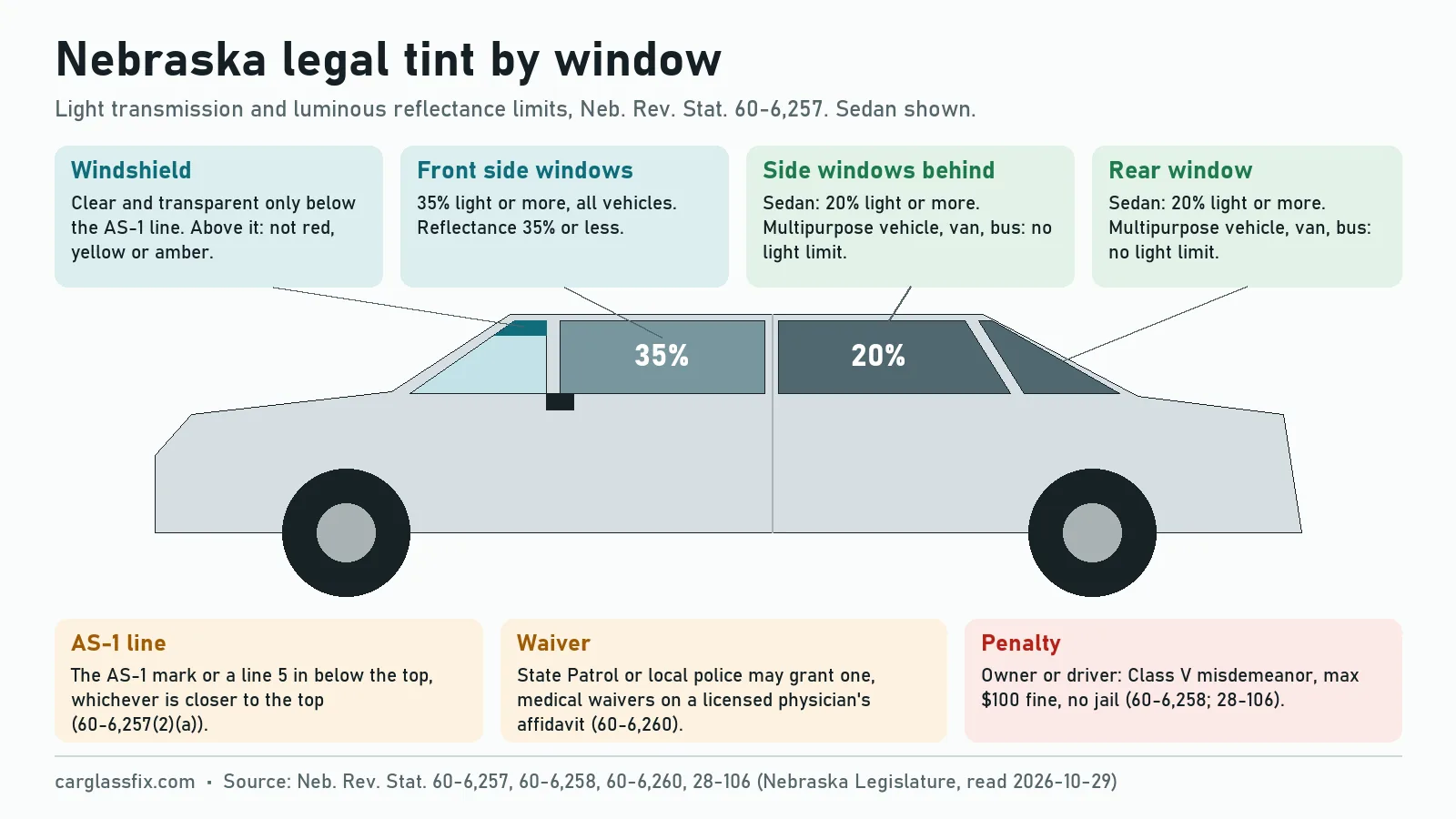
*Source: Neb. Rev. Stat. 60-6,257, 60-6,258 and 28-106 (Nebraska Legislature, official pages read on Wayback Machine copies, 2026). Diagram: CarGlassFix.*
A tint meter held against the window reads the glass and the film together. That reading is what an officer sees at the roadside. The statute does not say “film plus glass” in so many words, so the safe plan is to aim for a finished reading above the limit. Factory side glass already blocks some light, which means a film sold as 35% often reads lower once installed. Our guide on [how to measure window tint](https://carglassfix.com/how-to-measure-window-tint/) shows how the two numbers multiply. The [window tint meter](https://carglassfix.com/window-tint-meter/) page explains how roadside meters read VLT. Reflectance matters too. A mirror-finish film can pass the 35% light test and still break the 35% reflectance cap.
## Windshield rule: only clear film below the AS-1 line
Below the AS-1 line, a Nebraska windshield may carry only sunscreening that is “clear and transparent”. Section 60-6,257(1)(b) adds that material above the line may not be “red, yellow, or amber in color”. The statute gives no light percentage for the top strip. It also gives no reflectance figure for the windshield.
The AS-1 line has a two-part definition in (2)(a). It is the line running from the AS-1 letters on the glass, parallel to the top edge. It can also be a line 5 inches below and parallel to the top. The law picks “whichever is closer to the top of the windshield”. So a windshield with its AS-1 mark 6 inches down still gets only a 5-inch strip. A windshield with the mark 4 inches down gets a 4-inch strip. Learn how to find the mark on [the AS-1 line on a windshield](https://carglassfix.com/as1-line-on-windshield/). Clear, untinted heat or UV film is the only film the text allows across the main viewing area. Tinted ceramic film below the line is not clear and transparent, even if it is light.
## SUVs, vans, pickups and other vehicle types
Nebraska lifts the 20% floor behind the front seat for a multipurpose vehicle, a van or a bus, and for no other vehicle type. Section 60-6,257(2)(g) defines a multipurpose vehicle as one designed to carry “ten or fewer passengers” that is built on a truck chassis or has special features for occasional off-road use. Most SUVs fit that description. The front side windows of these vehicles still need 35%.
Pickup trucks are a grey area. The exception does not name pickups, and many websites simply group them with SUVs. Whether a given pickup counts as a multipurpose vehicle depends on that definition, and no Nebraska agency page addresses it. A pickup owner who wants dark rear glass should ask the State Patrol or local police first. Reflectance behind the front seat is also open to two readings. The exception sits at the end of (1)(d), so it may lift the 35% reflectance cap too. The cautious choice is to keep reflectance at 35% or less on every window. Other rules apply to special vehicles. Campers, motor homes and pickup covers must meet the federal glazing standard in 49 C.F.R. 571.205 under (1)(e). Section 60-6,261 exempts the side and rear windows of hearses and funeral coaches.
## Nebraska medical and safety waiver
Nebraska offers a written waiver, granted by the Nebraska State Patrol or a local law enforcement agency, not a DMV permit. Section 60-6,260 says the agency “may grant a waiver” of the 60-6,257 standards. The grounds are safety, security or medical reasons. A medical waiver rests on “an affidavit signed by a licensed physician”.
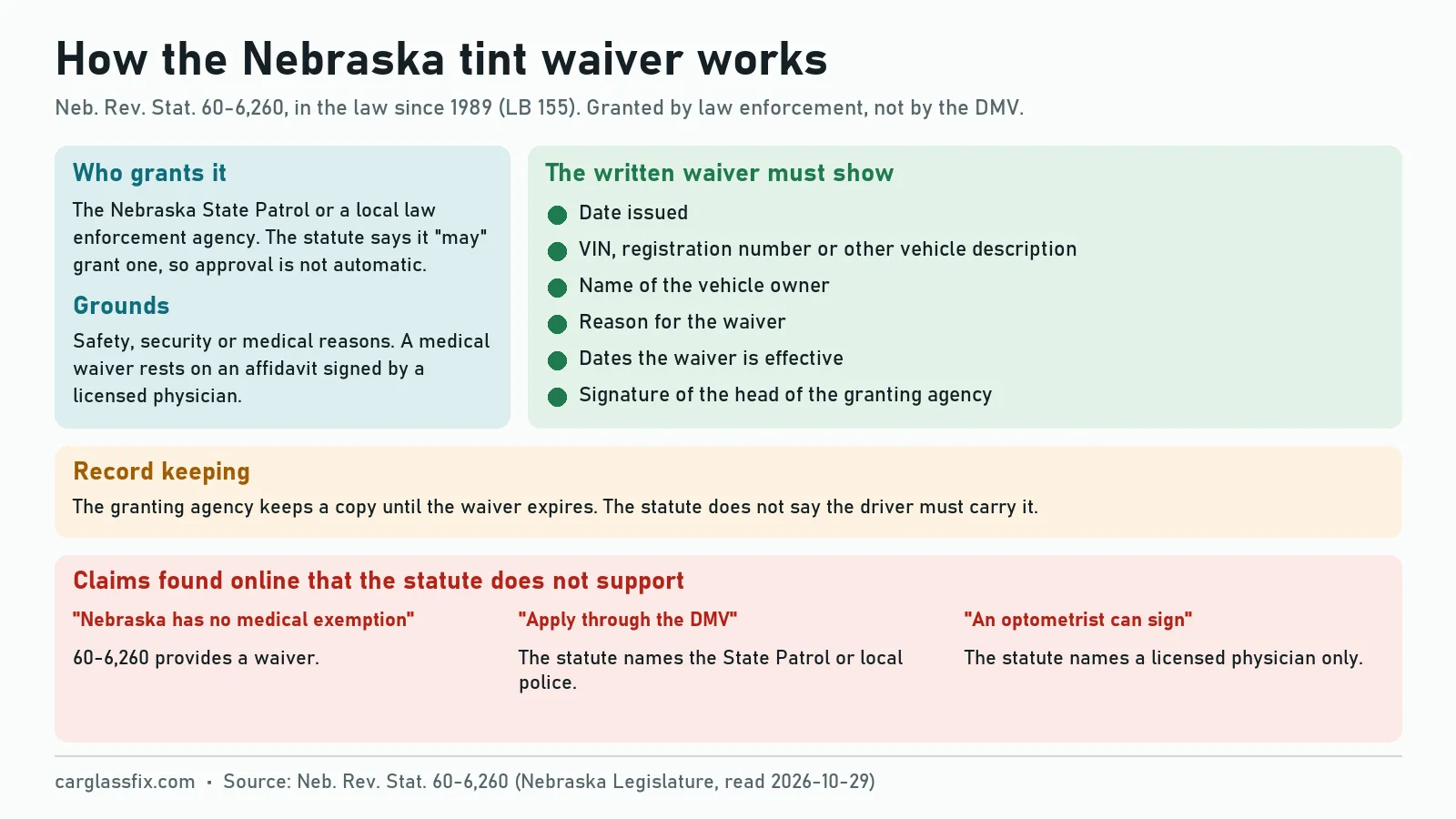
*Source: Neb. Rev. Stat. 60-6,260 (Nebraska Legislature). Diagram: CarGlassFix.*
The waiver is discretionary, so a physician’s affidavit does not guarantee approval. The statute names only a licensed physician. It does not list optometrists, physician assistants or nurse practitioners. No Nebraska DMV or State Patrol tint form was found online in October 2026. The statute itself lists what the written waiver must show.
## How the Nebraska tint waiver works under 60-6,260
1. ### Get the affidavit
A licensed physician signs an affidavit stating the medical reason for darker tint.
2. ### Ask the agency
Contact the Nebraska State Patrol or your local police or sheriff, the only agencies the statute names.
3. ### Check the waiver
It must show the date issued, the VIN, registration number or other vehicle description, the owner’s name, the reason and the effective dates.
4. ### Confirm the signature
The head of the granting agency signs it, and the agency keeps a copy until it expires.
5. ### Keep a copy with you
The statute does not require it, but a copy in the vehicle helps at a traffic stop.
## Penalties for illegal tint in Nebraska
Driving or owning a vehicle with illegal tint is a Class V misdemeanor under Neb. Rev. Stat. 60-6,258. Section 28-106 sets the Class V maximum at “no imprisonment, one hundred dollars fine”, with no minimum. Court costs are set separately and are not part of that figure.
The person who applies the film faces more. Section 60-6,259 makes it a Class III misdemeanor to apply sunscreening or glass-plastic glazing so that a window breaks 60-6,257(1). Under 28-106, a Class III misdemeanor carries up to three months in jail, a $500 fine, or both. The wording “any person who applies” reaches a tint shop and also a driver who installs film at home. The law covers vehicles “required to be registered in this state”, so a car registered in another state falls outside that wording. The statute does not make tint a secondary offense that needs another reason for a stop. Nebraska’s neighbors use other numbers. See [Kansas window tint laws](https://carglassfix.com/kansas-window-tint-laws/) and [Iowa window tint laws](https://carglassfix.com/iowa-window-tint-laws/) before a road trip across the border.
## What older and shop websites get wrong
Several popular pages misstate the Nebraska rules, even though the statute has not changed since 1993. The source line of 60-6,257 lists Laws 1989, LB 155, an amendment in 1990 (LB 1119) and the 1993 recodification in LB 370, which moved the section from 39-6,136.01. No later change appears in the official text.
One shop blog says trucks, SUVs and minivans need 35% “all around”. The statute has no light limit behind the front seat for multipurpose vehicles and vans. Two tint sites say Nebraska allows no medical exemption, and a medical-tint company’s FAQ says the same. Section 60-6,260 has allowed a waiver since 1989. Other pages send drivers to the DMV or say an optometrist can sign; the statute names law enforcement agencies and a licensed physician. Some charts say “5 inches or AS-1, whichever comes first”, which hides the “closer to the top” test. To compare Nebraska with other states, start at [what car window tint is legal](https://carglassfix.com/what-car-window-tint-is-legal/), or preview 35% and 20% shades in the [window tint simulator](https://carglassfix.com/window-tint-simulator/). Rules change, so check the current statute on nebraskalegislature.gov or ask the Nebraska State Patrol. This page is not legal advice.
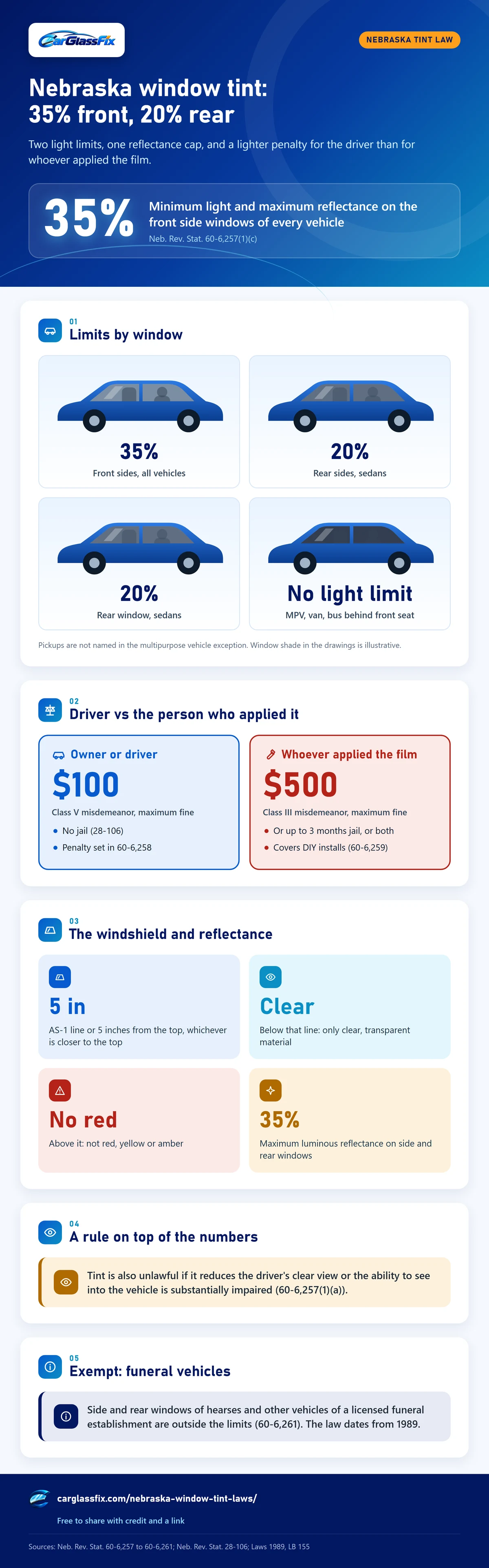
*CarGlassFix infographic. Sources: Neb. Rev. Stat. 60-6,257 to 60-6,261 and 28-106.*
**Share this infographic.** Free to use on your site under CC BY 4.0: keep the credit and the link to this page. Copy the code below.

Infographic: CarGlassFix
## Frequently asked questions
### What is the darkest legal tint in Nebraska?
On a sedan, the darkest legal film is 35% on the front side windows and 20% on the back side windows and rear window. On a multipurpose vehicle, van or bus, the windows behind the front seat have no light limit, but the front side windows still need 35%.
### Is 20% tint darker than 35%?
Yes. A 20% film lets 20% of visible light through, while a 35% film lets 35% through, so 20% is darker. The [window tint percentage chart](https://carglassfix.com/window-tint-percentage-chart/) shows how each shade looks.
### Can a cop pull you over for tint in Nebraska?
Yes. Section 60-6,257 makes driving with non-compliant tint unlawful on its own, and it does not limit enforcement to stops made for another reason. The owner or driver faces a Class V misdemeanor under 60-6,258.
### Can I install window tint myself in Nebraska?
Yes, but the limits still apply. Section 60-6,259 makes it a Class III misdemeanor for any person to apply film that leaves a window in violation, and that wording does not exclude the vehicle owner.
### Can an out-of-state car get a Nebraska tint ticket?
Section 60-6,257 applies to a motor vehicle “required to be registered in this state”. A car properly registered in another state falls outside that wording, but a Nebraska resident who must register here cannot rely on out-of-state plates.
## Sources
- [Neb. Rev. Stat. 60-6,257, Windshield and windows; tinting; sunscreening](https://nebraskalegislature.gov/laws/statutes.php?statute=60-6,257) (official text read on the Wayback Machine copy of 2026-01-19, checked 2026-10-29)
- [Neb. Rev. Stat. 60-6,258, violations; penalty](https://nebraskalegislature.gov/laws/statutes.php?statute=60-6,258) (checked 2026-10-29)
- [Neb. Rev. Stat. 60-6,259, applicator; prohibited acts; penalty](https://nebraskalegislature.gov/laws/statutes.php?statute=60-6,259) (checked 2026-10-29)
- [Neb. Rev. Stat. 60-6,260, waiver of standards; conditions](https://nebraskalegislature.gov/laws/statutes.php?statute=60-6,260) (checked 2026-10-29)
- [Neb. Rev. Stat. 60-6,261, funeral vehicles; exception](https://nebraskalegislature.gov/laws/statutes.php?statute=60-6,261) (checked 2026-10-29)
- [Neb. Rev. Stat. 28-106, misdemeanors; classification of penalties](https://nebraskalegislature.gov/laws/statutes.php?statute=28-106) (checked 2026-10-29)
- [49 C.F.R. 571.205, Glazing materials (FMVSS 205)](https://www.ecfr.gov/current/title-49/subtitle-B/chapter-V/part-571/subpart-B/section-571.205)
- [Nebraska State Patrol, contact page](https://statepatrol.nebraska.gov/contact)