---
title: "Oregon Window Tint Laws: 50% Film, 35% Total by Window"
canonical: "https://carglassfix.com/oregon-window-tint-laws/"
author: "Garrett Ross"
published: "2026-11-10T09:00:00+00:00"
modified: "2026-11-08T00:25:12+00:00"
language: "en-US"
site: "CarGlassFix"
description: "Oregon window tint laws: film must pass 50% of light, reflect 13% or less and total 35% with the glass. SUV rear windows, windshield, medical rules, fines."
categories: "Window Tint"
attribution: "CarGlassFix (https://carglassfix.com/)"
---
# Oregon Window Tint Laws: 50% Film, 35% Total by Window
Short answer
Oregon window tint laws let film on the side and rear windows only if the film alone passes at least 50% of light, reflects 13% or less, and the window passes at least 35% in total. SUVs, pickups and vans may go darker behind the driver with mirrors on both sides. Windshield tint is limited to the top 6 inches.
## Key takeaways
- Every tinted side or rear window on an Oregon car must pass three tests at once: film transmittance 50% or more, film reflectance 13% or less, and total transmittance 35% or more (ORS 815.221(2)).
- A film sold as 35% fails in Oregon, because the film by itself must pass at least 50% of light.
- Multipurpose passenger vehicles may use darker film on every window behind the driver only when they have rearview mirrors on each side (ORS 815.221(4)).
- Darker tint for a medical condition needs an affidavit, prescription or letterhead letter from a licensed physician or optometrist kept in the vehicle; Oregon DMV issues no tint permit.
- Illegal tint is a Class B traffic violation under ORS 815.222, with a presumptive fine of $265 under ORS 153.019.
## Oregon window tint limits by window
Oregon allows film on the side and rear windows of a car only when it meets a 50% film limit, a 13% reflectance cap and a 35% total limit, and it allows windshield tint only on the top 6 inches. The rules sit in Oregon Revised Statutes 815.221, and the penalties sit in ORS 815.222. The same three numbers apply to the front side windows, the rear side windows and the rear window of a sedan. The statute does not split the car into front and rear zones the way many states do. Its only split is by vehicle type. A multipurpose passenger vehicle, which covers most SUVs, pickups and vans, may carry darker film on every window behind the driver if it has a rearview mirror on each side. The statute sets no measurement tolerance.
| Window | Sedan | SUV, van, pickup |
| --- | --- | --- |
| Windshield | Darker tint on the top 6 in only; no film on the rest | Same |
| Front side windows | Film 50% or more, film reflectance 13% or less, total 35% or more | Same |
| Side windows behind the driver | Film 50% or more, reflectance 13% or less, total 35% or more | Any darkness with a rearview mirror on each side; windows must meet AS-3 glazing rules |
| Rear window | Film 50% or more, reflectance 13% or less, total 35% or more | Any darkness with a rearview mirror on each side |
| Banned on any window | Mirror finish; red, gold, yellow, amber or black film; brushed or sprayed liquid tint | Same |
| Tolerance | None stated in ORS 815.221 | Same |
## The three tests every Oregon side and rear window must pass
An Oregon side or rear window is legal only when it passes all three tests in ORS 815.221(2) at the same time. Test one is the film on its own: it must have “a light transmittance of 50 percent or more”. Test two is also the film on its own: it must have “a light reflectance of 13 percent or less”. Test three is the finished window: the “total light transmittance through the window with the tinting material applied” must be 35% or more. The statute joins the three with “and”, so failing any one makes the window illegal.
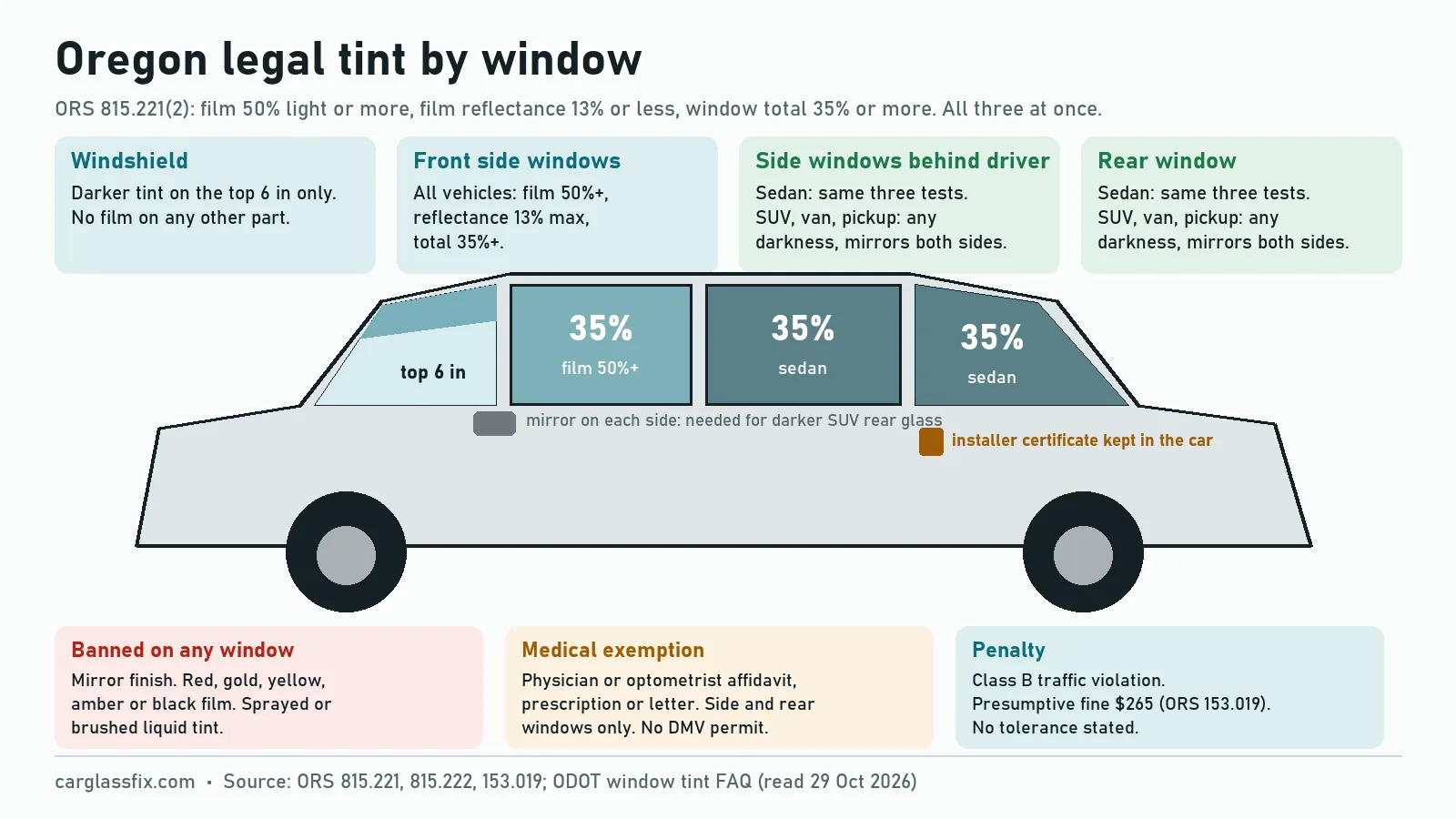
*Source: ORS 815.221 and 815.222, Oregon Board of Optometry and ODOT window tint FAQ. Diagram: CarGlassFix.*
Oregon checks the film as well as the finished window, which is why the installer has to state the film’s own transmittance and reflectance on the certificate. A tint meter on the car reads the total, the figure for test three. Our guide on [how to measure window tint](https://carglassfix.com/how-to-measure-window-tint/) explains the reading, and a [window tint meter](https://carglassfix.com/window-tint-meter/) shows how officers and shops take it. The 13% reflectance cap also applies to the film itself.
## Windshield tint and banned materials in Oregon
Oregon allows darker tint on a windshield only in the top 6 inches, and it bans film everywhere else on the windshield. ORS 815.221(3) says tint below the side-window limits “may be applied to the top six inches of a windshield”. The next sentence reads: “Tinting material may not be applied to any other portion of the windshield.” The statute does not use the AS-1 line. The 6-inch measure applies to every windshield, with or without that mark. The statute does not set a separate light limit for the strip itself.
Subsection (8) bans three kinds of material on every window. Mirror finish products are not permitted. Red, gold, yellow, amber or black material is not permitted. Liquid tint that is brushed or sprayed on is not permitted. Blue is not on that list, although some tint pages say it is. A separate rule, ORS 815.220, bans signs, posters, one-way glass or other material that impairs the view into or out of the windshield and the side windows beside the driver. That offense is a Class D traffic violation. For mirror films in other states, see [can you put mirror tint on a car](https://carglassfix.com/can-you-put-mirror-tint-on-a-car/), and for windshield rules elsewhere, read [is it illegal to have tint on windshield](https://carglassfix.com/is-it-illegal-to-have-tint-on-windshield/).
## Why a 35% film is illegal in Oregon
A film rated 35% is illegal on an Oregon car’s side and rear windows, because it fails the 50% film test before the glass is even counted. Many tint pages sum up Oregon as “35% all around”. That figure is only the total limit. The glass itself blocks some light, so the total reading is always lower than the film rating. A rough estimate multiplies the two: film transmittance times glass transmittance.
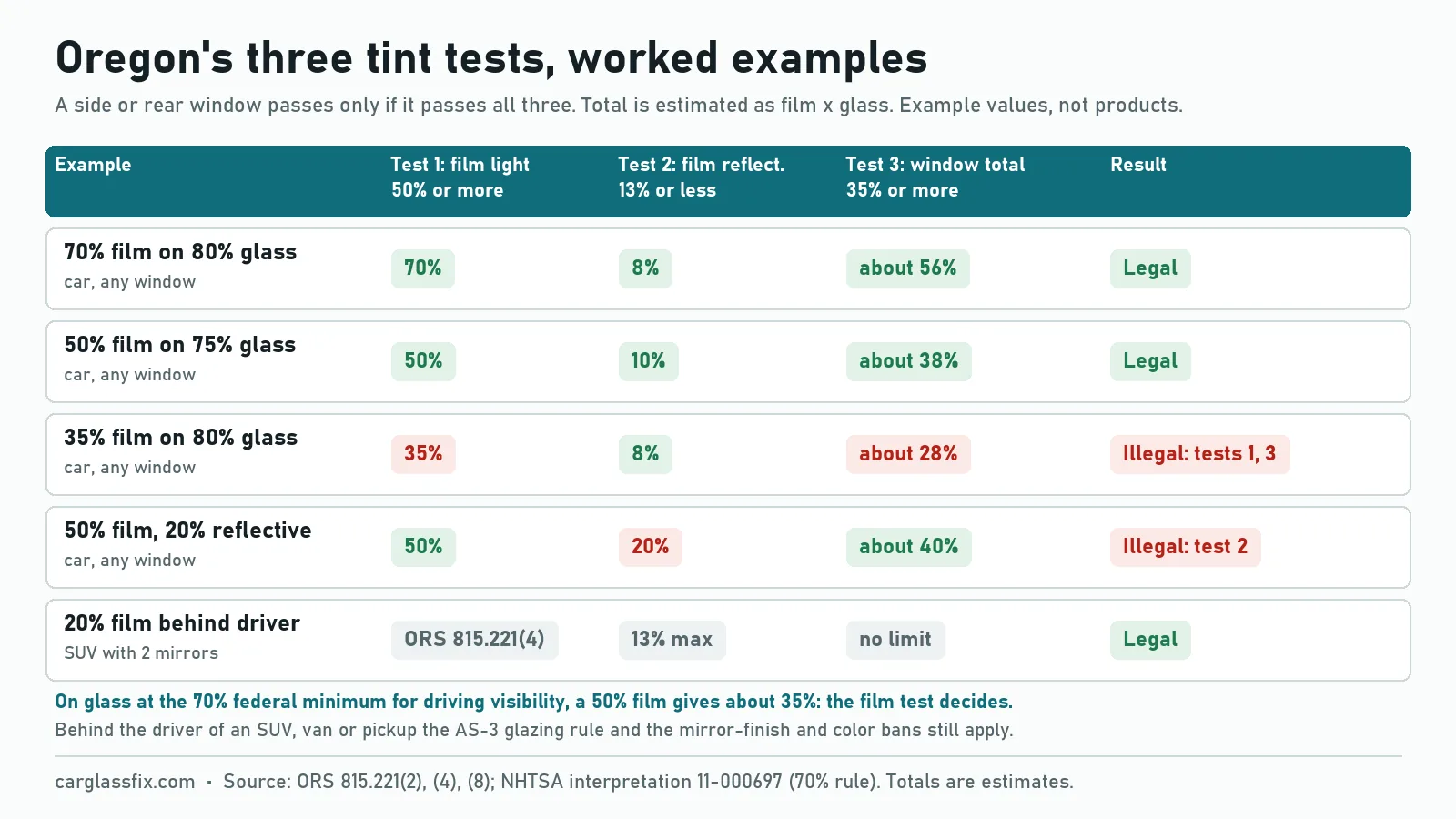
*Rules from ORS 815.221(2) and (4); glass and film values are examples, and totals are film times glass estimates. Diagram: CarGlassFix.*
Federal glazing rules require at least 70% light transmittance in the areas needed for driving visibility, as NHTSA explains in interpretation 11-000697. A 50% film on glass at 70% gives about 35%, right at the total limit. Clearer factory glass leaves more room. On glass that meets the federal minimum, a film that passes the 50% test will usually pass the total test too, so the film test is the one that decides. A meter reading on the car is what counts. The [window tint percentage chart](https://carglassfix.com/window-tint-percentage-chart/) shows how 50%, 35% and 20% shades compare, and the [window tint simulator](https://carglassfix.com/window-tint-simulator/) previews them on a car.
## SUVs, pickups and vans: darker tint behind the driver
A multipurpose passenger vehicle in Oregon may carry film of any darkness on all windows behind the driver, as long as it has a rearview mirror on each side. ORS 815.221(4) defines that vehicle as one “designed to carry 10 or fewer persons” and built on a truck chassis or with special features for occasional off-road operation. The Oregon Board of Optometry and ODOT say pickups and SUVs fall under this definition. A minivan or passenger van gets the same rule only if it fits that definition.
The darker film still has to meet two conditions. The tinted windows “shall meet the requirements for AS-3 glazing material established by federal regulation”. The mirror finish and color bans in subsection (8) also stay in force. The front side windows of these vehicles follow the same three tests as a sedan. Subsection (7) adds that there are “no light transmittance requirements for glazing materials applied to AS-3 type windows”, which covers the factory privacy glass many SUVs already have.
## Oregon medical exemption for window tint
Oregon allows darker tint for a medical condition through a signed document from a licensed physician or optometrist, and it has no DMV permit or application. ODOT and the Oregon Board of Optometry state that “DMV does not issue permits for darker window tint.” ORS 815.221(5) accepts an affidavit, a prescription or a letter on the practitioner’s letterhead. The document must say that the person, or another person in the household, has a physical condition that requires darker tint. The exemption covers the side and rear windows only. The windshield stays limited to the top 6 inches.
## How to use the Oregon medical exemption for window tint
1. ### Ask a physician or optometrist
The practitioner must be validly licensed and must state that the condition requires tint darker than ORS 815.221 allows.
2. ### Pick the document type
An affidavit, a prescription or a letter on the practitioner’s letterhead all qualify; the state agencies note that an affidavit is generally notarized.
3. ### Register the vehicle correctly
The exemption applies to a vehicle registered to the person or the person’s legal guardian.
4. ### Keep both papers in the car
ODOT says the medical document and the installer’s certificate must be carried at all times and shown to police on request.
A driver cited without the document in the car can still raise the condition in court. ORS 815.222(5) lets the court dismiss the citation or reduce the fine if the condition existed when the citation was issued.
## Oregon tint tickets: who can be cited and the fines
Illegal window tint in Oregon is a Class B traffic violation, with a presumptive fine of $265. ORS 815.222 creates two offenses. One applies to anyone who applies film that breaks ORS 815.221. The other applies to anyone who operates a vehicle “registered or required to be registered in Oregon” with illegal tint. ODOT adds that cars bought out of state and brought into Oregon are subject to Oregon law. ORS 153.019 sets the $265 presumptive fine for a Class B violation. ORS 153.021 sets a $135 minimum, which a court may waive in part or in full. ORS 153.018 caps the fine at $1,000 for an individual.
A fix after the stop can end the case. Under ORS 815.222(4), the court may dismiss the driver’s citation or reduce the fine if the windows were brought into compliance afterwards. It may consider a shop receipt for removing or replacing the film, a written statement from a law enforcement officer, or other evidence. Neighbouring states differ: see [Washington window tint laws](https://carglassfix.com/washington-window-tint-laws/) for the state to the north.
## Installer certificates and what older Oregon tint pages get wrong
Every Oregon tint installer must hand the customer a certificate, and many older tint pages leave out the rule that makes it necessary. ORS 815.221(9) says the certificate must state the installer’s name and address, the film’s light transmittance, the film’s light reflectance, and that the total through each window is at least 35%. Subsection (10) says it stays in the vehicle and is shown to an officer who asks. ODOT notes that some installers also put a certificate sticker on the door jamb.
Three errors show up often in search results. Pages that say “35% all around” leave out the 50% film test. One aggregator lists blue among the banned colors, while the statute bans red, gold, yellow, amber and black. A Bing AI answer checked for this page applied the 50% film test to the front side windows in its headline, although subsection (2) covers all side and rear windows. The statute history lists changes in 1995, 2003, 2013 and 2015, the last through Senate Bill 463 on the medical and court rules. Compare every state in [what car window tint is legal](https://carglassfix.com/what-car-window-tint-is-legal/).
Tint rules can change in any session. Check the current ORS 815.221 and 815.222 or ODOT before you tint. This article is general information, not legal advice.
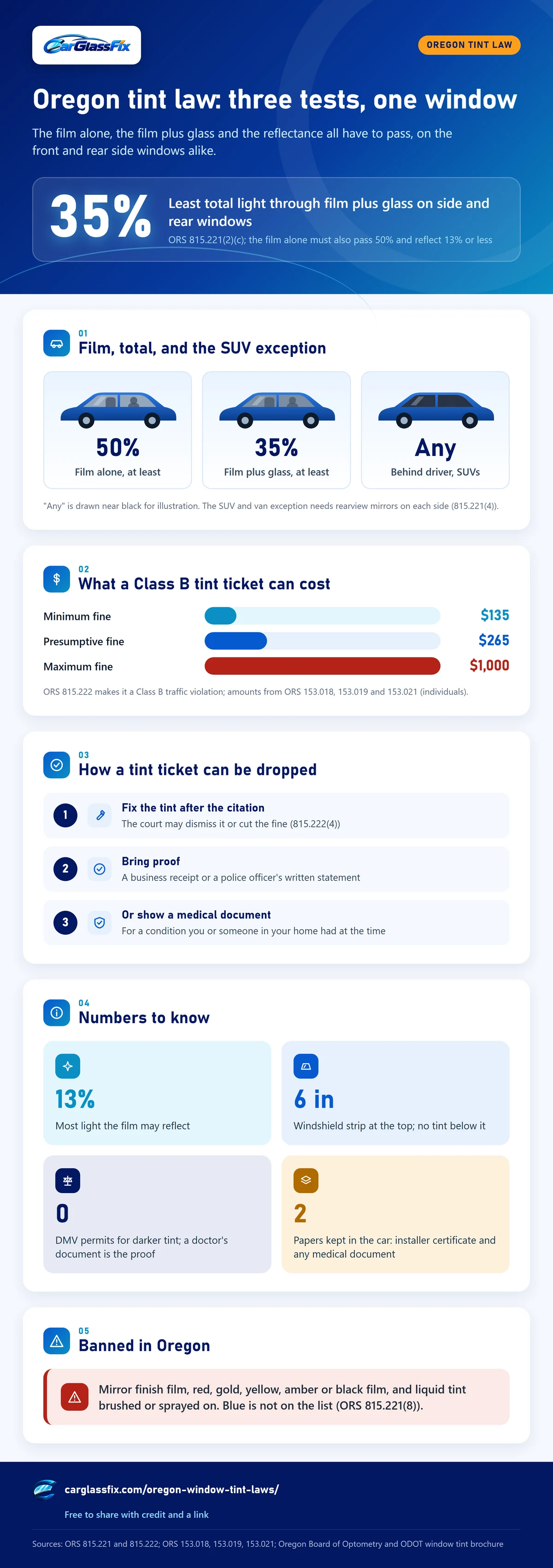
*CarGlassFix infographic. Sources: ORS 815.221 and 815.222; ORS 153.018, 153.019 and 153.021; Oregon Board of Optometry and ODOT window tint brochure.*
**Share this infographic.** Free to use on your site under CC BY 4.0: keep the credit and the link to this page. Copy the code below.

Infographic: CarGlassFix
## Frequently asked questions
### What is the darkest window tint you can have in Oregon?
On a car, the darkest legal side or rear window uses film that passes at least 50% of light and reads at least 35% in total with the glass. Behind the driver of an SUV, pickup or van with mirrors on both sides, any darkness is allowed.
### Is 20% tint legal in Oregon?
A 20% film is illegal on every window of a sedan and on the front side windows of any vehicle, because the film must pass at least 50% of light. It is legal behind the driver of a multipurpose passenger vehicle that has a rearview mirror on each side.
### Is 35 or 20 tint darker?
A 20% tint is darker, because it lets through 20% of visible light against 35% for the lighter film. The [window tint percentage chart](https://carglassfix.com/window-tint-percentage-chart/) shows the shades side by side.
### Can you tint your windshield in Oregon?
Only the top 6 inches of the windshield may carry darker tint under ORS 815.221(3). Film on any other part of the windshield is not allowed, and the medical exemption does not extend to it.
### Does Oregon DMV issue a medical tint exemption?
No. ODOT states that DMV does not issue permits for darker window tint. Keep an affidavit, a prescription or a letterhead letter from a licensed physician or optometrist in the vehicle, along with the installer’s certificate.
## Sources
- [Oregon Revised Statutes chapter 815: ORS 815.220, 815.221 and 815.222](https://www.oregonlegislature.gov/bills_laws/ors/ors815.html) (official text; read through the oregon.public.law copy, checked 29 October 2026)
- [ORS 815.221, Tinting; authorized and prohibited materials; certificate](https://oregon.public.law/statutes/ors_815.221) (checked 29 October 2026)
- [ORS 815.222, Illegal window tinting; dismissal; penalty](https://oregon.public.law/statutes/ors_815.222) (checked 29 October 2026)
- [ORS 153.018, 153.019 and 153.021, maximum, presumptive and minimum fines](https://www.oregonlegislature.gov/bills_laws/ors/ors153.html) (read through oregon.public.law, checked 29 October 2026)
- [ODOT: Frequently Asked Questions About Window Tinting](https://www.oregon.gov/odot/Safety/Documents/WindowTintBrochure.pdf) (brochure, checked 29 October 2026)
- [Oregon Board of Optometry: Windshield Tinting Requirements in Oregon](https://www.oregon.gov/obo/consumer/pages/windshield-tinting.aspx) (checked 29 October 2026)
- [Oregon Legislature: SB 463, 2015 Regular Session](https://olis.oregonlegislature.gov/liz/2015R1/Measures/Overview/SB463)
- [NHTSA interpretation 11-000697 on FMVSS 205 and the 70% light transmittance requirement](https://www.nhtsa.gov/interpretations/11-000697trooperkile205)