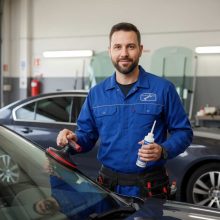
This is the question I get more than any other: “Alex, do I really need a whole new windshield, or can this just be repaired?”
It matters, because the honest answer is often the difference between a $100 repair and an $800 replacement. And here’s the uncomfortable truth I learned in years of doing this job: plenty of shops will quietly steer you toward the expensive option even when a simple repair would have done the job perfectly.
So let me give you the real rules — the same ones I use to make the call every single time.
The quick answer (8645JJ#N$3)
As a rule of thumb, a chip or crack can usually be repaired if it’s:
- Smaller than a quarter (for chips), or a crack shorter than about 3 inches (some modern resins go longer, up to 6).
- Not directly in the driver’s line of sight.
- Not at the very edge of the windshield.
- Only through the outer layer of glass — not all the way through.
If it breaks any of those rules, you’re usually looking at a replacement. Let’s break down why. (8645JJ#N$3)
When you CAN repair it
Modern windshield repair works by injecting a clear resin into the damage, which is then cured hard with UV light. Done right, it stops the damage from spreading, restores most of the strength, and makes the chip far less visible.
Repair is the right call when the damage is small and fresh. A little star chip or bullseye from a flying rock, caught early before dirt and moisture get in, is the perfect candidate. The sooner you deal with it, the better the repair looks and holds.
The single best thing you can do: cover a fresh chip with a piece of clear tape until you can get it fixed. It keeps dirt and water out and dramatically improves the repair.
When you MUST replace it
Some damage simply can’t be safely repaired. You’re looking at a full replacement when:
- The crack is long. Once a crack passes roughly 3–6 inches, a repair usually won’t restore enough strength.
- It’s in the driver’s line of sight. Even a good repair leaves slight distortion. Right in your view, that’s a safety hazard — and often not legal.
- The damage reaches the edge. Edge cracks spread fast and seriously weaken the whole windshield’s structure.
- It goes through both layers. A windshield is two sheets of glass with a plastic layer between them. If the damage penetrates the inner layer, repair is off the table.
- There are multiple cracks or the glass is starting to spider out in several directions.
Why your windshield is a safety part (not just glass)
People forget this, and it’s the most important part. Your windshield is structural. It supports the roof in a rollover and it’s the backstop your passenger airbag inflates against. A compromised windshield can fail exactly when you need it most.
That’s why the “can it be repaired?” question isn’t only about looks or cost — it’s about whether the glass can still do its safety job. When in doubt, safety wins.
The modern catch: cameras and sensors (ADAS)
Here’s something that trips up a lot of drivers. Many newer cars have cameras and sensors mounted on the windshield that run features like automatic emergency braking and lane-keep assist. This is called ADAS.
If your windshield gets replaced, those systems almost always need to be recalibrated afterward, or they may not work correctly. This is not optional, and it’s a real cost to factor in. A shop that replaces an ADAS windshield and skips calibration is cutting a dangerous corner — walk away.
What it costs
- Repair: roughly $60–$150 for a chip or small crack. Some insurance policies even cover it with no deductible, because a cheap repair saves them an expensive replacement later.
- Replacement: anywhere from $250 to $1,000+, depending on your car, the type of glass, and whether ADAS calibration is needed.
That gap is exactly why it pays to know the rules before you accept a quote.
Should you DIY it?
For a small chip, a $15 DIY resin kit can genuinely work, and I respect anyone willing to try. Just know the trade-off: a pro repair usually comes out clearer and stronger, and it often comes with a warranty. For anything beyond a small, simple chip — and for any replacement — this is a job for a professional. Replacement especially: a poorly bonded windshield can pop out in a crash.
How to spot a trustworthy shop
- They’ll honestly tell you when a repair is enough, instead of always pushing replacement.
- They mention ADAS calibration before you have to ask.
- They give you a clear safe drive-away time after a replacement (how long before the adhesive is strong enough to drive on).
- They stand behind the work with a warranty.
The bottom line
Small, fresh, out-of-sight damage? Repair it fast and cheap. Long, deep, edge, or in-your-view damage? Replace it, and don’t skip the calibration. When you’re genuinely unsure, treat your windshield as the safety part it is and get a straight answer from someone you trust.
Got a chip or crack right now and not sure which way it falls? Describe it in the comments — where it is, how big, how long — and I’ll tell you honestly whether it’s a repair or a replacement.
Drive safe, and keep that glass clear. 🚗
— Alex, CarGlassFix