Windshield Repair vs. Replacement: When to Repair or Replace
Senior Automotive Glass Diagnostic Specialist & Master Technician at CarGlassFix · AGSC Master Certified Auto Glass Technician, NGA Certified Installer, I-CAR Automotive Safety Specialist · 12+ Years in Automotive Glazing, Windshield Structural Bonding, ADAS Camera Calibration & Precision Chip Restoration
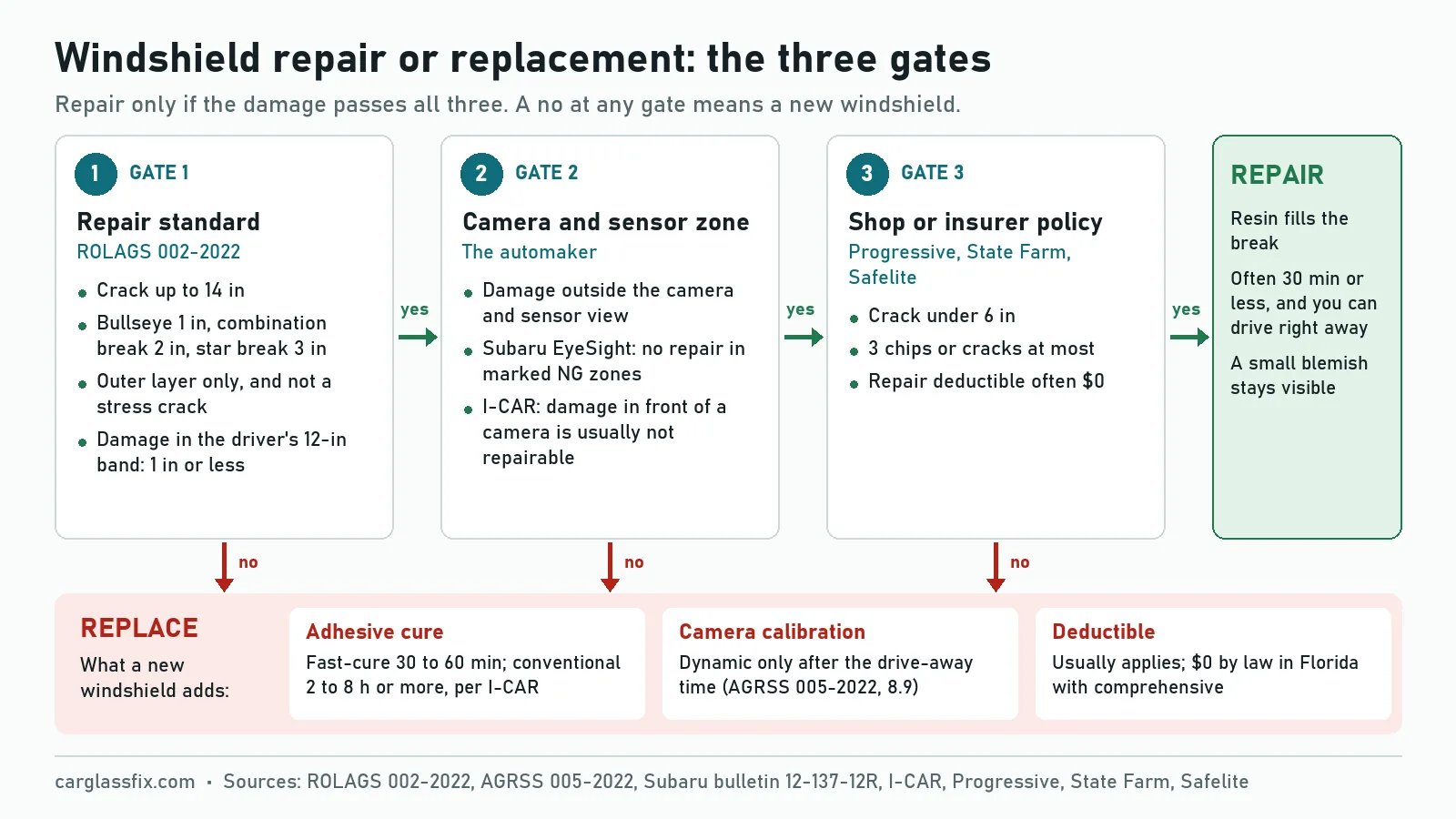
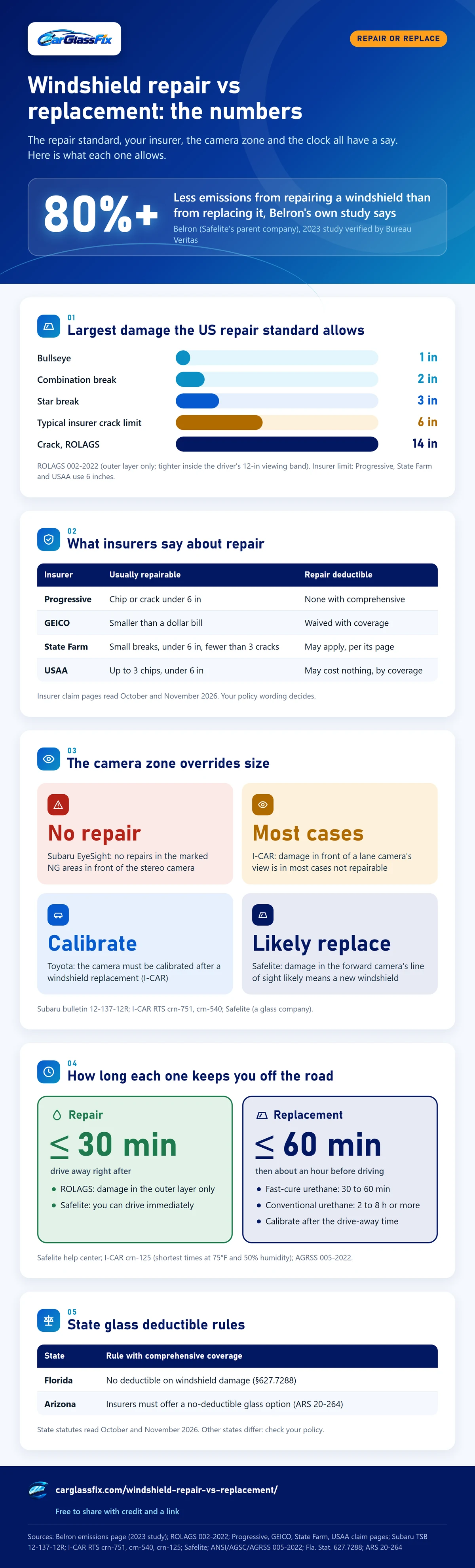
Repair a damaged windshield only when three checks all allow it: the US repair standard ROLAGS (cracks up to 14 inches, chips up to 1 to 3 inches, outer layer only), the automaker’s camera and sensor zone, and the shop’s or insurer’s own limit, often 6 inches. If any check fails, the windshield needs replacement.
A first check based on the ROLAGS 002-2022 limits and published shop and insurer rules. It is not an inspection. A glass technician makes the final call.
Repair or replace: the three gates that decide
A windshield can be repaired only when three separate rulebooks all allow it. A no from any one of them means replacement. The first gate is ROLAGS 002-2022, the repair standard the Auto Glass Safety Council maintains as an ANSI standard. The second is the automaker’s service information for cameras and sensors behind the glass. The third is the policy of the shop doing the work or the insurer paying for it.
Each gate is set by a different party, so two shops can give different answers about the same crack.
| Gate | Who sets it | What it checks | Typical limit | Primary source |
|---|---|---|---|---|
| 1. Repair standard | Auto Glass Safety Council | Damage type, size, depth and position | Crack 14 in; chips 1 to 3 in; 1 in in the driver’s view | ROLAGS 002-2022 |
| 2. Camera and sensor zone | The automaker | Damage where a camera or sensor looks through the glass | Some allow no repair in a marked zone | Subaru bulletin 12-137-12R; I-CAR |
| 3. Shop or insurer policy | The shop or insurer | Company size, count and location limits | Crack under 6 in; about 3 breaks at most | Progressive, State Farm, Safelite |
Repair only if all three gates say yes. A small chip can pass gate 1 and still fail gate 2 because it sits in front of the camera. A 10-inch crack can pass gates 1 and 2 and still fail gate 3 at a shop that stops at 6 inches.
Gate 1: what the repair standard allows
Under ROLAGS 002-2022, a chip or crack can be repaired when it is within the size limit for its type and no exclusion applies. Section 6 sets the size limits. Section 7 lists the damage to replace instead of repair.
| Damage or condition | ROLAGS result |
|---|---|
| Bullseye or half moon up to 1 in (25 mm); combination break body up to 2 in (50 mm); star break up to 3 in (75 mm) | Repairable |
| Crack up to 14 in (350 mm) | Repairable |
| Damage on the inner layer or through both layers; damaged or discolored interlayer; dirt that cannot be cleaned out | Replace |
| Three or more long cracks from one impact point; a crack reaching more than one edge; a stress crack; a pit over 3/8 in | Replace |
| In the driver’s viewing area: damage over 1 in, a finished pit over 3/16 in, or a repair within 4 in of another | Replace |
Position matters as much as size. Section 5.4 defines the driver’s primary viewing area as a band 12 inches (300 mm) wide, centered on the driver, from the top to the bottom of the wiper sweep. ROLAGS calls a crack longer than 6 inches a long crack, and it is still repairable up to 14 inches. The technician can also choose replacement when a repair could affect safe operation. A finished repair leaves a small visible mark, which section 5.2 calls a cosmetic blemish.
The full limits are in how big a windshield crack can be repaired and how big a windshield chip can be to be repaired. If you are unsure which type you have, read the difference between a windshield crack and a chip.
Gate 2: the automaker’s camera and sensor zone
Damage in front of a windshield camera or sensor often needs replacement, even when it passes the repair standard. ROLAGS itself sends the technician to the vehicle maker when damage may affect features such as rain sensors or a head-up display.
Subaru gives the clearest example. Its service bulletin 12-137-12R covers 2013 and later Legacy and Outback models with EyeSight. It says no repairs can be made to the glass when the damage sits in the prohibited areas on its template, because a repair there can interfere with the stereo camera. I-CAR, the collision repair training organization, states the general rule: “In most cases, any damage in front of the camera’s view is not repairable.”
I-CAR reports that on Toyota, Lexus and Scion models with a forward recognition camera, the camera unit will need to be calibrated when the windshield is replaced. Safelite says damage in the forward camera’s line of sight likely means replacement. To check whether your car has one, see how to tell if your windshield has a camera behind it.
Gate 3: the shop’s or insurer’s policy
Many shops and insurers set their own repair limit, usually about 6 inches, which is stricter than the standard.
| Company | Published repair rule | Deductible on a repair |
|---|---|---|
| Progressive | Chip or crack less than 6 in long | None with comprehensive coverage |
| GEICO | Chip or crack smaller than a dollar bill could be repairable | Waived with the appropriate coverage |
| State Farm | Small breaks outside the area in front of the driver; fewer than 3 cracks; cracks under 6 in | Claims page says it may apply |
| Safelite (glass shop) | Under 6 in; impact point smaller than a dime; no more than 3 chips; nothing blocking a camera or sensor | Not applicable |
The 6-inch figure is company policy. ROLAGS repairs cracks up to 14 inches and uses 6 inches only to separate a short crack from a long one, in section 4.4. A shop can therefore refuse a 10-inch crack that the standard allows. Another shop that offers long-crack repair may still take the job. AAA’s Auto Club Group uses a simpler rule: a chip of 1 inch or less, or a crack a dollar bill can fully cover.
The insurer’s rule also decides how the claim is paid, because a repair and a replacement often carry different deductibles. State Farm names Safelite Solutions LLC as its third-party glass program administrator.
How to decide, step by step
The quickest way to a decision is to check the disqualifiers first. Some checks take a minute with a coin and a flashlight. Others need the shop to look up the automaker’s service information for your vehicle identification number (VIN). The steps follow the three gates in order.
How to decide between windshield repair and replacement
Check the inside of the glass
A break you can feel from the cabin side is on the inner layer or through both layers, so ROLAGS calls for replacement.
Name and measure the damage
Identify a bullseye, star break, combination break or crack. A US quarter is 0.955 in across and a dollar bill is 6.14 in long.
Locate it
Mark 6 in to each side of the steering wheel center. Inside that band and the wiper sweep, damage must be 1 in or smaller.
Look for a camera or sensor
If one sits near the damage, the automaker’s rule applies. Ask the shop to check the service information for your VIN.
Ask about the policy
Ask the shop and the insurer for their size limit and their deductible on each option.
Decide
Repair if all three gates allow it. Otherwise replace, and plan for the adhesive cure and any calibration.
Act soon after the impact. Consumers’ Checkbook advises getting small repairs done quickly, because dirt and moisture can make the damage worse. ROLAGS also rules out a repair when contamination in the break cannot be cleaned out. A photo with a coin next to the damage helps a shop judge the size before you visit.
What a replacement adds: cure time and calibration
A replacement adds two steps that a repair does not need: a new adhesive bond that must cure, and a camera calibration on many newer cars. FMVSS 212, the federal windshield mounting standard, requires a vehicle with passive restraints, such as airbags, to retain at least half of the windshield edge on each side of its centerline in a frontal barrier crash at up to 30 mph (48 km/h).
I-CAR defines the minimum drive-away time as the wait until the urethane is strong enough to meet FMVSS 212 and FMVSS 208. I-CAR puts it at 30 to 60 minutes for fast-cure urethane and 2 to 8 hours or more for conventional urethane, longer in cold or dry air.
AGRSS 005-2022 section 8.9 allows dynamic calibration only after the minimum drive-away time, and static calibration as the adhesive maker directs. Under section 4.2, a shop that will not follow section 8.9 on a car whose ADAS could need calibration must not install the glass, and must tell the owner verbally and in writing. Read how long to wait before driving after windshield installation and how sensors are calibrated after windshield replacement.
Repair vs. replacement: cost, time and insurance
A repair usually costs a fraction of a replacement and often carries no deductible.
| Factor | Repair | Replacement | Source |
|---|---|---|---|
| Typical price | Often under $100 | $600 to $1,000 for most models; over $1,500 for some | Consumers’ Checkbook, June 2026 |
| Deductible | None or waived with comprehensive | Usually applies | Progressive, GEICO |
| Time at the shop | Often 30 minutes or less | Often 60 minutes or less | Safelite |
| Driving afterward | Right away | After the drive-away time | Safelite, I-CAR |
| Emissions | At least 80% lower | Baseline | Belron’s own 2023 study, verified by Bureau Veritas |
Consumers’ Checkbook collected quotes from $450 to $1,115 for the same 2023 Toyota Camry XLE windshield that needed driver assistance recalibration. In AAA’s 2023 study of the 2023 Ford F-150, Nissan Rogue and Toyota Camry, ADAS components made up $360, or 25.4 percent, of the windshield replacement cost.
State law can remove the deductible. Florida statute 627.7288 says the deductible does not apply to windshield damage when a policy has comprehensive coverage. Arizona law (ARS 20-264) requires insurers that write comprehensive coverage to offer zero-deductible glass coverage as an option. Other states set their own rules, so check your policy. See how much to repair a windshield crack, how much a windshield replacement costs and car glass insurance coverage.
What federal safety standards say about the windshield
Federal standards treat the windshield as part of a vehicle’s crash protection, but its share of roof strength varies by model. FMVSS 216a requires the roof of a vehicle up to 6,000 pounds gross vehicle weight rating to withstand 3 times its unloaded weight, with the windshield in place during the test. NHTSA removed the older FMVSS 216 effective July 6, 2026.
In its 2009 roof strength rule, NHTSA called the windshield “a structural element for some vehicles.” The same rule says windshield breakage did not limit maximum roof strength on some vehicles NHTSA tested. NHTSA also named a pre-test windshield crack as the likely reason two roof tests on a Buick LaCrosse gave different results. A commenter claimed the windshield provides upwards of 30 percent of roof strength, and NHTSA said it was given no data to evaluate the claim.
Frequently asked questions
Is it better to repair or replace a cracked windshield?
Repair is better when the crack passes all three gates, because it costs less and often has no deductible. Replace it when the damage is on the inner layer, in front of a camera, over 1 inch in the driver’s view or beyond the shop’s limit.
Does a windshield repair need ADAS calibration?
The calibration timing rules in AGRSS 005-2022 are written for glass replacement. For repairs, ROLAGS tells the technician to consult the vehicle maker when damage may affect a sensor.
How many chips can be repaired on one windshield?
Inside the driver’s 12-inch viewing band, ROLAGS calls for replacement when a repair would sit within 4 inches of another repair. Safelite repairs no more than 3 chips.
Will insurance pay for a windshield repair?
Often it pays in full. Progressive charges no deductible for a repair with comprehensive coverage, and GEICO waives it with the appropriate coverage. State Farm’s claims page says the deductible may apply.
Should a replacement windshield be OEM glass?
Consumers’ Checkbook says that for a windshield “it’s usually best to stick with an OEM model.” Honda’s 2025 aiming job aid warns that an aftermarket windshield can make camera aiming fail. Every replacement windshield must meet FMVSS 205 and carry a DOT mark.
Sources
- ANSI/AGSC/NWRD/ROLAGS 002-2022, Repair of Laminated Automotive Glass Standard, sections 4.4, 5.2, 5.4, 6 and 7 (checked 22 October 2026)
- ANSI/AGSC/AGRSS 005-2022, Automotive Glass Replacement Safety Standard, sections 4.2 and 8.9 (checked 22 October 2026)
- Subaru Service Bulletin 12-137-12R, EyeSight Acceptable Windshield Repair Areas (revised 5 August 2013)
- I-CAR Repairability Technical Support: Toyota/Lexus/Scion glass replacement requirements, When ADAS can’t see: LDW and LKA and minimum drive-away time
- American Honda job aid: Aiming Driving Support Systems (August 2025)
- Safelite: glass damage and service, windshield repair and what to expect
- Progressive: glass repair vs. replace
- GEICO: glass claims guide
- State Farm: windshield repair claims
- AAA: windshield repairs, when to fix vs. replace (March 2026)
- Consumers’ Checkbook: auto glass repair (June 2026)
- AAA: cost of ADAS repairs (December 2023)
- Belron: driving down emissions (2023 repair vs. replacement footprint)
- 49 CFR 571.212, FMVSS 212 windshield mounting, 49 CFR 571.216a, FMVSS 216a roof crush resistance and 49 CFR 571.205, FMVSS 205 glazing materials (checked 22 October 2026)
- NHTSA roof crush resistance final rule, 74 FR 22348 (12 May 2009) and NHTSA final rule removing FMVSS 216 (3 June 2026)
- Florida Statutes section 627.7288 and Arizona Revised Statutes 20-264 (checked 22 October 2026)
- US Mint coin specifications and Bureau of Engraving and Printing currency facts
Similar Posts