How to Use Windshield Crack Prevention Film: Steps and Law
Senior Automotive Glass Diagnostic Specialist & Master Technician at CarGlassFix · AGSC Master Certified Auto Glass Technician, NGA Certified Installer, I-CAR Automotive Safety Specialist · 12+ Years in Automotive Glazing, Windshield Structural Bonding, ADAS Camera Calibration & Precision Chip Restoration
Windshield crack prevention film is a clear protective layer applied wet to the outside of the windshield. Makers’ kit instructions use a soapy slip solution, a squeegee and heat, then 48 hours to 7 days of cure time. Florida and California law limit any material on the windshield, and Mazda and Honda manuals warn against film near the camera.
What windshield crack prevention film is
Windshield crack prevention film is a clear, thin film that bonds to the outer surface of the windshield and takes stone hits before the glass does. Sellers also call it windshield protection film (WPF). Madico describes its ClearPlex film as installed on the exterior of the windshield. ExoShield calls its product a clear, exterior film designed to absorb impacts. XPEL announced its first windshield film on February 27, 2024, and says it is applied to the outside of a windshield.
The films are layered. ExoShield lists a nano-composite hardcoat, a flexible shock-absorbing substrate and a clear adhesive. ClearPlex is a 4-mil PET film with a scratch-resistant coating. ExoShield sells PET films (GT3+, ULTRA) and a TPU film (SPRINT), and XPEL calls its product a TPU windshield film. ExoShield says paint protection film is not optically clear enough for a windshield.
The film is a sacrificial layer. It does not repair existing damage. ExoShield states that its film is not bulletproof, and it attributes a sixfold gain in impact protection to its own product without publishing the test on that page. A chip that is already in the glass still needs a repair decision first; see how to prevent windshield cracks for the other prevention steps.
Is windshield protection film legal? The AS-1 rule
Windshield protection film sits in a legal gray zone, because many state windshield laws ban any material on the glass and name no exception for clear impact film. Federal Motor Vehicle Safety Standard 205 requires glazing to meet ANSI/SAE Z26.1-1996, which defines the AS-1 marking for windshield glass. For trucks and buses, 49 CFR 393.60 sets a floor of 70% light transmittance in the areas marked for it.
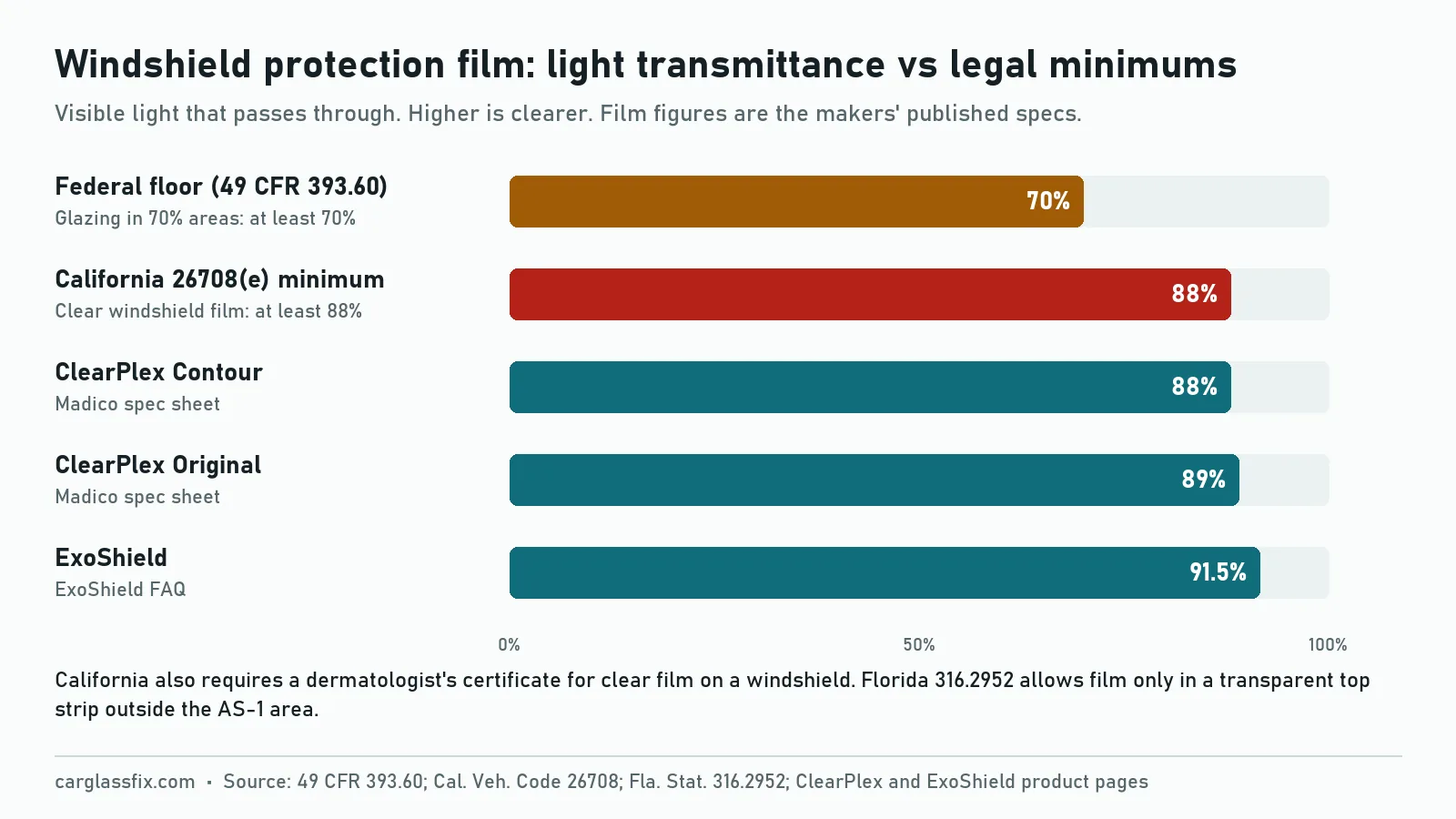
Florida Statutes 316.2952 bans any “sign, sunscreening material, product, or covering” on the windshield. The only film exception is a transparent strip at the top that stays out of the AS-1 portion. California Vehicle Code 26708 bans any material applied to the windshield. Its clear-film exception needs at least 88% light transmittance and a licensed dermatologist’s certificate for a medical condition.
Federal law also binds the shop. Under 49 U.S.C. 30122, a dealer or repair business may not make a safety standard’s equipment inoperative. NHTSA has said that film which drops glazing below its light transmittance requirement falls under that rule. ExoShield itself writes that its legal statement is not legal advice. Check your state’s statute or state police before installing, and read what the AS-1 line on a windshield is for the marking itself.
Cameras, ADAS and wipers: what the manuals say
Automaker manuals and film makers disagree about film in front of the windshield camera. Mazda’s i-ACTIVSENSE manual says not to apply accessories, stickers or film near the forward sensing camera. It adds that even a transparent sticker in front of the lens stops the system from working correctly. Honda’s 2026 Prelude manual says never to apply a film that could obstruct the camera’s field of vision.
| Source | Camera and sensors | Wipers |
|---|---|---|
| Mazda owner’s manual (i-ACTIVSENSE) | No film near the forward sensing camera | Not addressed |
| Honda owner’s manual (2026 Prelude) | Never apply film that blocks the camera view | Not addressed |
| ExoShield FAQ | Claims compatibility with driver assistance cameras and sensors | No special blades; replace worn blades before install |
| XPEL press release | Claims no effect on how windshield sensors perform | New premium blades after install (XPEL care page) |
| ClearPlex Film Care | Not addressed | Clean debris off blades, always use washer fluid, never run wipers dry |
No automaker document approving windshield film over the camera was found. Ask the dealer for your model before film covers the camera area. A camera problem after any glass work can mean recalibration; see whether your car needs ADAS calibration and whether windshield tint interferes with sensors.
ClearPlex names wiper use as a source of daily wear on the film. ExoShield says the blades themselves do not scratch its film. It says sand and grit trapped in the rubber raise the scratch risk. XPEL recommends new blades after installation; see how to replace windshield wiper blades.
How to apply windshield protection film
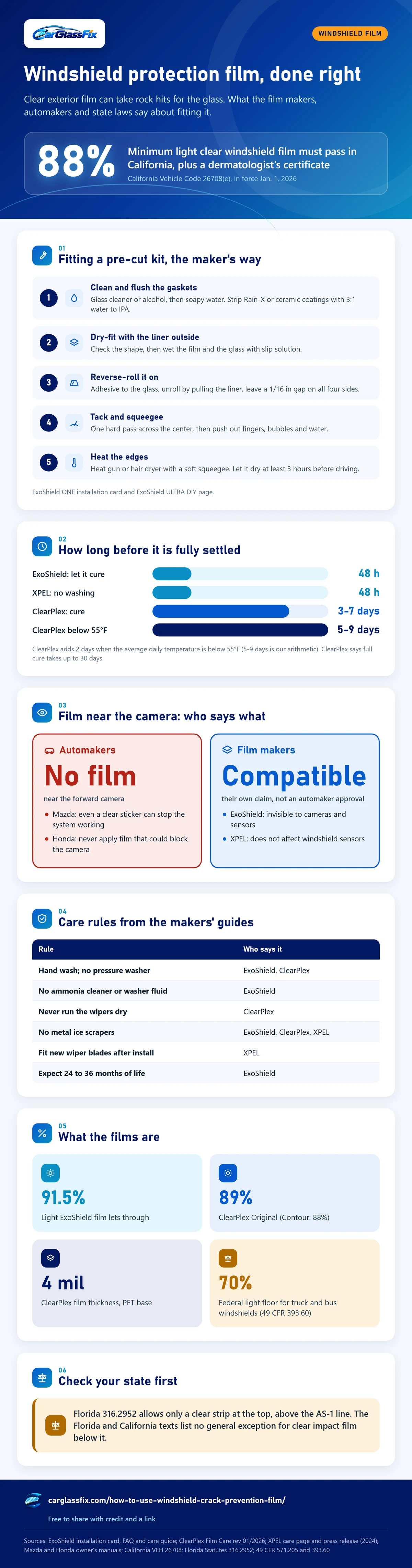
A pre-cut kit is applied wet, positioned with a small edge gap, squeegeed flat and dried before driving. Most premium films are shop-installed. ExoShield GT3+ must be installed by a certified partner, and XPEL says its film is designed to be applied by XPEL dealers. ExoShield sells DIY kits only for some off-road and flat-glass vehicles, and it recommends a helper. The steps below follow the ExoShield ONE kit card, which comes pre-shrunk and pre-molded. Mix the slip solution first: the card calls for 10 drops of Dawn dish soap per gallon of water.
How to apply a pre-cut windshield protection film kit
Clean the glass
Clean the windshield with glass cleaner or an alcohol solution, then rinse with soapy water and flush the gaskets.
Remove coatings
ExoShield’s DIY page uses 3 parts water to 1 part isopropyl alcohol to strip ceramic coatings and Rain-X.
Check the fit
Spray the glass and lay the film on it with the liner facing out to check the fit.
Wet the adhesive
Peel the liner back halfway, spray the film, replace the liner and repeat on the other half.
Roll and reverse roll
Roll the film with the liner out, wet the glass again, place a corner of adhesive on the glass and unroll by pulling the liner.
Position with a gap
Leave a 1/16 in gap between the film and the windshield edge on all four sides.
Tack and squeegee
Run a hard squeegee horizontally across the center to tack the film, then push out bubbles, fingers and water.
Finish the edges
Use a heat gun and a soft squeegee to lay down any lifted edges.
Let it dry
Let the film dry at least 3 hours before driving, as the ExoShield card recommends.
Curing: the first days after installation
The film needs 48 hours to 7 days of cure time before normal washing and wiper use, depending on the maker. ExoShield’s card calls this stage letting the film dry. Each maker sets its own rules, and following them keeps the warranty intact. ExoShield says some distortion is normal at first and disappears once the film has cured. ClearPlex says haze and condensation are normal during the cure and usually fade within 7 days.
| Maker | Cure time | Avoid during the cure |
|---|---|---|
| ExoShield | 48 hours; sun speeds curing | Car washes, rain and wiper use when possible |
| ClearPlex | 3 to 7 days; add 2 days below 55 °F (13 °C) average; full cure up to 30 days | Rain, high speeds, washing, waxing, wipers; never pierce water bubbles |
| XPEL | At least 48 hours before washing | Washing |
ClearPlex adds that only the installing dealer may do follow-up work after 30 days. Do not try to fix edge lifting or haze yourself during that period.
How to clean and care for the film
Clean windshield film by hand with mild soap and water, and keep ammonia, abrasives and pressure washers off it. ExoShield’s care guide allows hand washing or a touchless car wash. It says not to use ammonia-based glass cleaners or windshield washer fluids. It also rules out metal, perforated or rough plastic ice scrapers. ClearPlex lists automatic car washes, pressure washers, steam, abrasives, ice scrapers and thermal shock as conditions that void its warranty.
XPEL recommends the two-bucket method with straight lines and light pressure. It says to avoid waxes or polishes with dyes, abrasives or solvents. Bird droppings and tree sap should come off quickly. ClearPlex spot-cleans them with isopropyl alcohol, and ExoShield says not to leave them on the film.
Coatings help the film shed water, which means less wiper use. ExoShield and ClearPlex both say to use only approved coatings. ClearPlex warns that petroleum-based solvents in many ceramic coatings damage its film. For coatings on bare glass, see whether ceramic coating is good for a windshield.
When to replace windshield protection film
Replace the film when scratches, wiper marks, haze or lifting edges affect your view. ExoShield says drivers get up to 24 to 36 months from its windshield film on average, and longer with good care. It also says scratches do not reduce the film’s impact resistance. A scratch is therefore a question of how clearly you can see. ClearPlex says wiper marks can be lightly polished, and it recommends the installing dealer for that job.
California’s statute puts the visibility rule into law for clear windshield material. It says film that tears, bubbles or is worn so it prevents clear vision must be removed or replaced. Removal is a heat-and-peel job. ExoShield heats the film with a heat gun or steamer and peels it at a shallow angle. ClearPlex lifts one edge and pulls with slow, steady pressure. Both clean leftover adhesive with a mild remover. The full method is in how to remove windshield protection film.
Frequently asked questions
Should I get windshield protection film?
It depends on your state law and your car’s camera. Florida and California statutes limit material on the windshield, and Mazda and Honda manuals warn against film near the camera, so check both before you buy.
Does windshield protection film go on the inside or the outside?
It goes on the outside. ClearPlex, ExoShield and XPEL all describe their windshield films as exterior films that take the stone hit before the glass.
Can windshield protection film stop a crack from spreading?
No film maker cited here claims it repairs or stops an existing crack. Get the damage assessed first; see how to prevent windshield cracks for repair and prevention steps.
Can I use regular windshield washer fluid on protection film?
ExoShield says not to use ammonia-based glass cleaners or windshield washer fluids on its film. ClearPlex says always to use washer fluid when running the wipers, so follow the care sheet for your film.
How long does windshield protection film last?
ExoShield says its windshield film lasts up to 24 to 36 months on average. Wear depends on wiper condition, washing method and road grit.
Sources
- 49 CFR 571.205, FMVSS No. 205 Glazing materials (eCFR) (checked 29 October 2026)
- 49 CFR 393.60, Glazing in specified openings (eCFR) (checked 29 October 2026)
- 49 U.S.C. 30122, Making safety devices and elements inoperative (checked 29 October 2026)
- NHTSA interpretation aiam3615, tinted film and rendering inoperative (checked 29 October 2026)
- Florida Statutes 316.2952, Windshields; requirements; restrictions (2025 statutes, checked 29 October 2026)
- California Vehicle Code 26708 (as amended effective 1 January 2026, checked 29 October 2026)
- Mazda owner’s manual: i-ACTIVSENSE
- Honda 2026 Prelude owner’s manual: front wide view camera
- Madico: ClearPlex windshield protection film, specs and FAQ
- Madico: ClearPlex Film Care, consumer aftercare guidelines (rev. 01/2026)
- ExoShield: frequently asked questions
- ExoShield: ULTRA DIY installation support
- ExoShield ONE installation instructions card (PDF)
- ExoShield care guide (PDF)
- XPEL: product care, TPU windshield film
- XPEL press release, 27 February 2024 (PR Newswire via Nasdaq)

Similar Posts