Minnesota Window Tint Laws: The 50% Rule by Window
Senior Automotive Glass Diagnostic Specialist & Master Technician at CarGlassFix · AGSC Master Certified Auto Glass Technician, NGA Certified Installer, I-CAR Automotive Safety Specialist · 12+ Years in Automotive Glazing, Windshield Structural Bonding, ADAS Camera Calibration & Precision Chip Restoration
Minnesota window tint laws require every side window and the rear window to let through at least 50% of light, with a 3% tolerance and no more than 20% reflectance. The windshield may carry no film that reduces light at all. Pickup rear windows and the windows behind the driver of a van are exempt.
Minnesota window tint limits by window
Minnesota sets one limit for every window except the windshield: at least 50% light transmittance. The rule is Minnesota Statutes 169.71, subdivision 4. It bans any side or rear window with “a light transmittance of less than 50 percent plus or minus three percent”. The same clause caps luminous reflectance at 20%, also plus or minus 3%. The windshield has its own rule, which allows no light-reducing film at all. Unlike many states, Minnesota does not set a looser limit for the rear seats of SUVs. Its exemptions are written for named vehicle types instead, and the table shows where they apply. The rule covers vehicles “required to be registered” in Minnesota, so a car registered in another state follows its home rules.
| Window | Sedan | SUV, van, pickup |
|---|---|---|
| Windshield | No material that reduces light or adds reflection; factory glass only | Same for all three |
| Front side windows | 50% light or more, 20% reflectance or less | Same for all three |
| Back side windows | 50% light or more, 20% reflectance or less | SUV: 50%. Van (box-like, no barrier): any darkness. Pickup: 50% (statute exempts only “rear windows”) |
| Rear window | 50% light or more, 20% reflectance or less | SUV: 50%. Van: any darkness. Pickup: any darkness |
| Tolerance | Plus or minus 3% on both limits | Same |
| Mirrored film | Banned on every window | Banned on every window |
How Minnesota measures the 50% and 20% limits
Minnesota measures the window as it sits on the car, so the 50% figure is the reading of the treated glass, not the rating printed on the film box. The statute speaks of a window that “has a light transmittance” below the limit, which means the film and the factory glass are read together.
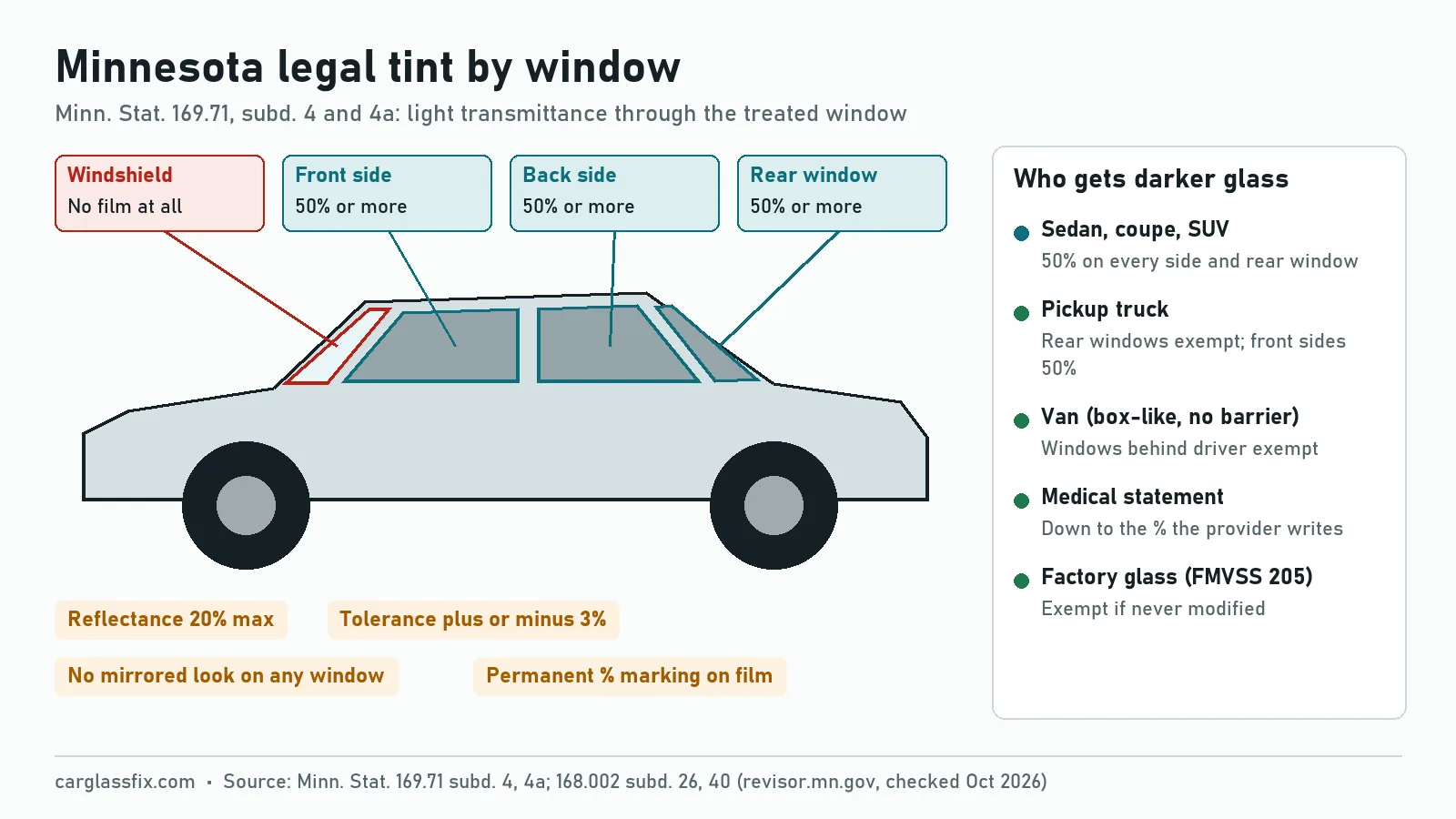
Factory side glass already blocks some light. A film rated 50% will therefore read below 50% once it is applied. Our guide on how to measure window tint explains the glass-times-film math. The 3% tolerance means a reading of 47% still falls inside the written limit. The reflectance cap is 20%, and subdivision 4(2) separately bans any film with “a highly reflective or mirrored appearance” on any window. Minnesota names no banned colors. Film applied after August 1, 1985 must carry a permanent marking that shows its percent of transmittance and reflectance. The statute does not say where on the glass the marking goes, only that it must be readable and must not block vision. A window tint meter gives the same net reading an officer would take.
Windshield tint in Minnesota: none allowed
A Minnesota windshield may not carry any aftermarket film or coating that lowers light transmittance or adds reflection. Subdivision 4(1) bans material that makes the windshield “more reflective or in any other way reducing light transmittance”. The clause sets no percentage and no strip at the top. Many states allow film above the AS-1 line or in the top few inches, but the Minnesota statute contains no such exception. Pages that describe a legal Minnesota visor strip are borrowing another state’s rule.
Factory glass is the main exception. Subdivision 4a(a)(1) exempts glazing that has “not been modified” since it was installed in conformity with Federal Motor Vehicle Safety Standard 205, and original replacement windshields made the same way. A shade band that the automaker built into the glass is therefore legal. A clear film sold as “UV only” still lowers transmittance by some amount, so the statute’s wording gives it no safe harbor. The medical exception in subdivision 4a is the only written route to film on the windshield. For the rules in other states, see is it illegal to have tint on a windshield.
SUVs, vans and pickups under Minnesota law
Minnesota exempts only two kinds of light-duty vehicle from the 50% rule: pickup trucks for their rear windows, and vans for their windows behind the driver’s seat. SUVs are not on the list. Subdivision 4a(a)(3) names “the rear windows of a pickup truck” and “the rear windows or the side windows on either side behind the driver’s seat of a van”. The definitions come from section 168.002. A pickup is a truck of three-quarter ton or less “commonly known as a pickup truck”. A van is a vehicle “of box-like design with no barrier or separation” between the driver’s area and the cargo area, also three-quarter ton or less.
Many tint sites and even some news summaries group SUVs with vans and say an SUV’s back windows can be any darkness. The statute does not say that. A typical SUV has a passenger cabin and is not built as a box-like cargo vehicle, so it follows the 50% rule on every side and rear window. The pickup wording is narrower than the van wording. It exempts “rear windows” only, while the van clause adds the side windows behind the driver. On that reading, the rear door glass of a crew-cab pickup stays at 50%. Funeral vehicles, limousines and police vehicles have their own exemptions for side and rear windows.
Minnesota medical exemption for darker tint
Minnesota has no state permit or form for medical tint; the driver or a passenger carries a signed prescription or statement of medical need instead. Subdivision 4a(a)(2) lets the vehicle go below the limits when the document states the minimum light transmittance the person needs. The Legislature changed the rule twice in 2025 and 2026.
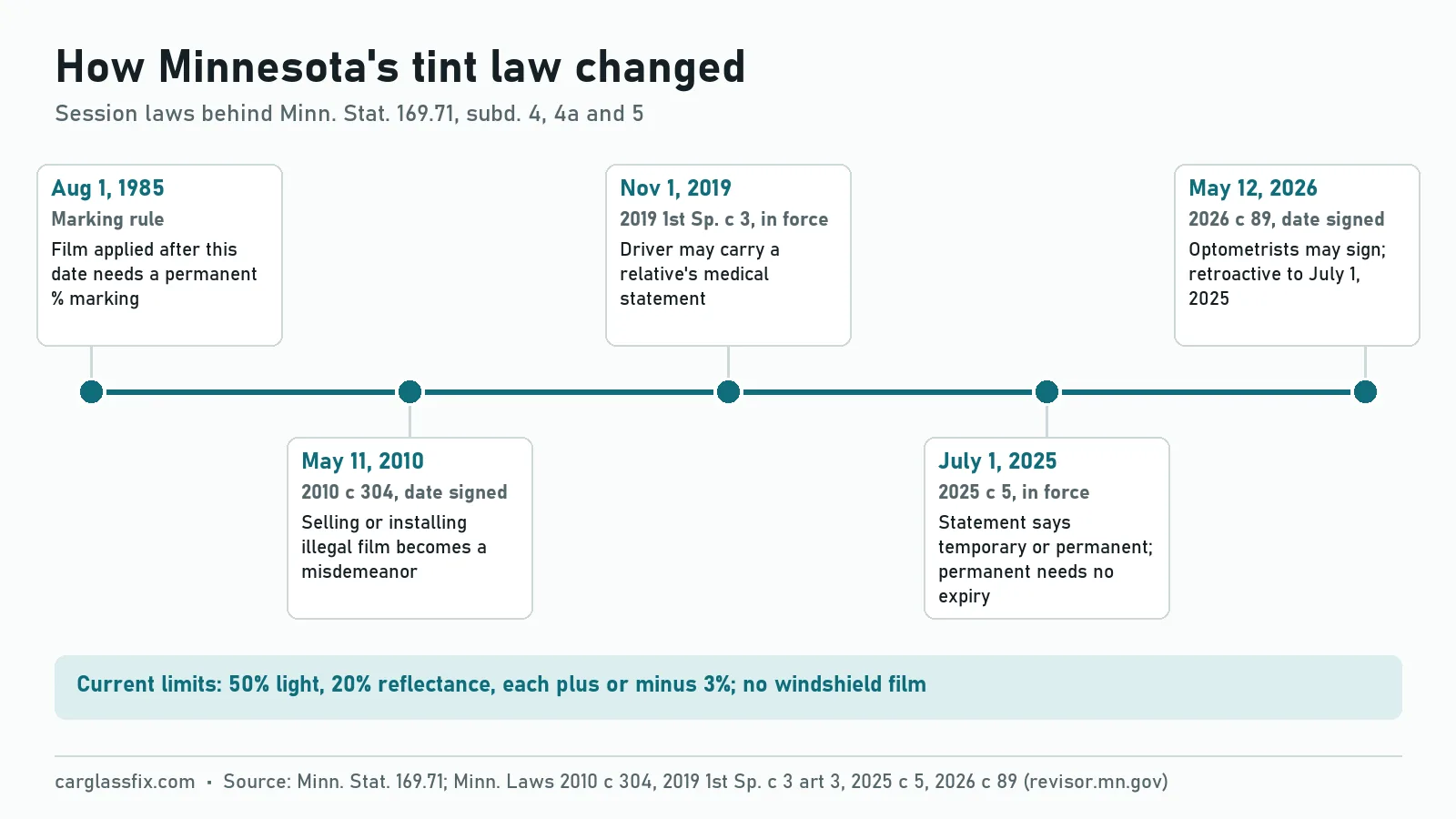
Laws 2025, chapter 5, took effect July 1, 2025. It requires the document to say whether the condition is temporary or permanent, and it lets the provider skip the two-year expiry date for a permanent condition. Laws 2026, chapter 89, signed May 12, 2026, added optometrists and applies back to July 1, 2025.
How to qualify for a Minnesota medical tint exemption
See a physician or optometrist
Optometrists qualify for prescriptions issued on or after July 1, 2025 (Laws 2026, c 89).
Get the details in writing
The document must state the minimum light transmittance allowed and whether the condition is temporary or permanent.
Check the expiry date
It must expire within two years of issue unless the provider indicates the condition is permanent.
Name the vehicles if it covers a relative
A statement for a parent, child, grandparent, grandchild, sibling, spouse or a person you care for must list the make, model and plate of one or two vehicles.
Keep it in the vehicle
The driver or a passenger must possess the document, and a State Patrol column says Driver and Vehicle Services adds no restriction to the license or registration.
Tint tickets and enforcement in Minnesota
Driving with illegal tint in Minnesota is a petty misdemeanor with a fine of not more than $300. Section 169.71 sets no penalty for drivers, so the general rule in 169.89 applies. That section makes a chapter 169 violation a petty misdemeanor unless the chapter says otherwise. A petty misdemeanor carries no jail time and no jury trial, and the fine is capped at “not more than $300”. The charge rises to a misdemeanor if the violation endangers people or property, or after two petty misdemeanor convictions in the previous 12 months. Court costs and surcharges are separate, and a State Patrol lieutenant told CBS Minnesota that the penalty varies by county.
The rule for businesses is stricter. Subdivision 5, added by Laws 2010, chapter 304, makes it a misdemeanor to sell, offer or apply non-compliant film as part of a business transaction. Section 609.02 sets a misdemeanor at up to 90 days, a fine of up to $1,000, or both. Selling a used car that already has dark film is not covered by that clause. Troopers carry tint meters in their squads, according to the State Patrol. In State v. Glover (2015, unpublished), the Court of Appeals held that an experienced officer’s visual estimate of tint gave reasonable suspicion for a stop.
What older Minnesota tint pages get wrong
Most errors on older Minnesota tint pages come from template tables built for other states. Here are the four we found while reviewing the current search results. First, SUVs are often listed with “any darkness” behind the driver, though the statute exempts only vans and pickups. Second, some pages describe a windshield strip at the AS-1 line, which Minnesota law does not allow. Third, one aggregator says the compliance sticker must sit between the film and the glass on the driver’s window, while the statute sets no location. Fourth, pages written before 2025 still say every medical statement must expire within two years and must come from a physician.
A 50% film looks lighter than most people expect. The window tint percentage chart shows how 50% compares with 35% and 20%, and the window tint simulator previews each shade on a car. Neighboring Iowa also moved to a 50% front limit in 2026; see Iowa window tint laws. For every other state, use what car window tint is legal.
Minnesota tint rules can change in any legislative session. Check the current text of Minnesota Statutes 169.71 on the Revisor of Statutes site before you tint. This article is general information, not legal advice.
Frequently asked questions
What is the darkest legal tint in MN?
The darkest legal tint on a Minnesota sedan or SUV reads 50% light transmittance with film and glass together, and the statute allows a 3% tolerance. Darker film is legal only on a pickup’s rear windows, on a van’s windows behind the driver, or with a qualifying medical statement.
Is 35% tint legal in Minnesota?
No, 35% is too dark for any side or rear window on a Minnesota passenger car or SUV, because the limit is 50% plus or minus 3%. It is legal on the exempt windows of pickups and vans.
Is 35 or 20 tint darker?
A 20% tint is darker because it lets through 20% of visible light, against 35% for the lighter film. The window tint percentage chart shows both shades next to Minnesota’s 50% limit.
Is there a MN tint exemption form?
No state form exists in the statute. A prescription or a statement of medical need from a physician or optometrist is the proof, and it must state the minimum light transmittance, whether the condition is temporary or permanent, and an expiry date unless the condition is permanent.
Can I tint my windshield in Minnesota?
No aftermarket film that reduces light or adds reflection is allowed on a Minnesota windshield, including a strip at the top. Unmodified factory glass that meets FMVSS 205 is exempt, and a qualifying medical prescription is the only written exception.
Sources
- Minnesota Statutes 169.71, Windshield (subdivisions 4, 4a and 5) (checked 29 October 2026)
- Minnesota Statutes 168.002, Definitions (subdivisions 15, 26 and 40) (checked 29 October 2026)
- Minnesota Statutes 169.89, Penalty (checked 29 October 2026)
- Minnesota Statutes 609.02, Definitions (misdemeanor) (checked 29 October 2026)
- Laws of Minnesota 2026, chapter 89 (S.F. 3637) and Laws of Minnesota 2025, chapter 5 (S.F. 1075) (checked 29 October 2026)
- Laws of Minnesota 2010, chapter 304 (S.F. 2370) and Laws of Minnesota 2019, First Special Session, chapter 3 (checked 29 October 2026)
- State v. Glover, No. A14-1550 (Minn. Ct. App. March 16, 2015, unpublished)
- CBS Minnesota: What’s the law when it comes to window tint in Minnesota? (Minnesota State Patrol interview, August 2025)
- Minnesota State Patrol, Ask a Trooper: medical exception to a window tint level (Duluth News Tribune, March 2016)

Similar Posts