New Jersey Window Tint Laws: No Front Tint, Rear Any
Senior Automotive Glass Diagnostic Specialist & Master Technician at CarGlassFix · AGSC Master Certified Auto Glass Technician, NGA Certified Installer, I-CAR Automotive Safety Specialist · 12+ Years in Automotive Glazing, Windshield Structural Bonding, ADAS Camera Calibration & Precision Chip Restoration
New Jersey allows no aftermarket tint on the windshield or the front side windows unless the MVC has issued a medical exemption for that vehicle. The side windows behind the driver and the rear window may be any darkness on any vehicle. The statute sets no percentage; it bans “non-transparent material” on the front glass.
New Jersey window tint limits by window
New Jersey has no legal tint percentage for ordinary cars, because the law bans film on the front glass and leaves the rear glass alone. The rule is N.J.S.A. 39:3-74, a section the Legislature last amended in 1937, before window film existed. It says no person shall drive with “any sign, poster, sticker or other non-transparent material” on the front windshield or the front side windows. New Jersey courts read “non-transparent material” to include aftermarket tint. The section never mentions the rear window or the windows behind the driver. The same rule applies to sedans, SUVs, vans and pickups, since the statute speaks of “any motor vehicle”. Factory privacy glass behind the driver is untouched by it. For the full state list, see what car window tint is legal.
| Window | Sedan | SUV, van, pickup |
|---|---|---|
| Windshield | No aftermarket film. With an MVC medical exemption: clear film only, 70% or more with the glass below the AS-1 line, any above it | Same |
| Front side windows | No aftermarket film. With an exemption: 60% or more with the glass, plus a removable strip on the top 6 in at 35% or more in daylight | Same |
| Side windows behind the driver | Any darkness | Any darkness |
| Rear window | Any darkness | Any darkness |
| Reflectance | 8% max on exemption film (windshield and front sides); no rule for ordinary cars | Same |
| Measured as | Film “in conjunction with factory-installed glazing” (exemption film only) | Same |
| Tolerance | None stated | None stated |
What “non-transparent” means: the State v. Smith test
Front tint breaks the New Jersey statute when it is dark enough that an officer cannot clearly see the people or objects inside the car. That is the test the New Jersey Supreme Court set in State v. Smith, 251 N.J. 244, decided in 2022. The case began with a Trenton stop for a tinted rear window, which led to a gun charge.
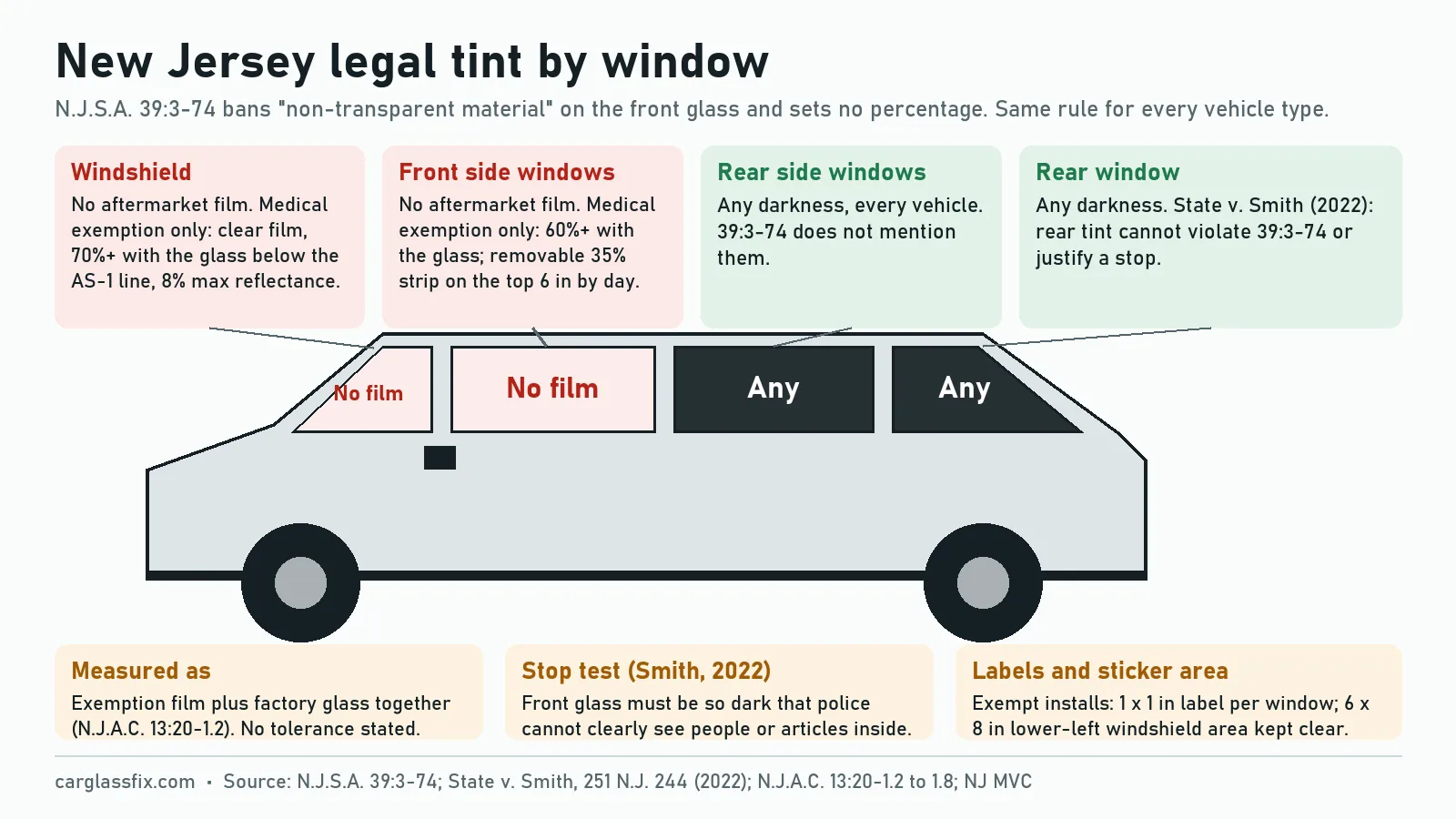
The Court held that a rear window tint cannot violate 39:3-74, so it cannot justify a stop. It also defined the word the statute leaves undefined: reasonable suspicion of a tint violation “arises only when a vehicle’s front windshield or front side windows are so darkly tinted that police cannot clearly see people or articles within the car”. The Court added that the safety glazing statute, 39:3-75, covers the condition of the glass and “has no bearing” on aftermarket film. The New Jersey Law Revision Commission reported in September 2026 that courts now treat Smith as a new rule: the State must show that the tint actually blocked the officer’s view. The window tint percentage chart shows how much each shade hides, and the window tint simulator previews it on a car.
Windshield tint in New Jersey: the AS-1 line and the sticker area
A New Jersey windshield may carry no aftermarket film at all unless the vehicle has a medical exemption, and even then only a clear film. There is no legal shade band for ordinary cars in 39:3-74. The band rule that tint sites quote comes from N.J.A.C. 13:20-33.7(d), which lets windshield film run “no lower than six inches from the top” or the “AS-1 marking”. That subsection has been a commercial vehicle inspection rule since 2013, so it is not the standard for a passenger car. The 2026 bills discussed below would write that same strip into 39:3-74, but they have not passed.
For an exempt vehicle, N.J.A.C. 13:20-1.2(a) says film may not cut light “below 70 percent” with the factory glass, measured as film and glass together. Subsection (b) allows darker film “above the AS-1 line”. The film must be clear, “a neutral gray appearance” in 13:20-1.1, with reflectance of 8% or less. Section 13:20-1.8(d) keeps a lower-left area about 6 in wide by 8 in tall free of any film for the inspection sticker. Our guide to the AS-1 line on a windshield shows where the mark sits. Other states’ strip rules are in is it illegal to have tint on a windshield.
New Jersey medical exemption for window tint
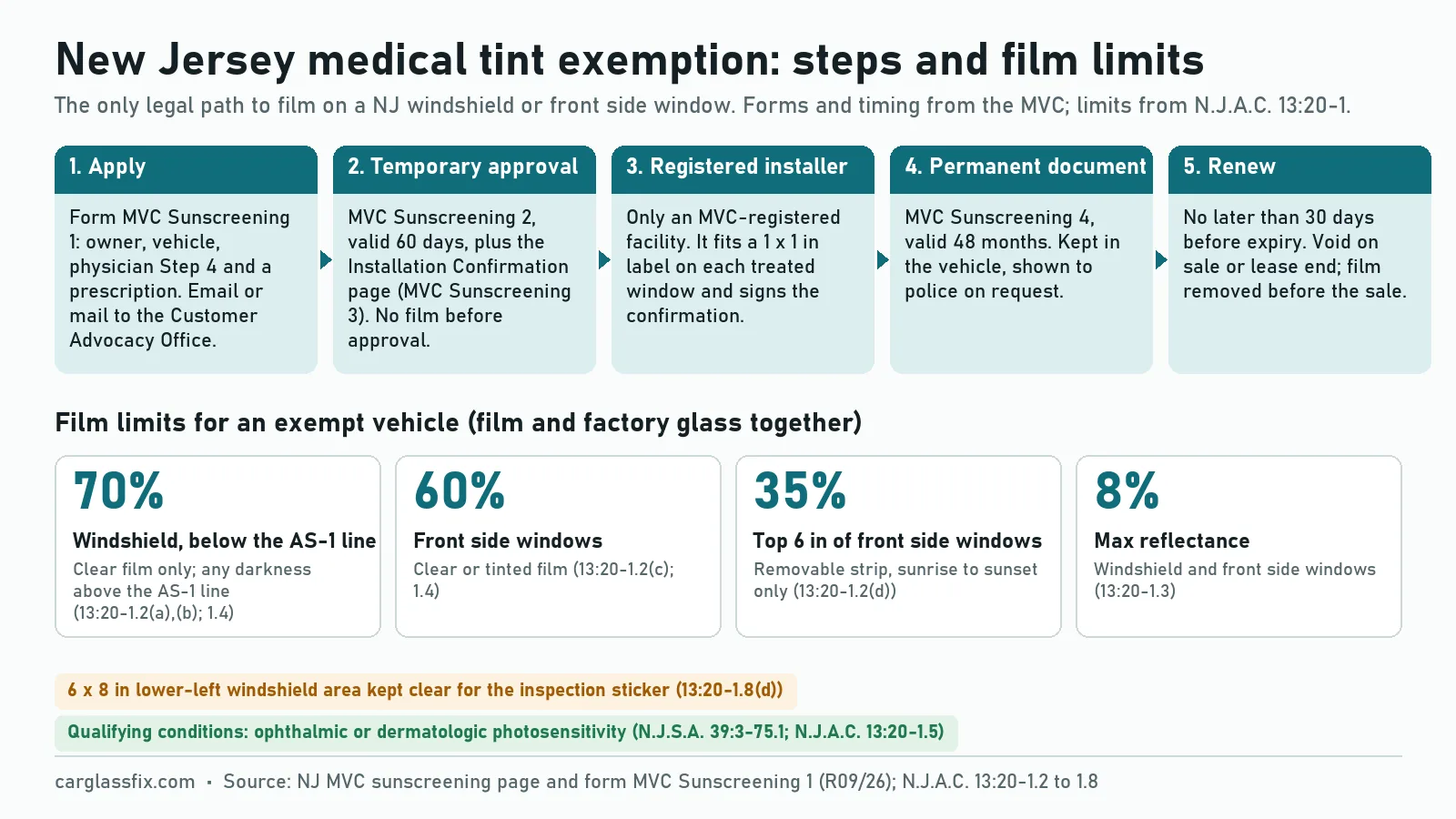
The only legal way to film a New Jersey windshield or front side window is an MVC medical exemption under N.J.S.A. 39:3-75.1. The statute applies “notwithstanding the provisions of any other law” to a vehicle driven by, or used to regularly transport, a person with “ophthalmic or dermatologic photosensitivity”. It lists polymorphous light eruption, persistent light reactivity, actinic reticuloid, porphyrins, solar urticaria and lupus erythematosus. The regulation adds chronic actinic dermatitis, photosensitive eczema and related skin cancers. The MVC page states the rule plainly: tinting of the windshield or front side windows is allowed “with a medical exemption only”.
How to get a New Jersey medical tint exemption
Complete form MVC Sunscreening 1
The owner fills in the vehicle and owner sections; Step 4 is completed and signed by a certified ophthalmologist or a physician with a plenary license in New Jersey or a bordering state, naming the condition and the light wavelengths involved. Skin conditions need photo-testing proof (N.J.A.C. 13:20-1.5).
Send it with a prescription
Email SUNSCREENING@mvc.nj.gov or mail the Customer Advocacy Office, PO Box 403, Trenton, NJ 08666-0403. The MVC says no film may go on until approval arrives.
Receive a temporary approval
The MVC sends form MVC Sunscreening 2, valid 60 days, and an Installation Confirmation page (MVC Sunscreening 3).
Install at an MVC-registered facility
Only a registered installer may apply the film. It attaches a 1 x 1 in label to each treated window (13:20-1.8) and signs the confirmation page.
Return the confirmation and keep the permit
The MVC issues the permanent document, MVC Sunscreening 4, valid 48 months. It stays in the vehicle and is shown to police on request. Renew no later than 30 days before it expires.
The permit is tied to one vehicle. It is void when the car is sold or the lease ends, and the owner must remove the film before the sale (13:20-1.6). The exemption film limits are 70% on the windshield, 60% on the front side windows, 35% for a removable daylight strip on the top 6 in of the front side windows, and 8% reflectance.
Rear window tint, mirrors and the inspection rule that moved
New Jersey sets no darkness limit on the rear window or the side windows behind the driver, for sedans or for SUVs. The Supreme Court said so in Smith: “whether or not defendant’s car was equipped with exterior side mirrors, New Jersey law allows for rear window tinting on passenger vehicles”. The Law Revision Commission’s 50-state survey lists New Jersey as one of five states with no rear window light limit.
The “dual mirrors required” line on most tint sites has a real source, but the wrong one for a passenger car. N.J.A.C. 13:20-33.7(g) lets a vehicle registered for commercial purposes and built on a truck chassis obscure its rear glass “provided that the motor vehicle is equipped with an exterior mirror on each side”. The same section bars “mirror-type material on any window”. In 2010 the state cut the periodic inspection of private cars to emissions items, and in 2013 the MVC retitled 13:20-33.7 “Commercial vehicle inspection: glazing”. The general mirror rule, 39:3-71, still requires every passenger car built after January 1, 1965 to carry an interior mirror and a driver’s-side exterior mirror. A second outside mirror is sensible with a dark rear window, but it is not a tint condition. Mirror films are covered in can you put mirror tint on a car.
How much is a tint ticket in New Jersey
The statute itself caps a 39:3-74 fine at $25, before court costs. Section 39:3-74 names no penalty of its own. The penalty section for the equipment article, 39:3-79, says a violator “shall be subject to a fine not exceeding twenty-five dollars”. Municipal courts add their own costs, and the statute does not set those, so the amount on a summons will be higher than $25. Ask the court named on the ticket for the total.
The larger figures that circulate online come from 39:3-75.3, the medical-exemption penalty section. Subsection (a) fines a driver who cannot show a valid exemption certificate up to $100, and the judge “may dismiss the charge” if a card valid on the day is shown, though court costs may still be imposed. Subsection (b) fines anyone who breaks the installation or installer-registration rules “not to exceed $1,000 for a first offense and not to exceed $5,000 for a second or subsequent offense”. Those are installer and exemption penalties, not the price of a dark front window. New Jersey has no fix-it ticket in the statute. Since the 2010 inspection change, enforcement for private cars happens at traffic stops, and the MVC warns that police can issue a summons for equipment “out of compliance” at any time.
Bills that did not pass, and what older pages get wrong
Several New Jersey bills since 2020 tried to put a tint percentage into the law, and none passed. A3496, introduced on March 8, 2022, would have allowed film on the windshield and front side windows at 70% light transmittance, with a darker band in the top 6 in or above the AS-1 line. The same text appeared in the 2020 session as A3728 and in the 2024 session as A2233. S3858 (May 15, 2023) would have added migraine to the medical conditions; S2063 (January 9, 2024) and S3971 (December 16, 2024) would have widened the exemption in 39:3-75.1. The Law Revision Commission’s June 2025 memo found no pending bill that amended 39:3-74 at all.
Two 2026 bills are different. A4233 (February 19, 2026) and A4673 (March 10, 2026) would ban “any tinted material on the windshield or the front side windows”, except the top 6 in or the area above the AS-1 line and medical exemptions, and would make tint an inspection item again. Neither sets a percentage. The Commission’s final report of September 17, 2026 recommended no change. Until a bill is signed, the 1937 text and the Smith test are the law. Rules change; check the current N.J.S.A. 39:3-74 and the MVC before you tint. This is general information, not legal advice.
Frequently asked questions
Is 20% tint legal in NJ?
A 20% film is legal on the rear window and the side windows behind the driver, which have no limit in New Jersey. On the windshield or front side windows it is not, because 39:3-74 allows no aftermarket film there without an MVC medical exemption, and exemption film must stay at 60% or more on the front sides.
Are tints a secondary offense in NJ?
No. A tint violation can be the reason for a stop, but only under the State v. Smith test: the front windshield or front side windows must be so dark that police cannot clearly see people or articles inside. Rear tint alone cannot justify a stop.
How much is a NJ tint ticket?
The statute caps the fine for a 39:3-74 violation at $25 under 39:3-79, and the court adds its own costs. The $1,000 and $5,000 figures in 39:3-75.3 apply to installers and to breaches of the medical-exemption rules.
How do I get a tint exemption in NJ?
File form MVC Sunscreening 1 with a physician’s certification and a prescription, wait for the MVC’s temporary approval, have an MVC-registered facility install the film, and return the installation confirmation. The permanent document lasts 48 months.
Is 70% tint legal in NJ?
Only on a vehicle with a medical exemption, where 70% with the glass is the windshield limit and 60% is the front side limit. On an ordinary car, 70% film on the front glass is still aftermarket film on the front glass, which the MVC says is allowed with an exemption only; behind the driver any shade is legal.
Sources
- N.J.S.A. 39:3-74, windshield unobstructed (FindLaw copy current as of 1 January 2024; checked 29 October 2026)
- N.J.S.A. 39:3-75, safety glazing, 39:3-75.1, medical tint permission, 39:3-75.2, rules and 39:3-75.3, penalties (checked 29 October 2026)
- N.J.S.A. 39:3-79, penalty for the article and 39:3-71, mirrors (checked 29 October 2026)
- N.J.A.C. 13:20-1.1 to 1.8, sun-screening for medical exemption vehicles (Cornell LII; checked 29 October 2026)
- N.J.A.C. 13:20-33.7, commercial vehicle inspection: glazing (checked 29 October 2026)
- NJ MVC: Window Sun-screening for Medical Reasons and form MVC Sunscreening 1 (R09/26) (checked 29 October 2026)
- NJ MVC: About Vehicle Inspections and What If My Vehicle Failed Inspection (checked 29 October 2026)
- New Jersey Law Revision Commission: Final Report, Windshield Statute (N.J.S. 39:3-74), 17 September 2026, with the Update Memorandum of 2 June 2025 and the Memorandum of 6 November 2023 (quoting State v. Smith, 251 N.J. 244 (2022), and State v. Cohen, 347 N.J. Super. 375 (App. Div. 2002))

Similar Posts