Illinois Window Tint Laws: Legal Percentages by Window
Senior Automotive Glass Diagnostic Specialist & Master Technician at CarGlassFix · AGSC Master Certified Auto Glass Technician, NGA Certified Installer, I-CAR Automotive Safety Specialist · 12+ Years in Automotive Glazing, Windshield Structural Bonding, ADAS Camera Calibration & Precision Chip Restoration
Illinois window tint laws allow 35% light transmission on the front side windows when every window behind the driver passes 35% or more. The front limit rises to 50% when a rear window sits between 30% and 35% or has factory smoked glass. Windshield film may cover only the top 6 inches and must be nonreflective.
Illinois window tint limits by window
Illinois allows 35% light transmission on the front side windows, and that figure holds only when no window behind the driver is darker than 35%. The rule is Illinois Vehicle Code section 12-503, subsection (a-5). It begins by banning all tint on “the windows immediately adjacent to each side of the driver” and then lists the exceptions. The statute sets no separate limits for sedans, SUVs, vans or pickups; a vehicle-class rule existed from 2009 to 2010 and was deleted. What matters is whether the glass behind the driver carries aftermarket film or factory smoked glass. Most SUVs and vans leave the factory with smoked rear glass, so their front film is held to 50%. A sedan with clear factory glass can run 35% all round. The table shows the darkest legal setting for each case.
| Window | Sedan (clear factory glass) | SUV, van, pickup (factory smoked rear glass) |
|---|---|---|
| Windshield | Nonreflective strip only, no more than 6 in down from the top | Same |
| Front side windows | 35% or more when every rear window is 35% or more; 50% or more when a rear window is between 30% and 35% | 50% or more over factory smoked glass (12-503(a-5)(4)) |
| Rear side windows | No direct limit; their darkness sets the front side limit | Factory glass as built |
| Rear window | No direct limit; side mirror on each side when treated | Factory glass as built; side mirror on each side when treated |
| Variance | 5% when an officer meters the window | Same |
| Reflective film | Not allowed on the windshield strip or the front side windows | Same |
How Illinois measures tint: the 5% variance, nonreflective film and mirrors
Illinois gives every front side limit a 5% variance, so a window that must pass 35% is within the law down to a metered 30%. The statute’s words are film that “allows at least 35% light transmittance, with a 5% variance observed by any law enforcement official metering the light transmittance”. The same clause follows each 50% option.
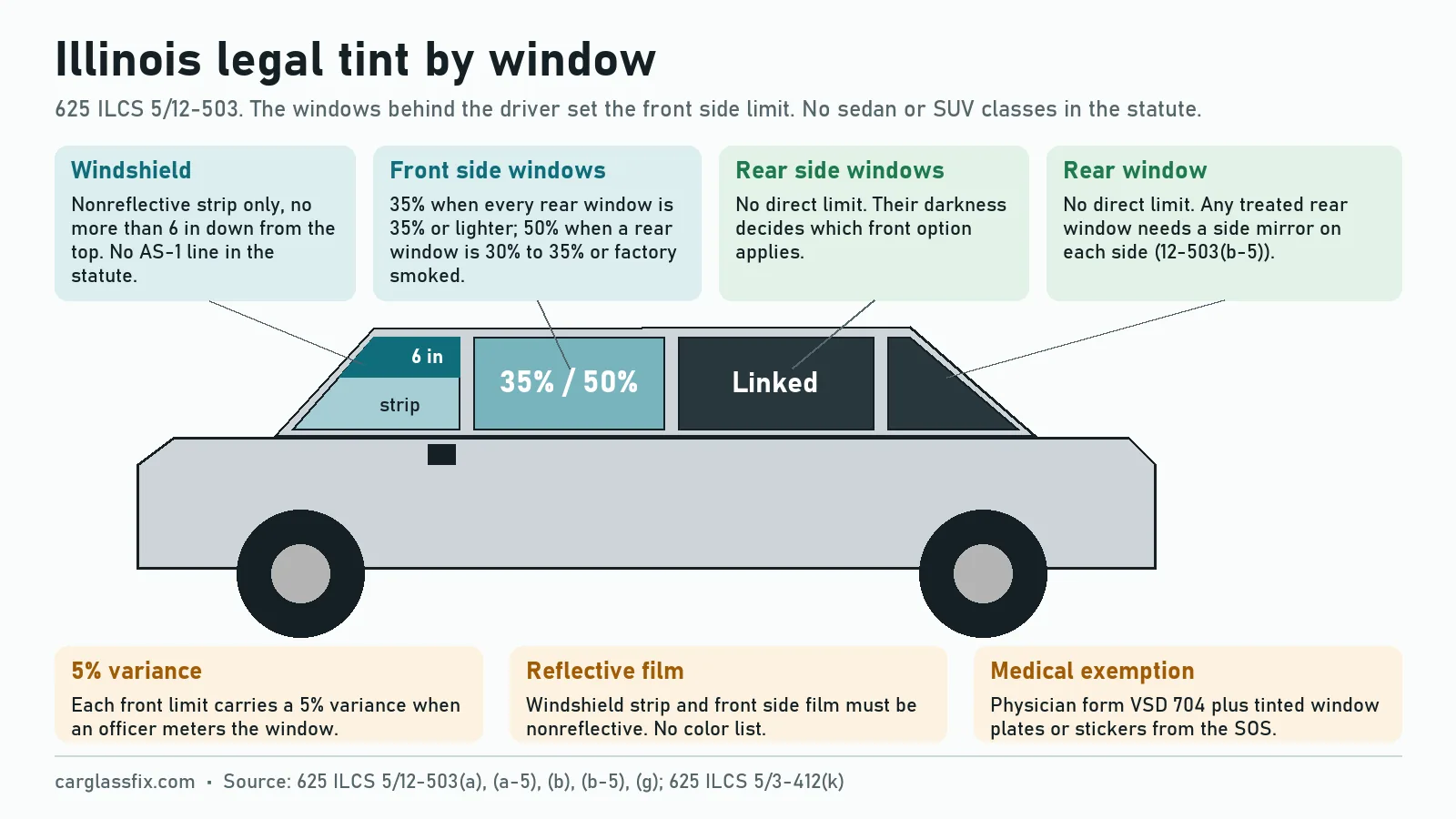
The section does not say whether the percentage describes the film alone or the film and glass together. The variance clause refers to an officer metering the window, so the reading that counts is the one taken through the installed film and the glass. Factory glass blocks some light before any film goes on, and our guide on how to measure window tint shows the math. A window tint meter gives the same net reading an officer would see. Two more conditions apply. Film on the windshield strip and on the front side windows must be “nonreflective”, so mirror and metallic films fail on that word alone. A vehicle with any treated window behind the driver “shall be equipped with a side mirror on each side” that meets section 12-502.
Windshield tint in Illinois: the top 6 inches
Illinois allows windshield film only as a nonreflective strip along the top that “does not extend more than 6 inches down from the top of the windshield”. Subsection (a) bans every other sign, poster, window application, reflective material, nonreflective material or tinted film on the front windshield. The statute measures the strip in inches, not by the AS-1 mark that many states use. Our page on the AS-1 line on a windshield explains that mark; in Illinois the tape measure decides, not the mark.
The strip rule has no light-transmission figure, so the 6-inch band may be any darkness as long as it is nonreflective. Full-windshield films, clear or tinted, are not among the exceptions. The medical exemption in subsection (g) lifts subsection (a) as well as (a-5), so a plate holder may tint the windshield. Subsection (h) exempts state and local stickers that must be shown on the glass. Since 2018, under subsection (a-3), a dealer may not send a car on a test drive with paperwork or decals on the windshield or the front side windows. For other states, see is it illegal to have tint on a windshield.
The linked rule: your front side limit depends on the rear windows
The front side limit in Illinois is set by the darkest window behind the driver, which is why one car is legal at 35% and the next only at 50%. Subsection (a-5) lists the allowed cases as alternatives. Meet any one of them and the front film is legal. Leave the front side windows untreated and subsection (b) takes over, with no limit behind the driver at all.
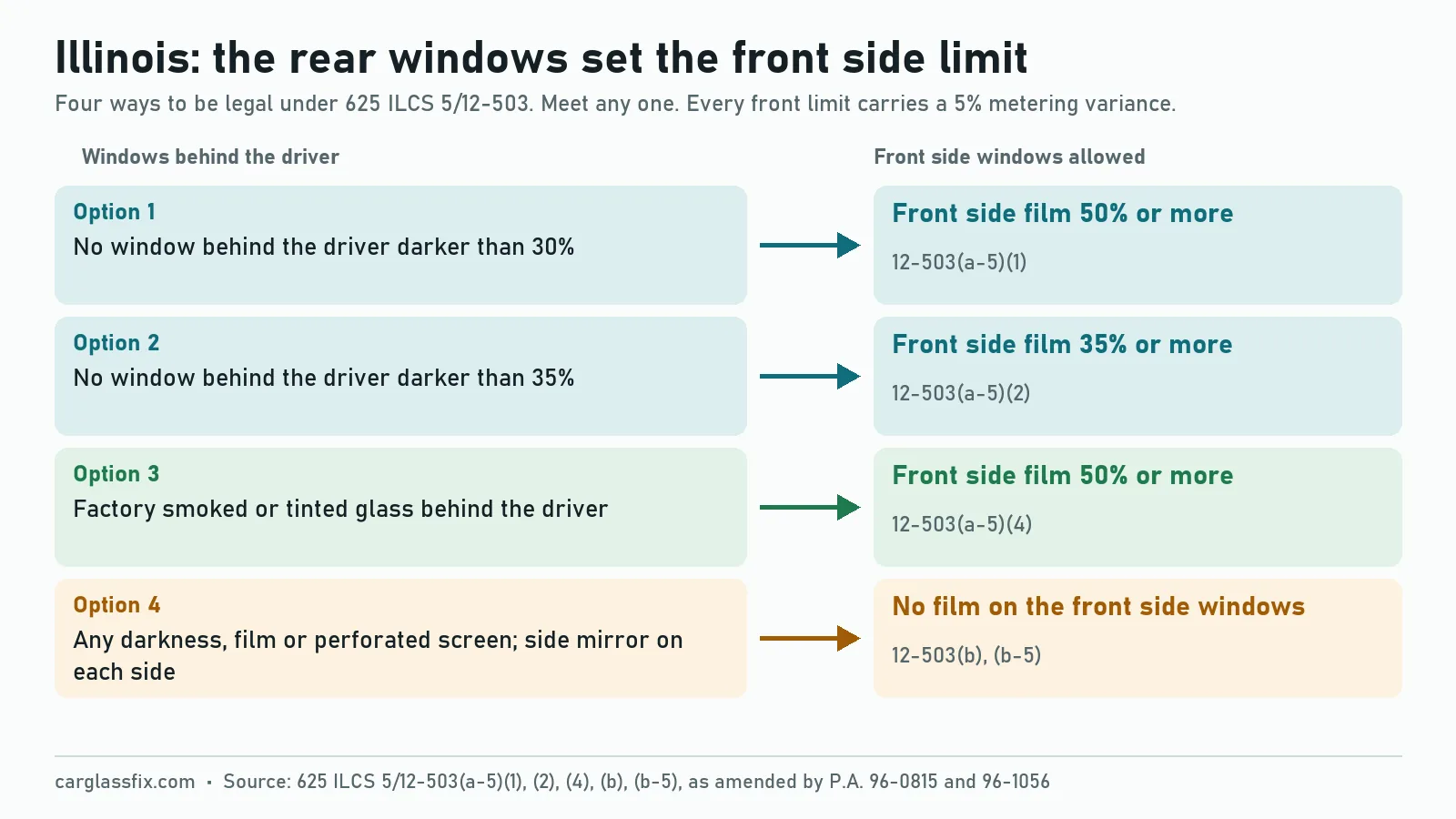
| Option | Windows behind the driver | Front side film allowed | Statute |
|---|---|---|---|
| 1 | None darker than 30% | 50% or more | 12-503(a-5)(1) |
| 2 | None darker than 35% | 35% or more | 12-503(a-5)(2) |
| 3 | Factory smoked or tinted glass | 50% or more | 12-503(a-5)(4) |
| 4 | Any darkness, film or perforated screen; side mirror on each side | No film | 12-503(b), (b-5) |
Darker rear windows mean lighter front windows, down to no film at all, so a driver who wants 20% or 5% behind the driver must leave the front side windows untreated. The sedan-versus-SUV split that most tint pages use is a shortcut. An SUV with factory smoked rear glass falls under option 3, and a sedan whose owner films the rear windows to 20% falls under option 4. The statute does not say whether factory smoked glass counts as a window “treated” below 35% for options 1 and 2; option 3 is the one written for it. Use the window tint simulator to preview each shade on your car, and the window tint percentage chart to compare 30%, 35% and 50% side by side.
Illinois medical exemption: form VSD 704 and the tinted window plate
Illinois lifts the windshield and front side rules for a vehicle that carries tinted window license plates or plate stickers issued under section 3-412(k). Subsection (g) names systemic or discoid lupus, disseminated superficial actinic porokeratosis, light sensitivity from a traumatic brain injury and albinism, and covers any other disease that requires the person to be shielded from direct sun. The vehicle must be owned and driven by that person, or carry a person with the condition who lives at the registered owner’s address. No front side exemption is granted for a condition that sunglasses or other eye protection can handle.
How to get the Illinois tinted window plate
Get the certificate signed
An Illinois-licensed physician completes form VSD 704, Tinted Window Certification, with the diagnosis, and the applicant signs it too.
Mail it to Springfield
The Secretary of State processes the request only at the Special Plates Division, 501 S. Second St., Rm. 520, Springfield, IL 62756, with the plate fee listed on its page.
Receive the plates or stickers
Section 3-412(k) tells the Secretary of State to issue them “immediately upon receiving the physician’s certification”.
Fit the plate before the tint
Installers may apply medical tint only to a vehicle that already shows the plate or sticker, and must keep a copy of the certificate (12-503(g-7), (a-10)).
Carry and renew
Keep the certificate in the vehicle at all times; the physician renews it every 4 years, and the SOS asks for a copy with each yearly plate renewal.
The Secretary of State page lists the conditions it accepts as systemic and discoid lupus, albinism, disseminated superficial actinic porokeratosis and xeroderma pigmentosum. It does not yet name traumatic brain injury, which Public Act 102-0111 added to the statute on January 1, 2022, so a TBI applicant should cite subsection (g) on the form. The form warns that a false statement carries a fine of up to $1,000 and that misuse of the plate can bring revocation and a fine of up to $500.
Fines for illegal tint in Illinois and how stops work
A first Illinois tint violation is a petty offense with a fine of “no less than $50 nor more than $500”. That is subsection (j), and it covers the windshield rule, the front side rule, the rear-window rules, the installer ban and the installer plate rule. A second or later violation is a Class C misdemeanor with a fine of $100 to $500. In both cases the court “shall” order the nonconforming windows altered into compliance, so the film comes off or gets replaced. Court costs are not in the statute, and the $250 Chicago ticket figure on some tint-shop pages has no published source.
Illinois appellate courts have held that police may stop a vehicle solely for a tint violation, and that a car bought in a state that allows tint still had to comply once registered in Illinois (People v. Strawn, 4th District, 1991). The no-stop rule added in 2024 as subsection (c-5) covers only objects hanging between the driver and the windshield, not tint. Vehicles “properly registered in another jurisdiction” are exempt from the tint rules while in Illinois. Subsection (m) stops home rule units such as Chicago from writing a tint rule inconsistent with the state’s.
How the Illinois tint law changed and what older pages get wrong
Front side tint of any darkness was illegal in Illinois until October 30, 2009. Before then, subsection (a) banned tinted film on the “sidewings or side windows immediately adjacent to each side of the driver”; only pre-1982 cars and medical cases were exempt. Public Act 96-0815 created subsection (a-5) with the 50/30 and 35/35 options, a factory-film option for multipurpose vehicles, and the plate-based medical exemption. Public Act 96-1056 deleted the multipurpose vehicle option on July 14, 2010 and replaced it with the factory smoked glass option for any vehicle. Later acts set certificate renewal at 4 years (2015), added the dealer test-drive rule (2018), traumatic brain injury (2022) and the windshield-object no-stop rule (2024).
Ranking pages repeat three errors. “SUVs may have any tint behind the driver” is true only when the front side windows are untreated, for sedans too. Bing’s AI answer bans red and amber and names the AS-1 line; the statute has neither. Several pages describe a Secretary of State “permit”; the statute issues plates or plate stickers. A 2020 bill, HB 4033, would have allowed full medical tint; we found no Public Act for it. Compare other states in what car window tint is legal. Check the current text on ilga.gov before you tint. This article is general information, not legal advice.
Frequently asked questions
Is 20% window tint darker than 35%?
Yes. A 20% film passes 20% of visible light, against 35% for a 35% film. In Illinois, 20% is legal only behind the driver, and only when the front side windows carry no film. The window tint percentage chart shows the two shades side by side.
What is the AS-1 line, and does Illinois use it?
The AS-1 line is a mark near the top of the windshield that many states use as the lower edge of a tint strip. Illinois does not use it. Section 12-503(a) measures the strip as 6 inches from the top of the windshield.
What is the darkest legal tint in Illinois?
On the front side windows, 35%, and an officer’s meter may read as low as 30% under the 5% variance. Behind the driver there is no direct limit, so 5% is legal there when the front side windows are untreated and the vehicle has a side mirror on each side.
Do Illinois cops care about tint, and can they pull you over for it?
A tint violation is a petty offense, and an Illinois appellate court held in People v. Strawn (1991) that police may stop a vehicle solely for violating section 12-503(a). The 2024 no-stop rule applies only to objects hanging inside the windshield.
Is 5% tint legal in Illinois?
Not on the windshield or the front side windows. Behind the driver, 5% is legal when the front side windows have no film and the vehicle has a side mirror on each side.
Sources
- 625 ILCS 5/12-503, Windshields must be unobstructed and equipped with wipers (Source line P.A. 102-111 and 103-32; read from an archived copy of 6 May 2025 and FindLaw’s text current to 1 January 2025, checked 29 October 2026)
- 625 ILCS 5/3-412(k), Registration plates for tinted window exemptions (checked 29 October 2026)
- Illinois Secretary of State: Tinted Windows License Plates (checked 29 October 2026)
- Illinois Secretary of State form VSD 704, Tinted Window Certification (October 2022 edition)
- Public Act 96-0815 (HB 3325), effective 30 October 2009
- Public Act 96-1056, effective 14 July 2010
- Public Act 98-0737, effective 1 January 2015 and Public Act 100-0346, effective 1 January 2018
- Public Act 102-0111, effective 1 January 2022 and Public Act 103-0032, effective 1 January 2024
- Office of the State Appellate Defender: Traffic Offenses digest (People v. Hagen, 1989; People v. Strawn, 1991)
- THE SHOP: Vehicle tint exception under consideration in Illinois (HB 4033, 21 January 2020)

Similar Posts