Pennsylvania Window Tint Laws: The 70% Rule by Window
Senior Automotive Glass Diagnostic Specialist & Master Technician at CarGlassFix · AGSC Master Certified Auto Glass Technician, NGA Certified Installer, I-CAR Automotive Safety Specialist · 12+ Years in Automotive Glazing, Windshield Structural Bonding, ADAS Camera Calibration & Precision Chip Restoration
Pennsylvania window tint laws require 70% light transmittance on the windshield, front side windows, rear side windows and rear window of a 1998-or-newer passenger car. Trucks, SUVs and vans need 70% only on the windshield and front side windows. A windshield strip must be transparent and no more than 3 inches from the top.
Pennsylvania window tint limits by window
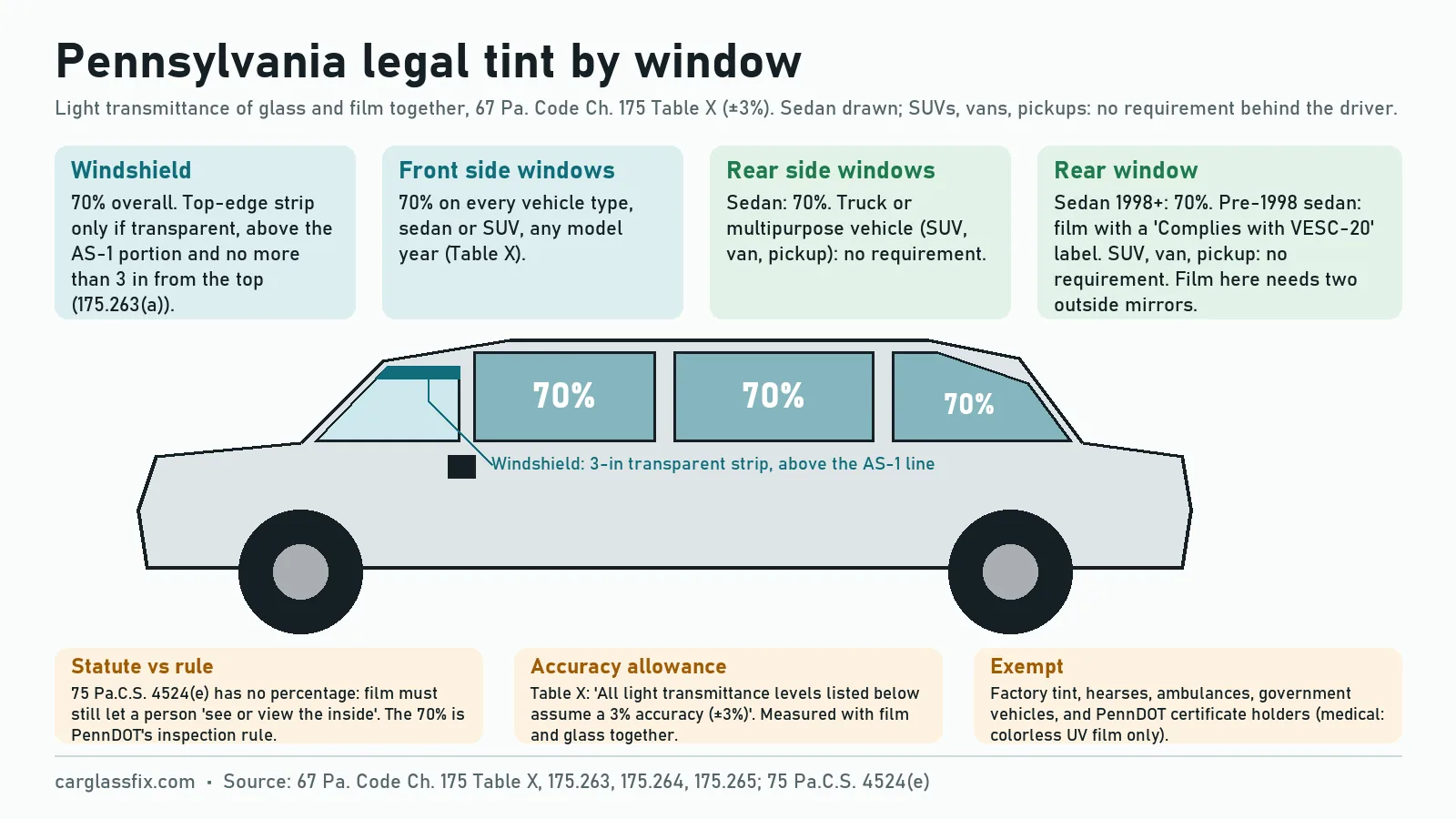
Pennsylvania sets one number, 70%, and applies it to every window of a passenger car built for the 1998 model year or later. The number sits in Table X of PennDOT’s vehicle inspection regulations, titled “Acceptable light transmittance levels for vehicle glazing”, adopted in 1996. A truck or multipurpose passenger vehicle gets a lighter rule: 70% on the windshield and front side windows, and “No Requirement” for the rear side windows and rear window. PennDOT’s fact sheet defines a multipurpose passenger vehicle as one “built on a truck chassis or specifically designed for occasional off-road use”, which covers most SUVs, pickups and vans. Table X states that every level assumes “a 3% accuracy (±3%)”. The percentages are read through the glass with the film on it, so a 70% film on factory glass reads below 70%. The window tint percentage chart shows how light 70% is next to the common 35% and 20% films.
| Window | Sedan (passenger car) | SUV, van, pickup (multipurpose vehicle or truck) |
|---|---|---|
| Windshield | 70%; transparent strip only along the top edge, above the AS-1 portion and no more than 3 in from the top | Same |
| Front side windows and wings | 70% | 70% |
| Rear side windows and wings | 70% | No requirement |
| Rear window | 70% (1998 and newer); VESC-20 labelled film on pre-1998 cars | No requirement |
| Mirrors | Right and left outside mirrors, 19.5 sq in each, with any film other than the windshield strip | Same |
| Accuracy allowance | Table X levels assume 3% accuracy | Same |
| Reflectivity and colors | No limit written in the statute or the rule | Same |
Why the statute has no number: 75 Pa.C.S. 4524(e) and Table X
The Pennsylvania Vehicle Code never says 70%. Section 4524(e)(1) makes it an offense to drive with “any sun screening device or other material which does not permit a person to see or view the inside of the vehicle through the windshield, side wing or side window”. The 70% levels live in PennDOT’s safety inspection regulations in Title 67 of the Pennsylvania Code, where section 175.67(d)(4) repeats the see-inside wording and points to Table X “for specific requirements for vehicles subject to this subchapter”.
The two layers do not merge. In Commonwealth v. Brubaker (Pa. Super. 2010), noted under section 175.67, the court held that the inspection rule “requires a vehicle’s windows to have a light transmittance of 70% or greater” but cannot be read into the statute, because 4524(e)(1) only asks whether a person can see through the glass. A police officer therefore writes the ticket on what the officer could see, with a meter reading as evidence, while tint shops and mechanics work from Table X. Our how to measure window tint guide explains how a meter reads glass and film together, and the hub what car window tint is legal compares Pennsylvania with the other states.
Windshield tint in Pennsylvania: a 3-inch transparent strip
A Pennsylvania windshield may carry material only along its top edge, and only if that material is transparent. Section 175.263(a) allows “products or materials along the top edge of the windshield” when they “are transparent and do not encroach upon the AS-1 portion of the windshield as provided by FMVSS No. 205” and are “not more than 3 inches from the top of the windshield”. The inspection procedure in 175.80(a)(2)(ii) repeats the same three conditions. The strip stops at the AS-1 line or at 3 inches, whichever comes first. The AS-1 mark is etched near the top corners of the glass; the AS-1 line on a windshield page shows where to find it. Below the strip, the windshield itself is held to 70% in Table X, the same figure as the side windows. Pennsylvania does not use the 5-inch or 6-inch fallbacks that several other states write into their laws, so pages that give Pennsylvania a 6-inch band are quoting another state. A medical certificate changes nothing here: it covers colorless film only, so a tinted windshield band below 3 inches is not legal with or without one. For the general picture across states, see is it illegal to have tint on a windshield.
Factory tint, the 1998 model-year split and the 1984 grandfather rule
Pennsylvania exempts three groups of vehicles from the sun screening ban, and each has a date or a label attached. Section 4524(e)(2)(i) excludes “tinted windows of the type and specification that were installed by the manufacturer of the vehicle”. That is why a new SUV with dark privacy glass behind the driver passes. The exemption does not transfer to aftermarket film laid over factory glass, which must still meet the Table X level for that window. Hearses, ambulances and government vehicles are exempt under the same paragraph.
Table X splits passenger cars at the 1998 model year. A 1998-or-newer car must read 70% on the rear window. A pre-1998 car may instead carry a rear window film with a label “permanently installed between the sun screening device or other material and the glazing” that names the film maker or a registration number and states “Complies with VESC-20”. The front and rear side windows of the older car stay at 70%. The third group is the grandfather certificate in 4524(e)(3)(i) and rule 175.265(b)(1): a vehicle registered in Pennsylvania as of September 8, 1984 and fitted with prohibited material before September 9, 1984 could apply for a certificate of exemption, carried in the car and shown to police and to the inspection station.
Inspection, tickets and fines in Pennsylvania
A Pennsylvania inspection station has not been required to check window tint since 1996, so passing inspection does not make the tint legal. PennDOT’s fact sheet, dated April 2025, says the 1996 regulations “eliminated the requirement that window tint be checked at the time of inspection”, and adds that owners whose tint exceeds the levels “may be stopped and cited while operating their vehicle on the highway”.
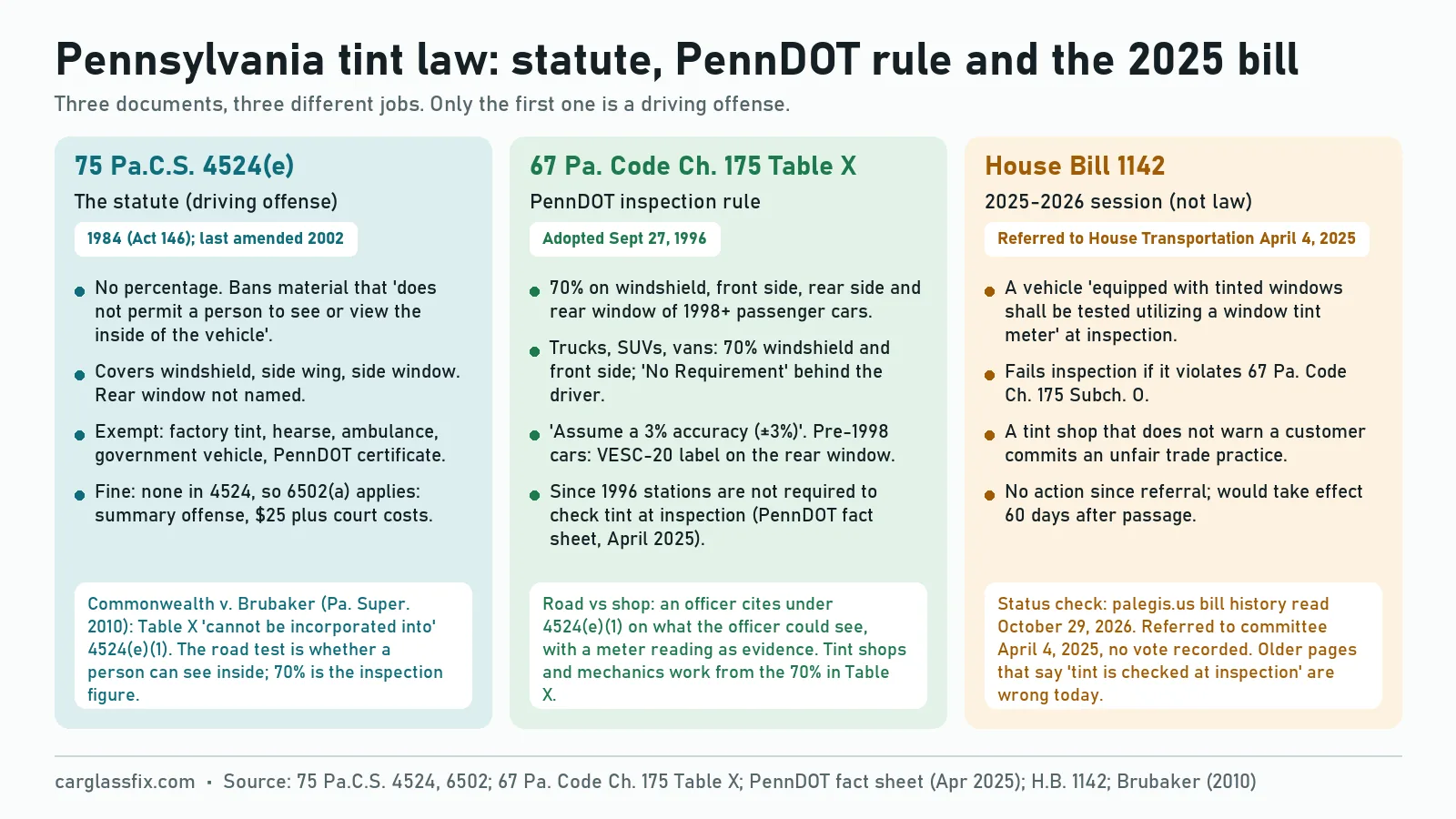
Newtown Township Police state that tint “is a primary violation” and that the department has tint meters. Section 4524 sets no fine of its own. The Vehicle Code’s general penalty, 75 Pa.C.S. 6502(a), makes any violation without its own penalty a summary offense with “a fine of $25”. Court costs and surcharges set by other statutes are added on top, so citations run well above $25. A window tint meter reading shows where a window sits against 70%. House Bill 1142, introduced on April 4, 2025, would require that a vehicle “equipped with tinted windows shall be tested utilizing a window tint meter” at inspection and fail if it breaks Subchapter O; it has stayed in the House Transportation Committee since that day.
Pennsylvania medical exemption for window tint: colorless film only
Pennsylvania’s medical exemption does not allow dark tint; it allows colorless film that blocks ultraviolet light. Rule 175.265(b)(2) says a certificate “will be granted only for colorless sun screening device or other material”, and 175.265(d) describes the result as a certificate “authorizing the installation of a colorless sun screening device or other material which filters ultraviolet light”. The statute, 4524(e)(3)(ii), limits the certificate to a physical condition that PennDOT, “in consultation with the Medical Advisory Board”, has decided justifies it, certified “by a licensed physician or optometrist”. The owner, or a household member who regularly drives or rides in the car, must have the condition.
How to get a Pennsylvania medical certificate of exemption for window tint
Get the PennDOT application
PennDOT’s inspection-forms list names it “MV-402, Application for sun screening certificate of exemption”; the April 2025 fact sheet gives the Medical Unit, (717) 787-9662, as the contact for the current form.
Have a physician or optometrist certify the condition
The form needs the vehicle’s make, year, model and VIN and “a medical certification of need due to a disability from a licensed physician or optometrist” (175.265(b)(2)).
Install colorless UV film only
The certificate covers colorless material that filters ultraviolet light; it never covers a dark or colored film (175.265(d)).
Carry the certificate
It must be “carried in the vehicle at all times”, shown to a police officer on request and handed to the inspection station at each inspection.
Remove the film before selling
On sale or transfer the certificate is void; the seller must remove the film, destroy the certificate and give the buyer a notarized statement naming the business and process used (4524(e)(5)).
A vehicle with a medical certificate may run with only a left outside mirror, unless it was built with mirrors on both sides (175.264). PennDOT’s fact sheet names no form number, so confirm the current form with the Medical Unit before mailing anything.
What older Pennsylvania tint pages and AI answers get wrong
Most pages ranking for Pennsylvania tint law carry at least one claim that is not in the statute, the rule or PennDOT’s fact sheet. The common ones, checked on October 29, 2026: a “6-inch” windshield band (the rule says 3 inches); a ban on red, amber or blue film and on mirrored film (no color or reflectance rule exists in 4524 or Subchapter O, although a mirror film can still fail the see-inside test); “tint is checked at annual inspection” (PennDOT dropped that check in 1996, and H.B. 1142 to restore it has not passed); a “Form DL-38” (the Bing answer repeats a tint-law aggregator; PennDOT’s list names MV-402); and fixed ticket prices of $110 or $176 (the statutory fine is $25 plus costs that vary by county). One real local rule is often missed: Philadelphia’s 2024 ordinance, reported by PhillyVoice and 6abc, lets the Parking Authority and police ticket a parked car $100 when its tint breaks state law, from July 1, 2024. If you are weighing a film, the window tint simulator shows what 70% looks like on your car before you buy. Rules change; check the current statute, 67 Pa. Code Chapter 175 and PennDOT’s fact sheet before installing film. This page is general information, not legal advice.
Frequently asked questions
Is 20% tint illegal in PA?
Yes on any window of a passenger car and on the windshield and front side windows of an SUV, van or pickup, because Table X requires 70% light transmittance there. A 20% film is legal only behind the driver on a truck or multipurpose passenger vehicle, where Table X lists “No Requirement”.
Is 15% window tint legal in PA?
No on a sedan, where every window must read 70%, and no on the front side windows or windshield of any vehicle. On the rear side windows and rear window of a truck, SUV or van, Pennsylvania sets no requirement, so 15% is allowed there.
How much are tint tickets in PA?
The tint statute, 75 Pa.C.S. 4524, sets no fine, so the Vehicle Code’s general penalty applies: a summary offense with a $25 fine under 75 Pa.C.S. 6502(a). Court costs and surcharges set by other laws are added, so the amount on the citation is higher and varies by county.
Is window tint a primary offense in Pennsylvania?
Yes. Driving with sun screening that does not let a person see inside is an offense under 4524(e)(1) on its own, and local police departments such as Newtown Township state that a driver can be stopped for tint alone.
Does PA state inspection check window tint?
Not since 1996. PennDOT’s Vehicle Window Tint fact sheet says the 1996 regulations eliminated the requirement to check tint at inspection, so a passed inspection is no defense to a tint stop. House Bill 1142 (2025) would add a window tint meter test at inspection, but it has not left committee.
Sources
- 75 Pa.C.S. 4524, Windshield obstructions and wipers (official text, last amended 2002; checked 29 October 2026)
- 75 Pa.C.S. 6502, Summary offenses (checked 29 October 2026)
- 67 Pa. Code 175.67, Glazing, with the Notes of Decisions on Commonwealth v. Brubaker (checked 29 October 2026)
- 67 Pa. Code 175.80, Inspection procedure (checked 29 October 2026)
- 67 Pa. Code 175.263, Sun screening location, 175.264, Mirrors and 175.265, Exemption provisions (checked 29 October 2026)
- 67 Pa. Code Chapter 175, Table X: Acceptable light transmittance levels for vehicle glazing (adopted 27 September 1996; site effective through 56 Pa.B. 5370, 8 August 2026; checked 29 October 2026)
- PennDOT fact sheet: Vehicle Window Tint (April 2025; read 29 October 2026)
- Pennsylvania House Bill 1142, 2025-2026 Regular Session (bill history and PN 1261 text; checked 29 October 2026)
- Newtown Township Police Department: window tint (checked 29 October 2026)
- PhillyVoice: Philadelphia tinted-window ordinance signed (2 May 2024) and 6abc: parking tickets for illegally tinted windows (2024)

Similar Posts