Best Car Window Tint for Style & Privacy
Senior Automotive Glass Diagnostic Specialist & Master Technician at CarGlassFix · AGSC Master Certified Auto Glass Technician, NGA Certified Installer, I-CAR Automotive Safety Specialist · 12+ Years in Automotive Glazing, Windshield Structural Bonding, ADAS Camera Calibration & Precision Chip Restoration
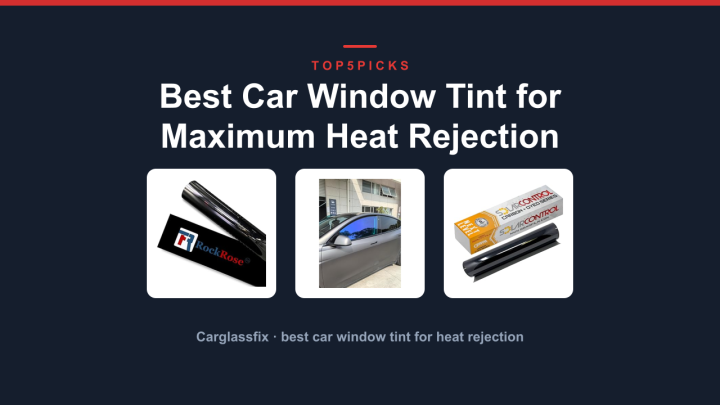
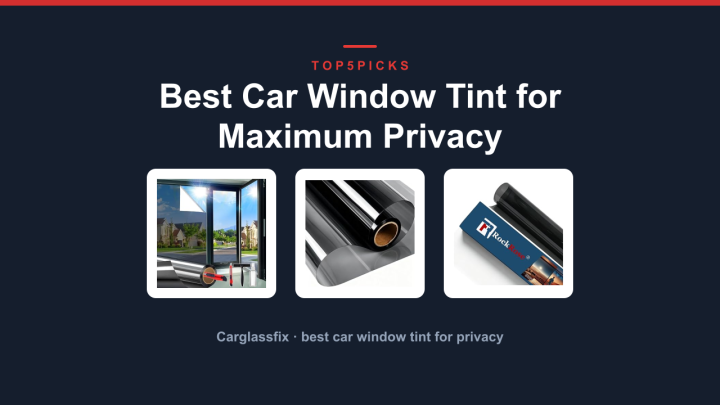
The best car window tint for most drivers is the darkest film type your state allows on each window, chosen by heat rejection (TSER), not by darkness. Among these five DIY rolls, the RockRose 5% Premium Carbon is the pick for maximum privacy behind the driver: it is 5% VLT carbon film with 99% UV block and up to 55% infrared rejection, according to the seller.
Want more light for night driving and a shade that is closer to legal front-window limits? The 20% films further down let in four times as much light, and the RockRose 20% Nano Ceramic lists the highest infrared rejection of the five.
As an Amazon Associate, CarGlassFix earns from qualifying purchases. The picks below come from the makers’ published specifications, not from our own testing.
This guide compares the five rolls on the numbers their sellers publish: VLT, film type, UV and infrared rejection, and roll size. It also explains TSER, state tint limits, warranties and DIY versus professional installation, and flags who should skip a DIY roll.
Picks are based on makers’ specifications and product data, not hands-on testing. We checked each Amazon listing on October 28, 2026.
Quick Answer: The Best Car Window Tint
The RockRose 5% Premium Carbon Car Window is the top pick for maximum privacy on windows where 5% is legal. For heat, the RockRose 20% Nano Ceramic lists the highest infrared rejection here.
- RockRose 5% Premium Carbon Car Window (Best for maximum privacy): 5% VLT 2-ply carbon film, 99% UV block and up to 55% infrared rejection (seller figures), on a 36 in x 100 ft roll.
- United Universal Black Window Tint Film (Best budget-friendly option): 5% VLT 1-ply dyed PET film with up to 99% UV block on a 24 in x 100 ft roll; no heat figure is listed.
- United 20% VLT Nano Carbon 2Ply (Best for balanced visibility and heat rejection): 20% VLT nano carbon film, the only pick that lists TSER (35 to 50%) and IRR (30 to 35%).
- United 20% VLT Carbon Window Tint (Best for wide coverage): 20% VLT 2-ply carbon film with up to 99% UV block on a 36 in x 100 ft roll.
- RockRose 20% Nano Ceramic Car Window (Best for premium heat rejection): 20% VLT nano ceramic film with 99% UV block and 85% IRR in the listing title (another bullet says 90%).
Thinking about legal restrictions or other priorities instead? Jump to Who Should NOT Buy below before you spend anything.
Comparison Table
Here's the lineup at a glance: photo, product, who it's built for, and the key spec each seller states. There is no made-up score; the spec column comes straight from the listings.
| Photo | Product | Best for | Key maker spec | Buy |
|---|---|---|---|---|
 | RockRose 5% Premium Carbon Car Window | Maximum privacy seekers | 5% VLT, up to 55% IR | Check price → |
 | United Universal Black Window Tint Film | Budget-conscious buyers | 5% VLT, dyed, 99% UV | Check price → |
 | United 20% VLT Nano Carbon 2Ply | Balanced visibility and heat rejection | 20% VLT, 35 to 50% TSER | Check price → |
 | United 20% VLT Carbon Window Tint | Wide coverage needs | 20% VLT, 36 in carbon | Check price → |
 | RockRose 20% Nano Ceramic Car Window | Premium heat rejection | 20% VLT, 85% IRR | Check price → |
Scroll sideways on small screens to see every column.
RockRose 5% Premium Carbon Car Window: Best for maximum privacy
United Universal Black Window Tint Film: Best budget-friendly option
United 20% VLT Nano Carbon 2Ply: Best for balanced visibility and heat rejection
United 20% VLT Carbon Window Tint: Best for wide coverage
RockRose 20% Nano Ceramic Car Window: Best for premium heat rejection
How to Choose the Best Car Window Tint: Film Type, VLT, TSER and the Law
Choose car window tint in this order: the darkest VLT your state allows on each window, then the film type with the highest TSER at that shade, then a warranty that covers your install. Darkness controls privacy and glare. Film type controls heat.
Film Type Sets Heat Rejection, Not Darkness
Dyed film absorbs light with dye, carbon film uses carbon particles, and ceramic film uses non-metal ceramic nanoparticles. IR ceramic lines add particles tuned to absorb infrared. LLumar's own sheet shows the ladder at the same shade: at about 35% VLT, its dyed ATC 35 lists 35% TSER, ceramic CTX 35 lists 48% and IR ceramic IRX 35 lists 54%. SunTek lists 38% for Carbon 35.
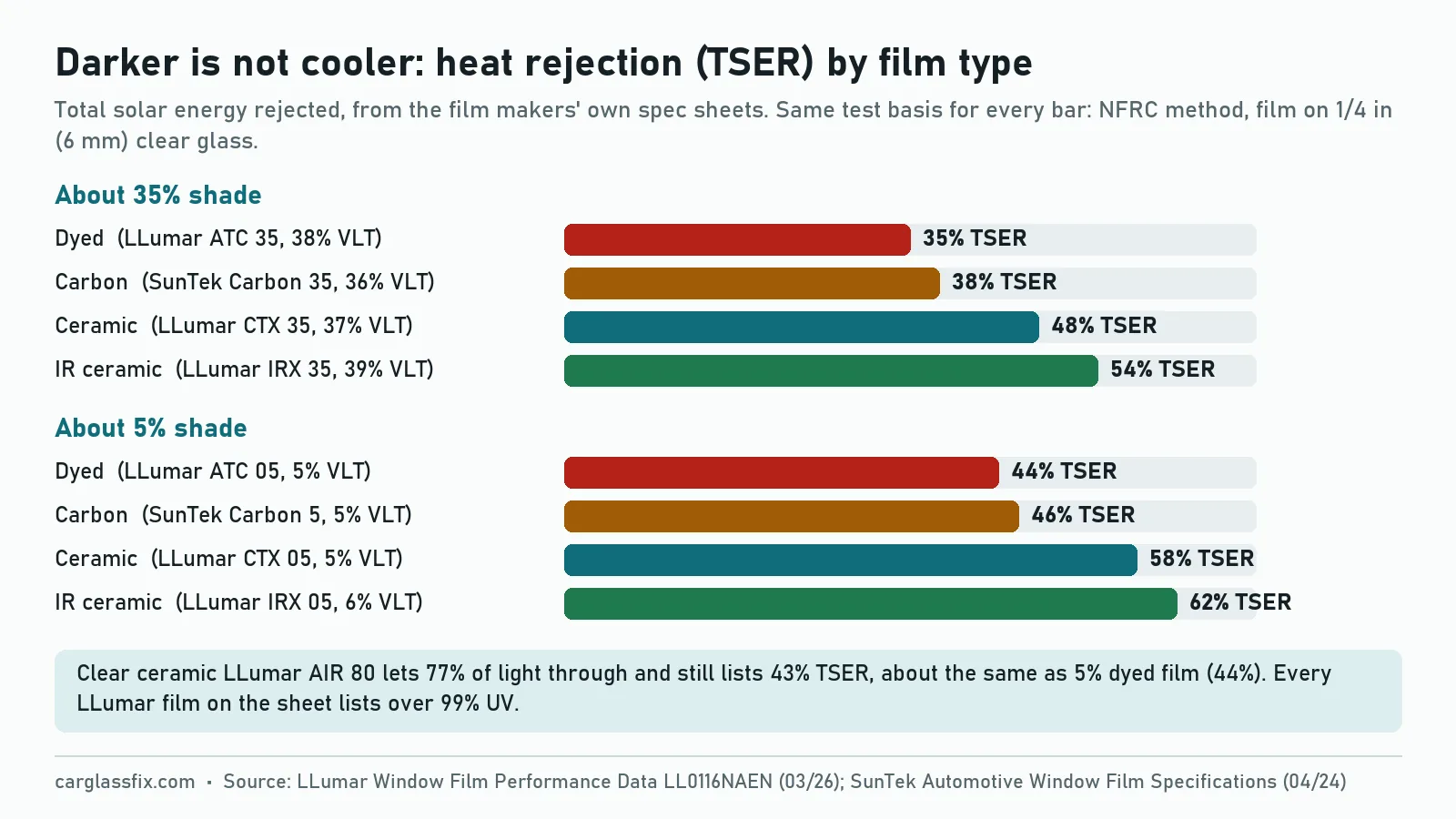
Darker film is not automatically cooler. LLumar's clear AIR 80 lets 77% of light through and still lists 43% TSER, close to the 44% of its 5% dyed film. For a deeper look at heat numbers by brand, see our guide to the best car window tint for heat rejection.
VLT vs TSER vs IRR vs UV: Read the Spec Sheet
TSER is the number to compare first, because the IWFA says occupant comfort is best described by SHGC or TSER. Use IRR only alongside TSER. VLT tells you darkness, and UV tells you skin and interior protection.
| Spec | What it tells you | How our five picks list it |
|---|---|---|
| VLT | Share of visible light that passes through. Lower is darker. States measure film and glass together in most cases. | 5% (two picks), 20% (three picks) |
| TSER | Share of the sun's total energy rejected: the heat number. IWFA defines it as 1 minus SHGC. | Only United Nano Carbon lists it: 35 to 50% |
| IRR | Infrared rejection. IWFA notes it has no standard test method, and makers measure different wavelength ranges. | Up to 55% (RockRose 5%), 30 to 35% (United Nano Carbon), 85% or 90% (RockRose ceramic) |
| UV rejection | Share of ultraviolet blocked. Quality films list 99% or more at every shade. | All five list 99% or up to 99% |
| Film type | Dyed, carbon, ceramic or IR ceramic. Metallized films can interfere with radio and phone signals (IWFA). | 1 dyed, 3 carbon, 1 ceramic; none names a metal layer |
| Roll size | Width decides whether large back glass needs a seam. Length decides how many cars a roll covers. | 24 or 36 in wide; 25 or 100 ft long |
Check Your State's Limit Before You Pick a Shade
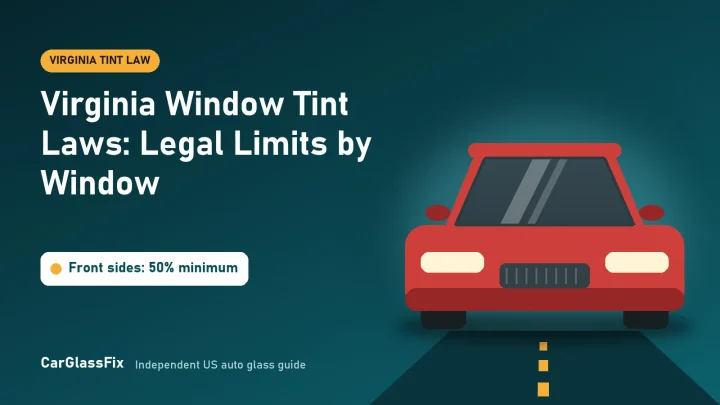
Your state's limit, not the film, decides the darkest shade you can use on each window. Our dataset of state statutes shows that no state or DC allows 5% film on a sedan's front side windows. Only New Mexico lists 20%, and 35% is the most common front limit, in 19 jurisdictions.
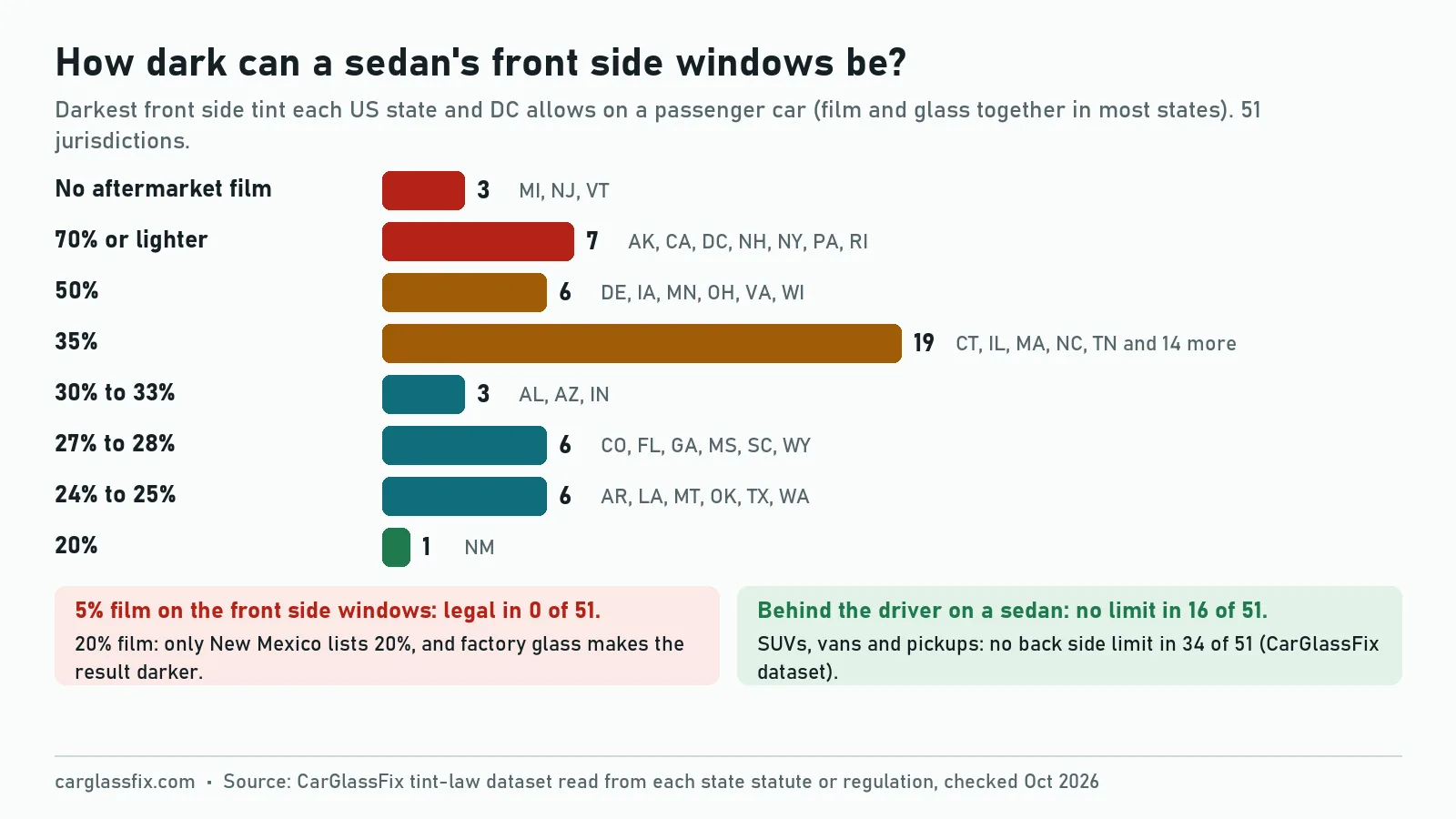
Most states measure film and glass together, and film is rated on clear glass, so a 20% film on factory glass reads darker than 20%. Look up your exact numbers in what car window tint is legal, compare shades in the window tint percentage chart, and preview a shade on your car with the window tint simulator.
Warranty: Read What Voids It
Film warranties usually depend on a legal, professional install. Madico's automotive warranty covers film on interior glass only and states that illegal installation voids it. LLumar offers a lifetime limited warranty through its dealers. Gila covers its DIY film for two years against manufacturing defects. A roll you install yourself usually has only the seller's terms, so check them before you buy.
DIY Roll or Professional Install
A DIY roll suits flat side windows and a patient installer. Curved back glass needs heat shrinking, and a mistake there costs film and time. Gila says its film cures over about a week to 10 days, and Madico says not to roll windows down for at least 3 days. Follow our steps for how to install car window tint, and see how long car window tint lasts before you choose a film type.
Who Should NOT Buy a DIY Window Tint Roll
A DIY tint roll is the wrong purchase for drivers who need a legal front-window shade these rolls do not offer, or who need a film warranty. Here's who they are.
You Only Want to Tint the Front Side Windows
All five picks are 5% or 20% VLT. That is darker than the front side limit in 50 of 51 jurisdictions for a sedan. Front windows usually need 35% or lighter film, or no film at all in Michigan, New Jersey and Vermont.
You Want a Lifetime Warranty
Lifetime limited warranties such as LLumar's come through authorized dealers. A roll bought online and installed at home does not carry that kind of coverage.
You Drive Often at Night
Dark film cuts the light you see by at night. If you drive at night a lot, compare lighter shades in the window tint percentage chart linked above before you buy a 5% or 20% roll.
Frequently Asked Questions
Is ceramic or carbon tint better?
Ceramic is better for heat at the same shade. On makers' own sheets, LLumar's ceramic CTX 35 lists 48% TSER and SunTek's Carbon 35 lists 38%. Carbon still blocks over 99% of UV and costs less, so it suits drivers who mainly want privacy.
Which brand of car window tint is best?
No single brand is best; compare the TSER each maker publishes at the shade you can legally use. At about 35% VLT, SunTek Evolve 35 lists 57%, LLumar IRX 35 lists 54% and XPEL PRIME XR PLUS 35 lists 59%. XPEL tests on thinner 3 mm glass with a different method, so its figure is not a direct match.
Which tint is better, 3M or ceramic?
The question mixes a brand with a film type. 3M is a film maker, and ceramic is a film type that 3M also sells, for example its Ceramic IR Series. Compare a specific 3M line's TSER sheet with other ceramic films at the same shade.
What is the darkest legal tint for front side windows?
For a sedan, New Mexico's 20% is the darkest front side limit in the US, and 35% is the most common limit. Michigan, New Jersey and Vermont allow no aftermarket film there. Check your state's exact rule in what car window tint is legal.
How long does new window tint take to cure?
Plan on several days to a few weeks. Gila says its film cures over about a week to 10 days, and Madico says not to roll the windows down for at least 3 days. Haze and small water bubbles during that time are normal.
Sources
- International Window Film Association, Automotive Education Guide 2026
- LLumar Window Film Performance Data, LL0116NAEN (03/26)
- SunTek Automotive Window Film Specifications (04/24)
- XPEL PRIME USA Specification Sheet, Rev 0523
- Madico Automotive Window Film Limited Warranty M956431 (5/25)
- Gila Automotive Window Tint FAQ
- LLumar automotive tint FAQ (warranty)
- State tint limits: CarGlassFix tint-law dataset, read from each state statute or regulation, checked October 2026.
- Product specifications: each product's Amazon listing, checked October 28, 2026.

Similar Posts