Window Tint Simulator: Preview Any Shade on Your Car
Senior Automotive Glass Diagnostic Specialist & Master Technician at CarGlassFix · AGSC Master Certified Auto Glass Technician, NGA Certified Installer, I-CAR Automotive Safety Specialist · 12+ Years in Automotive Glazing, Windshield Structural Bonding, ADAS Camera Calibration & Precision Chip Restoration
A window tint simulator previews a chosen film shade on a car before any film is bought. The simulator on this page sets film from 5% to 90% per window, adds factory glass, and shows the car from outside in daylight and from the driver’s seat at night. Its picture is an illustration and does not measure real film.
| Window | Film | Glass | Net VLT (glass x film) | Outside view (net squared) |
|---|
Use a side photo of your car in daylight. It stays on your device and is never uploaded.
Illustration only. Screens, photos and eyes differ, so this is not a measurement. Net VLT multiplies the film by the factory glass; people outside see the inside at about the square of that, because light crosses the glass twice. Check your state’s tint limits before you buy film.
What this window tint simulator does
A window tint simulator, also called a tint visualizer, shades the windows of a car picture so you can compare film darkness before an install. The simulator on this page has two modes. The car illustration mode draws a sedan or an SUV from the side. The photo mode lets you upload a picture of your own car, paint over the windows with a brush and pick a shade. The photo never leaves your device. A download button saves the result with a small carglassfix.com mark.
Each window group has its own film slider from 5% to 90%, or no film: windshield, front side windows, back side windows and rear window. A factory-glass setting adds the glass under the film. A readout lists four numbers per window: film VLT, glass VLT, net VLT and outside-view light. The readout links to our state rules page for limits. It does not check state law yet.
Use these steps to compare shades on your car.
How to use the window tint simulator
Choose a mode
Pick the car illustration and choose sedan or SUV, or upload a photo of your own car.
Mark the windows
In photo mode, paint over each window with the brush so the shade lands only on the glass.
Set the factory glass
Choose clear (about 90%), factory-tinted (about 80%) or privacy glass (about 20%).
Set each film slider
Move the windshield, front side, back side and rear window sliders. Use the rated VLT from the film’s spec sheet, because a product name can carry a different number.
Check the outside view
Look at the daylight view to see how much of the cabin shows through each window.
Check the night view
Switch to the driver’s seat at night and look at the road through the window you plan to tint.
Read the numbers
Compare the net VLT of each window with your state’s limit for that window.
Save the result
In photo mode, download the image to compare shades side by side or to show a tint shop.
The numbers behind the simulator
The simulator multiplies the glass VLT by the film VLT to get the net VLT, then squares the net VLT for the outside view. VLT, or visible light transmission, is the share of visible light that passes through a window. Film maker Madico gives the multiply rule with an example: 70% factory tint plus a 50% film gives 35%.
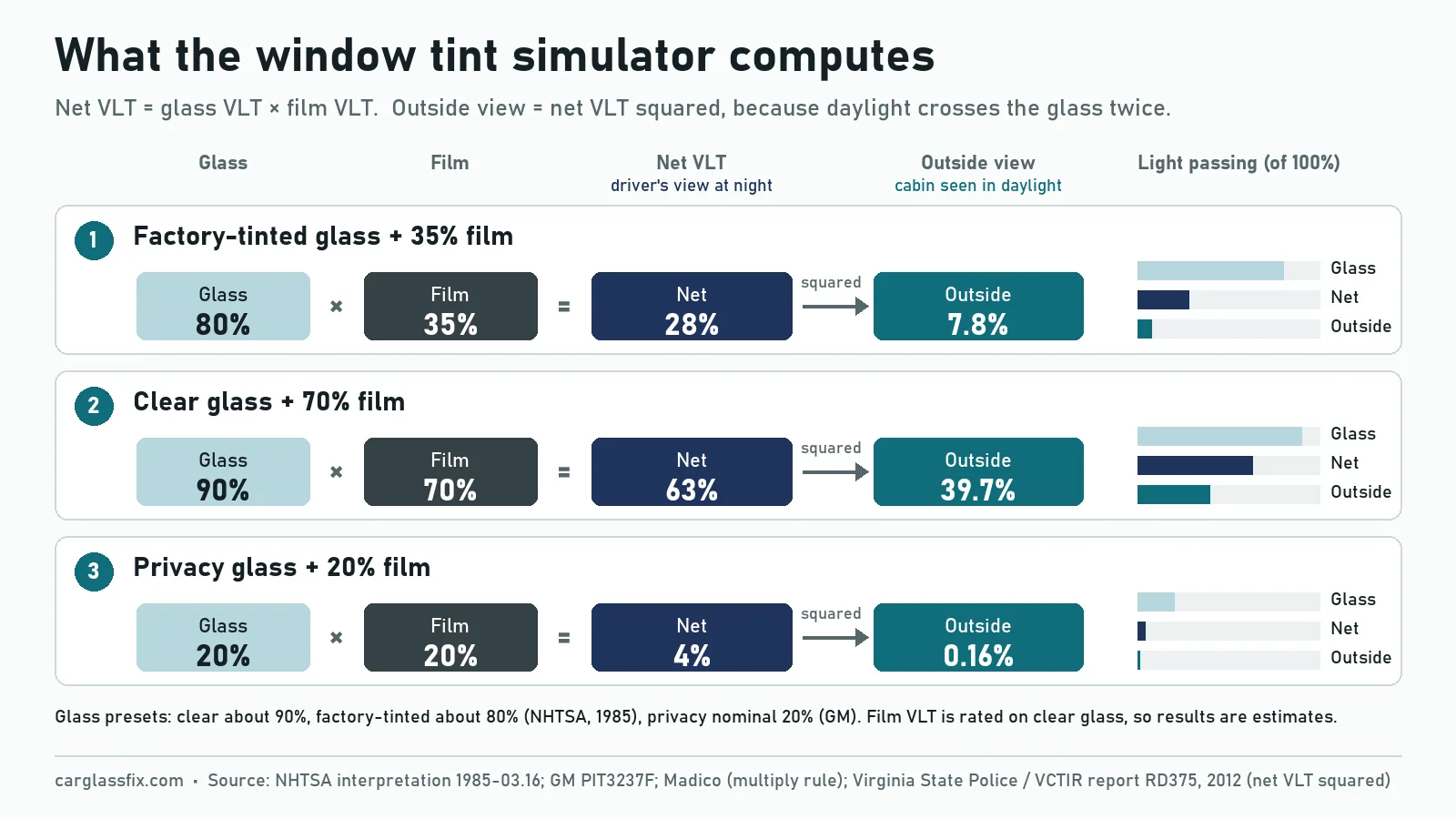
The squared step comes from a 2012 University of Virginia study for the Virginia State Police. Daylight crosses the tinted glass on the way into the cabin and again on the way back out to the viewer. In the study’s example, a 35% window returns about 12.25% of the light, and a 70% window about 49%. The same report calls the result of film over factory glass multiplicative.
NHTSA wrote in 1985 that clear windows pass about 90% of light and factory-tinted windows in new cars about 80%. GM lists its privacy glass at a nominal 20%. Film makers rate VLT on clear glass, such as LLumar’s single 1/4-inch (6 mm) pane, so the net VLT for your car is an estimate.
| Window setup | Film VLT | Glass VLT | Net VLT (glass x film) | Outside-view light (net squared) |
|---|---|---|---|---|
| No film, clear glass | None | 90% | 90% | 81% |
| Light film, clear glass | 70% | 90% | 63% | 39.7% |
| Medium film, factory-tinted glass | 35% | 80% | 28% | 7.8% |
| Dark film, factory-tinted glass | 5% | 80% | 4% | 0.16% |
| Privacy film, privacy glass | 20% | 20% | 4% | 0.16% |
For each shade from 5% to 90%, see the window tint percentage chart.
Outside in daylight vs the driver’s seat at night
The daylight view shows how private the car looks, and the night view shows how much light reaches the driver. In the daylight view, the cabin shows through at about the square of the net VLT. In the night view, a road scene appears through the chosen window at the net VLT, because light from the road crosses the glass once on its way to the driver.
The outside view has a measured effect. In the 2012 Virginia study, 299 participants played the role of an officer at a traffic stop. They placed both of a driver’s hands correctly 70.5% of the time with the lighter car and 48.3% with the darker car. The lighter car’s front side windows measured 55%, and the darker car’s measured 31%.
The night view shows brightness only. NHTSA described a study in which drivers in simulated twilight detected low-contrast targets 25 to 35 percent less well through 40% glazing than through 76% glazing. NHTSA also wrote that clear side windows are needed in darkness to use the outside mirrors and to see sideways at intersections. A dimmed picture on a screen cannot reproduce that loss of contrast. Our page on whether car window tinting reduces visibility covers the wider research.
Why the preview on your screen differs from real film
A preview differs from real film because the screen, the light, film color, the glass and reflections all change what you see. Eastman, maker of LLumar and SunTek film, states on both brands’ websites that visual renderings are for illustrative purposes only.
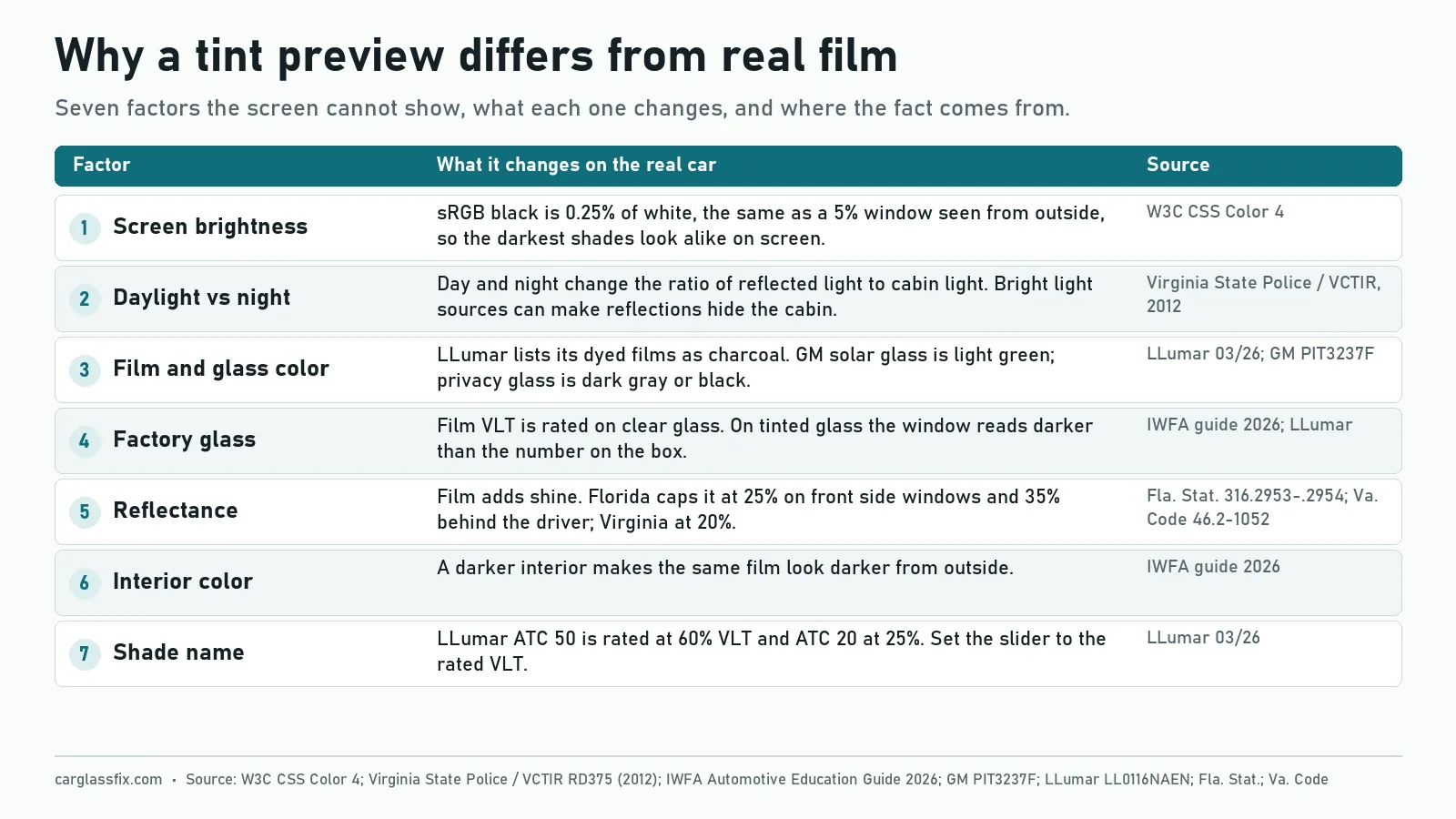
The W3C CSS Color 4 specification defines sRGB, the default color space of web pages, with a white of 80 cd/m2 and a black of 0.20 cd/m2. That black is 0.25% of the white. A 5% window returns about 0.25% to an outside viewer, so the darkest shades all hit the screen’s black floor. Brightness settings shift every shade.
Real glass also reflects. The Virginia report notes that an outside viewer sees reflected light on top of cabin light, and the reflection can mask the cabin. Florida caps film reflectance at 25% on front side windows and 35% behind the driver. Virginia bans film that reflects more than 20% of light.
GM describes its solar glass as light green and its privacy glass as dark gray or black. The International Window Film Association (IWFA) says a darker interior makes the same film look darker. Shade names can differ from ratings: LLumar’s ATC 50 is rated at 60% VLT.
What to check before you choose a shade
Check four things before you pick a shade: the state limit for each window, the meter tolerance, the windshield rule and the film’s heat rating. The simulator shows the look. The table shows the rules and data behind each check.
| Check | What the rule or data says | Source |
|---|---|---|
| State limit by window | Florida: front side windows at least 28%; on cars, windows behind the driver at least 15% (6% on multipurpose vehicles). Virginia: front side at least 50%, rear side and rear at least 35%. California: front side windows take only clear film of at least 88%, and the glass with film must still pass 70%. | Fla. Stat. 316.2953 and 316.2954; Va. Code 46.2-1052; Cal. Veh. Code 26708 |
| Meter tolerance | State tolerances average about 5%, from 3% to 7%, and some states allow none. | IWFA Automotive Education Guide 2026 |
| Windshield | Glass below the AS-1 line must pass at least 70% of light. Texas exempts windshield film only if it stays above the AS-1 line or within 5 inches of the top, whichever is closer to the top. | NHTSA interpretation 11-000697; Tex. Transp. Code 547.613 |
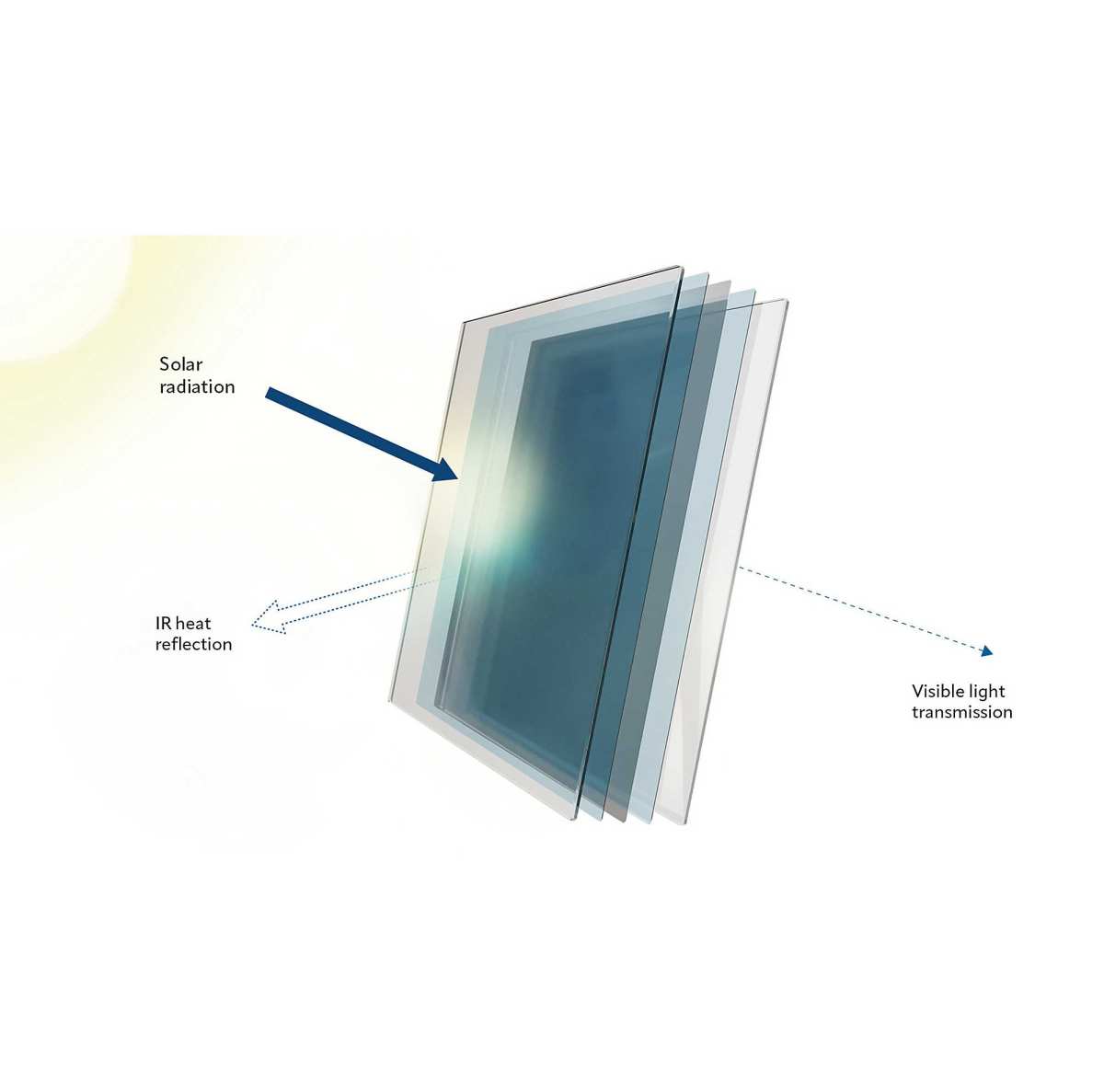
| Heat | Madico’s darkest films range from 26% to 93% infrared rejection at about the same shade. | Madico window tint simulator page |
State laws judge the window as installed. Florida tests film on the glass of the specific vehicle, which is the net VLT the readout shows. A 35% film on 80% glass gives about 28%, which leaves no margin under Florida’s front-side minimum. For every state, see what car window tint is legal. Before you set the windshield slider, read about the AS-1 line on a windshield. Heat depends on the film type, and how much ceramic car window tint costs covers the price side.
How film makers’ visualizers differ from this one
Film makers’ visualizers show their own product lines, and this simulator uses plain VLT numbers with the glass math added. 3M organizes its automotive window film simulator by film line, such as Crystalline 20 to 90 and Color Stable 5 to 50. Madico’s simulator renders a representative sedan or SUV in shades from 90% to 5%, with settings for heat, glare and privacy priorities. Madico’s own FAQ says its simulator shows daytime appearance. Ceramic Pro runs a visualizer and previews each of its films’ shades, with a note that the preview is for illustration only.
The simulator on this page adds a factory-glass setting, a net VLT readout per window, the squared outside view and a night view from the driver’s seat. None of these tools measures film on your car.
A physical sample on your own glass is the next step. On its official YouTube channel, Madico, Inc. explains how its dealers use swatch samples of film types, shades and colors to help drivers choose.
After the install, a window tint meter reads the real net VLT, and our guide on how to measure window tint explains the method. If you plan to fit the film yourself, follow how to install car window tint.
Frequently asked questions
Is there a window tint simulator app?
The simulator on this page runs in a web browser, so you do not need to install an app. Film makers 3M, Madico and Ceramic Pro also offer online visualizers for their own films.
Can I see window tint on a photo of my own car?
Yes. In photo mode you upload a picture, paint over the windows with the brush and pick a shade. The photo never leaves your device, and the download saves the result with a small carglassfix.com mark.
How accurate is a window tint simulator?
A simulator shows relative darkness and does not measure anything. Screens, photos and eyes differ, and real film also has a color and reflects light. Only a meter reading on the installed window gives the net VLT.
What does 30% tint look like on a car?
On factory-tinted glass at about 80%, a 30% film gives a net VLT of about 24%, and an outside viewer sees about 6% of the cabin’s light. See what 30% car window tint looks like for more detail.
Does a darker shade keep the car cooler?
Not by itself. LLumar rates its 77% AIR 80 clear film at 43% total solar energy rejection and its 5% ATC 05 dyed film at 44%, so the film type matters more than the shade.
Sources
- NHTSA interpretation 1985-03.16, FMVSS 205 light transmittance (letter of 11 July 1985) (checked 24 October 2026)
- NHTSA interpretation 11-000697, AS-1 line and windshield tint (2011) (checked 24 October 2026)
- Federal Register 63 FR 10964, NHTSA, Fleetwood Enterprises inconsequential noncompliance (1998)
- Virginia State Police and VCTIR, Safety and Visibility Issues Associated with Motor Vehicle Window Transmittance and Aftermarket Window Tinting (RD375, 2012)
- GM Preliminary Information PIT3237F, glass UV protection and tint percentage (2012)
- Madico: Mastering Tint Percentage Guide
- Madico: Car Window Tint Simulator
- 3M: Automotive Window Film Simulator
- Ceramic Pro: Visualizer and Ceramic Pro: Automotive Window Tint
- LLumar (Eastman): Window Tint and Paint Protection Film Simulator
- LLumar Window Film Performance Data, LL0116NAEN (03/26)
- International Window Film Association: Automotive Education Guide 2026
- W3C: CSS Color Module Level 4, predefined sRGB color space
- Florida Statutes 316.2953 and 316.2954 (2025 statutes, checked 24 October 2026)
- Code of Virginia 46.2-1052 (checked 24 October 2026)
- California Vehicle Code 26708 (checked 24 October 2026)
- Texas Transportation Code 547.613 (checked 24 October 2026)

Similar Posts