How to Measure Window Tint? With or Without a Meter
Senior Automotive Glass Diagnostic Specialist & Master Technician at CarGlassFix · AGSC Master Certified Auto Glass Technician, NGA Certified Installer, I-CAR Automotive Safety Specialist · 12+ Years in Automotive Glazing, Windshield Structural Bonding, ADAS Camera Calibration & Precision Chip Restoration
To measure window tint, clean the glass and read it with a tint meter. A one-piece meter slides over a lowered side window, and a two-piece meter clamps both faces of a windshield or fixed window. The display shows the visible light transmission (VLT) of the glass and film together, the number most state tint limits use.
As an Amazon Associate, CarGlassFix earns from qualifying purchases. The picks below come from the makers’ published specifications, not from our own testing.
What a window tint reading measures
A tint reading measures visible light transmission (VLT), the share of visible light that passes through the window. A lower number means a darker window. A 20% reading passes 20% of the light, so it is darker than a 35% reading. The reading always covers the glass and the film together. The International Window Film Association (IWFA) says film is almost impossible to measure alone once it is installed, so most state laws set a “net” VLT for the combination.
State rules spell this out. Texas measures film in combination with the vehicle’s original glass, and Florida tests it on the glass of the specific vehicle. Laser Labs and EDTM, two US meter makers, send light at 550 nanometers through the glass and compare what arrives with what was sent. For how film cuts light and heat in the first place, see how car window tint works.
Why the reading is darker than the film’s number
The reading is darker because the glass blocks some light before the film does. Net VLT is close to the film’s VLT multiplied by the glass’s VLT, the rule that Madico, a window film maker, gives. A 35% film on glass that passes 80% gives 0.35 × 0.80 = 0.28, or about 28%. Florida’s front side minimum is 28%, so that result sits exactly on the limit. The window tint percentage chart shows what each shade looks like.
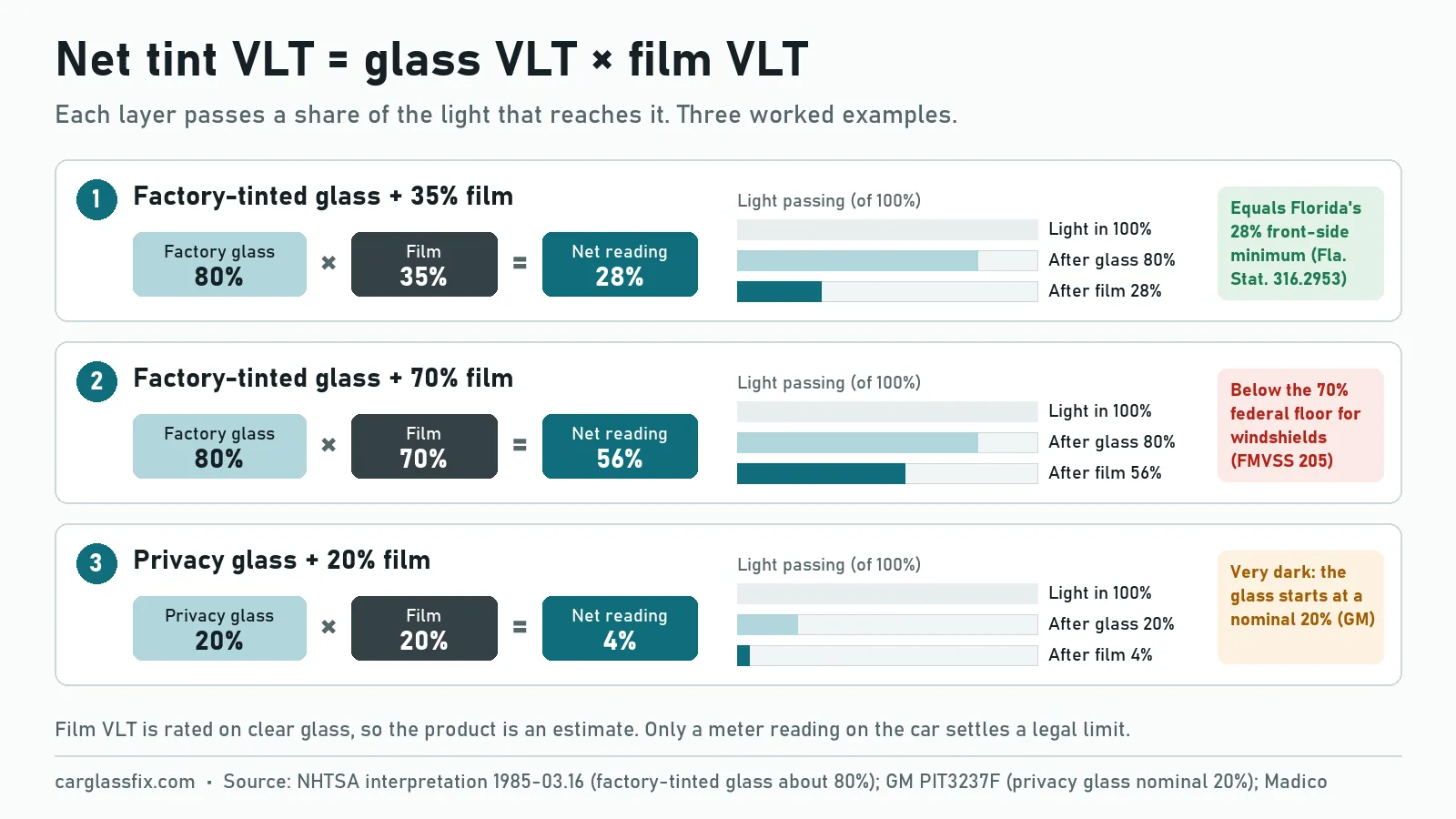
NHTSA wrote in 1985 that clear windows pass about 90% of light and factory-tinted windows in new vehicles about 80%. FMVSS 205 sets a 70% floor for the windshield and the other windows needed for driving visibility. GM lists its windshields and front door glass at 70% or more and its privacy glass at a nominal 20%. Glass maker AGC offers privacy glass from 4.5% to 40%. To tell which glass your car has, read what privacy glass on a car is.
| Glass under the film | 70% film | 50% film | 35% film | 20% film | 5% film |
|---|---|---|---|---|---|
| Clear glass, about 90% (NHTSA, 1985) | 63% | 45% | 31.5% | 18% | 4.5% |
| Factory-tinted glass, about 80% (NHTSA, 1985) | 56% | 40% | 28% | 16% | 4% |
| Federal floor, 70% (FMVSS 205) | 49% | 35% | 24.5% | 14% | 3.5% |
| Privacy glass, nominal 20% (GM) | 14% | 10% | 7% | 4% | 1% |
Treat the product as an estimate. Film makers rate VLT on clear glass, and SunTek’s sheet uses 1/4-inch (6 mm) clear glass. The film’s number already includes one clear pane, so multiplying it by your car’s glass can understate the real reading. Only a reading on the car settles a legal question.
How to measure window tint with a tint meter
A tint meter gives the reading that inspectors and police rely on, and the window decides which type you need. A one-piece meter has a slot that slides over the top edge of a roll-down window. Laser Labs says its one-piece Enforcer II works on roll-down windows. A two-piece meter puts a light unit and a sensor unit on opposite faces of the glass, lined up by magnets. Only a two-piece meter can read a windshield, a rear window or fixed side glass. Laser Labs and EDTM publish these steps for their meters:
How to measure window tint with a tint meter
Pick the meter for the window
Use a one-piece meter on roll-down side windows. Use a two-piece meter on the windshield, the rear window and any glass that does not roll down.
Clean the glass
EDTM warns that dirty glass can affect the accuracy of the result.
Check the meter
On a two-piece meter, hold the halves together with no glass between them until it reads 100. Then test a reference sample: Laser Labs says the meter is set if it reads within two points of the sample’s number.
Place the meter
Lower a roll-down window partway and slide the one-piece slot over its top edge. For a two-piece meter, fix the reflector unit inside the glass with its suction cups and hold the instrument unit outside, where the magnets line them up.
Choose a flat spot
EDTM advises a flat area away from curved edges and the frame. On rear glass, keep the suction cups off the defroster lines, or they will not stick.
Read and repeat
The display shows the VLT of glass and film together. Take a second reading to confirm it, and measure each window on its own.
On a windshield, measure in the main viewing area below the AS-1 line. NHTSA says FMVSS 205 sets no transmittance limit for the shade band above that line. Our guide to the AS-1 line on a windshield shows how to find the mark.
EDTM, the maker of Tint-Chek meters, shows the two-piece method on a car’s rear window in this video from its official YouTube channel.
Can a phone app measure window tint?
A phone app can only estimate window tint. The tint apps we checked compare a light reading through the glass with one taken without it and show the ratio as VLT. The HighApps Tint Meter app on Google Play takes one reading with the window up and one with it down. Its own listing says “Tint Meter is an estimate only.” It warns against legal use and says results vary by device, sensor placement, lighting and method.
The limit is the sensor. On Android, the light sensor reports illuminance in lux. Google’s developer guide says most device makers use it to control screen brightness. A meter, by contrast, sends its own beam of light through one spot of glass. On iPhone, Apple’s documented route to ambient light data, SensorKit, needs an entitlement for an Apple-approved research study and holds new data for 24 hours. The iPhone app Window Tint Meter by CODIGITAL SOLUTIONS says it uses the device’s light sensors but gives no accuracy figure. EDTM, a meter maker, says apps are “not considered legally reliable.” We found no app listing that publishes a tested accuracy figure.
How to check window tint without a meter
Without a meter you can only estimate window tint, and the best estimate starts with the installer’s paperwork. Texas requires a label between the film and the lower rear corner of the driver’s window. Florida requires one on the inside of the left door jamb, naming the film and the installer. An invoice or warranty card may name the film’s shade.
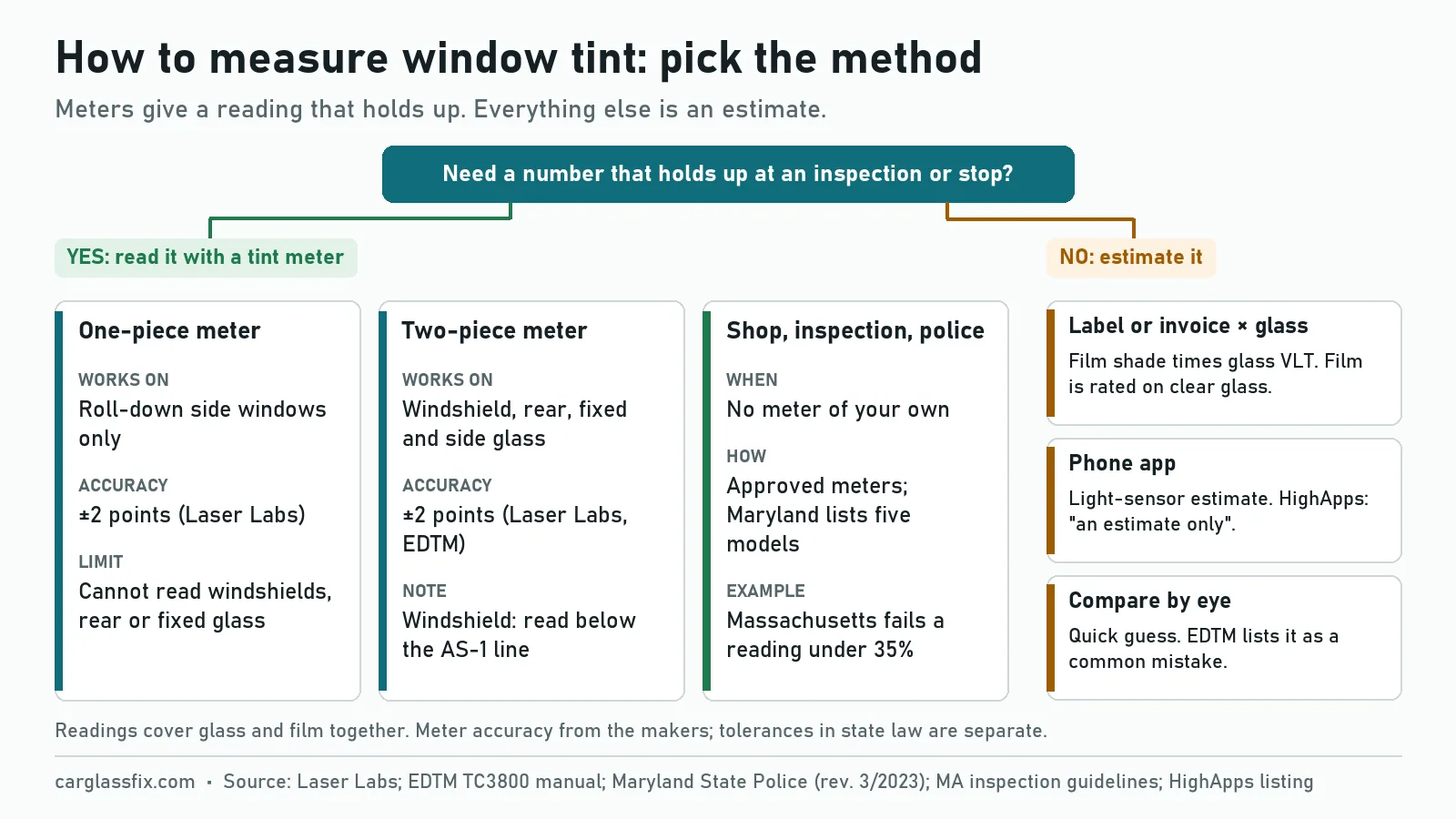
Next, estimate the glass. GM’s service information says light green glass is solar glass at 70% or more, and dark gray or black glass is privacy glass at a nominal 20%. Multiply the film’s shade by that figure, as in the table above. Comparing your window with a car of known tint gives a rough check, and photos of what 30% car window tint looks like can help. EDTM lists “relying on visual judgment” as a common measuring mistake, so treat an eye estimate as a guess.
The surest way to check window tint percentage at home is a borrowed or bought meter. The next best is a tint shop, since the IWFA says shops should have hand-held meters. Film you put on yourself is measured the same way, so check it after you install car window tint.
Tolerances, inspections and police checks
Official checks use the same kind of meter, and many rules allow a small margin for meter error. The IWFA says state tolerances average about 5% and range from 3% to 7%, while some states allow none. Tolerance matters most when a reading lands near the limit, like the 28% example above in Florida.
| Who measures | What the rule or agency says | Source |
|---|---|---|
| Florida | Every percentage measurement in the tint statutes carries a tolerance of plus or minus 3 percent. A reading from an approved device is presumed accurate. | Fla. Stat. 316.2955 |
| Ohio | Windshield film: 70%, plus or minus 3%, with the glass. Front side windows: 50%, plus or minus 3%. | Ohio Admin. Code 4501-41-03 |
| Massachusetts inspection | The car fails if the inspector’s tint meter reads under 35%. The reading covers the window and the film. | MA aftermarket tint guidelines |
| Maryland inspection | Only five listed meters are approved, including the Laser Labs Inspector II and EDTM Tint-Chek Pro. | Maryland State Police, rev. 3/2023 |
| Texas | Windshield film only above the AS-1 line, passing 25% or more with the glass. | 37 Tex. Admin. Code 21.3 |
The meters carry a similar margin. Laser Labs and EDTM rate theirs at plus or minus 2 points, and the Pocket Detective sheet lists plus or minus 2% of full scale. California limits both layers: front side film must pass at least 88%, and the window must still pass 70% with the film on. An 88% film on 80% glass gives about 70%. Each state’s limits are in what car window tint is legal. Windshield rules are in is it illegal to have tint on your windshield, and California’s are in is car window tint legal in California.
If you want your own meter
A meter of your own makes sense if you check several cars or want a number before an inspection. We chose these from the makers’ specifications, the Maryland State Police list of approved inspection meters and current availability on Amazon. We have not tested them. Check the current price on Amazon.
| Meter | Type | Works on | Maker’s stated accuracy | Amazon |
|---|---|---|---|---|
| Laser Labs Enforcer II | One-piece | Roll-down side windows only | Plus or minus 2% (Laser Labs) | Check Laser Labs Enforcer II on Amazon |
| Laser Labs Inspector II TM2000 | Two-piece | All windows, glass up to 1/2 inch thick | Plus or minus 2% (Laser Labs, all its meters) | Check Laser Labs Inspector II on Amazon |
| EDTM TC3800 Tint-Chek PRO | Two-piece | Windshield, rear and side glass up to 1/4 inch (6.5 mm) | Plus or minus 2 points, 1-point repeatability (EDTM) | Check EDTM Tint-Chek PRO on Amazon |
- Laser Labs Enforcer II: a pocket one-piece meter that Laser Labs built for patrol use, with 550 nm light and two NIST-traceable reference samples. It cannot read a windshield or fixed glass. It suits owners who only check front door windows. Check Laser Labs Enforcer II on Amazon
- Laser Labs Inspector II TM2000: a two-piece meter for every window, and on Maryland’s approved list. Laser Labs says ambient light does not affect it. It suits anyone who needs the windshield or rear glass. Check Laser Labs Inspector II on Amazon
- EDTM TC3800 Tint-Chek PRO: a two-piece meter on Maryland’s list, with a 0.1% display and reference standards near 27% and 59%. It takes glass up to 1/4 inch thick. It suits shops and frequent users. Check EDTM Tint-Chek PRO on Amazon
Frequently asked questions
Is there an app to measure window tint?
Yes, but phone apps only estimate VLT from the phone’s light sensor. The HighApps Tint Meter listing calls its result an estimate only, so use a calibrated meter for any reading that matters.
What do cops use to measure window tint?
Police use handheld tint meters. Laser Labs, for example, sells its Enforcer II for patrol cars, and Florida law presumes a reading from an approved device accurate. State limits are listed in what car window tint is legal.
Is 35% or 20% tint darker?
20% tint is darker. The number is the share of light that passes through, so a 20% window lets in less light than a 35% window.
Can a one-piece tint meter read a windshield?
No. A one-piece meter slides over a free glass edge, so it works only on roll-down windows. Windshields, rear windows and fixed glass need a two-piece meter.
How accurate is a tint meter?
Laser Labs and EDTM rate their meters at plus or minus 2 points. Both include reference samples, and a meter that reads within 2 points of a sample’s printed value is set.
Sources
- International Window Film Association: Automotive Education Guide 2026, pages 40 and 41
- NHTSA interpretation 1985-03.16 on FMVSS 205 light transmittance and NHTSA interpretation 11-000697 on the AS-1 line (2011) (checked 24 October 2026)
- FMVSS 205, Glazing materials, 49 CFR 571.205 (checked 24 October 2026)
- GM Preliminary Information PIT3237F: Glass UV Protection and Tint Percentage (October 2012)
- AGC Automotive: Privacy Glass
- Madico: Mastering Tint Percentage Guide
- SunTek (Eastman): Automotive Window Film Specifications
- Laser Labs: Enforcer II, Inspector II, How to use
- EDTM: TC3800 Tint-Chek PRO manual and Window tint meter: how to measure VLT
- Maryland State Police: Division Approved Window Tint Meters (rev. March 2023)
- Massachusetts Vehicle Check: Aftermarket Window Tint Guidelines
- Mississippi DPS: Official Window Tint Inspection Station application, with the Pocket Detective specifications
- Florida Statutes 316.2953 and 316.2955 (2025, checked 24 October 2026)
- Ohio Admin. Code 4501-41-03 and 37 Tex. Admin. Code 21.3 (checked 24 October 2026)
- California Vehicle Code 26708 (checked 24 October 2026)
- Android Developers: Environment sensors and Apple Developer: SensorKit entitlement and SRFetchRequest
- App listings: HighApps Tint Meter on Google Play and Window Tint Meter by CODIGITAL SOLUTIONS on the App Store (checked 24 October 2026)

Similar Posts