Windshield Frit: What the Black Band and Dots Do
Senior Automotive Glass Diagnostic Specialist & Master Technician at CarGlassFix · AGSC Master Certified Auto Glass Technician, NGA Certified Installer, I-CAR Automotive Safety Specialist · 12+ Years in Automotive Glazing, Windshield Structural Bonding, ADAS Camera Calibration & Precision Chip Restoration
Windshield frit is the black ceramic enamel band and dot pattern printed around the edge of a windshield and fused into the glass during bending, at about 600 to 740°C (1,112 to 1,364°F). The band blocks UV light from the urethane that holds the glass, hides the bead, and fades into dots that limit distortion from uneven heating.
What windshield frit is and how it is made
Windshield frit is a black ceramic enamel printed onto the glass and fused into its surface. Glass maker AGP America describes it in a 2017 patent as a mix of pigments, a carrier, binders and finely ground glass. Additives tune its firing temperature, chemical resistance and anti-stick behavior. It is printed with a silk screen or an ink-jet printer while the glass is flat.
During bending, the ground glass in the paste softens and fuses with the glass surface, a step the industry calls firing. A 2007 Johnson Matthey patent puts the bending temperature at about 600 to 740°C (1,112 to 1,364°F). Enamel maker Fenzi AGT says a pre-fire at about 500°C (932°F) usually burns off the paste’s organic part first.
A laminated windshield has four glass faces, numbered from the outside in. Enamel maker Vibrantz says its heavy-metal-free enamels are used on surface 2, the inner face of the outer sheet, and surface 4, the face toward the cabin. Other marks on the glass are explained in what is the sticker on my windshield.
| Term you may see | What it means | Source of the term |
|---|---|---|
| Frit band, black band | The solid black enamel border around the glass | AGP America patent |
| Dot matrix, dot fadeout | Rows of smaller and smaller dots between the band and clear glass | AGP patent; Gila and Avery Dennison film instructions |
| Third visor frit | A field of dots above the rearview mirror, between the sun visors | Mercedes-Benz patent; glass part listings |
| Obscuration | Any printed opaque area, including camera surrounds | AGP and Johnson Matthey patents |
| Burn line | Optical distortion along the inner edge of the black band | AGP patent |
| Surface 2, surface 4 | The inner face of the outer sheet, and the face toward the cabin | Vibrantz; AGP patent |
What the frit band does
The solid black band protects the adhesive bond, hides it from view, and covers wiring and sensor connections. AGP’s patent says the band became common in the 1980s, when the industry moved from rubber H-channel and butyl-strip mounting to polyurethane adhesive. The older mountings often let the windshield come loose in a crash.
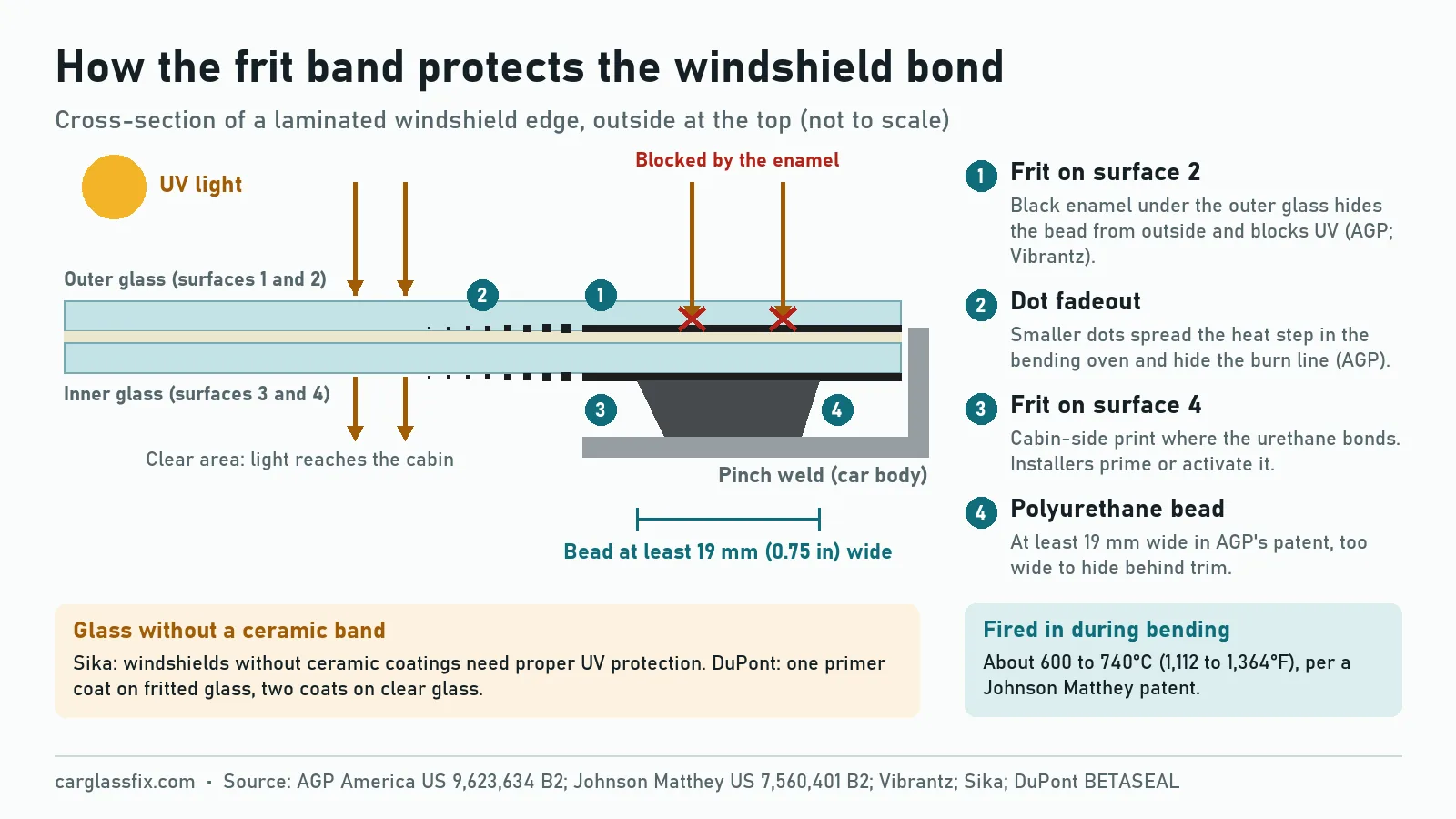
Polyurethane needed a wider bead than butyl to reach the required strength. AGP gives a minimum bead width of 19 mm (0.75 in), which is too wide to hide behind a trim molding. Polyurethane also needs protection from ultraviolet light to prevent degradation. The black band solved both problems.
| Job | How the frit does it | Who says so |
|---|---|---|
| Blocks UV light from the urethane | Opaque enamel sits over the bond line | AGP and Johnson Matthey patents; Vibrantz |
| Hides the adhesive bead | Covers a bead at least 19 mm (0.75 in) wide | AGP patent |
| Hides silver lines and connections | Conceals bus bars, antennas, heater and sensor connections | Johnson Matthey patent; Vibrantz |
| Gives the adhesive a known surface | Adhesive makers publish their own prep for ceramic-coated glass | DuPont BETASEAL; Sika |
| Softens the edge | Dots fade from solid black to clear | AGP patent |
Glass without a ceramic band needs another form of protection. Sika’s data sheet for SikaTack Global 30 says windshields without ceramic coatings need proper UV protection. Vibrantz says UV absorption from sunlight can crack or degrade the materials that hold windows in place. A glass-maker source quoted by Jalopnik in 2017 added that the band gives the adhesive a rougher surface to grip.
Why the band fades into dots
The dots smooth out the temperature difference between black and clear glass while the windshield is bent. Black enamel absorbs heat better than clear glass, so the printed area runs hotter. AGP’s patent says the abrupt change causes optical distortion along the inner edge of the band, which the industry calls the burn line.
Rows of smaller and smaller dots work like grayscale printing and spread the temperature change over a wider strip. The dots also hide the distortion that remains. AGP notes that a wide fadeout is not always allowed, because the size of the opening and driver-vision rules limit how far the print can reach.
Frit also changes the glass itself. AGP says fired frit adds microscopic surface flaws that weaken the glass, and the hotter band cools last during annealing, which leaves residual stress. Its tests compare frit with a black area printed on the plastic interlayer instead.
| Measure (AGP test data) | Black enamel frit | Printed interlayer |
|---|---|---|
| Fracture strength, ring-on-ring | 60 MPa | 115 MPa |
| Distortion in a camera window, 5 mm (0.2 in) from the black edge | 150 millidiopters | 25 millidiopters |
| Double image at the same point | 20 arc minutes | 3 arc minutes |
AGP puts the smallest practical screen-printed feature at 0.3 to 0.5 mm (about 0.01 to 0.02 in). Other causes of wavy glass are in what causes windshield distortion.
Third visor frit: the dots behind the mirror
The third visor frit is the field of black dots at the top center of the windshield, above the rearview mirror and between the two sun visors. It shades the gap that the folded-down visors leave open. Mercedes-Benz patented one version in the US in 1994 as a fixed replacement for a swiveling third sun visor.
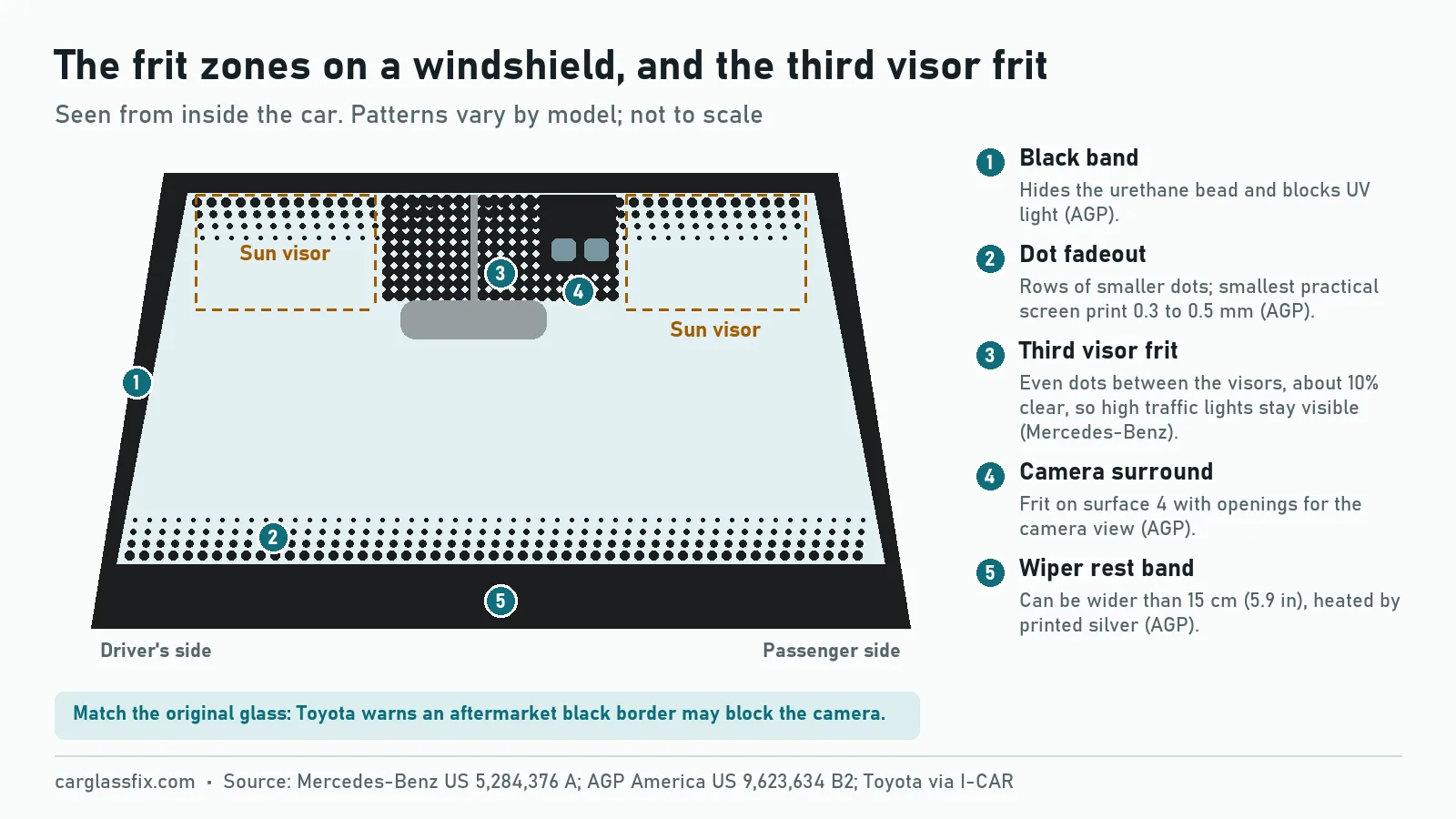
In that patent, the dots are spread evenly so that about 10% of the covered area stays clear. Mercedes-Benz found that this value blocks dazzling sun while the driver can still see high-mounted traffic lights change. The patent prints the dot field in the same screen-printing pass as the black band and the fading dots, which keeps the cost low.
AGP’s patent says rain sensors and cameras mount in this zone, inside the wiped area, and the frit is extended down on surface 4 with openings for each camera’s view. Toyota warns that the black ceramic border on aftermarket glass may not let the camera see through properly. To check your car, read how to tell if your windshield has a camera behind it.
What frit means for a windshield replacement
In a replacement, the new urethane bead runs along the frit band, so the installer prepares that strip with the adhesive maker’s products. AGRSS 005-2022, the US replacement standard, requires technicians to follow the adhesive maker’s application instructions in section 6.1. Section 6.5 requires the finished bead to match the original equipment profile and dimensions, or the adhesive maker’s recommendation.
Adhesive makers write different steps for fritted and clear glass. DuPont’s BETASEAL sheet calls for one coat of BETAPRIME 5504G on fritted glass and two coats on clear glass without frit. DuPont’s primerless BETASEAL U-418 and U-418HV urethanes are designed to form the same chemical bonds to clean frit that the primer does. Sika’s 2026 guideline treats float glass and ceramic-coated glass with one product, Sika Aktivator-317. The steps below combine both makers’ instructions.
How installers prepare the frit for a new windshield bond
Match the glass
Compare the new windshield’s frit, camera openings and brackets with the original. AGRSS section 5.6 requires glass compatible with the car’s driver assistance systems.
Clean the bonding area
Sika cleans with Sika Cleaner G+P and scrubs remaining dirt with Sika Cleaner PCA. DuPont uses BETABRADE F1 and BETACLEAN GC-800.
Activate or prime the frit
Sika wipes on Aktivator-317 in one direction and waits at least 3 minutes, or 10 minutes below -5°C (23°F). DuPont applies one wet coat of 5504G and waits 2 minutes at 20°F (-7°C) and above.
Watch the time limit
DuPont says to reprime the glass if it is not installed within 24 hours, and never more than once.
Apply the bead
Sika lays a triangular bead that must touch both the prepared glass and the fresh-cut old urethane on the body.
Set the glass
Sika sets the glass within the adhesive’s open time and allows only small adjustments after contact.
If a camera sits behind the frit, calibration comes next, as described in ADAS calibration and windshield replacement. Warning signs after the job are listed in signs of a poor car glass replacement job.
Can frit be removed or tinted over?
Frit cannot be removed from the glass, because the enamel is fused into the surface during bending. AGP’s patent notes that dissolving the black pigment with chemicals leaves a frosted surface, like sandblasted glass. Search results for windshield frit removal mostly show tint removal. Film and stick-on visor strips are separate layers that do come off, and the method is in how to remove car window tint.
Window film is trimmed to the frit, and its edge often overlaps the black print. Avery Dennison’s 2026 installation bulletin tells installers to let the film cover the ceramic dots of fixed glass by 2 mm. On curved rear glass, it trims the film 2 to 3 mm over the solid part of the dot-matrix print. Gila’s rear-window instructions use the dot-matrix border as the cutting template. The full steps for side and rear glass are in how to install car window tint.
Frequently asked questions
What is a windshield frit?
It is the black ceramic enamel border and dot pattern around the edge of a windshield. The enamel is printed on the flat glass and fused into it when the glass is heated and bent.
Why do windshields have frits?
The band blocks UV light from the polyurethane that holds the glass in place and hides the adhesive bead from outside. The dots spread the heat difference during bending and hide the distortion at the band’s edge.
What does third visor frit mean in a windshield listing?
It means the glass has the dot field above the rearview mirror that shades the gap between the sun visors. Glass listings name it as a feature, as OER does for its 2000 to 2004 Mustang windshield. Ask for glass with the same frit as the original, and compare OEM vs aftermarket glass for car replacement.
Can you remove frit from a windshield?
No. The enamel is fused into the glass surface, and AGP’s patent says dissolving it leaves frosted glass. Tint film and stick-on visor strips are separate layers and can be removed.
Do side and rear windows have frit?
Many do. The Johnson Matthey patent describes obscuration enamel on windshields, side windows and rear windows, where it also hides silver bus bars and antennas. Vibrantz makes these enamels for both tempered and laminated glass.
Sources
- AGP America, US 9,623,634 B2, Obscuration having superior strength and optical quality for a laminated automotive windshield (granted 18 April 2017)
- Mercedes-Benz AG, US 5,284,376 A, Motor vehicle windscreen having strip-shaped opaque dot pattern (granted 8 February 1994)
- Johnson Matthey, US 7,560,401 B2, Frits and obscuration enamels for automotive applications (granted 14 July 2009)
- Vibrantz: coatings and enamels for automotive glass and automotive glass enamels for laminated glass
- glassonweb: Innovative Fenzi AGT technology for auto-industry specific enamels
- ANSI/AGSC/AGRSS 005-2022, Automotive Glass Replacement Safety Standard, sections 5.6, 6.1 and 6.5 (checked 24 October 2026)
- Sika: Clear Aktivator Process, auto glass replacement installation guideline (01.2026)
- Sika Canada: SikaTack Global 30 product data sheet (version 02.01, December 2024)
- DuPont: BETASEAL primerless-to-glass adhesive data sheet (form 001-20131-OIA0519, 2019)
- I-CAR Repairability Technical Support: Toyota/Lexus/Scion glass replacement requirements (validated 2024)
- OER: DW1517 2000-2004 Mustang windshield with third visor frit
- Avery Dennison: Instructional Bulletin 7.1, automotive window film installation (15 January 2026)
- Gila: rear window strips installation instructions
- Jalopnik: Here’s what those black dots at the edge of your windshield actually do (3 February 2017)

Similar Posts