Do Blind Spot Mirrors Work? What Geometry and Studies Show
Senior Automotive Glass Diagnostic Specialist & Master Technician at CarGlassFix · AGSC Master Certified Auto Glass Technician, NGA Certified Installer, I-CAR Automotive Safety Specialist · 12+ Years in Automotive Glazing, Windshield Structural Bonding, ADAS Camera Calibration & Precision Chip Restoration
Blind spot mirrors work for one job: showing that a vehicle is in the zone a flat side mirror misses. The convex glass widens the view but shrinks the image, so drivers judge the other car as farther away than it is. No published study shows that stick-on mirrors cut crashes, and a shoulder check is still needed.
Do blind spot mirrors work?
Blind spot mirrors work as a presence detector: they show that something is beside the car, but they are poor at showing how far away it is. An add-on blind spot mirror is a small convex mirror stuck or clipped onto the existing side mirror. Its curved surface reflects a wider slice of the adjacent lane than the flat glass around it.
The engineering literature supports that job and warns against a second one. George Platzer, the inventor of several blind zone mirror patents, writes that a convex spot gives a wide field of view at the cost of a smaller image. He calls that acceptable only if the mirror is used to see that a vehicle is present, not to judge its distance or closing speed.
The safety evidence is thinner than the marketing. No study of stick-on mirrors and crash rates turned up in the research for this page. The nearest data comes from Finnish cars with factory convex driver mirrors and from US crash studies of electronic blind spot monitoring. Both are covered below.
| Question | Short answer | Basis |
|---|---|---|
| Does it show more of the next lane? | Yes, if it is aimed at the blind zone | Platzer geometry (SAE 950601, US patent 6,315,419) |
| Does it show true distance? | No, objects look smaller and farther away | UMTRI studies, 1997 and 1998 |
| Is it legal to add one? | FMVSS 111 sets rules for the car maker’s mirrors, not for owner add-ons | 49 CFR 571.111; 49 U.S.C. 30122 |
| Is there crash data for add-ons? | None found | Closest: Finnish UMTRI-94-34 study |
| Does it replace a shoulder check? | No | Platzer; Flannagan, Sivak and Traube (SAE 1999) |
How a convex blind spot mirror widens the view
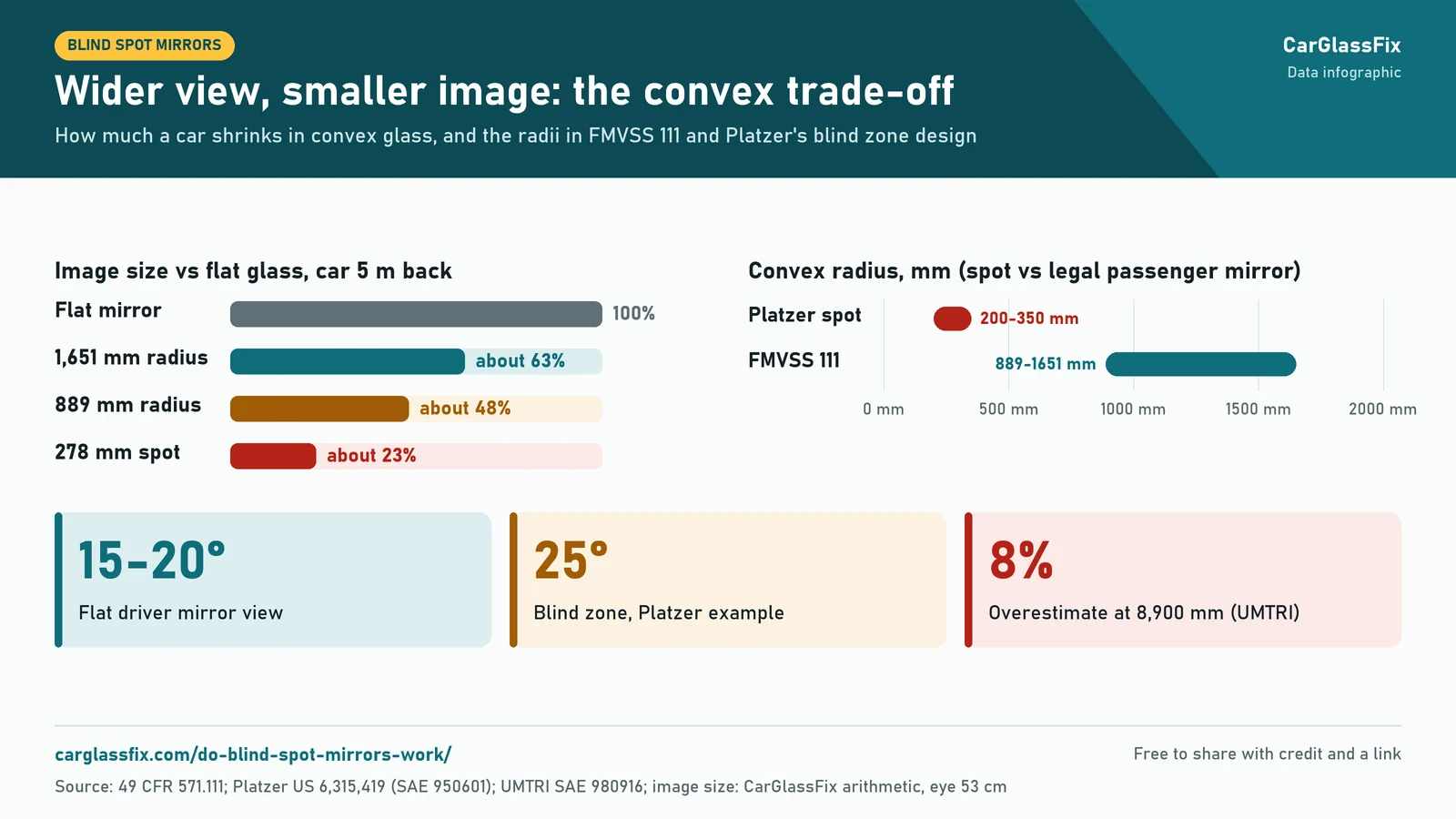
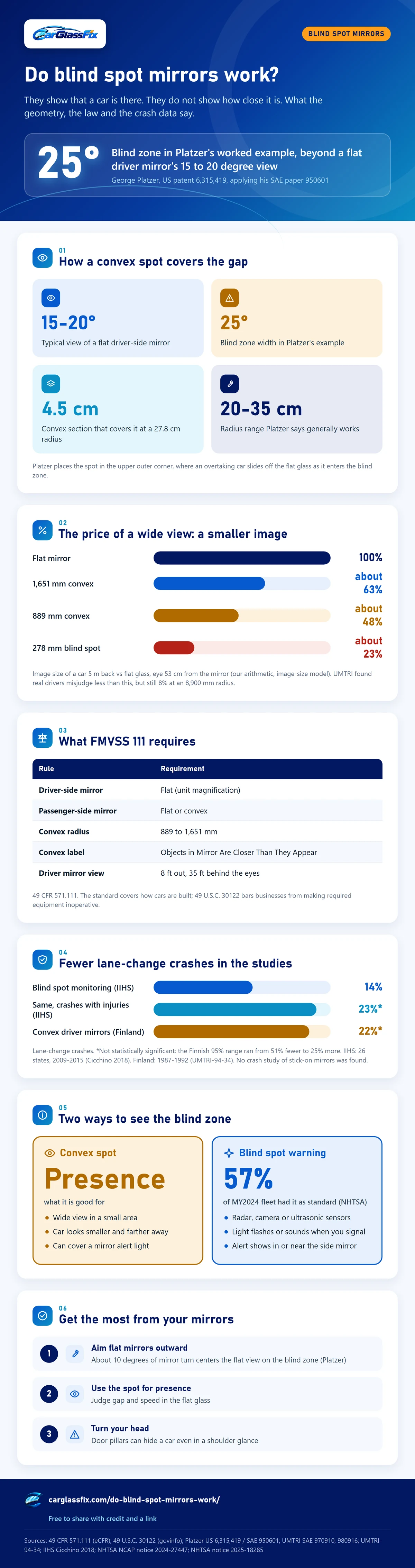
A convex blind spot mirror widens the view because each part of its curved surface faces a slightly different direction, so the mirror reflects a wider fan of the road than flat glass of the same size. The diagram shows the numbers behind that fan.
What a flat side mirror covers
A flat driver-side mirror covers a narrow wedge of about 15 to 20 degrees. That figure comes from Platzer’s 2001 patent, which applies the equations of his 1995 SAE paper 950601, “The Geometry of Automotive Rearview Mirrors”. Federal Motor Vehicle Safety Standard (FMVSS) 111 only requires the mirror to show a point on the road 8 ft (2.4 m) out from the side of the car and 35 ft (10.7 m) behind the driver’s eyes. Platzer calculates that this point sits about 11.5 degrees off the car’s side for almost any passenger car.
The blind zone is the gap between the mirror’s wedge and the edge of the driver’s side vision. In Platzer’s worked example that gap is about 25 degrees wide. He notes that the choice of 25 degrees is partly subjective, because peripheral vision varies. He cites research showing side vision reaching 88 degrees from straight ahead at age 20 and 75 degrees at age 70.
How much curve a blind spot mirror needs
A small convex section needs a tight curve to cover a 25 degree blind zone. Platzer’s example uses a section 4.5 cm (about 1.8 in) wide and calculates a radius of 27.8 cm (about 11 in). He states that a radius between 20 and 35 cm will generally work, depending on the vehicle. That is much tighter than the 889 mm minimum FMVSS 111 sets for a factory convex passenger mirror.
Why a round spot shows more than the blind zone
A round stick-on spot is a full bullseye, so it also reflects the side of your own car, the sky and the road surface. Platzer calls that extra content distracting and extraneous. His patented design keeps only the part of the sphere that points at the blind zone. Removing the rest lets the remaining segment use a gentler radius, which gives a larger image in the same space.
The trade-off: objects look smaller and farther away
Convex mirrors make other vehicles look farther away than they are, and the tighter the curve, the stronger the effect. This is why FMVSS 111 requires every factory convex mirror to carry the words “Objects in Mirror Are Closer Than They Appear”. The letters must be 4.8 to 6.4 mm high at the lower edge of the glass.
What UMTRI measured
Researchers at the University of Michigan Transportation Research Institute (UMTRI) tested distance judgments with convex mirrors through the 1990s. Michael Flannagan, Michael Sivak and Eric Traube reviewed the studies in SAE paper 970910 (1997). Every quantitative study found that convex mirrors caused overestimation of distance. The overestimation was smaller than a simple image-size model predicts. Mirrors with tighter curves caused more of it, and mirrors up to 2 m radius still caused substantial overestimation.
A 1998 UMTRI field study (SAE 980916) tested gentler radii. Overestimation kept falling as the radius grew past 2,000 mm. At 8,900 mm it was still 8%, which the authors said was not small enough to dismiss. A third UMTRI report (UMTRI-97-32) found more overestimation when the mirror sits farther from the eyes, as a passenger-side mirror does.
How much smaller the image gets
The table shows how big a car 5 m (16 ft) behind the mirror looks in convex glass compared with flat glass. The figures are CarGlassFix arithmetic from the standard mirror equation, using the 53 cm (21 in) eye-to-mirror distance in Platzer’s example. They follow the image-size model only. UMTRI found that real drivers misjudge distance less than this model predicts, so the table shows the direction and scale of the effect, not a driver’s actual error.
| Mirror | Radius | Image size vs flat glass |
|---|---|---|
| Flat driver mirror (FMVSS 111) | None (flat) | 100% |
| Gentlest legal convex passenger mirror | 1,651 mm (65 in) | About 63% |
| Tightest legal convex passenger mirror | 889 mm (35 in) | About 48% |
| Blind zone spot in Platzer’s example | 278 mm (11 in) | About 23% |
The practical rule follows from both sources. Use the blind spot mirror to answer “is something there”. Use the flat mirror and a direct look to judge gap and speed.
Where to put a blind spot mirror on the side mirror
The upper outer corner of the side mirror is the position Platzer’s geometry supports. He explains that an overtaking car moves across the mirror from the inside edge to the outside edge as it closes in. A spot in the outer corner continues that motion, so the car slides off the flat glass and onto the convex glass as it enters the blind zone. In his example, a car about 1.25 lengths back shows partly in each part. A car fully in the blind zone shows only in the convex part. A spot on the inner side would break that flow.
The top of the mirror is chosen for a second reason. Platzer notes that most drivers aim the mirror so the horizon sits near its middle on a level road. The FMVSS 111 test point, 8 ft out and 35 ft back, then appears low in the outer part of the glass. A spot high in the outer corner leaves that required view clear.
Platzer also lists the problems with stick-on spots. They can interfere with the FMVSS 111 view, reduce the flat mirror’s viewing angle, and get in the way of cleaning, especially when the glass is iced. Cars with blind spot warning add one more point. NHTSA says these systems usually show their alert in the outboard mirror glass, on the inner edge of the mirror housing or at the base of the A-pillar. A spot mirror should not cover an alert light in the glass.
A stick-on spot sits on the mirror glass itself. If that glass cracks or the adhesive pulls the reflective layer when a spot is removed, the glass can be replaced on its own, as shown in how to replace car side mirror glass.
What FMVSS 111 says about convex mirrors
FMVSS 111 requires a flat driver-side mirror on US passenger cars and allows a convex mirror only on the passenger side. The standard is published at 49 CFR 571.111 and applies to passenger cars, multipurpose vehicles, trucks, buses, school buses, motorcycles and low-speed vehicles. The table lists the rules that matter for blind spot questions.
| Rule | What FMVSS 111 requires | Section |
|---|---|---|
| Driver-side outside mirror | Unit magnification (flat) | S5.2.1 |
| Driver mirror field of view | Road from a line 8 ft (2.4 m) out, 35 ft (10.7 m) behind the eyes, to the horizon | S5.2.1 |
| Passenger-side outside mirror | Flat or convex, needed when the inside mirror’s view falls short | S5.3 |
| Convex radius | Average 889 to 1,651 mm (about 35 to 65 in) | S5.4.3 |
| Radius tolerance | No reading more than 12.5% from the average | S5.4.1 |
| Warning label | “Objects in Mirror Are Closer Than They Appear”, 4.8 to 6.4 mm letters | S5.4.2 |
| Inside mirror | Flat, at least 20 degrees wide | S5.1.1 |
Are add-on blind spot mirrors legal?
FMVSS 111 sets what a new vehicle must have when it is built, and it does not ban an owner from adding a spot mirror. Federal law adds one limit after sale. Under 49 U.S.C. 30122, a manufacturer, distributor, dealer, rental company or repair business may not knowingly make inoperative equipment installed to meet a safety standard. A business that covers or replaces a required mirror view could fall under that rule. Vehicle owners are not on the list in the statute. State equipment laws can add their own rules, so check with your state motor vehicle agency for your vehicle.
Trucks, vans and SUVs
Larger vehicles follow different mirror rules. Multipurpose vehicles, trucks and buses up to 4,536 kg (10,000 lb) gross vehicle weight rating may use the passenger-car mirror set, or flat outside mirrors on both sides of at least 126 sq cm each. Heavier trucks and multipurpose vehicles, and buses other than school buses, need flat outside mirrors of at least 323 sq cm on both sides. The UMTRI distance findings apply to convex glass on any vehicle.
Blind spot mirrors vs adjusting mirrors vs blind spot warning
Three tools attack the same blind zone: a convex add-on, a flat mirror aimed farther out, and an electronic blind spot warning system. None of them replaces a direct look. The table compares them on the points the sources cover.
| Tool | How it covers the blind zone | Main limit | Evidence |
|---|---|---|---|
| Add-on convex spot | Wide view in a small area | Small image; distance looks longer | No add-on crash study found |
| Flat mirror aimed outward | Moves the 15 to 20 degree view toward the blind zone | Less view straight back along the car | Geometry (Platzer); no crash study found |
| Blind spot warning | Radar, camera or ultrasonic sensors light an alert | Detection range and conditions vary by system | IIHS: 14% fewer lane-change crashes |
| Shoulder check | Direct view | Pillars can block it | Needed with every tool |
Aiming the side mirrors outward
Aiming a flat side mirror farther out shifts its view toward the blind zone without any extra glass. Platzer explains that the reflected view turns twice as far as the mirror does. In his example, centering the flat mirror’s view on the blind zone takes about 10 degrees of mirror rotation, and he notes that many drivers already set their mirrors this way. A Toyota patent (US 8,087,791) describes the opposite habit: drivers often aim the driver mirror too far inward, so too much of their own car shows and blind spots remain outboard.
A widely taught way to make that outward turn is to set each mirror from a shifted head position, described for example by Police1 in 2006. The steps follow that method.
How to aim side mirrors outward to shrink the blind zone
Set the seat first
Sit in your normal driving position, because the mirror view depends on where your eyes are.
Set the inside mirror
Aim it to frame the rear window as usual.
Lean left to set the driver mirror
Rest your head near the driver’s window and turn the mirror until you can just see along the side of the car.
Lean right to set the passenger mirror
Move your head over the middle of the car and set the right mirror until you can just see along that side.
Check with a passing car
In traffic, a car leaving the inside mirror should appear in a side mirror, then in your side vision.
Keep the shoulder check
Look before every lane change, since pillars and seat position still leave gaps.
Back in the normal seating position, little or none of the car’s own side shows in the side mirrors. That is the point of the setting, because the glass now shows the next lane instead. The trade-off is less view straight down the side of the car, which matters when backing up.
Blind spot warning systems
Blind spot warning (BSW) is an electronic system that alerts the driver when a vehicle is in or approaching the blind zone in the next lane. NHTSA describes systems that use camera, radar or ultrasonic sensors on the sides or rear of the car. The alert is usually a light, and it may flash or add a sound or vibration when the driver signals toward the other vehicle. These sensors are separate from the windshield camera that needs ADAS calibration after glass work.
BSW is now common. NHTSA reports that standard BSW rose from 5.8% to 57% of the fleet between model years 2018 and 2024. NHTSA has added BSW and blind spot intervention to its New Car Assessment Program, and a 2025 notice moved the start to model year 2027 vehicles.
What the crash evidence shows
The crash evidence supports wider coverage of the blind zone in general, but no study of add-on spot mirrors was found. The data below comes from factory convex mirrors and electronic systems.
How big the lane-change problem is
Lane-change and merge crashes are a modest but real share of US crashes. NHTSA’s 2024 NCAP decision, citing its own 2019 target population report (DOT HS 812 653), puts them at about 503,070 crashes a year. That is 8.7% of all crashes, with 542 deaths and 188,304 injuries a year on average.
Convex driver mirrors in Finland
The closest mirror evidence comes from Finland, where driver-side convex and multiradius mirrors were legal. UMTRI researchers Juha Luoma, Michael Sivak and Michael Flannagan analyzed 407 lane-change accidents reported to Finnish insurers from 1987 to 1992 (UMTRI-94-34). Compared with flat mirrors, convex and multiradius driver mirrors showed a mean 22% decrease in lane-change accidents. The 95% confidence interval ran from a 51% decrease to a 25% increase, so the result is uncertain. The authors still concluded that the data supported nonplanar driver mirrors.
Blind spot monitoring in US crash data
Electronic blind spot monitoring has stronger evidence. Jessica Cicchino of the Insurance Institute for Highway Safety (IIHS) compared police-reported lane-change crashes in 26 states from 2009 to 2015. Vehicles with blind spot monitoring had a 14% lower crash rate than the same models without it. Injury crashes were 23% lower, but that figure was not statistically significant. Cicchino estimated that the systems could have prevented about 50,000 crashes and almost 16,000 injuries if every 2015 vehicle had them.
When a blind spot mirror is not enough
A blind spot mirror is not enough on its own whenever the decision depends on distance, speed or an area the mirror does not show. Flannagan, Sivak and Traube found in SAE paper 1999-01-0656 that drivers looking at the driver-side mirror still detect vehicles fairly well in far side vision, but more slowly. They concluded that any blind zone fix should cover the area from the edge of the car to a line about 45 degrees out.
Direct vision has gaps too. Platzer points out that the pillar between the front and rear doors can block the view into the blind zone during a shoulder glance. He adds that drivers may not notice this and assume the glance covered the zone. How window tint changes the view through side and rear glass during that glance is covered in does car window tinting reduce visibility.
The safest pattern combines tools. Aim the flat mirrors outward, add a spot mirror or use the car’s blind spot warning to flag presence, and turn your head before moving over. Judge the gap from the flat mirror and the direct look, not from the convex spot. Inside mirror problems are a separate issue, covered in how to fix a rearview mirror that keeps falling off.
Frequently asked questions
Do blind spot mirrors really work?
Yes, for showing that a vehicle is beside you, because convex glass covers a wider angle than the flat side mirror. They make that vehicle look smaller and farther away, so UMTRI research supports using them for presence only, not for judging the gap.
Where is the best place to put a blind spot mirror?
The upper outer corner of the side mirror. George Platzer’s geometry shows that an overtaking car moves from the inner to the outer edge of the mirror, and that corner leaves the FMVSS 111 view near the bottom of the glass clear.
Are blind spot mirrors legal in the US?
FMVSS 111 governs the mirrors a car is built with: a flat driver mirror and a flat or convex passenger mirror. It does not ban an owner from adding a spot mirror, but 49 U.S.C. 30122 bars businesses from making required equipment inoperative, and state laws can add rules.
Is adjusting your mirrors better than a blind spot mirror?
Aiming flat mirrors outward keeps true image size while moving the view toward the blind zone, which Platzer puts at about 10 degrees of mirror rotation. A convex spot adds coverage with a smaller image. Many drivers use both, plus a shoulder check.
Do blind spot mirrors work as well as blind spot monitoring?
No direct comparison exists. IIHS found blind spot monitoring cut lane-change crash rates by 14%, while no crash study of stick-on mirrors was found. A cracked mirror can be fixed by following side mirror glass replacement steps.
Sources
- 49 CFR 571.111, FMVSS No. 111 Rear visibility (eCFR), checked 2026-11-06
- 49 U.S.C. 30122, Making safety devices and elements inoperative (govinfo), checked 2026-11-12
- Platzer, US 6,315,419 B1, Automotive rearview mirror having a main viewing section and an auxiliary blindzone-viewing section (2001)
- Platzer, US 7,097,312 B2, Compound automotive rearview mirror
- Platzer, SAE 950601, The Geometry of Automotive Rearview Mirrors (1995), abstract
- Toyota, US 8,087,791 B2, Methods and systems for adjusting the position of vehicle outside mirrors
- Flannagan, Sivak, Traube, SAE 970910, Effects of Large-Radius Convex Rearview Mirrors on Driver Perception (1997)
- Flannagan, Sivak, Kojima, Traube, SAE 980916, A Field Study of Distance Perception with Large-Radius Convex Rearview Mirrors (1998)
- Flannagan et al., UMTRI-97-32, Distance perception in driver-side and passenger-side convex rearview mirrors (TRID record)
- Flannagan, Sivak, Traube, SAE 1999-01-0656, Quantifying the Direct Field of View when Using Driver-Side Rearview Mirrors
- Luoma, Sivak, Flannagan, UMTRI-94-34, Effects of Driver-Side Mirror Type on Lane-Change Accidents (TRID record)
- Cicchino, Effects of blind spot monitoring systems on police-reported lane-change crashes, Traffic Injury Prevention (2018), IIHS
- IIHS, Lane departure warning, blind spot detection help drivers avoid trouble (August 23, 2017)
- NHTSA, NCAP Final Decision Notice, ADAS and Roadmap, 89 FR (December 3, 2024), checked 2026-11-06
- NHTSA, NCAP Notice, Delay of Program Updates (September 22, 2025), checked 2026-11-06
- Police1, Setting mirrors to eliminate vehicle blind spots (August 29, 2006)

Similar Posts