South Dakota Window Tint Laws: 35% Front, 20% Rear
Senior Automotive Glass Diagnostic Specialist & Master Technician at CarGlassFix · AGSC Master Certified Auto Glass Technician, NGA Certified Installer, I-CAR Automotive Safety Specialist · 12+ Years in Automotive Glazing, Windshield Structural Bonding, ADAS Camera Calibration & Precision Chip Restoration
South Dakota window tint laws require the front side windows to pass at least 35% of light and every window behind the driver at least 20%, with a nine percent enforcement tolerance. Windshield film must stop at the AS-1 line or the lowest point of the sun visor. Cars, SUVs and vans share these limits.
South Dakota window tint limits by window
South Dakota allows 35% tint on the front side windows and 20% tint on every window behind the driver. Two short sections of the South Dakota Codified Laws carry these numbers. SDCL 32-15-2.4 covers the “front windshield, side wing vents, or side windows on either side forward of or adjacent to the operator’s seat”. SDCL 32-15-2.5 covers the “rear windows behind the operators seat”. The statute has no separate class for multipurpose vehicles, so a sedan, an SUV, a minivan and a pickup all follow one table. That differs from neighboring Nebraska window tint laws, which share the car numbers but drop the rear limit on SUVs. The South Dakota Highway Patrol restated the same 35% and 20% figures in a post on May 23, 2025, saying it gets “asked frequently” about tint.
| Window | Sedan | SUV, van, pickup |
|---|---|---|
| Windshield | Film only down to the AS-1 line or the lowest point of the sun visor; 35% combined | Same |
| Front side windows and wing vents | 35% or more | Same |
| Side windows behind the driver | 20% or more | Same |
| Rear window | 20% or more | Same |
| Reflectivity | No percentage in the statute | Same |
| Tolerance | Nine percent on the 35% and 20% limits | Same |
How South Dakota measures the 35% and 20% limits
South Dakota measures the light that passes through the finished window, so the number on the film box is only part of the reading. SDCL 32-15-2.4 speaks of light transmittance at “the combined level”. SDCL 32-15-2.6 defines light transmission as the light passing through a product or material compared with the light falling on “the product or material and the glazing”. The rear section, 32-15-2.5, does not repeat the word “combined”, but it uses the same defined term.
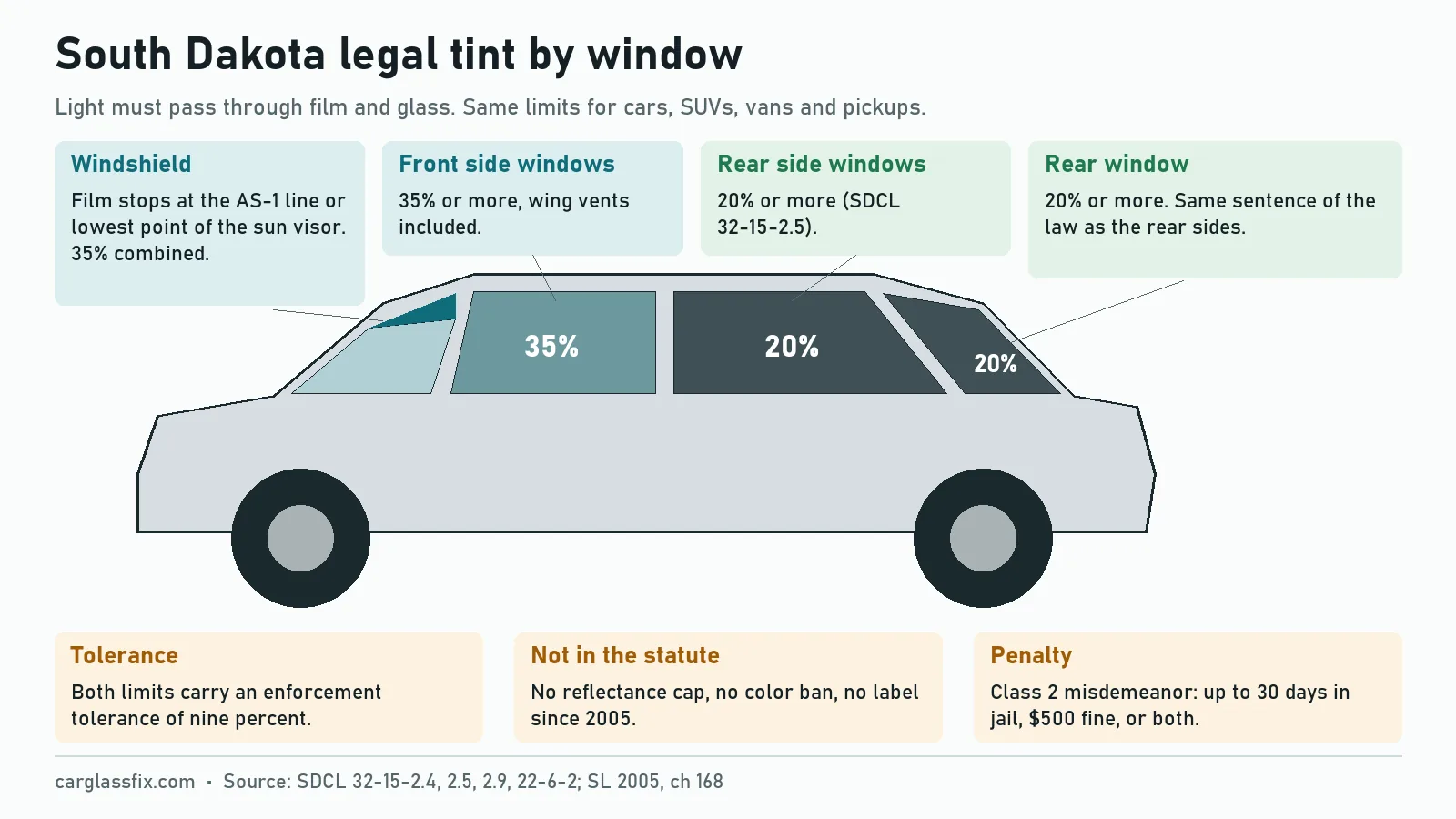
Glass and film multiply. A 35% film on a pane that passes 80% of light would read 28%, which is below the 35% limit. The window tint percentage chart shows what each shade means in practice. You can also read a finished window yourself with the steps in how to measure window tint. The statute contains no express exemption for factory-tinted glass, so a tint shop should meter the window before adding film.
What the nine percent enforcement tolerance means
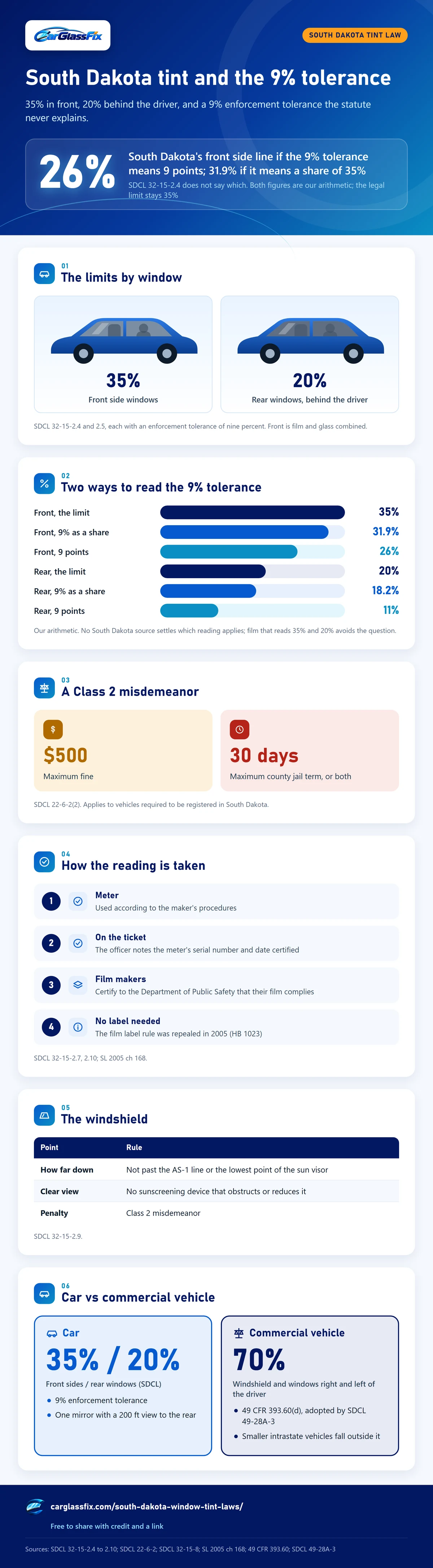
The nine percent enforcement tolerance is a margin in the statute, and the code does not say how to calculate it. Both 32-15-2.4 and 32-15-2.5 end their limit with the phrase “with an enforcement tolerance of nine percent”. Neither section says whether nine means percentage points or nine percent of the limit, and the definitions in 32-15-2.6 are silent too.
The two readings give different numbers. Read as percentage points, the citation lines would be 26% for the front and 11% for the rear, which is how RecordingLaw describes them. Read as a share of the limit, they would be about 31.9% and 18.2%. No South Dakota source read for this page settles the question. The legal limits stay 35% and 20%, and the tolerance is written as a matter of enforcement. Texas and Idaho, by comparison, use a 3% margin. Choosing film so the finished window reads 35% and 20% avoids the argument altogether.
Windshield film and the sun visor wording
Windshield film may reach down only to the AS-1 line or the lowest point of the sun visor. SDCL 32-15-2.9 says “No film may be extended downward beyond the AS-1 line or more than the lowest point of the sun visor of the motor vehicle”. The section names two markers and gives no “whichever is higher” rule, so a driver whose two markers sit at different heights gets no answer from the text. The safer choice is the higher of the two. Our guide to the AS-1 line on a windshield shows where to find the marking.
The strip also has a darkness limit. SDCL 32-15-2.4 lists the front windshield among the glass held to the 35% combined level. South Dakota sets no inch measurement, so the “top 6 inches” figure on some websites does not come from this statute. The word “film” in 32-15-2.9 has no exception for clear UV film below the line. The same section bars any sunscreening device that would “obstruct or reduce the driver’s clear view”. For the wider question, see is it illegal to have tint on a windshield.
Reflectivity, colors, mirrors and labels
South Dakota’s tint sections set no reflectance percentage, no color ban, no dual-mirror condition and no label requirement. Sections 32-15-2.4 and 32-15-2.5 do name “one-way glass”, but only as glazing that may not cut light below the limits. Mirrored film therefore still has to meet the 35% and 20% readings. SDCL 32-15-8 asks for “a mirror” giving a view of at least 200 feet to the rear, and it does not mention tint.
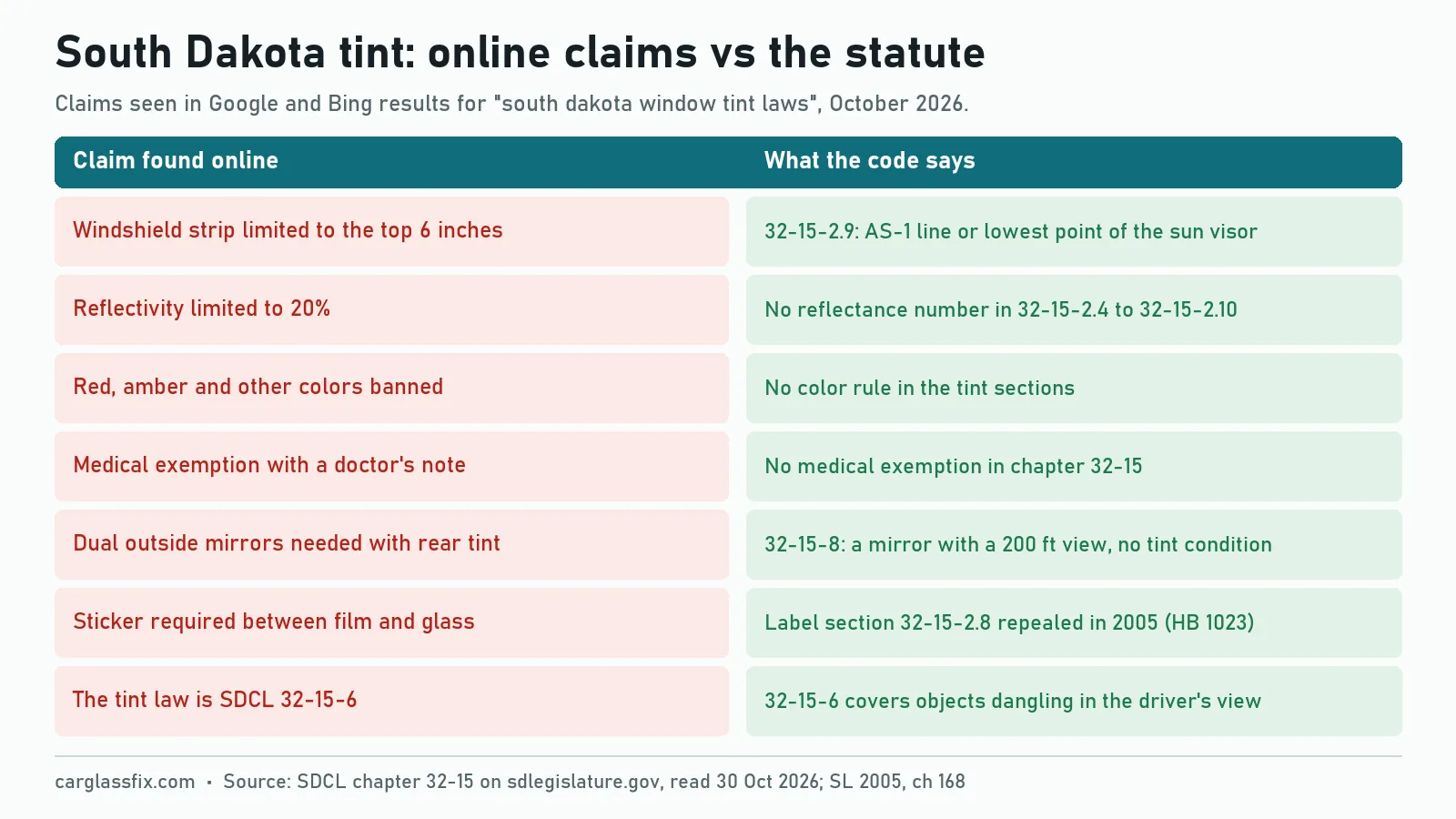
The sticker claim has a real history. South Dakota once required labeling of window film under 32-15-2.8. House Bill 1023 repealed that section, and it was signed on February 8, 2005 (SL 2005, ch 168). Pages that still say a sticker belongs between the film and the glass are repeating a rule that ended more than 20 years ago. The duty that survives sits with manufacturers. Under 32-15-2.7 each film maker must certify to the Department of Public Safety that its product complies with the light transmission limits.
Is there a medical exemption in South Dakota?
South Dakota has no medical exemption in its tint statutes. Sections 32-15-2.4 through 32-15-2.10 list no exception for a medical condition, a doctor’s letter, a permit or a form. The chapter 32-15 index shows no other section on the subject. The Highway Patrol’s 2025 tint post mentions none either.
Several websites and Bing’s AI answer say an exemption is available with a physician’s certification, yet they name no South Dakota statute that creates one. Some cite SDCL 32-15-6, which is the section on objects dangling in the driver’s view. Others cite 32-15-3.2 or 32-37-10, and neither section exists on the South Dakota Legislature’s site. The code has no public full-text search we could run across every title, so a provision elsewhere cannot be ruled out completely. A driver with a light-sensitive condition should ask the South Dakota Department of Public Safety in writing before installing darker film. A doctor’s note carried in the vehicle has no stated legal effect under these sections.
Fines and how police enforce South Dakota tint law
A tint violation is a Class 2 misdemeanor, the penalty named in 32-15-2.4, 32-15-2.5 and 32-15-2.9. SDCL 22-6-2 sets the maximum for that class at “thirty days imprisonment in a county jail or five hundred dollars fine, or both”. Those are ceilings, and the statute names no fixed amount for a tint ticket. Dollar ranges on tint websites cite no South Dakota source, so we leave them out.
Police use a meter, and the statute controls how. SDCL 32-15-2.10 requires testing equipment to be used “in compliance with the meter manufacturer’s testing procedures”. The officer must note the meter’s serial number and the date it was certified on any citation under 32-15-2.4 or 32-15-2.5. A driver can check those two entries on the ticket. Window tint meters explains how these devices read light.
The tint sections do not limit officers to secondary enforcement. The dangling-object rule next to them, 32-15-6, says enforcement “shall be accomplished as a secondary enforcement”. The tint sections carry no such wording, and they contain no fix-it or correction clause either.
Out-of-state and commercial vehicles
The two limit sections apply to a vehicle “required to be registered in this state”, so their text reaches South Dakota-registered vehicles first. A visitor’s car registered elsewhere is outside that wording while it stays lawfully registered in another state. The windshield rule in 32-15-2.9 has no such phrase. A move to South Dakota changes the answer once registration here becomes required.
South Dakota drivers crossing a border meet different numbers. Our Iowa window tint laws guide covers a 50% front limit, and the what car window tint is legal guide compares the wider rules.
Commercial vehicles can face a stricter federal layer. SDCL 49-28A-3 adopts 49 CFR parts 390 to 397, and 49 CFR 393.60(d) requires 70% on the windshield and the windows to the immediate right and left of the driver. Intrastate vehicles under 26,001 pounds are outside that adoption unless they carry placarded hazardous materials or are designed for more than 15 passengers. You can preview shades in the window tint simulator before choosing a film. Rules change, so check the current statute or the Department of Public Safety. This page is not legal advice.
Frequently asked questions
What is the darkest legal tint in South Dakota?
The darkest legal tint is 35% on the front side windows and 20% on the side and rear windows behind the driver, under SDCL 32-15-2.4 and 32-15-2.5. Each limit carries a nine percent enforcement tolerance that the code does not define.
Is 20% window tint darker than 35%?
Yes. The percentage is the share of light passing through, so 20% lets in less light than 35%. In South Dakota, 20% film is too dark for the front side windows even before the factory glass is counted.
Can you get pulled over for tint in South Dakota?
The tint sections contain no secondary-enforcement limit, unlike the dangling-object rule in SDCL 32-15-6. An officer who cites a driver must record the meter’s serial number and certification date on the citation.
Do I need a sticker for window tint in South Dakota?
No sticker rule remains in the code. South Dakota repealed its window film labeling section, 32-15-2.8, through House Bill 1023 in 2005. Film manufacturers still certify compliance to the Department of Public Safety.
What is the fine for illegal tint in South Dakota?
Illegal tint is a Class 2 misdemeanor. SDCL 22-6-2 sets the maximum at 30 days in a county jail, a $500 fine, or both.
Sources
- SDCL 32-15-2.4, windshield and front side windows (checked October 30, 2026)
- SDCL 32-15-2.5, rear windows (checked October 30, 2026)
- SDCL 32-15-2.6, definitions (checked October 30, 2026)
- SDCL 32-15-2.7, manufacturer certification (checked October 30, 2026)
- SDCL 32-15-2.9, windshield film (checked October 30, 2026)
- SDCL 32-15-2.10, meters and citations (checked October 30, 2026)
- SDCL chapter 32-15 index, including the repeal of 32-15-2.8 by SL 2005, ch 168 (HB 1023) (checked October 30, 2026)
- SDCL 32-15-6, dangling objects (checked October 30, 2026)
- SDCL 32-15-8, rear-vision mirrors (checked October 30, 2026)
- SDCL 22-6-2, misdemeanor classes (checked October 30, 2026)
- SDCL 49-28A-3, adoption of federal regulations (checked October 30, 2026)
- 49 CFR 393.60, glazing in specified openings (checked October 30, 2026)
- South Dakota Highway Patrol, window tint post, May 23, 2025
- RecordingLaw, South Dakota window tint laws (tolerance reading)

Similar Posts