Rhode Island Window Tint Laws: 70% on Every Car Window
Senior Automotive Glass Diagnostic Specialist & Master Technician at CarGlassFix · AGSC Master Certified Auto Glass Technician, NGA Certified Installer, I-CAR Automotive Safety Specialist · 12+ Years in Automotive Glazing, Windshield Structural Bonding, ADAS Camera Calibration & Precision Chip Restoration
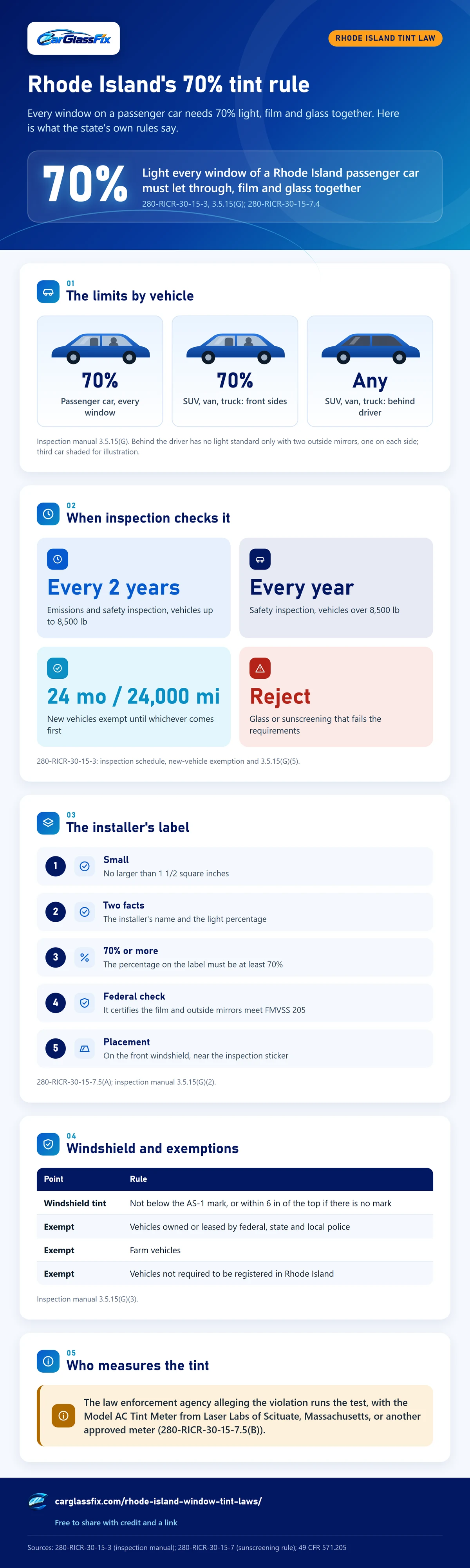
Rhode Island window tint laws require at least 70% of light through film and glass on every window of a passenger car. SUVs, vans and trucks need 70% on the windshield and front side windows, and may go any shade behind the driver with two outside mirrors. Windshield tint may not go below the AS-1 mark, or past 6 inches from the top if there is no mark.
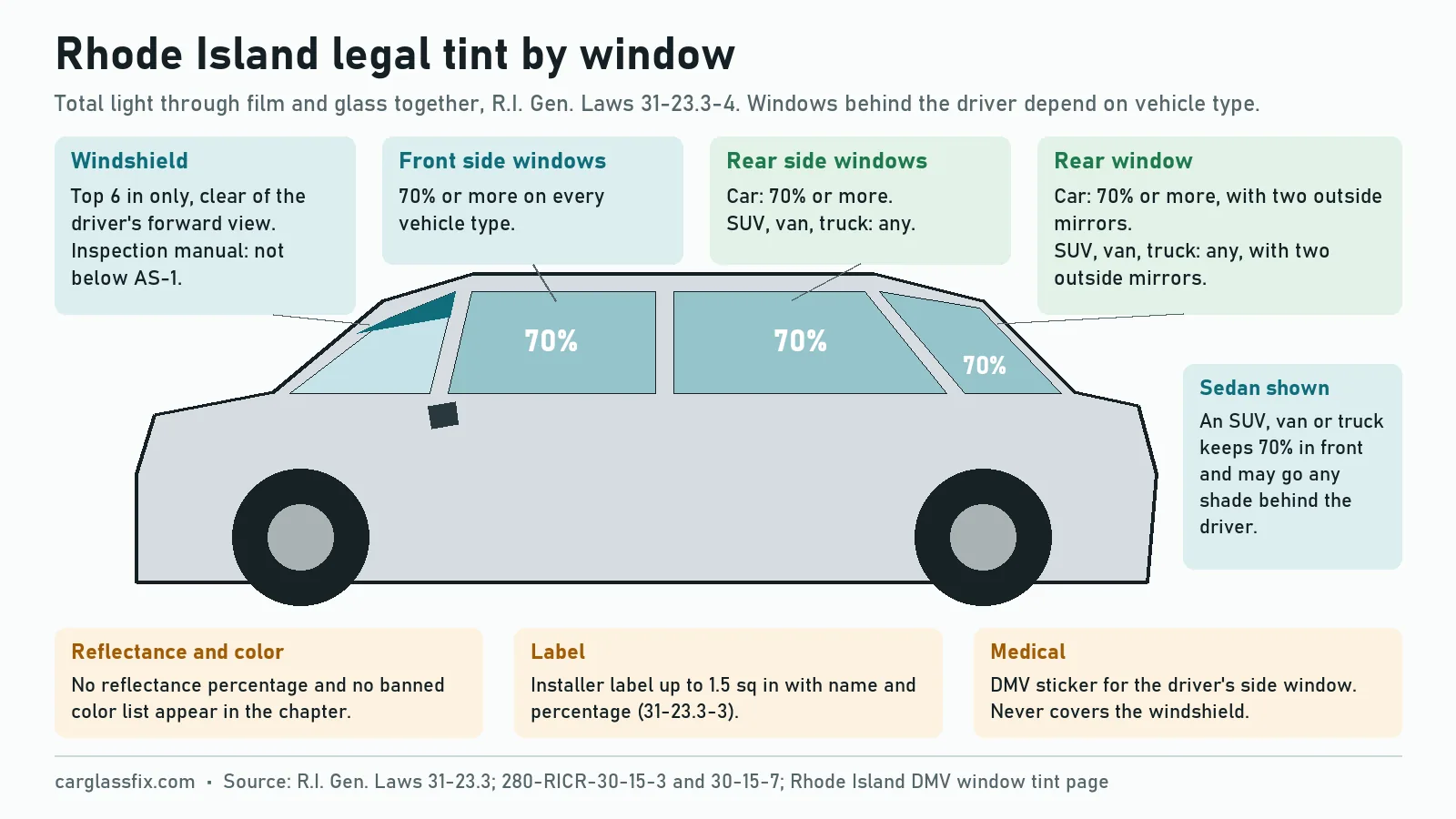
Rhode Island window tint limits by window
Rhode Island allows 70% light transmittance on all windows of a passenger car, and it adds a looser rule behind the driver for SUVs, vans and trucks. That makes it one of the strictest states in the country. WPRI calls its rules the “strictest rules in New England,” and the 35% limit in Massachusetts window tint laws shows the gap with a next-door state. The table below follows R.I. Gen. Laws 31-23.3-4 and the chart on the Rhode Island DMV window tint page. The DMV chart says “No Requirement” behind the driver on SUVs, but the statute attaches a condition: two outside mirrors, one on each side. A multipurpose vehicle is one built for 10 or fewer people on a truck chassis or with features for occasional off-road use (31-23.3-1(2)). The state inspection manual adds that this group includes “all vans.”
| Window | Sedan | SUV, van, pickup |
|---|---|---|
| Windshield | Not below the AS-1 mark, or within the top 6 in if there is no mark; any other material 70% or more | Same |
| Front side windows | 70% or more | 70% or more |
| Rear side windows | 70% or more | Any shade, with two outside mirrors |
| Rear window | 70% or more, with two outside mirrors | Any shade, with two outside mirrors |
| Measured as | Film and glass together, perpendicular to the glass | Same |
| Reflectance limit | No percentage in the chapter | Same |
| Tolerance | None stated | Same |
The ban and the eight exemptions in 31-23.3-4
Rhode Island starts from a full ban, and every legal tint is an exemption from it. Section 31-23.3-2 says no person shall “own and operate” a vehicle with sunscreen material, reflective film or nonreflective film on the windshield, the side windows or the rear window unless the vehicle meets a listed criterion. The text points to 31-23.3-3, but the exemptions sit in 31-23.3-4, and the DMV cites 31-23.3-4.
The table lists all eight exemptions in the order of the statute. Two definitions narrow the law further. “Window” leaves out roof-mounted devices and any viewing device under 150 square inches (31-23.3-1(6)). “Motor vehicle” leaves out farm-husbandry vehicles (31-23.3-1(1)). The inspection manual repeats the 150-square-inch carve-out in its sentence about SUVs and similar vehicles, so a sedan owner should confirm it with the DMV before tinting a small quarter window. Section 31-23.3-6 adds one more case: an owner need not remove material the maker installed on a vehicle purchased before December 1, 1993.
| 31-23.3-4 | Who or what is exempt | Condition |
|---|---|---|
| (1) | Factory glass | Meets 49 CFR 571.205 (FMVSS 205) |
| (2) | Law enforcement vehicles | Owned or leased by federal, state or local agencies |
| (3) | The 70% rule | Rear window only with two outside mirrors |
| (4) | Windshield strip | Transparent, uppermost 6 in, clear of the forward view |
| (5) | Vehicles not required to be registered in Rhode Island | None stated |
| (6) | Windows behind the driver on trucks, buses, trailers, mobile homes, campers, multipurpose vehicles, charter buses, funeral service vehicles and limousines | Two outside mirrors meeting federal standards |
| (7) | Medical need | Affidavit and DMV sticker |
| (8) | Executive security vehicles | Written permission from the local police chief |
Windshield tint in Rhode Island: 6 inches and the AS-1 line
A Rhode Island windshield may carry a strip only in the uppermost 6 inches, and the safest strip also stays above the AS-1 line. The state’s own documents word this limit three ways. The statute allows “any transparent material limited to the uppermost six inches” that does not reach the driver’s direct forward viewing area. It never mentions AS-1. The Official Manual for Vehicle Inspection, 280-RICR-30-15-3, says tint must not sit below the “AS-1” edge mark, or past 6 inches from the top when the glass has no mark. The DMV’s graphics say “NO Tint on Windshield Below AS-1 Line.”
A strip that meets both the 6-inch limit and the AS-1 line on a windshield satisfies all three. The word “transparent” has no number attached, and the statute does not define it. The DMV chart lists 70% for the windshield, and exemption (3) also allows 70% material on the windshield. Ask the DMV inspection office before fitting a dark band. For the rules elsewhere, read is it illegal to have tint on a windshield.
How the 70% rule is measured, and why film rarely fits
The 70% is measured through the finished window, so the glass counts against the limit. Section 31-23.3-1(5) defines transmittance as light passing through the material “including glazing,” and the 70% exemption is “measured perpendicular to the surface of the glass.” The Rhode Island DMV says factory glass usually passes between 70% and 80% of light, and that aftermarket tint on stock glass “would likely” drop below 70%.
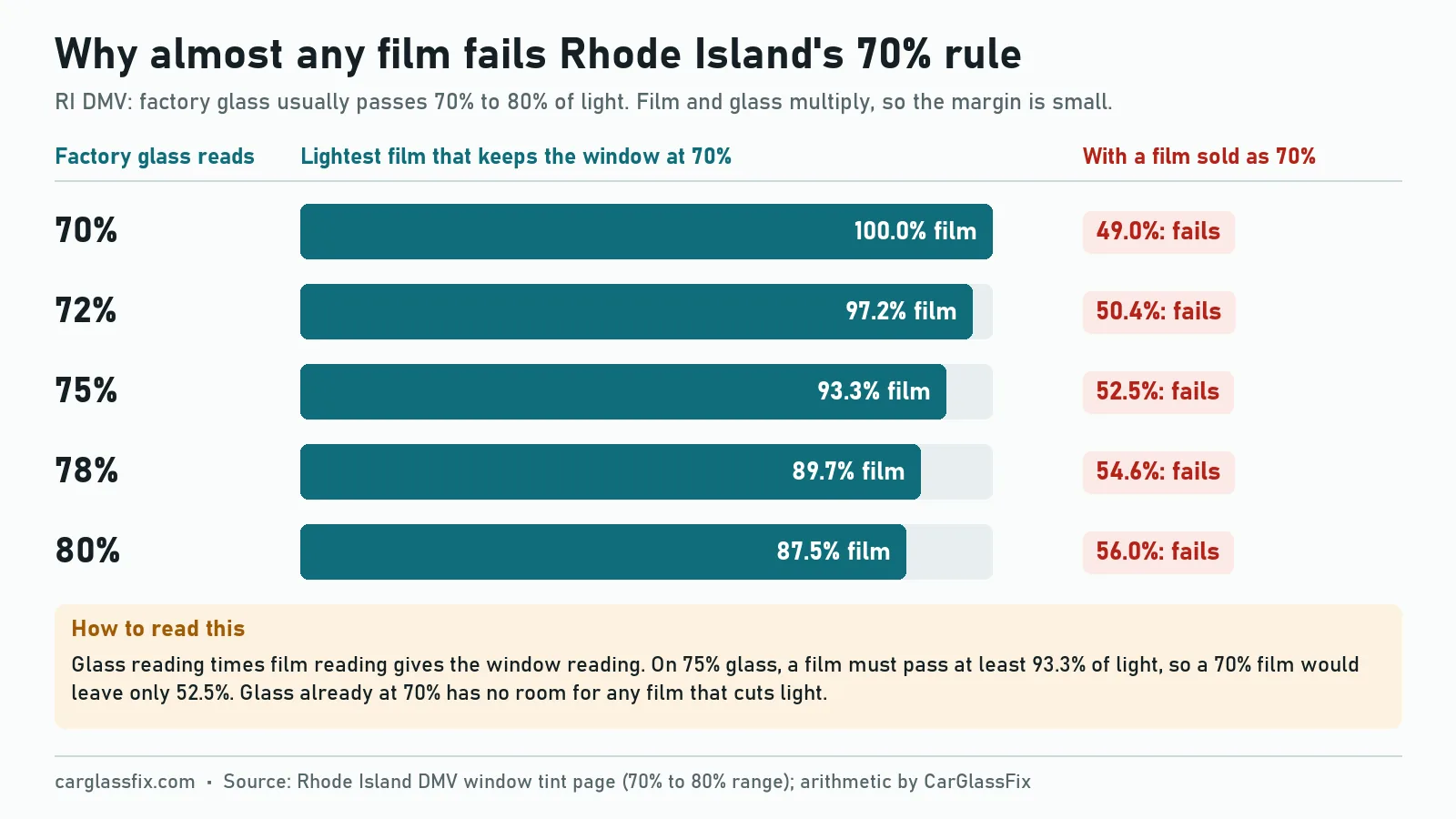
The chart shows the arithmetic. Glass reading multiplied by film reading gives the window reading, as our how to measure window tint guide explains. A film sold as 70% on 75% glass leaves 52.5%, which fails. Only a nearly clear film can pass, and only on lighter glass. Any such film should be checked on the car with a window tint meter after fitting. The DMV rule names the meter police may use: the Model AC Tint Meter from Laser Labs of Scituate, Massachusetts, or another approved meter (280-RICR-30-15-7.5). The chapter defines reflectance but sets no reflectance percentage and lists no banned colors. Any film, whatever its color, must still reach 70%.
The installer label and the inspection tint check
Every tint job in Rhode Island needs an installer label, and tint is checked at inspection. Section 31-23.3-3(b) requires a label no larger than 1 1/2 square inches showing the installer’s name and the light transmittance. The state inspection manual places it on the front windshield, “near inspection sticker”, and the sunscreening rule, 280-RICR-30-15-7.5, also puts it on the front window. The DMV rule adds that the percentage “shall be not less than seventy percent” and that the label certifies the film and mirrors meet 49 CFR 571.205. The rule leaves no room for a label below 70%.
The inspection is not annual for most cars. The DMV requires light-duty vehicles up to 8,500 lb GVWR to pass at least once every 24 months, and heavier vehicles every 12 months. New vehicles are exempt for 2 years or 24,000 miles, whichever comes first. A used vehicle newly registered in Rhode Island must pass within 5 days. That timing matters for a car tinted to 35% in Massachusetts. Section 3.5.15 of the manual lists as a cause for rejection any sun screening “that fails to meet the requirements.” WJAR reported in 2020 that the DMV told stations to focus on tint.
Rhode Island medical exemption for window tint
A Rhode Island medical exemption comes from the DMV as a sticker, and a physician’s note alone does not create it. Section 31-23.3-4(7) covers a vehicle registered to the person or the person’s legal guardian, with an affidavit from a physician or optometrist licensed in Rhode Island. The DMV page says the agency issues a sticker “or a certificate,” while the statute names only the sticker for the driver’s side window. The form is the Application for Medical Exemption from Maximum Window Tint Limits (rev. 07/20), sent to the DMV Adjudication Office at 600 New London Avenue, Cranston.
How to apply for a Rhode Island tint exemption
Check eligibility
The applicant must be a Rhode Island resident, and a leased vehicle needs a letter from the leasing company authorizing the tint.
Fill in the application
List each vehicle by registration, make, model and VIN, then sign before a notary.
Get the affidavit
The physician or optometrist explains the condition, why quality sunglasses are not enough, what percentage below 70% is needed, and whether the condition is permanent or temporary.
Send the original
Submit it within 30 days of the affidavit. The form says no faxes, and incomplete applications are not processed.
Apply the sticker
Put the DMV sticker on the driver’s side window once the application is approved.
The DMV says “Medical exemptions DO NOT apply to the windshield.” The form has fields for a permit number and an expiration date, so check the date on any approval.
Tint fines, pending bills and what older pages get wrong
The Rhode Island tint fine falls on the vehicle owner. In the FindLaw copy of the statute read for this article, section 31-23.3-5(b) caps it at $250; the official statute site did not respond, so confirm the amount with the court or the DMV. Section 31-23.3-5(a) sets the same ceiling for an installer “for each offense.” WJAR reported DMV investigators leaving tint notices in the Cranston DMV parking lot in 2024.
Two recent bills show no enactment on the FastDemocracy tracker. H 5644 would raise fines for repeat violations; it passed the House on April 3, 2025, and went to Senate Judiciary. H 8312 would remove the windshield exemption and add a registration suspension of up to one year; a House committee held it for further study on April 7, 2026.
A Bing AI answer checked for this page gave a 25% reflectance limit, a ban on red and amber, and a minimum fine. None of those appear in the chapter. Rules can change, so check chapter 31-23.3 or the DMV before you tint, and preview shades in the window tint simulator. Other states are compared in what car window tint is legal. This article is general information, not legal advice.
Frequently asked questions
Is 70% tint legal in RI?
A window that reads 70% or higher with film and glass together is legal. A film sold as 70% will usually read far lower once it sits on factory glass, so it would likely fail on a sedan or on the front side windows of an SUV.
What state is strictest on tint?
Rhode Island is among the strictest, and WPRI describes its rules as the strictest in New England. No state ranking is set by law, and our guide to what car window tint is legal shows that a few states, such as New Jersey, bar film on front side windows altogether.
Is 35% or 20% tint darker?
A 20% tint is darker because it passes 20% of visible light against 35%. Both fail Rhode Island’s 70% rule on a sedan, and the window tint percentage chart shows each shade.
How do I get a tint exemption in RI?
File the DMV’s Application for Medical Exemption from Maximum Window Tint Limits with a sworn affidavit from a Rhode Island-licensed physician or optometrist. The exemption never covers the windshield.
Can a car with Massachusetts tint stay on the road in Rhode Island?
A visiting car not required to be registered in Rhode Island is exempt under 31-23.3-4(5). Once the car must be registered in Rhode Island, the 70% rule applies, and a newly registered used vehicle must pass inspection within 5 days.
Sources
- R.I. Gen. Laws 31-23.3-1, Definitions, 31-23.3-2, 31-23.3-3, 31-23.3-4, Exemptions, 31-23.3-5, Penalties and 31-23.3-6 (FindLaw copy, current as of January 1, 2026; checked 30 October 2026)
- 280-RICR-30-15-7, Sunscreening Devices (active rule effective 4 January 2022; checked 30 October 2026)
- 280-RICR-30-15-3, Official Manual for Vehicle Inspection, section 3.5.15 (checked 13 November 2026)
- Rhode Island DMV: Nontransparent Windshield and Window Laws (archived copy of 19 April 2026 read)
- Rhode Island DMV: Application for Medical Exemption from Maximum Window Tint Limits, rev. 07/20 (archived copy of 16 September 2026 read)
- Rhode Island DMV: Vehicle Inspection Requirements (archived copy of 19 April 2026 read)
- RI.gov: Ask the DMV, 26 January 2013
- FastDemocracy: 2025 H 5644 history and 2026 H 8312 history (checked 30 October 2026)
- WPRI Target 12: Thousands of tickets issued in RI due to strict law against dark window tint and RI lawmakers to vote on more penalties
- WJAR: Rhode Island cracks down on vehicle inspection requirements (28 February 2020) and WJAR: DMV issues notices for tinted windows at its parking lot (2024)

Similar Posts