New Mexico Window Tint Laws: Legal Limits by Window
Senior Automotive Glass Diagnostic Specialist & Master Technician at CarGlassFix · AGSC Master Certified Auto Glass Technician, NGA Certified Installer, I-CAR Automotive Safety Specialist · 12+ Years in Automotive Glazing, Windshield Structural Bonding, ADAS Camera Calibration & Precision Chip Restoration
New Mexico window tint laws allow film that passes at least 20% of light on the front side windows, the darkest front limit of any state. Sedans need 20% on every side and rear window; SUVs and vans have no limit behind the driver. Windshield film must stay above the AS-1 line or the top 5 inches.
New Mexico tint limits by window
New Mexico lets film darken a front side window down to 20% light transmission, which is darker than any other state allows on the windows beside the driver. The rule is NMSA 1978 Section 66-3-846.1, enacted in 1997 and last amended in 2018. It treats the side wings, the front side windows, the side windows behind the driver and the rearmost window as one group. Every window in that group must be “nonreflective” and must have a light transmission “of not less than twenty percent.” Subsection (F) then lifts the light requirement on windows behind the driver for multipurpose passenger vehicles and a few other classes. That split gives sedans and SUVs different rear limits. The table shows each window for both groups.
| Window | Sedan | SUV, van, pickup |
|---|---|---|
| Windshield | Top strip only, down to the AS-1 line or 5 in from the top, whichever is closer to the top; nonreflective; not red, yellow or amber | Same |
| Front side windows | 20% light or more, nonreflective | 20% light or more, nonreflective |
| Side windows behind the driver | 20% light or more, nonreflective | SUVs and vans (multipurpose passenger vehicles): no light limit, still nonreflective. Pickups: not named in (F), so treat as 20% |
| Rear window | 20% light or more, nonreflective | Same as the side windows behind the driver |
| Mirrors | Film on any side or rear window needs a right and a left outside mirror | Same |
| Tolerance | None stated in the statute | None stated |
How the New Mexico 20% rule works
The 20% rule means at least one fifth of the light that falls on the window must pass through it. Section 66-3-846.1(H) defines light transmission as the ratio of light that passes through “a product or material” to the light that falls on it.
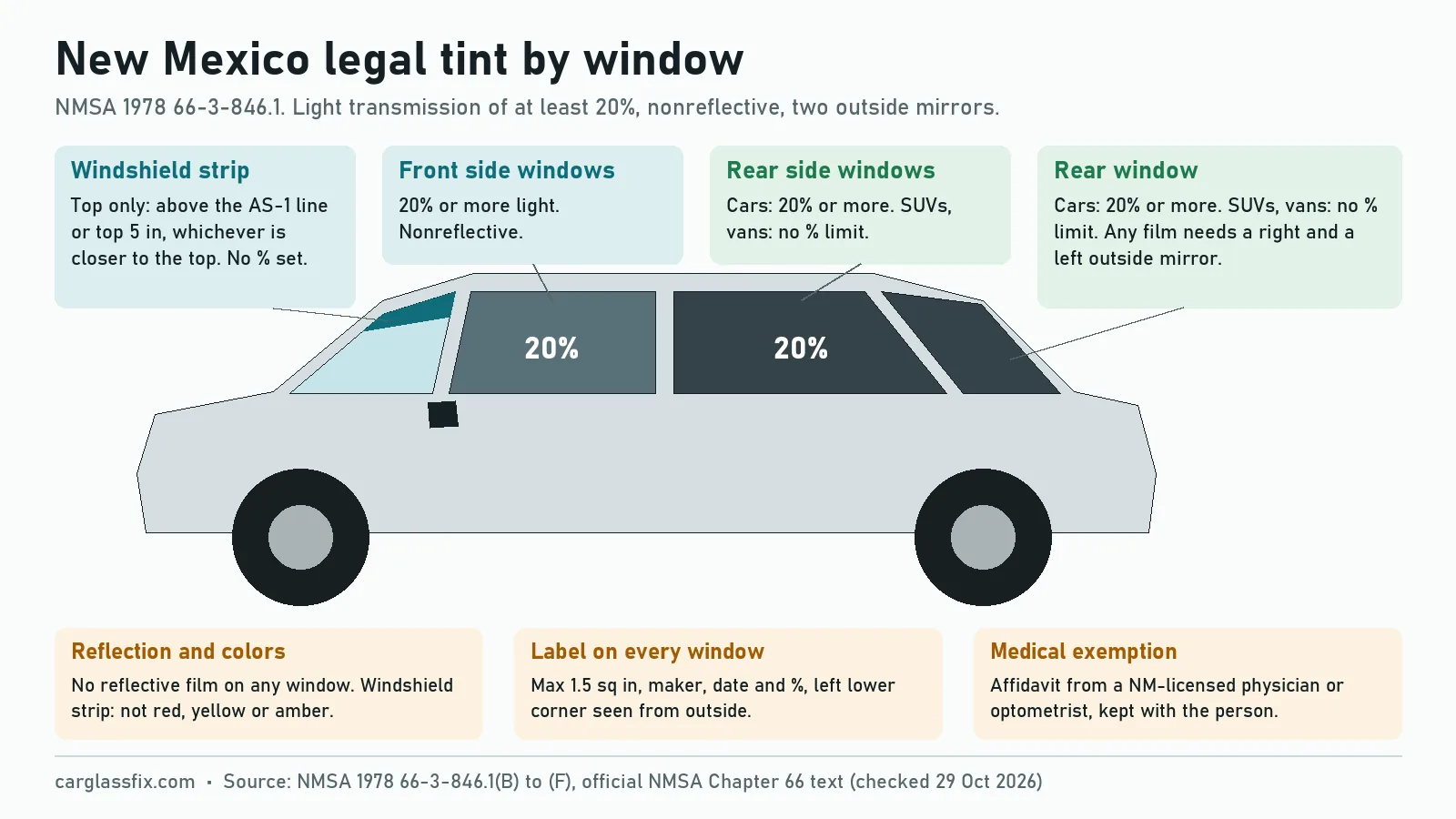
The statute does not say whether the 20% is read for the film alone or for the film and the glass together. Factory glass already absorbs some light, so a 20% film on tinted glass reads lower than 20% on a meter. A driver who wants a safe margin can ask the installer to read the finished window. Our guide on how to measure window tint explains that reading.
Two further conditions apply to every tinted side or rear window. The film must be nonreflective, which the statute defines as “designed to absorb light rather than to reflect it.” The vehicle must also carry one right and one left outside rearview mirror. Mirror-finish film is therefore illegal on all New Mexico windows, on SUVs too. The rules on mirror tint on a car differ between states.
Windshield tint in New Mexico: the top strip only
New Mexico allows windshield film only as a strip along the top of the glass. Section 66-3-846.1(B)(1) says the film may not extend “beyond the ASI line or more than five inches from the top of the windshield, whichever is closer to the top.” The statute writes the marking as “ASI,” which is the AS-1 line etched near the top edge of most windshields. Our page on the AS-1 line on a windshield shows where to find it.
The strip must be nonreflective and may not be red, yellow or amber. The statute sets no darkness figure for the strip, so a dark band is legal if it stays inside that area. Clear film on the rest of the windshield is not mentioned as an exception. The definition of sun screening material covers “any film material” made to reduce the effects of the sun. Section 66-3-846(A) separately bars signs, posters and other nontransparent material on the windshield.
How New Mexico compares with other states
New Mexico’s 20% front side minimum is the lowest of any state that allows front film. Our count of the 48 states with a numeric front side limit, re-checked on 9 November 2026, puts Montana (MCA 61-9-405) and Washington (RCW 46.37.430) next at 24%. Arkansas, Louisiana, Oklahoma and Texas follow at 25%.
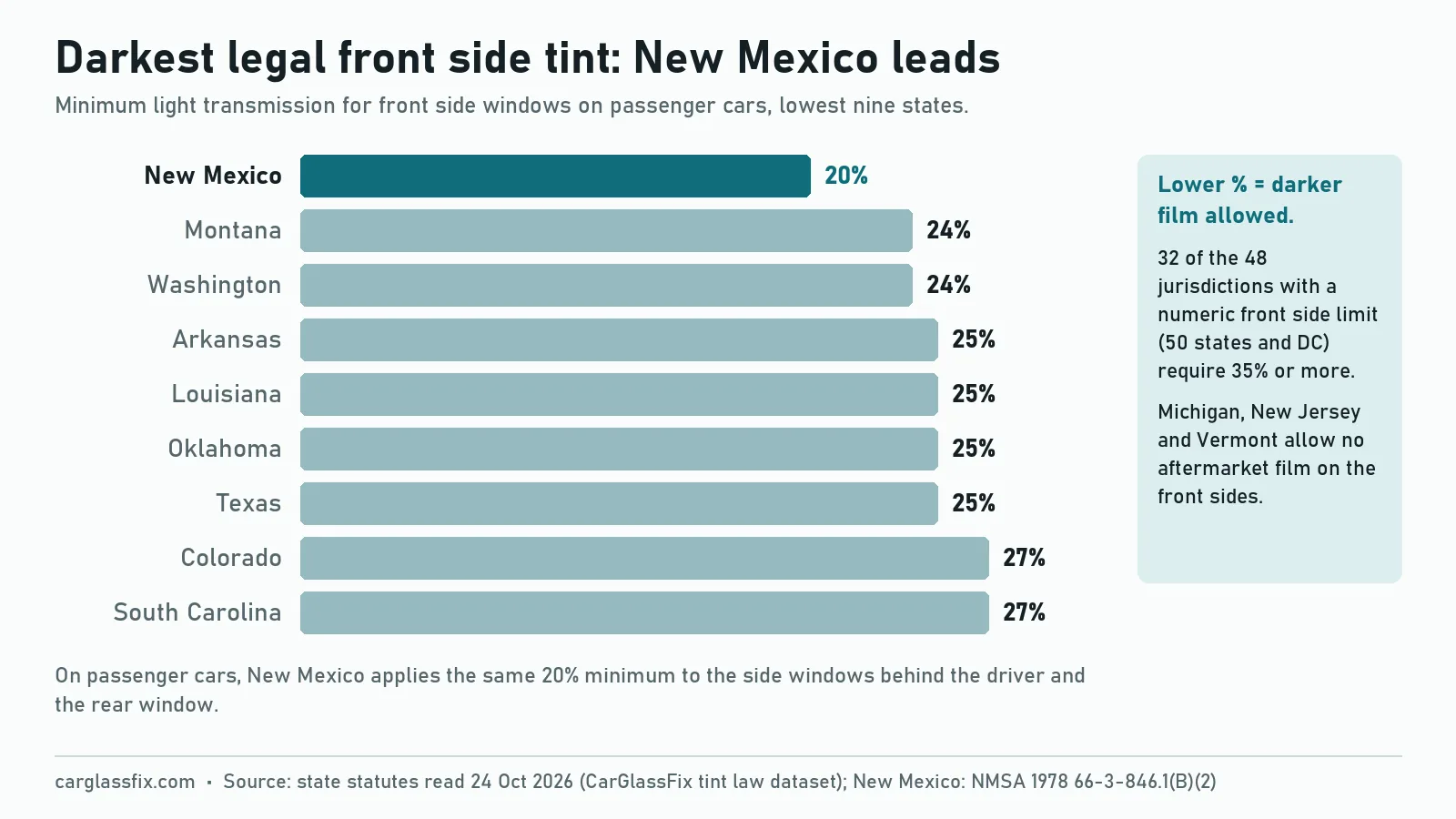
Most states are far lighter. Of the 48 jurisdictions with a numeric front side limit, counting the 50 states and the District of Columbia, 32 require 35% or more. Michigan, New Jersey and Vermont allow no aftermarket film on the front side windows at all.
The low front number matters for drivers who move or travel. A New Mexico car with 20% front film is legal at home. It can still break the law in Texas, whose own statute sets 25%, once the car is registered there. The Texas window tint laws page has that state’s limits. A 20% film looks dark from outside, and the window tint percentage chart shows it next to lighter shades. The window tint simulator previews a 20% shade on a car before you buy film.
SUVs, vans, pickups and vehicles the limits skip
SUVs and vans have no light limit on windows behind the driver, because Section 66-3-846.1(F) says the light requirement “does not apply to windows behind the driver” on multipurpose passenger vehicles. The same subsection covers truck tractors, buses, recreational vehicles and motor homes. Only the light limit is lifted. Those windows must still be nonreflective, and the vehicle still needs both outside mirrors. Some ranking pages say SUVs have no reflection limit, which the statute does not support.
New Mexico law does not define a multipurpose passenger vehicle. The federal definition in 49 CFR 571.3 covers vehicles for 10 or fewer people built on a truck chassis or with features for occasional off-road use. Federal rules list a truck, a vehicle built mainly to carry property, as a separate class. Pickups are not named in subsection (F). A pickup owner should treat the rear windows as 20% unless MVD or an officer confirms otherwise.
Three more groups fall outside the section. Subsection (A) covers only vehicles “registered or required to be registered in this state.” Factory glazing that meets federal motor vehicle standards is exempt under (F). Film applied before July 1, 1997 is exempt under (G).
New Mexico medical exemption for darker tint
New Mexico exempts a vehicle from the whole tint section when its owner holds a medical affidavit. Section 66-3-846.1(E) requires an “affidavit signed by a physician or an optometrist licensed to practice in this state.” The affidavit must state that the person has a physical condition that makes darker film necessary. The vehicle must be registered in the name of that person or the person’s legal guardian. The statute names no MVD form, no MVD approval and no expiry date. It also sets no minimum light figure for an exempt vehicle. No MVD page on tint exemptions was found while this guide was researched. The steps below follow the statute.
How to use the New Mexico medical tint exemption
See a licensed New Mexico doctor
The affidavit must come from a physician or an optometrist licensed to practice in New Mexico.
Get a signed affidavit
It must state that a physical condition makes it necessary to equip the vehicle with film that breaks the normal limits.
Check the registration
The vehicle must be registered in the name of the person with the condition or that person’s legal guardian.
Carry the affidavit
The person or guardian must have it “at all times while being transported in the motor vehicle.”
An out-of-state doctor’s letter does not meet the statute’s wording. Ask MVD how to handle a driver without the condition using the car alone, because the statute does not address that case.
Labels, film certification and installer duties
New Mexico requires a small label on every tinted window, placed by the installer. Section 66-3-846.1(C) makes each film maker certify to the Motor Vehicle Division that its film meets the nonreflective and light rules. The maker must supply a label “not to exceed one and one-half square inches in size.” The label shows the maker’s name, the date the film was made and its light transmission percentage. It sits between the film and the glass in “the left lower corner of each glazing surface” when viewed from outside. That means one label per tinted window, not one per car.
Subsection (D) puts two duties on sellers and installers. Nobody may sell or offer film for road vehicles that fails the section. Nobody may install film on a road vehicle “without permanently affixing the label.” The statute calls this a label, not an installer certificate. A missing label on a window is a sign that the film may not be certified for New Mexico. A window tint meter reading still decides whether the window passes 20%.
How much is a tint ticket in New Mexico
A New Mexico tint violation is a “penalty assessment misdemeanor” under Section 66-3-846.1(I). The penalty schedule in Section 66-8-116 lists “Improper equipment” for Sections 66-3-842 through 66-3-851 at $50.00. Section 66-3-846.1 falls inside that numeric range, though the schedule does not name it. Under Section 66-8-117, the officer offers the penalty assessment unless a warning notice is given. Signing the notice is an admission of guilt, and payment goes by mail to the Motor Vehicle Division within thirty days.
A driver can take a notice to appear in court instead. Section 66-8-116(C) says a fine after a later conviction “shall not exceed the penalty assessment” for that offense. The penalty assessment route does not apply when the violation caused or contributed to a crash with injury or death (66-8-116(B)). Compare other states in what car window tint is legal.
New Mexico tint rules can change with any legislative session. Check the current NMSA 66-3-846.1 or ask the New Mexico MVD before you tint. This article is general information, not legal advice.
Frequently asked questions
Is it legal to have 5% tint in New Mexico?
No on sedans, where every side and rear window needs at least 20% light. On SUVs and vans, 5% is legal behind the driver if the film is nonreflective and the vehicle has both outside mirrors, and a medical affidavit exempts the vehicle of the person who holds it.
How dark is 20% tint?
A 20% tint lets through one fifth of the visible light that hits the window, and the other 80% is absorbed or reflected. It is the darkest front side shade New Mexico allows without a medical affidavit.
Which state has the strictest window tint laws?
Michigan, New Jersey and Vermont allow no aftermarket film on the front side windows. Alaska, California, New Hampshire, New York, Pennsylvania, Rhode Island and the District of Columbia require 70% on the front side windows.
Do I need a sticker for window tint in New Mexico?
Yes. The installer must place the maker’s label, at most 1.5 square inches, in the left lower corner of each tinted window, showing the maker, the film date and its light percentage.
Can I tint my whole windshield in New Mexico?
No. Film is allowed only along the top, down to the AS-1 line or 5 inches from the top, whichever is closer to the top.
Sources
- NMSA 1978 Chapter 66, Motor Vehicles (official unannotated text, NMOneSource): Sections 66-3-846, 66-3-846.1, 66-8-116 and 66-8-117 (file dated 1 July 2026; checked 29 October 2026)
- FindLaw: N.M. Stat. 66-3-846.1, Sun screening material on windshields and windows (checked 29 October 2026)
- RCW 46.37.430 (Washington) and MCA 61-9-405 (Montana) (checked 12 November 2026)
- 49 CFR 571.3, Definitions (multipurpose passenger vehicle, truck) (checked 29 October 2026)

Similar Posts