Utah Window Tint Laws: Legal Limits by Window
Senior Automotive Glass Diagnostic Specialist & Master Technician at CarGlassFix · AGSC Master Certified Auto Glass Technician, NGA Certified Installer, I-CAR Automotive Safety Specialist · 12+ Years in Automotive Glazing, Windshield Structural Bonding, ADAS Camera Calibration & Precision Chip Restoration
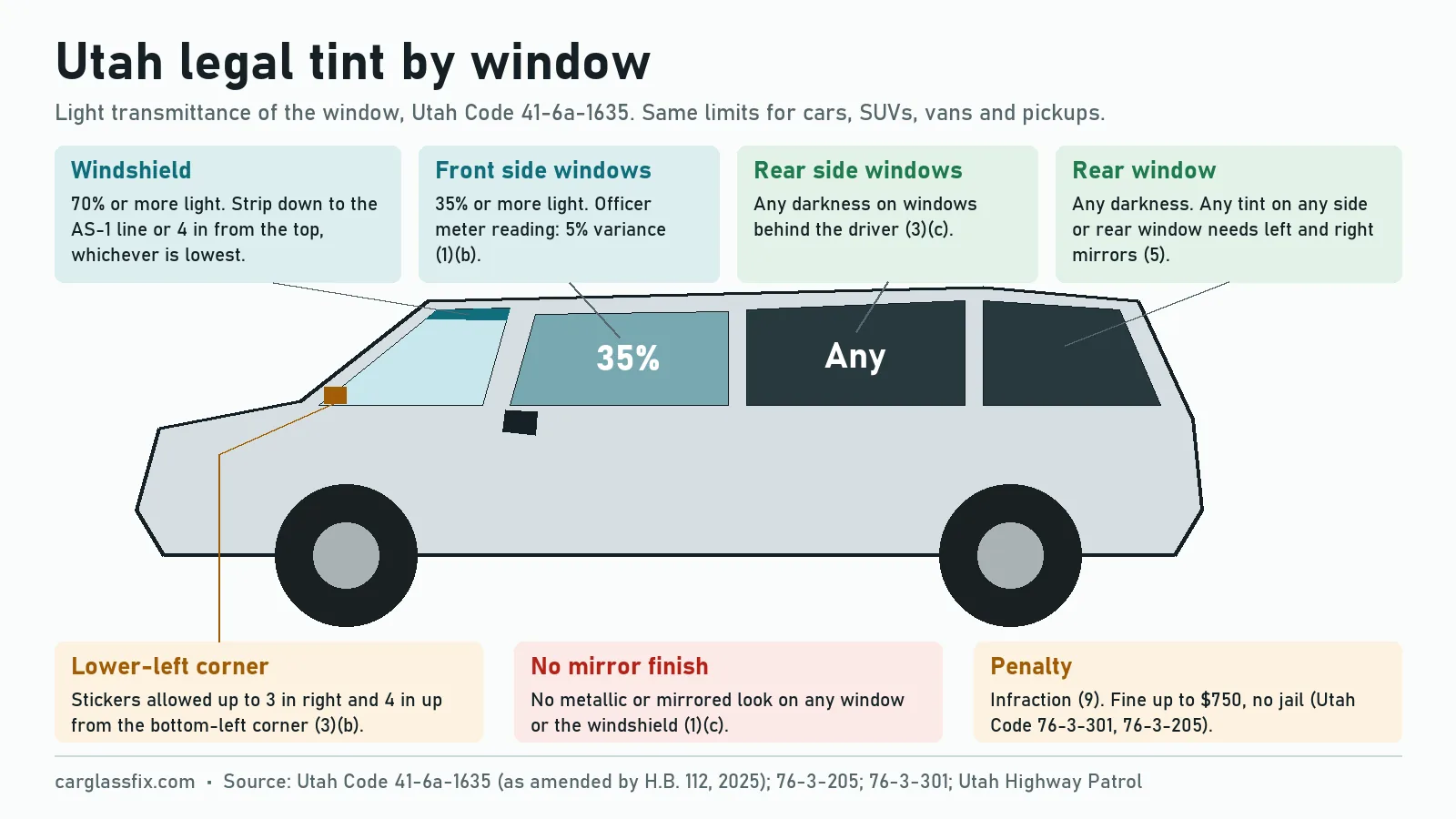
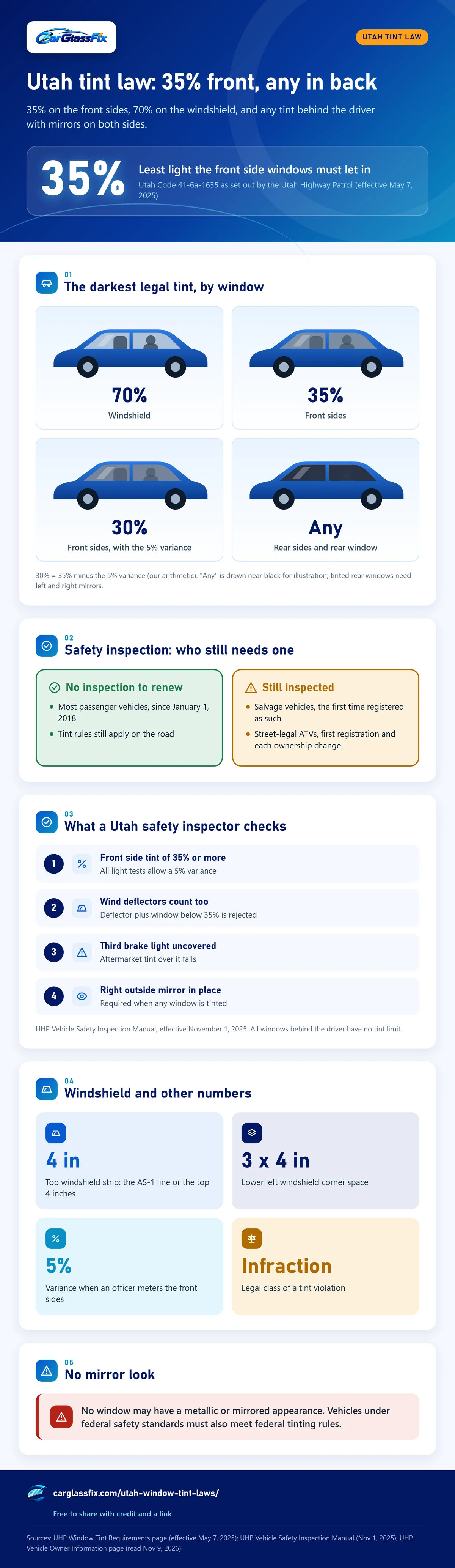
In Utah, front side windows must let in at least 35% of light, with a 5% variance on an officer’s meter. Side windows behind the driver and the rear window may be any darkness with left and right outside mirrors. The windshield must pass 70% of light, with a top strip to the AS-1 line or 4 inches.
Utah window tint limits by window
Utah allows 35% light transmittance on the front side windows and no limit on the windows behind the driver. The rule is Utah Code 41-6a-1635, last amended by H.B. 112 in the 2025 General Session. Subsection (1) lists what a person may not drive with. Subsection (3) then lists where nontransparent material is allowed, and that list includes “the rear windows including rear side windows located behind the vehicle operator”. The statute uses one set of limits for every motor vehicle. Many states give SUVs, vans and pickups a looser rear limit, but Utah needs no such split because every window behind the driver is already open to any shade. Some Utah tint shop pages still suggest that multipurpose vehicles follow different rules. The statute text does not support that.
| Window | Sedan | SUV, van, pickup |
|---|---|---|
| Windshield | 70% light or more; tint strip down to the AS-1 line or 4 in from the top, whichever is lowest; corner space 3 in by 4 in at the lower left | Same |
| Front side windows (left and right of the driver) | 35% light or more; 5% variance on an officer’s meter | Same |
| Side windows behind the driver | Any darkness | Any darkness |
| Rear window | Any darkness | Any darkness |
| Condition | Left and right outside mirrors if any window is tinted | Same |
| Finish | No metallic or mirrored appearance on any window | Same |
How Utah measures the 35% front side limit
Utah measures what the finished window lets through, so the 35% figure covers the film and the glass together. The statute bars “a front side window that allows less than 35% light transmittance”. The wording refers to the whole window, so a film sold as 35% is likely to read darker once it sits on factory glass that already blocks some light.
The variance in (1)(b) is written for “a peace officer metering the light transmittance”. The Utah Highway Patrol inspection manual applies it more widely: “All light transmittance testing will allow a 5% variance.” Our how to measure window tint guide shows how glass and film combine, and the window tint percentage chart shows how dark 35% looks next to other shades. A window tint meter reads the same net number an officer sees. The manual also covers wind deflectors on the front windows. An inspector rejects a deflector tinted below 35%, or a deflector and window that together fall below 35%.
Windshield tint in Utah: 70%, the AS-1 line and the 4-inch strip
A Utah windshield must pass at least 70% of light, and darker material may sit only in a top strip and one small corner. Subsection (3)(a) allows nontransparent material along the top edge if it does not reach more than four inches down “or beyond the AS-1 line whichever is lowest”. The AS-1 mark is the line the glass maker prints near the top edge of the windshield, and our guide to the AS-1 line on a windshield shows where to find it. The words “whichever is lowest” differ from the “closer to the top” wording that many other states use. The inspection manual repeats the rule as “whichever is lower”. Below the strip, the 70% floor in (1)(a) still applies to the whole windshield. That leaves room only for a very light, near-clear film, and only if the windshield keeps reading 70% or more. Subsection (3)(b) adds a corner space at the lower left. Material there may not reach more than 3 inches to the right of the left edge or 4 inches above the bottom edge. Other stickers fall under (1)(d), which allows only a certificate or paper the law requires, or an etched VIN. Our page on the sticker on your windshield explains the printed marks that come from the factory.
How Utah’s tint law changed since 2016
Utah’s front side limit was 43% until May 4, 2022, when S.B. 149 lowered it to 35%. The enrolled bill shows the change as “[43%] 35%” in subsection (1)(b) and leaves every other limit as it was. Senator Daniel McCay sponsored it, Representative Walt Brooks carried it in the House, and the governor signed it on March 22, 2022, as Laws of Utah 2022, chapter 183.
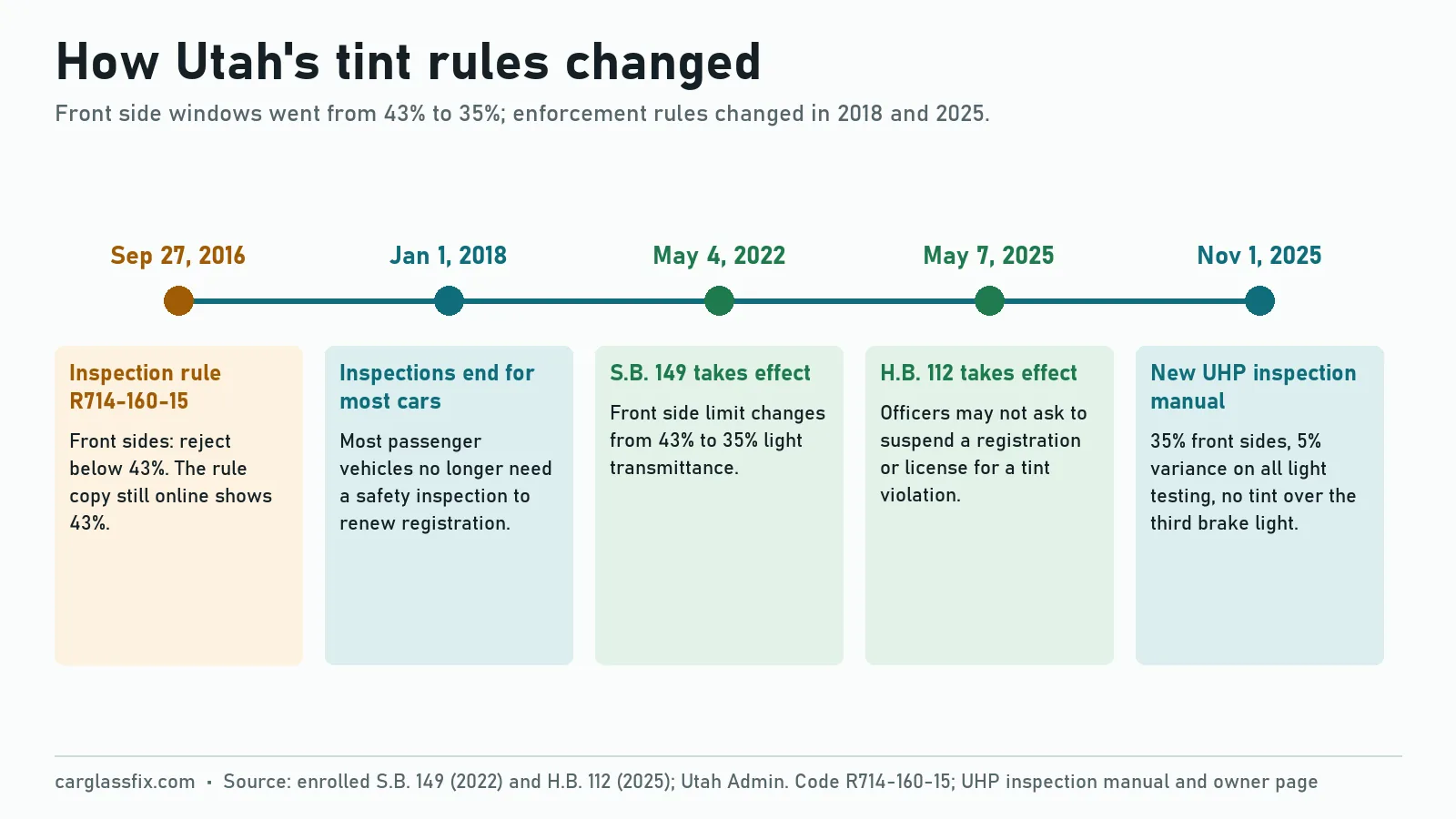
H.B. 112, sponsored by Representative Karianne Lisonbee, took effect on May 7, 2025. It added subsection (10), covered below under tickets. The Utah Highway Patrol tint page carries the same date as its effective date. Several pages in today’s search results still give 43%, including a 2025 law-firm blog post and a 2021 tint shop page. The administrative rule R714-160-15, effective September 27, 2016, also still reads 43% in the copy published by Cornell’s Legal Information Institute. The statute wins over a stale rule, and the November 1, 2025 inspection manual uses 35%.
Mirrors, mirrored film and what tint shops may install
Any tint on any Utah window, apart from the windshield strip and corner, requires outside rear-view mirrors on both the left and the right side. Subsection (5) says the mirrors must “reflect to the driver a view of the highway to the rear”. The inspection manual rejects a vehicle that lacks a right outside mirror “if the vehicle has any amount of tint on its windows”. Subsection (1)(c) bans any material that “presents a metallic or mirrored appearance” on every window and the windshield, so reflective film is out even on the rear glass. Our page on whether you can put mirror tint on a car explains how these films differ. Utah’s statute names no banned colors. The rules also reach businesses. Subsection (7) bars anyone from selling, installing or treating a window in violation of the section. Subsection (8) requires makers, dealers, importers and repair businesses to follow federal tint standards, and (4) treats a window that meets federal rules as compliant. The inspection manual also rejects aftermarket tint applied over the center high-mounted stop lamp.
Utah tint tickets: an infraction, a fine and no suspension
A violation of Utah’s tint statute is an infraction, which carries a fine of up to $750 and no jail. Subsection (9) of 41-6a-1635 states that “A violation of this section is an infraction.” The tint section sets no amount of its own. Utah Code 76-3-301(1)(e) caps the fine at “$750 for a class C misdemeanor conviction or infraction conviction”. Utah Code 76-3-205 says a person convicted of an infraction “may not be imprisoned” but may face a fine, forfeiture or disqualification. The $750 figure is a ceiling. The amount a court actually sets is not stated in either statute. Tint shop pages and forum posts quote much smaller ticket amounts, and we found no official schedule to confirm them. H.B. 112 added subsection (10). It says a peace officer may not ask the Motor Vehicle Division or Driver License Division to revoke or suspend a registration or driver license for violations of the windshield or front side limits. Nothing in the section limits tint enforcement to stops made for another reason.
Medical exemptions and safety inspections in Utah
Utah’s tint statute contains no medical exemption that allows darker front side windows or a darker windshield. The full text of 41-6a-1635 lists exceptions for the windshield strip, the corner space, the rear windows and federally compliant glass, and none of them mentions a medical condition. The Utah Highway Patrol tint page and the 2025 inspection manual mention no exemption either. Bing’s AI answer and some shop pages describe a physician statement and a DMV approval process, but we found no Utah government source for one. A driver who needs light protection can ask a doctor or an attorney about options and keep the front glass at 35% or lighter until an official source says otherwise. Most passenger vehicles have not needed a safety inspection since January 1, 2018, according to the Utah Highway Patrol. Salvage vehicles at first registration, street-legal ATVs, some commercial vehicles, buses, taxis and tow trucks still need one, and inspectors meter the windshield and front side windows. The window tint simulator previews each shade, and the hub on what car window tint is legal compares Utah with other states. Rules change, so check the current statute or the Utah Highway Patrol before you tint. This page is not legal advice.
Frequently asked questions
How much is a ticket for tint in Utah?
A tint violation is an infraction under Utah Code 41-6a-1635(9), and Utah Code 76-3-301 caps an infraction fine at $750. The statute sets no fixed amount, and the court decides the fine within that cap.
Can you be pulled over for window tint in Utah?
Yes. Tint below the limits is an infraction under Utah Code 41-6a-1635, and nothing in the section limits it to secondary enforcement. Since May 7, 2025 the officer may not ask to suspend the driver license or registration for a windshield or front side violation.
Is 20% tint legal in Utah?
A 20% tint is legal on the side windows behind the driver and on the rear window if the vehicle has left and right outside mirrors. It is illegal on the front side windows, which need 35% or more.
Is 35 or 20 tint darker?
A 20% tint is darker, because it lets through 20% of visible light against 35% for the lighter film. The window tint percentage chart shows both shades side by side.
Does Utah allow a medical exemption for window tint?
Utah Code 41-6a-1635 contains no medical exemption, and the Utah Highway Patrol tint page lists none. Ask the Utah Highway Patrol or an attorney before relying on any exemption described online.
Sources
- Utah Code 41-6a-1635, Windshields and windows, tinting (text read from the enrolled H.B. 112 and the FindLaw copy; checked 29 October 2026)
- Utah H.B. 112, Motor Vehicle Safety Inspection Modifications, 2025 General Session, enrolled (effective 7 May 2025)
- Utah S.B. 149, Tinted Vehicle Windows Amendments, 2022 General Session, enrolled (effective 4 May 2022)
- Utah Code 76-3-301, Fines of individuals and 76-3-205, Infraction conviction (FindLaw, current as of 1 January 2025; checked 29 October 2026)
- Utah Highway Patrol: Window Tint Requirements (effective date 7 May 2025; checked 29 October 2026)
- Utah Department of Public Safety: Official Vehicle Safety Inspection Manual, Passenger Vehicles and Light Duty Trucks (effective 1 November 2025)
- Utah Highway Patrol: Vehicle Owner Safety Inspection Information (checked 29 October 2026)
- Utah Admin. Code R714-160-15, Vehicle Windows (Cornell LII copy, effective 27 September 2016)

Similar Posts