Wisconsin Window Tint Laws: 50% Front, 35% Rear
Senior Automotive Glass Diagnostic Specialist & Master Technician at CarGlassFix · AGSC Master Certified Auto Glass Technician, NGA Certified Installer, I-CAR Automotive Safety Specialist · 12+ Years in Automotive Glazing, Windshield Structural Bonding, ADAS Camera Calibration & Precision Chip Restoration
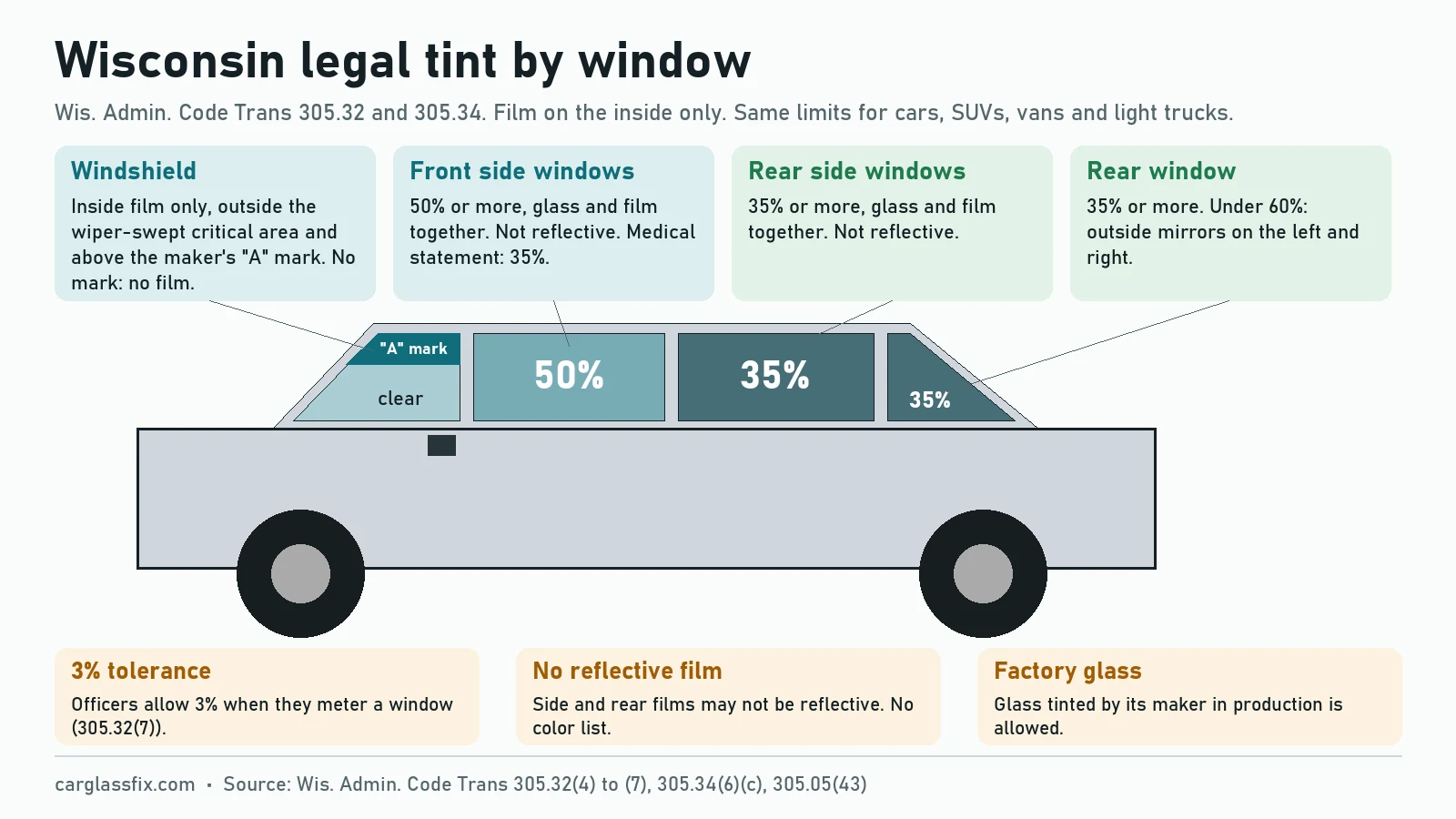
In Wisconsin, front side windows must pass at least 50% of visible light with film and glass together, and side windows behind the driver and the rear window at least 35%. Film goes on the inside and may not be reflective. Windshield film is allowed only above the maker’s “A” mark and outside the driver’s critical area.
Wisconsin window tint limits by window
Wisconsin requires 50% light transmission on the front side windows and 35% on the rear side windows and the rear window. These limits come from Wisconsin Administrative Code Trans 305.32, a rule written by the Wisconsin Department of Transportation (WisDOT). Subchapter II of Trans 305 covers “automobiles, light trucks and motor homes” (Trans 305.02(2)(a)). A light truck is one rated at 10,000 pounds or less (Trans 305.05(25)). The rule draws no line between sedans and multipurpose vehicles, so an SUV, minivan or pickup follows the same numbers as a sedan. Many states let SUVs run darker rear glass with film; Wisconsin does not. Every film must go on the inside of the glass, and no film allowed by the rule may be reflective.
| Window | Sedan | SUV, van, pickup |
|---|---|---|
| Windshield | Inside film only, outside the critical area and above the maker’s “A” mark; no mark, no film | Same |
| Front side and vent windows | 50% or more; 35% with a medical statement; not reflective | Same |
| Rear side windows | 35% or more; not reflective | Same |
| Rear window | 35% or more; under 60% needs outside mirrors on both sides | Same |
| Measured as | Glass and film together | Same |
| Tolerance | 3% when an officer measures | Same |
| Factory-tinted glass | Allowed | Allowed |
How Wisconsin measures the 50% and 35% limits
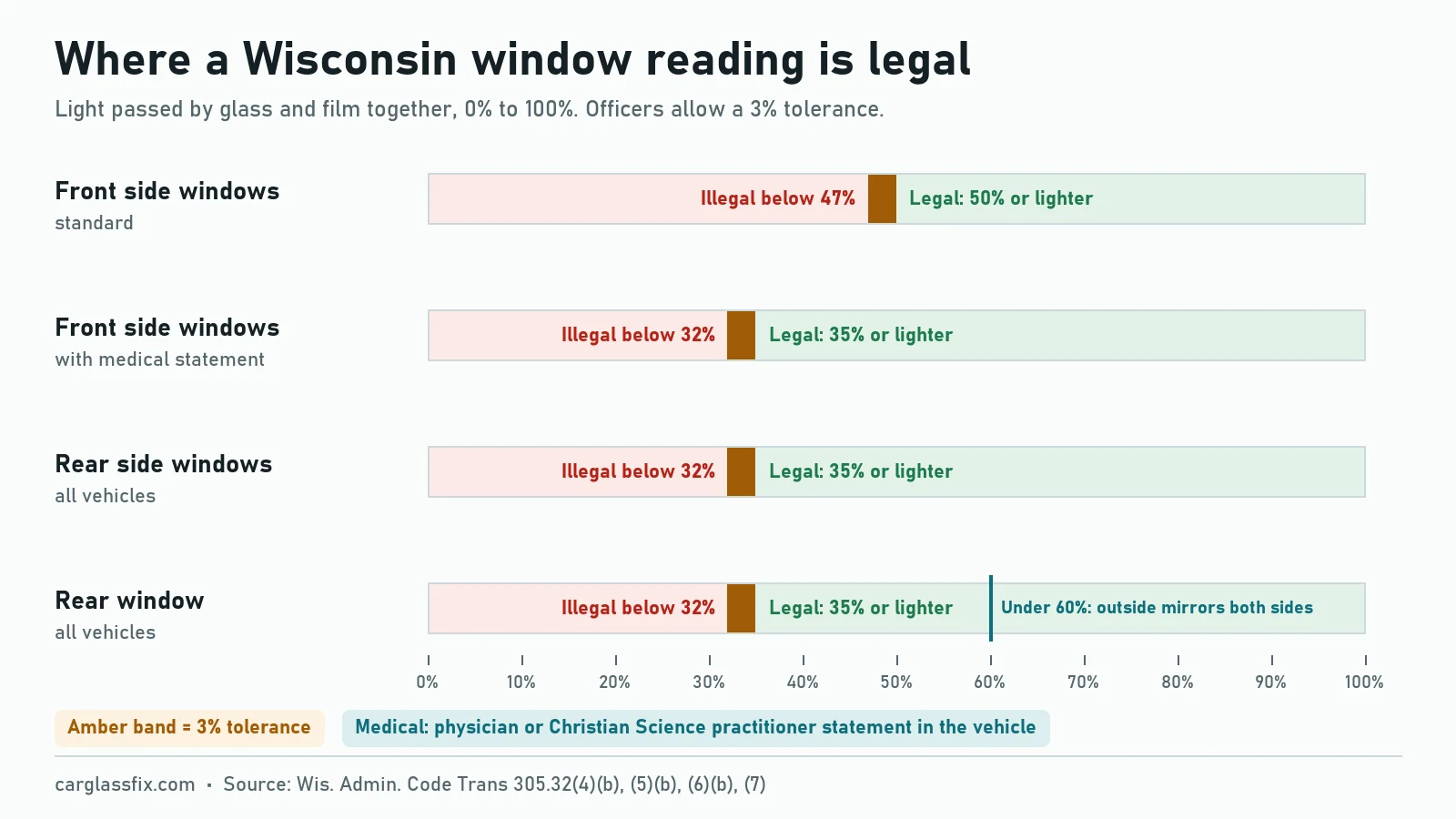
Wisconsin measures the finished window, glass and film together, so the legal figure is the meter reading, not the shade printed on the film box. Trans 305.32(4)(b)2 says “the combination of the glazing and tinting film” must pass at least 50% of the visible light striking a front side window. The rear side and rear window rules use the same wording with 35%.
Factory glass already blocks some light before any film goes on. A 50% film on a window that passes less than 100% will read below 50%, which is why a lighter film is often needed to stay legal. Our how to measure window tint guide explains the glass-times-film math, and the window tint percentage chart shows how dark each shade looks. Trans 305.32(7) tells officers they “shall allow a tolerance of 3%”. A front side window that reads 47% therefore passes, and a rear window that reads 32% passes. A window tint meter reads the same combined figure an officer sees. A rear window that passes less than 60% of light also needs an outside rearview mirror on the left and the right (Trans 305.32(5)(b)3).
Windshield tint in Wisconsin: the “A” mark and the critical area
A Wisconsin windshield may carry film only on the inside, on the part that is both outside the critical area and above the maker’s horizontal mark. Trans 305.34(6)(c) names that mark “A” or “A.”, and the official code prints the first “A” underlined. The code never uses the term AS-1 and gives no inch figure. If the maker put no such mark on the glass, “no window tinting film may be attached” at all.
The critical area is wider than many drivers expect. Trans 305.05(43) defines it as the part the driver uses for “necessary observations to the front,” including the areas normally swept by the factory wipers. A strip must clear both limits. Several sites say Wisconsin allows the top 5 or 6 inches; we found no inch limit in Trans 305.34. Pages that call the mark the AS-1 line use a term the Wisconsin code does not print. Read about the AS-1 line on a windshield to see what that marking means elsewhere. For the windshield rules of other states, see is it illegal to have tint on a windshield. Glass tinted by its maker during production is allowed under Trans 305.34(6)(b).
Wisconsin medical exemption for window tint
Wisconsin allows darker front side windows on a medical recommendation, and the proof is a written statement kept in the vehicle, not a state permit. Trans 305.32(4)(b)3 lets the vent and front side windows go down to 35%, glass and film together, on the recommendation of a physician or a Christian Science practitioner. The person treated can be the owner or an immediate family member. Trans 305.05(23) defines that as a spouse, child, stepchild, foster child or other dependent living in the owner’s household. The film must still be non-reflective. The rule gives no medical relief for the windshield, and the rear windows already allow 35%.
How to use the Wisconsin medical tint rule
Get a recommendation
A treating physician or Christian Science practitioner recommends the tint for the owner or an immediate family member.
Get a written statement
It must identify the patient, the medical condition, whether the condition is temporary or permanent, and the vehicle by make, model, year and VIN.
Keep it in the vehicle
The rule says the statement “shall be carried in the vehicle at all times”.
Tint to 35% or lighter
Film goes on the inside of the front side and vent windows and may not be reflective.
Remove the film when required
Take it off when the vehicle is sold, when the person moves out of the household, or when a temporary condition ends.
The code describes no application to WisDOT, no certificate and no decal. Pages that tell Wisconsin drivers to apply for a state waiver describe a step that Trans 305.32 does not contain.
Why Wisconsin tint rules sit in the administrative code
Wisconsin’s tint numbers are an administrative rule made by WisDOT, not a section of the Wisconsin Statutes. The legislature points to that rule in Wis. Stat. 347.02(8): “If the department establishes by rule limitations on the tinting of motor vehicle windows,” those limits do not apply to certain police vehicles. Trans 305.32 was created in Register No. 482, effective March 1, 1996. Its only later amendment, in 1997, changed subsection (3) on cloudy glass, not the tint numbers.
Because the limits sit in a rule, searches of the statutes alone turn up little, and some pages guess. A Bing AI answer checked for this page said reflective film is banned on the windshield too. Trans 305.34(6)(c) has no reflectance clause; the “may not be reflective” wording sits in the side and rear window rules. The same answer listed banned colors, yet neither Trans 305.32 nor 305.34 names a color. A short video in the Google results says 20% is legal on the sides and rear; the rule says 35%. Another video correctly notes that factory-darkened rear glass is allowed. Aftermarket film added on top of factory glass still has to meet 35% with the glass.
How much is a tint ticket in Wisconsin
A Wisconsin tint violation carries a forfeiture of $10 to $200. Trans 305.04 sends violations of the equipment rule to the penalty in Wis. Stat. 110.075(7), unless another statute sets a different penalty. Section 110.075(7) says persons violating chapter 347 “or rules issued pursuant thereto” shall forfeit “not less than $10 nor more than $200.” A forfeiture is a civil penalty, not a criminal fine. Any court costs or fees on top of it vary by court, so read the citation for the total.
Wis. Stat. 110.075(2) lets a traffic officer or motor vehicle inspector direct a driver to stop and submit the vehicle to an equipment inspection, and the listed items include glass. Under 110.075(5), an officer who finds a vehicle out of compliance may issue a repair order, and the owner or driver “shall thereupon obtain such repairs.” Trans 305.03 also bars anyone from operating, or allowing someone to operate, a non-conforming vehicle on Wisconsin highways. That puts the owner on the hook as well as the driver.
Who the Wisconsin tint limits do not apply to
The Wisconsin limits do not apply to factory-tinted glass, to some police vehicles or to heavy trucks covered by another subchapter. Trans 305.32 allows windows “tinted by the manufacturer of the glazing” and installed as part of the original manufacturing process on every window it covers. Wis. Stat. 347.02(8) exempts police vehicles owned by the state, a county, a city, a village or a town when tint is needed to protect personnel, passengers or equipment. Heavy trucks over 10,000 pounds fall under subchapter IV of Trans 305, not the subchapter II tint rule.
The out-of-state exemption is narrow. Trans 305.02(1)(h) leaves out only homemade, street modified, replica or reconstructed vehicles owned by a nonresident and registered elsewhere. A visitor’s ordinary car is not named. Neighboring Illinois sets its own rules; see Illinois window tint laws. Before choosing a shade, try the window tint simulator, and compare every state in what car window tint is legal.
Tint rules can change. Check the current Wis. Admin. Code Trans 305.32 and 305.34 on the Wisconsin Legislature site before you tint. This article is general information, not legal advice.
Frequently asked questions
Is 20% tint legal in Wisconsin?
No. A 20% reading is below the 35% minimum for the rear side windows and the rear window and far below the 50% front side limit, even with the 3% tolerance.
Is 35% tint legal in Wisconsin?
A 35% reading is legal on the rear side windows and the rear window. On the front side windows it is legal only with a written medical statement from a physician or Christian Science practitioner carried in the vehicle.
How do I get a tint exemption in Wisconsin?
Get a written statement from a treating physician or Christian Science practitioner that names the patient, the condition, whether it is temporary or permanent, and the vehicle with its VIN. Keep it in the vehicle; the rule then allows 35% on the front side windows.
Can a cop pull you over for tint in Wisconsin?
Wis. Stat. 110.075(2) lets a traffic officer direct a driver to stop for an equipment inspection that includes glass. The officer must allow a 3% tolerance when measuring, and the penalty is a forfeiture of $10 to $200.
How dark is 35% window tint?
A 35% window lets through 35% of visible light and blocks the rest, so it is darker than 50% and lighter than 20%. The window tint percentage chart shows each shade side by side.
Sources
- Wis. Admin. Code Trans 305.32, Vent, side and rear windows (read on Cornell LII and an archived copy of the official page of 11 June 2026; checked 29 October 2026)
- Wis. Admin. Code Trans 305.34, Windshields (checked 29 October 2026)
- Wis. Admin. Code Trans 305.05, Definitions and Trans 305.02, Applicability (Cornell LII, checked 29 October 2026)
- Wis. Admin. Code Trans 305.03, Enforcement and Trans 305.04, Penalty (Cornell LII, checked 29 October 2026)
- Wis. Stat. 110.075, Motor vehicle inspection (archived copy of the official page read, checked 29 October 2026)
- Wis. Stat. 347.02(8), Applicability of chapter (archived copy of the official page of 3 November 2025 read)

Similar Posts