Tail Light Tint Legal by State: Headlight Tint Checker
Senior Automotive Glass Diagnostic Specialist & Master Technician at CarGlassFix · AGSC Master Certified Auto Glass Technician, NGA Certified Installer, I-CAR Automotive Safety Specialist · 12+ Years in Automotive Glazing, Windshield Structural Bonding, ADAS Camera Calibration & Precision Chip Restoration
Tail light tint is illegal by name in Illinois, and Minnesota bans non-clear lamp covers. Florida bans covers that alter visibility from 1,000 feet. Utah and Virginia reject it at inspection. No source read says any state allows it, and other states apply color and visibility tests instead.
18 states were checked against their vehicle code or inspection rule. “Output rule applies” does not mean tint is allowed. It means the sections read set a color, distance or lens test and do not name tint. General information, not legal advice.
How the tail light tint checker works
The tail light tint checker shows what the state rules read for this page say about tinted or smoked lamps. Pick a state and a light. The result gives one of four labels, the rule, its source and the check date.
“Not allowed” means the law names tint, smoked lenses or covering material. “Fails state inspection” means an inspection rule rejects it. “Output rule applies” means the sections read set a color, distance or lens test and do not name tint. That label does not mean tint is allowed. “Not confirmed” means the state was not verified, so the tool shows the general rule.
The set is small on purpose. A state appears as checked only if its code or inspection rule was opened and read. Lists on retail and forum sites conflict with each other and rarely cite a section. Window film has its own rules, so use the guide to what car window tint is legal for side and rear glass.
Is tail light tint legal by state
Tail light tint is banned or fails inspection in five of the 18 states checked here. The other 13 set a color, distance or lens test. In those states dark film can still break the rule, because the lamp must keep working as the law describes.
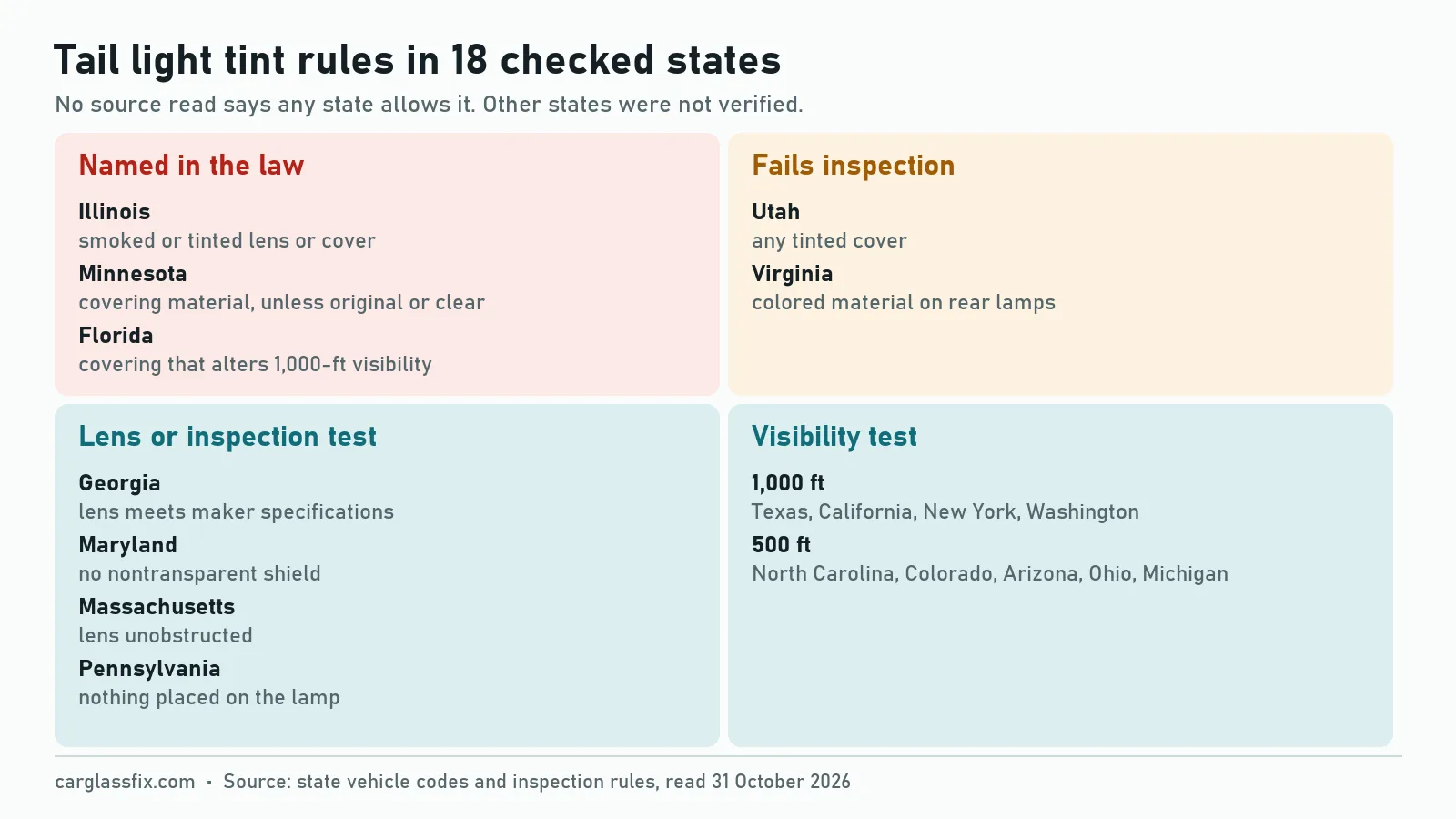
| State | Tail light rule | Source |
|---|---|---|
| Illinois | No smoked or tinted lens or cover | 625 ILCS 5/12-212(d) |
| Minnesota | No covering material unless original or clear and colorless | Minn. Stat. 169.64 subd. 10 |
| Florida | No covering that alters visibility from 1,000 feet | Fla. Stat. 316.221(1) |
| Utah | Inspection rejects a tinted cover or tinted stop lamp | R714-160-13 |
| Virginia | Inspection rejects colored material on rear lamps | 19VAC30-70-150 |
| Georgia | Lenses must meet manufacturers’ specifications | O.C.G.A. 40-8-23(e) |
| Texas | Red, visible at 1,000 feet, and FMVSS 108 applies | Transp. Code 547.322, 547.3215 |
| California | Red, visible within 1,000 feet, in good working order | Veh. Code 24600, 24252 |
| New York | Red, visible for at least 1,000 feet | VTL 375(2)(a) |
| Ohio, Michigan, Arizona, Colorado, North Carolina | Red, visible from 500 feet | State vehicle codes |
Florida’s rule is the clearest output test. A violation is a noncriminal nonmoving infraction, so the tint does not need to be dark on sight. It only needs to alter visibility from 1,000 feet. New Hampshire was left out, because its inspection rule could not be opened.
Is headlight tint legal
Headlight tint is banned by name or rejected at inspection in five of the states checked. Illinois’s sentence covers all lighting, and Minnesota’s rule names headlamps. Utah rejects a headlamp cover that is tinted, colored or painted other than clear.
Virginia rejects foreign material or colored material on or in front of a headlamp. Its rule also says no glazing may go in front of a headlamp unless it is part of an approved assembly. Maryland’s inspection rule goes further and rejects an aftermarket clear, tinted or screen-type headlamp cover.
Federal Standard 108 points the same way for new vehicles. Paragraph S6.2.3.1 says a headlamp must not have a styling ornament or other feature, “such as a translucent cover or grill”, in front of the lens. Texas ties its lighting rules to that standard in Transportation Code 547.3215. Most other checked states read as Not confirmed for headlights, because no headlight cover wording was found in the sections read. For the lamp housing itself, see whether car headlights are glass or plastic.
What FMVSS 108 says about lamp tint
FMVSS 108 is the federal lighting standard, and it applies to new vehicles and new equipment. Paragraph S6.2.1 says no added equipment may be installed that impairs the effectiveness of required lighting. No NHTSA letter on tinted tail lights was found for this page, so the rule is stated here as written.
Federal law also reaches some businesses after sale. Under 49 U.S.C. 30122, manufacturers, distributors, dealers, rental companies and repair businesses may not knowingly make safety equipment inoperative. A 2004 NHTSA letter applied this to aftermarket lighting. The same letter says the list of covered persons “does not include vehicle owners”.
So a shop and an owner sit in different positions. A shop that dims a compliant lamp can face the federal rule. An owner answers to state law. Inspection rules and ticket rules then decide what happens on the road. Federal law does not make tint legal for owners. It leaves that question to each state.
Film, spray and smoked covers in the rules
State rules read for this page reach film, spray and smoked covers alike, though each uses its own words. Illinois says “lens or cover”. Minnesota says “equipment or material”, which takes in film and a snap-on cover. Florida says “object, material, or covering”. Utah says painted or tinted, and it also rejects a lamp with a tinted cover.
Virginia’s list names wire, unapproved lens or plastic covers, non-original materials and colored material. Factory smoked lenses raise a different point. Minnesota exempts original equipment, and Virginia’s rule targets material that is not original. Those exceptions do not lift the color and distance rules, which still apply to the lamp.
Percent ratings do not help here. A window tint meter reads glass, and no rule read gives a percent for lamps. Tint can also cut your own view of the road, as the page on whether car window tinting reduces visibility explains for windows.
What to check before tinting your lights
Check your state’s rule and your inspection status first, since film can fail either one. A state with a safety inspection can reject the car even when no officer stops it. Virginia and Maryland publish their reject lists in their inspection rules, so you can read the wording before you buy film. Massachusetts publishes its lens rule the same way. Stations in other states may apply a manual that is not online, so ask before you apply anything.
How to check lamp tint before you apply it
Run the checker
Pick your state and light, and read the label and rule.
Read the state code
Search your state’s vehicle code for lamp, lens and cover wording.
Check inspection rules
Ask your inspection station whether lens film passes.
Test visibility
Compare the lamp with the distance your state sets, at night and with help.
Remove it if in doubt
Take the film off the lens or fit a stock lens.
The steps above treat film and covers alike because no rule read makes a safe exception for dark material. If you remove film from the lamps, the same care applies as for the methods on how to remove car window tint.
Check the states you drive through as well, since a visiting car can still draw a stop. A ticket for lamp tint falls under lighting rules, so window tint fine figures do not carry over.
Frequently asked questions
Is tail light tint illegal?
It is illegal by name in Illinois and through cover rules in Minnesota and Florida. Utah and Virginia reject it at inspection, and other states apply color and visibility tests.
Is headlight tint legal?
No checked source says it is legal. Illinois and Minnesota ban it, Utah, Virginia and Maryland reject it at inspection, and FMVSS 108 bars translucent covers on new vehicles.
Is tail light tint legal in Texas?
Texas requires a red tail lamp plainly visible at 1,000 feet, and lighting must comply with FMVSS 108. The sections read do not name tint, so film that fails those tests can break the rule.
Is clear lamp film legal?
Minnesota exempts clear and colorless material. Maryland rejects any aftermarket clear headlamp cover, and Virginia rejects unapproved covers, so clear film is not safe everywhere.
What tail light tint percentage is legal?
None of the rules read sets a percent for lamps. Percent limits belong to window film, which the window tint percentage chart explains.
Sources
- 49 CFR 571.108, FMVSS 108 (read 31 October 2026)
- NHTSA interpretation GF006332 (read 31 October 2026)
- 625 ILCS 5/12-212 (read 31 October 2026)
- Minn. Stat. 169.64 (read 31 October 2026)
- Fla. Stat. 316.221 (read 31 October 2026)
- Utah Admin. Code R714-160-13 (read 31 October 2026)
- 19VAC30-70-140 (read 31 October 2026)
- 19VAC30-70-150 (read 31 October 2026)
- COMAR 11.14.02.10 (read 31 October 2026)
- 540 CMR 4.04 (read 31 October 2026)
- 67 Pa. Code 175.80 (read 31 October 2026)
- O.C.G.A. 40-8-23 (read 31 October 2026)
- Tex. Transp. Code 547.322 (read 31 October 2026)
- Tex. Transp. Code 547.3215 (read 31 October 2026)
- Cal. Veh. Code 24600 (read 31 October 2026)
- Cal. Veh. Code 24252 (read 31 October 2026)
- N.Y. Veh. & Traf. Law 375 (read 31 October 2026)
- RCW 46.37.050 (read 31 October 2026)
- N.C.G.S. 20-129 (read 31 October 2026)
- C.R.S. 42-4-206 (read 31 October 2026)
- A.R.S. 28-925 (read 31 October 2026)
- Ohio Rev. Code 4513.05 (read 31 October 2026)
- MCL 257.686 (read 31 October 2026)

Similar Posts