Window Tint Cure Time Calculator: Range by Film Maker
Senior Automotive Glass Diagnostic Specialist & Master Technician at CarGlassFix · AGSC Master Certified Auto Glass Technician, NGA Certified Installer, I-CAR Automotive Safety Specialist · 12+ Years in Automotive Glazing, Windshield Structural Bonding, ADAS Camera Calibration & Precision Chip Restoration
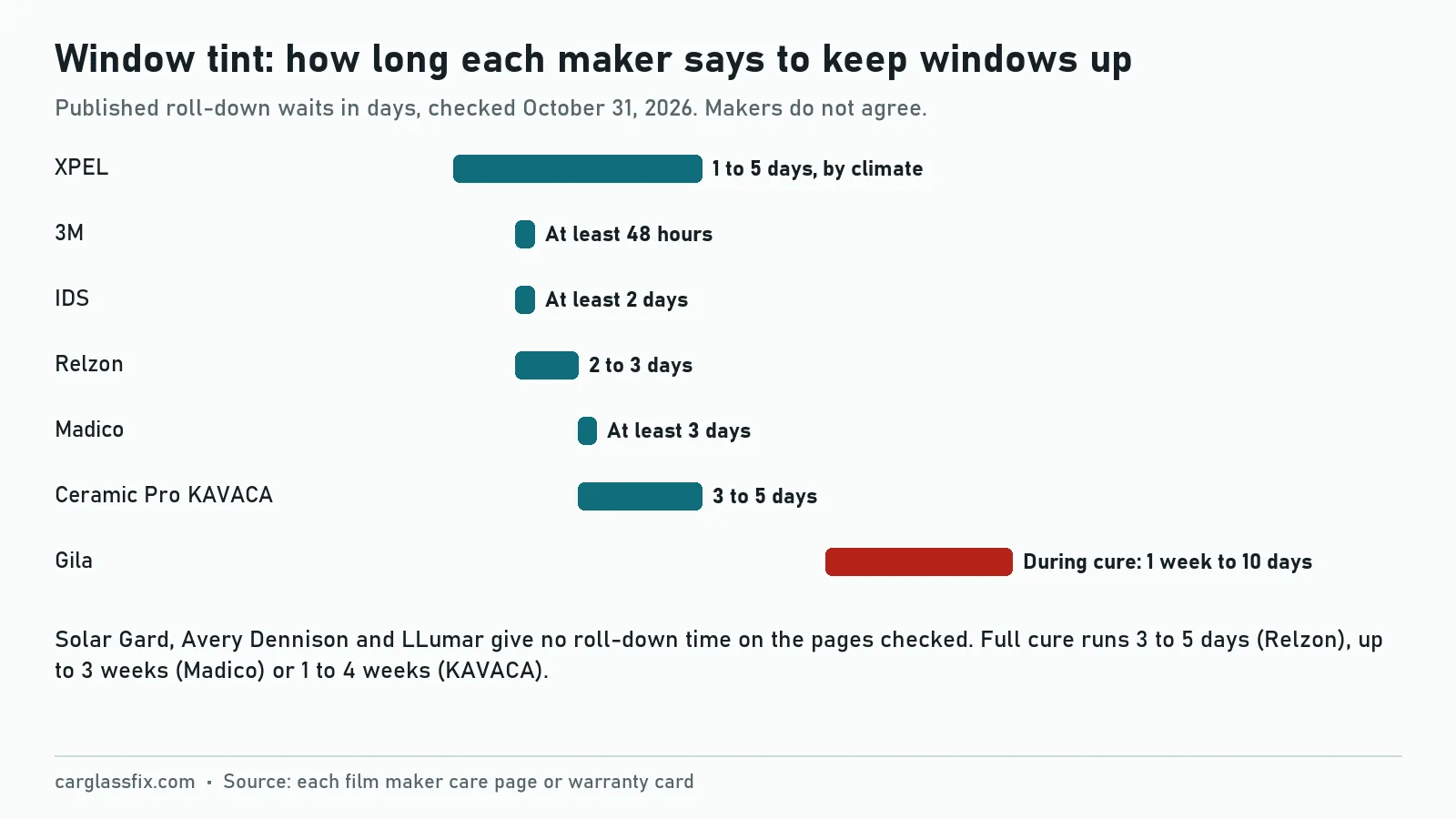
Window tint cure time runs from about 3 days to 4 weeks, depending on the film maker and the weather. Makers ask you to keep windows up for about 1 to 10 days. Relzon lists a 3 to 5 day cure, Gila a week to 10 days, and Ceramic Pro KAVACA 1 to 4 weeks.
| Maker | Windows down | First cleaning | Full cure |
|---|
Figures are each maker’s own published wording, checked October 31, 2026. The tool shows ranges because no maker publishes a days-per-degree rule. Your installer’s written instructions come first, and they can affect your warranty.
How the window tint cure time calculator works
The window tint cure time calculator shows what your film maker publishes for three separate waits. Pick a film maker, a film type and the weather after install. Add your install date to get a calendar date for rolling the windows down. Choose “not sure” if you do not know the brand, and the tool lists all ten makers.
The tool does no temperature math. Makers say weather moves cure time, but none of them publishes a formula. Hot weather therefore points you to the short end of a maker’s published range, and cold weather points to the long end. Where a maker gives one fixed minimum, the tool shows that minimum and says so.
Your installer’s written instructions come first, because they can tie into your warranty. Relzon and Ceramic Pro both link their aftercare rules to warranty terms. For the full first-week routine, read what to do after tinting car windows.
Window tint cure time by film maker
Film makers publish different times, and some publish none at all. The table lines up ten makers on the same three questions. All wording was checked on October 31, 2026.
| Maker | Windows down | First cleaning | Full cure |
|---|---|---|---|
| 3M | At least 48 hours | At least 48 hours | Not stated |
| IDS | At least 2 days | At least 2 days | Not stated |
| XPEL | About 1 to 5 days, by climate | About 1 to 5 days | Haze up to 10 days |
| Madico | At least 3 days | At least 3 days on one page, 30 days on another | Up to 3 weeks |
| Relzon | 2 to 3 days | 5 to 7 days | 3 to 5 days |
| Ceramic Pro KAVACA | 3 to 5 days | At least 7 days | 1 to 4 weeks |
| Gila | Not during cure | At least 3 days | A week to 10 days |
| Solar Gard | Not stated | 30 days | By weather |
| Avery Dennison | Not stated on this sheet | 30 days | Several days or weeks |
| LLumar | Not stated | Not stated | Not stated |
Gila is the only entry written mainly for DIY film. The rest describe installed film, so a Gila kit should follow Gila’s longer wait. LLumar’s FAQ page gave no time when checked, so ask your LLumar dealer. Solar Gard and Avery Dennison give no roll-down time on the pages read, so ask the installer there too. A blank cell in the table means the maker did not state a figure on that page.
Why roll-down time and full cure time differ
Roll-down time and full cure time measure different things. The roll-down wait gives the film time to bond, as 3M puts it, and Relzon says it prevents damage to the film. Full cure is the point when the leftover application solution has gone from under the film. Madico describes cure as the time the remaining solution takes to evaporate.
That split explains most of the numbers above. Ceramic Pro says 3 to 5 days for windows and 1 to 4 weeks for full cure. Relzon says 2 to 3 days for windows and 3 to 5 days for full cure. Only Gila ties the windows to the full cure.
First cleaning is a third clock. It runs from 2 days at IDS to 30 days at Solar Gard and Avery Dennison. Madico gives both 3 days and 30 days on two parts of its site. The safe reading is to use the longer figure, and to follow the guide on how to clean tinted side glass once that wait ends. The reasons behind the window rule are in why you can’t roll down windows after tint.
How weather changes tint cure time
Warm, sunny weather shortens cure time, and cold, wet weather lengthens it. Six makers tie cure time to the weather or climate. None of them gives a number of extra days for a given temperature, so any multiplier you see elsewhere did not come from these makers. The calculator follows the same limit and only moves you within a published range.
| Maker | What it says about weather |
|---|---|
| Gila | Dry, sunny weather speeds curing, and wet, cold weather prolongs it |
| Solar Gard | Cold or non-sunny weather can lengthen dry-out, and warm weather and direct sun shorten it |
| Ceramic Pro KAVACA | More sun and heat means faster drying |
| Madico | A dark solar film in a hot summer can cure in a few days, and heavy safety film in winter can take over a month |
| XPEL | The 1 to 5 day wait depends on the climate of the install |
| Relzon | The 3 to 5 day cure depends on ambient temperature and conditions |
Madico’s example of over a month describes heavy safety film on a north-facing window, which is a building case. Madico’s automotive page gives up to three weeks for car film, depending on weather and film type. The tool uses that automotive figure.
Does ceramic tint cure differently
None of the makers checked gives a separate car-tint cure time for ceramic film. Their care pages use one time for the whole brand. Dyed, carbon and ceramic film from one maker get the same instructions, so a ceramic film follows its maker’s figure in the table.
Two statements come close to a rule about film type. The IWFA Automotive Education Guide says most sputtered films dry more slowly, unless the maker uses a process to improve drying. Madico says thicker safety film takes longer than a dark solar control film. Sputtered and safety films are specific constructions, so these statements do not cover ceramic film in general.
Claims that ceramic cures in a set number of days come from shops and videos. Treat those as local habits, and ask for the figure in writing. For a look at the film itself, read what ceramic windshield tint is.
What curing film looks like
Curing film can look hazy, cloudy or streaked, and that look is normal at first. XPEL says haze or moisture bubbles can last up to ten days. Gila says the hazy look disappears with time or heat. Madico says the bubbles and streaks are cosmetic, and that the film performs as designed during drying.
Small water bubbles differ from air bubbles. Gila says most small water bubbles dry out in a few days, while air bubbles will not disappear without proper squeegee work. Avery Dennison says not to pop or press local bubbles.
Know when to call the installer. Avery Dennison says to contact the installer if the window still looks foggy after several weeks. Use your maker’s cure figure as the first checkpoint. Our guides to blurry car window tint and why window tint bubbles cover what to do next.
Frequently asked questions
How long does window tint take to cure?
Published figures run from 3 to 5 days at Relzon to 1 to 4 weeks at Ceramic Pro KAVACA. Gila says a week to 10 days, and Madico says up to three weeks for automotive film.
How do I know if tint is cured?
Haze, streaks and water bubbles are gone when the solution has dried, according to Madico. If a window still looks foggy after several weeks, Avery Dennison says to contact the installer.
How long does ceramic tint take to cure?
No maker checked gives a separate figure for ceramic film on cars. Use the time your film maker gives for its brand, and ask your installer for it in writing.
Can I roll my windows down after 2 days?
3M and IDS allow it after at least 48 hours or 2 days. Madico says at least 3 days, Ceramic Pro says 3 to 5 days, and Gila says to wait through its cure.
Does cold weather slow tint curing?
Yes. Gila and Solar Gard both say cold or wet weather lengthens drying. No maker checked says by how many days, so plan on the long end of its range.
Sources
- 3M: product care (read in browser 31 October 2026)
- XPEL: care (read 31 October 2026)
- Gila: automotive window tint FAQ (read 31 October 2026)
- Madico: automotive window tint (read 31 October 2026)
- Solar Gard: care instructions (read 31 October 2026)
- Avery Dennison: solar film maintenance sheet (read 31 October 2026)
- Relzon: aftercare 2023 (read 31 October 2026)
- Ceramic Pro KAVACA: warranty and aftercare (read 31 October 2026)
- IDS: automotive window tint warranty card (read 31 October 2026)
- LLumar: automotive window tint FAQ (read in browser 31 October 2026)
- IWFA Automotive Education Guide 2026 (read 31 October 2026)

Similar Posts