Delaware Window Tint Laws: 50% Front Sides Since 2026
Senior Automotive Glass Diagnostic Specialist & Master Technician at CarGlassFix · AGSC Master Certified Auto Glass Technician, NGA Certified Installer, I-CAR Automotive Safety Specialist · 12+ Years in Automotive Glazing, Windshield Structural Bonding, ADAS Camera Calibration & Precision Chip Restoration
Delaware window tint laws allow tint with a visible light transmission of 50% or greater on the front side windows and side wings since August 17, 2026. Side windows behind the driver and the rear window may be any darkness. Windshield tint must stay transparent and above the AS-1 portion of the glass (21 Del. C. 4313).
Delaware window tint limits by window
Delaware sets one tint limit, 50% visible light transmission on the windows beside the driver, and no limit on the windows behind the driver. The rule is 21 Del. C. 4313, as amended by 85 Del. Laws c. 425 on August 17, 2026. Subsection (c)(1) covers “the side windows to the immediate right and left of the driver and side wings forward of and to the left and right of the driver”. Side wings are the small vent windows some cars have ahead of the front door glass. Subsection (c)(2) covers “the side windows behind the driver or the rear window” and allows tint with “a visible light transmission of 0% or greater”, which is no limit at all. The statute makes no distinction between a sedan and an SUV, van or pickup. Every passenger vehicle gets the same numbers. The windshield rule sits in subsection (b) and has no percentage; it is a position rule tied to the AS-1 mark.
| Window | Sedan | SUV, van, pickup |
|---|---|---|
| Windshield | Transparent material along the top edge only, not into the AS-1 portion; 5 in from the top on older glass with no AS-1 mark (DMV reg. 2277) | Same |
| Front side windows and side wings | 50% light transmission or greater | Same |
| Side windows behind the driver | Any darkness (0% or greater) | Any darkness |
| Rear window | Any darkness; DMV reg. 2277 requires outside mirrors on both sides | Same |
| Reflectivity and colors | No rule in the statute or the DMV regulation | Same |
| Tolerance | Plus or minus 3% in DMV reg. 2277; none in the statute | Same |
How Delaware measures the 50% limit
The Delaware statute sets the 50% figure on “the window tint or other material” and does not say whether the glass counts in the reading. The DMV regulation that guides the inspection lane, 2 Del. Admin. Code 2277, is explicit about the method but not about the new number. Section 3.1.2 says film “when used in conjunction with glazing (vehicle glass) material, must provide a light transmission of not less than 70 percent”, within “normal manufacturer’s tolerance, i.e., +/- 3%”.
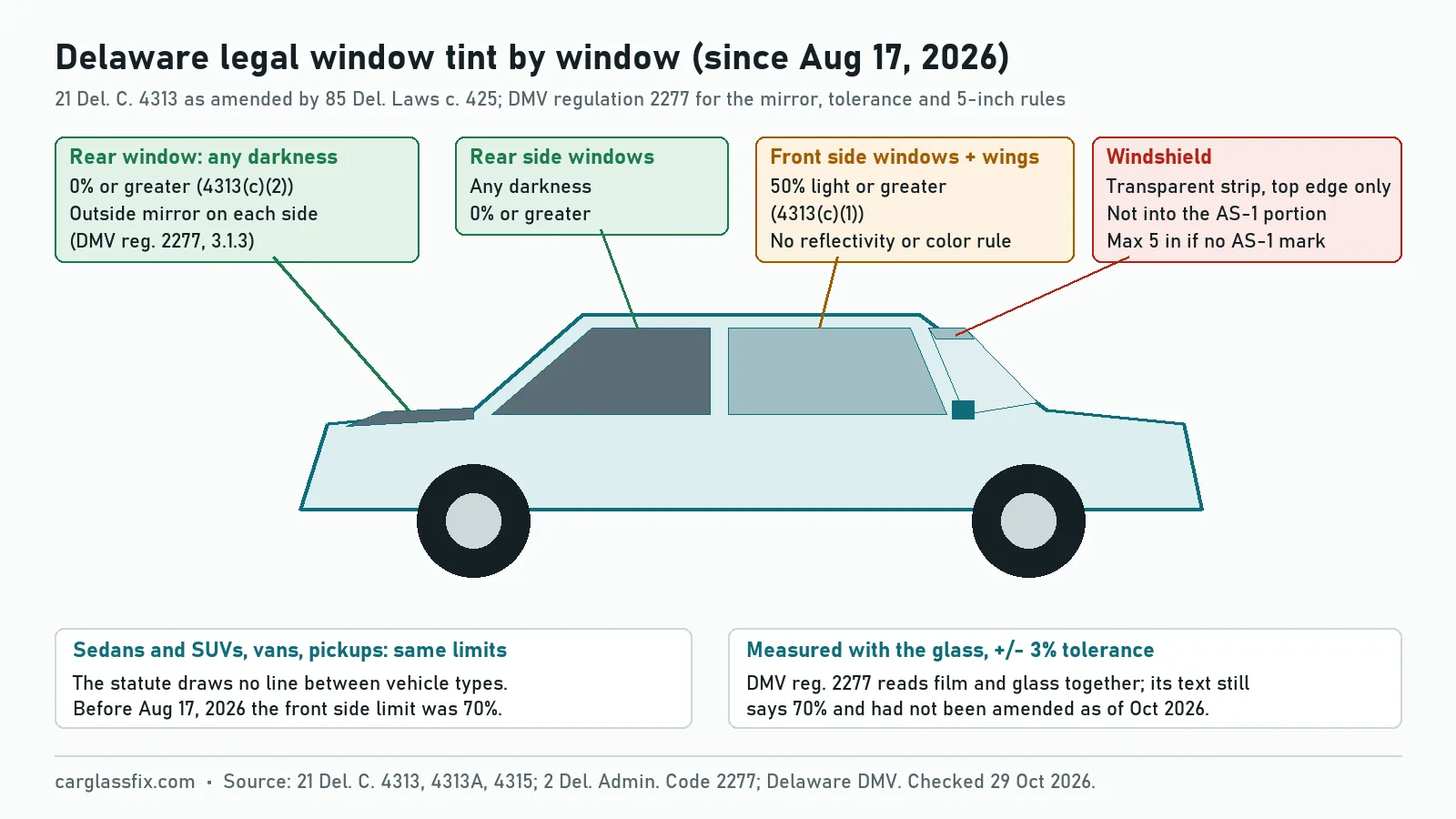
That regulation was adopted in 2006 and last updated in 2018, so its 70% line predates the 2026 statute. We found no 2026 Delaware Register notice amending it, so the regulation and the statute disagree on the number until DMV rewrites it. The regulation also applies “regardless of where such vehicles are registered”. Our how to measure window tint guide shows the glass-times-film math, and a window tint meter gives the net reading an inspector would see. A film sold as 50% reads below 50% on factory glass, so ask for a film that lands above the line installed.
Windshield tint in Delaware: the AS-1 portion
A Delaware windshield may carry tint only along its top edge, and only if the material is transparent and stays out of the AS-1 portion of the glass. Subsection 4313(b) says tint “may be applied along the top edge of a motor vehicle’s windshield if the window tint or other material is transparent and does not encroach on the AS-1 portion of the windshield” under Federal Motor Vehicle Safety Standard 205. The AS-1 portion is the glazing area marked near the top corners of the windshield; see what is the AS-1 line on a windshield to find the mark on your glass.
The statute gives no inch figure and no light transmission figure for the strip. DMV regulation 2277, section 3.1.1, fills the inch gap for older cars: material “shall not extend more than five (5) inches down from the uppermost part of the windshield on older vehicles where no AS-1 mark is indicated”. Neither the statute nor the regulation bans a color or caps reflectivity on the windshield or on any other window. A Bing AI answer checked for this page said reflective and colored tints are prohibited in Delaware; no Delaware source says that. For how other states handle the strip, read is it illegal to have tint on a windshield.
What changed on August 17, 2026, and what older pages get wrong
Senate Substitute 1 for Senate Bill 255 moved the Delaware front side window limit from 70% to 50% light transmission, effective on the day it was signed, August 17, 2026, as 85 Del. Laws c. 425. The original SB 255 asked for 35%; the May 7, 2026 substitute moved the figure “from 35% or great to 50% or greater”, in the synopsis’s own words. The Senate passed it 20 to 0, with support from the Delaware Association of Chiefs of Police.
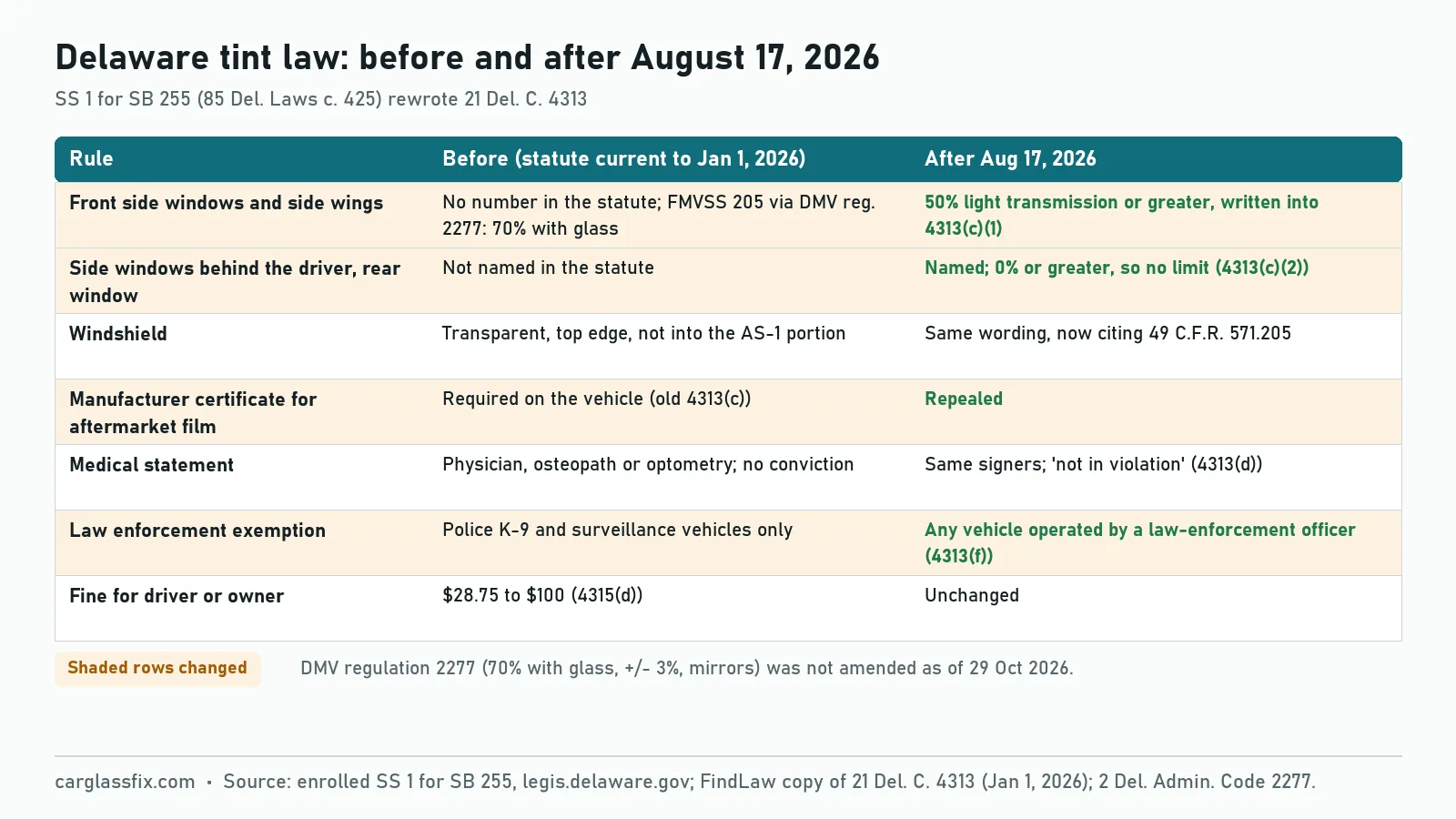
Three details separate the new statute from the old one. The old 4313 held no percentage; it pointed to FMVSS 205, and the 70% figure reached drivers through DMV regulation 2277. The old subsection (c) made it an offense to drive without displaying “a certificate by the manufacturer” of any aftermarket film; that requirement was struck. The police K-9 and surveillance exemption became one for any “vehicle operated by a law-enforcement officer”. Tint-site pages in the Google and Bing top 10 still show 70%, 30% or “no front tint” for Delaware, and a late August 2026 forum thread quotes the 35% from the original bill.
Delaware medical tint waiver: who signs and how to apply
A Delaware driver who needs darker tint than the law allows applies online to the Division of Motor Vehicles for a Medical Tint Waiver, backed by a signed statement from a licensed practitioner of medicine and surgery, osteopathic medicine or optometry. The statute, 4313(d), says a person “is not in violation of this section” while possessing that statement, which must say tinted windows are “medically necessary for the owner or usual operator of the motor vehicle”. DMV moved the application online on August 29, 2022, and stopped accepting paper applications on October 31, 2022. The title and registration must be in the applicant’s name, and the applicant needs a valid Delaware license or ID.
How to get a Delaware medical tint waiver
Start the online application
Open the Medical Tint Waiver Application under Online Services on dmv.de.gov, enter your details and the vehicles, up to four per application.
Print the packet
DMV emails the completed application and an upload link; DMV offices do not print or complete the form for you.
Get the physician’s signature
A licensed physician, osteopathic physician or optometrist signs and certifies the packet.
Upload the signed packet
Use the link in the DMV email to submit the signed waiver and Physician Certification.
Keep the sealed waiver
DMV stamps the approved waiver with the State Security Seal, adds it to the vehicle record and mails a new registration card stating the vehicle has a valid tint waiver.
Existing waiver holders add a new vehicle through the same form without a new physician signature. DMV lists reasons an application may be refused, among them a failed safety inspection, an outstanding warrant, a mismatched address or a vehicle not yet registered. In August 2022, DMV said 49,615 of the 873,500 passenger and truck vehicles registered in Delaware had a waiver. Sponsors of the 2026 change said the new 50% limit should cut that demand.
Delaware tint fines, inspection and enforcement
A Delaware tint ticket for the driver, owner or custodian carries a fine of $28.75 to $100 under 21 Del. C. 4315(d), the penalty subsection for sections 4312 to 4316. A January 2026 Delaware News Journal article gave $25 to $115; that range is the 4315(a) penalty for sections 4301 to 4305, which do not include tint. Section 4315(g) says a 4313 violation “may be dismissed before trial if the defendant establishes that repairs have been made”, provided no collision occurred. A shop that installs illegal film as a commercial activity faces $100 to $500 under 4313A and must refund the installation fee to the owner as restitution.
Tint is checked at DMV inspection lanes as well as at traffic stops. DMV performs inspections at its four facilities in Wilmington, Delaware City, Dover and Georgetown, free of charge, and lists windows among the items in the safety inspection. Regulation 2277 was written, in its own words, to give DMV “a more definitive method” for “the vehicle safety inspection and to assist police officers”. In State v. Trower (2007), the Superior Court held that tint dark enough to hide the occupants gave an officer reasonable suspicion to stop the car. Before choosing a shade, try the window tint simulator and the window tint percentage chart.
Who the Delaware tint law does not cover
The Delaware tint statute does not apply to anodized glass in antique vehicles and street rods, or to vehicles operated by a law-enforcement officer. Subsection 4313(e) exempts anodized glass “correctly installed in the windshield and windows of an antique motor vehicle or street rod”, and a vehicle insured under an antique, classic or street rod policy under section 2118. Subsection (f) exempts “a vehicle operated by a law-enforcement officer” as defined in 11 Del. C. 222. Out-of-state cars get no exemption: regulation 2277 applies “regardless of where such vehicles are registered”, so a visitor with 35% front tint is outside the Delaware rule while driving there.
Factory privacy glass on the rear windows of an SUV or pickup needs no attention, because the windows behind the driver have no limit. A rear window with tint must have an outside mirror on each side under regulation 3.1.3, and a rear-window brake light on a 1986 or later vehicle must be “clear of any tint material” under 3.1.4. Compare other states in what car window tint is legal. Delaware tint rules changed in 2026 and the DMV regulation may change again to match. Check the current text of 21 Del. C. 4313 or ask Delaware DMV before you tint. This article is general information, not legal advice.
Frequently asked questions
Is 35% tint legal in Delaware?
No on the front side windows, which must pass 50% or more of visible light since August 17, 2026. A 35% film is legal on the side windows behind the driver and on the rear window, which have no limit.
Is 35 or 20 tint darker?
A 20% tint is darker, because it lets through 20% of visible light against 35% for the lighter film. The window tint percentage chart shows the shades side by side.
What does 70 percent tint look like?
A 70% film looks almost clear from outside and cuts glare without hiding the occupants. It was the Delaware front-window standard under DMV regulation 2277 until the statute moved to 50% in 2026.
How do I get a tint waiver in Delaware?
Apply online through the Medical Tint Waiver Application on dmv.de.gov, print the packet, have a licensed physician, osteopath or optometrist sign it, and upload it through the link DMV emails you. DMV mails the sealed waiver and a new registration card.
Do I still need a medical waiver for 50% tint in Delaware?
No. Since August 17, 2026, film that reads 50% or greater on the front side windows is legal without a waiver. A waiver is still needed for anything darker on the front windows or below the AS-1 portion of the windshield.
Sources
- 21 Del. C. 4313, 4313A and 4315, Delaware Code Online (checked 29 October 2026)
- Delaware General Assembly: SS 1 for SB 255, bill detail and enrolled text (85 Del. Laws c. 425) (checked 29 October 2026)
- FindLaw: 21 Del. C. 4313, pre-amendment text current as of 1 January 2026 (checked 29 October 2026)
- 2 Del. Admin. Code 2277, Approved Tinting for Side Windows (Formerly Reg. No. 76) (9 DE Reg. 1988, 1 June 2006; checked 29 October 2026)
- Delaware DMV: Medical Tint Waiver and Medical Tint Waiver FAQs (checked 29 October 2026)
- Delaware DMV: Vehicle Inspections (checked 29 October 2026)
- Delaware DMV: DMV Announces New Medical Tint Waiver Application Process (29 August 2022)
- Delaware Senate Republican Caucus: window tint bill signed (25 August 2026) and Delaware House Republican Caucus: window tint reform (19 June 2026)
- State v. Trower, Delaware Superior Court (18 April 2007)
- 49 CFR 571.205, Federal Motor Vehicle Safety Standard 205 (checked 29 October 2026)
- Delaware News Journal via Yahoo: Is window tint legal in Delaware? (3 January 2026)

Similar Posts