8 Best Anti-Fog Sprays for Windshields (October 2026)
Senior Automotive Glass Diagnostic Specialist & Master Technician at CarGlassFix · AGSC Master Certified Auto Glass Technician, NGA Certified Installer, I-CAR Automotive Safety Specialist · 12+ Years in Automotive Glazing, Windshield Structural Bonding, ADAS Camera Calibration & Precision Chip Restoration
As an Amazon Associate, CarGlassFix earns from qualifying purchases. The picks below come from the makers’ published directions and Amazon listings, not from our own testing.
The best anti fog spray for windshield picks are the Invisible Glass 92472 Anti-Fog Interior Windshield Treatment for most windshields, because its maker labels it for inside glass only and gives a 40°F (4°C) minimum, and the Rain-X 630543 Anti-Fog Spray for untinted glass, because Rain-X publishes clear directions and a haze fix.
Both are hydrophilic interior treatments. They make condensation spread into a thin, clear film instead of light-scattering droplets on the inside of the windshield.
This guide covers sprays for the inside of the windshield only: the film that builds up on that glass, the camera zone behind the mirror, heated glass, defroster use and the cure or buff step. For wipes, cloths and coating kits for every window, see our broader best car glass anti-fog guide.
Picks come from maker directions and Amazon listings, not hands-on testing. Each Amazon listing was checked for US delivery on October 29, 2026.
Quick Answer: The Best Anti-Fog Spray for Windshields
The Invisible Glass 92472 Anti-Fog is the top pick because its maker states an inside-only rule, a temperature minimum and cloth application, the three limits that matter most on a windshield.
- Invisible Glass 92472 Anti-Fog Interior Windshield Treatment (Best overall): 8 fl oz spray; Stoner says inside glass only, above 40°F (4°C), never on a hot windshield.
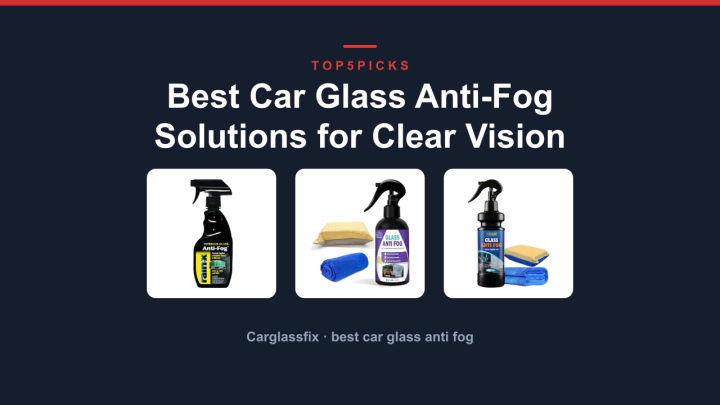
- Rain-X 630543 Anti-Fog Spray, 12 oz (2 Pack) (Best for untinted glass): Two 12 oz bottles of Rain-X Interior Glass Anti-Fog, with a published haze fix.
- Adam’s Polishes Anti-Fog (4 fl oz) (Best for tint): 4 fl oz hydrophilic spray; Adam’s states contact angles under 10°, no cure time and tint safety.
- Rain-X BCAF21112 Anti-Fog 3.5 oz (Best glovebox size): The 3.5 oz Rain-X Interior Glass Anti-Fog that Rain-X says fits a glove compartment or door panel.
- Invisible Glass 5-Piece Windshield Glass Treatment Kit, 99016 (Best kit): Glass cleaner, interior anti-fog, exterior rain repellent and two microfibers in one kit.
- Boat Juice 2-in-1 Boat Glass Cleaner & Anti-Fog Spray, 16 fl oz (Best one-step): 16 fl oz ammonia-free glass cleaner with anti-fog control; the maker says it is safe on tinted windows.
- Nanoskin Anti Fog Spray for Clear Glass, 16 oz (Best large bottle): 16 oz spray with an anti-static polymer, per the listing; directions are on the listing only.
- Nexgen Anti-Fog Spray (4 oz) (Small detailing bottle): 4 oz spray-and-wipe anti-fog from the Nexgen detailing line; directions and claims come from the listing only.
Fog on the outside of the glass, or fog that never clears? Read Who Should NOT Buy below before you spend anything.
How We Chose These Picks
We chose these eight sprays from the makers’ product pages, help centers and Amazon listings. We did not test them. Each pick had to be sold as an anti-fog spray for car glass, give application directions, and be in stock on Amazon for US delivery on October 29, 2026. Where a maker does not state something, the card says “not stated” instead of guessing.
The score out of 10 is our editorial weighting of published specs, not a test result or a customer rating. It weights how complete the maker’s directions are (40%), windshield limits such as inside-only use and temperature (30%), surface statements such as tint (20%), and size and format (10%). The four bars on each card show those parts.
Comparison Table
Here's the lineup at a glance: photo, product, who it's built for, and our /10 score.
| Photo | Product | Best for | Score | Buy |
|---|---|---|---|---|
 | Invisible Glass 92472 Anti-Fog Interior Windshield Treatment | Most windshields | 9.1/10 | Check price → |
 | Rain-X 630543 Anti-Fog Spray, 12 oz (2 Pack) | Untinted glass, big supply | 8.8/10 | Check price → |
 | Adam’s Polishes Anti-Fog (4 fl oz) | Tint film, no cure wait | 8.6/10 | Check price → |
 | Rain-X BCAF21112 Anti-Fog 3.5 oz | Glovebox touch-ups | 8.5/10 | Check price → |
 | Invisible Glass 5-Piece Windshield Glass Treatment Kit, 99016 | Inside anti-fog plus outside repellent | 8.3/10 | Check price → |
 | Boat Juice 2-in-1 Boat Glass Cleaner & Anti-Fog Spray, 16 fl oz | Clean and treat in one step | 7.5/10 | Check price → |
 | Nanoskin Anti Fog Spray for Clear Glass, 16 oz | Largest single bottle | 7.1/10 | Check price → |
 | Nexgen Anti-Fog Spray (4 oz) | Small bottle, glass and visors | 6.0/10 | Check price → |
Scroll sideways on small screens to see every column.
Invisible Glass 92472 Anti-Fog: Best Overall for Windshields
Rain-X 630543 Anti-Fog Spray: Best for Untinted Windshields
Adam’s Polishes Anti-Fog: Best for Tint and No Cure Time
Rain-X Anti-Fog 3.5 oz: Best Glovebox Size
Invisible Glass 99016 Windshield Kit: Best Inside-and-Outside Kit
Boat Juice 2-in-1 Glass Cleaner & Anti-Fog: Best One-Step Clean and Treat
Nanoskin Anti Fog Spray: Best Large Bottle
Nexgen Anti-Fog Spray: Best Small Bottle from a Detailing Brand
What Makes a Windshield Anti-Fog Spray Different
A windshield anti-fog spray is a hydrophilic treatment for the inside surface only, and it works only on glass that is free of the oily film that builds up there.
Hydrophilic inside, hydrophobic outside
Interior anti-fog makes water spread flat. MIT researchers describe fog as tiny droplets that scatter light, and a super-hydrophilic coating as one that flattens them into a transparent sheet. Rain-X says its anti-fog applies a hydrophilic coating, and Adam’s states contact angles under 10° for its spray. Rain repellents do the opposite and make water bead, which helps only on the outside glass. Adam’s says a cleaner with a hydrophobic additive is not preferred before its anti-fog, so never put a rain repellent on the inside.
The inside film and outgassing
The inside of a windshield collects a film that the outside never does. Thermo Fisher explains that hot interior plastics, textiles and other materials release vapors that condense on the cooler windshield. Automakers measure this with fogging tests such as SAE J1756. Nissan’s owner’s manual calls the film normal after parking in hot sun and says glass cleaner and a soft cloth remove it. Anti-fog applied over that film streaks, so clean first. Our guide on how to get rid of haze on the inside of a windshield covers the cleaning step.
Tint film and tint strips
Tint compatibility depends on the maker’s statement. The Rain-X help center says Rain-X anti-fog needs clear glass with no tint. Adam’s Polishes and Invisible Glass say their anti-fog products are safe on tint. Boat Juice says its 2-in-1 cleaner is safe on tinted windows. The Nanoskin and Nexgen listings make no tint statement. AAA Club Alliance warns that ammonia in glass cleaners can damage window tint, and 3M says not to clean newly tinted windows for at least 48 hours.
| Spray | Inside only? | Tint statement | Temperature limit | Reapply |
|---|---|---|---|---|
| Invisible Glass 92472 | Yes (Stoner) | Safe on tint (Invisible Glass article) | Above 40°F (4°C), not on hot glass | Every few weeks (article) |
| Rain-X 630543 and 3.5 oz | Interior glass and mirrors | Clear glass only (help center) | Not stated | As needed |
| Adam’s Polishes Anti-Fog | Not stated | Safe on tint (Adam’s) | Not stated | Until touched or rubbed |
| Invisible Glass 99016 kit | Anti-fog: interior glass | Cleaner: tint-safe (listing) | Not stated in listing | Not stated in listing |
| Boat Juice 2-in-1 | Not stated | Safe on tint (Boat Juice) | Not stated | Repeat as needed |
| Nanoskin Anti Fog | Interior glass (listing) | Not stated | Not stated | Not stated |
| Nexgen Anti-Fog | Not stated | Not stated | Not stated | Not stated |
Statements as published on the makers’ pages and Amazon listings, checked October 29, 2026.
How to Apply Anti-Fog Spray to a Windshield
Apply anti-fog to clean, dry, cool inside glass with a cloth, one section at a time, then buff or wait as the label says before you drive.
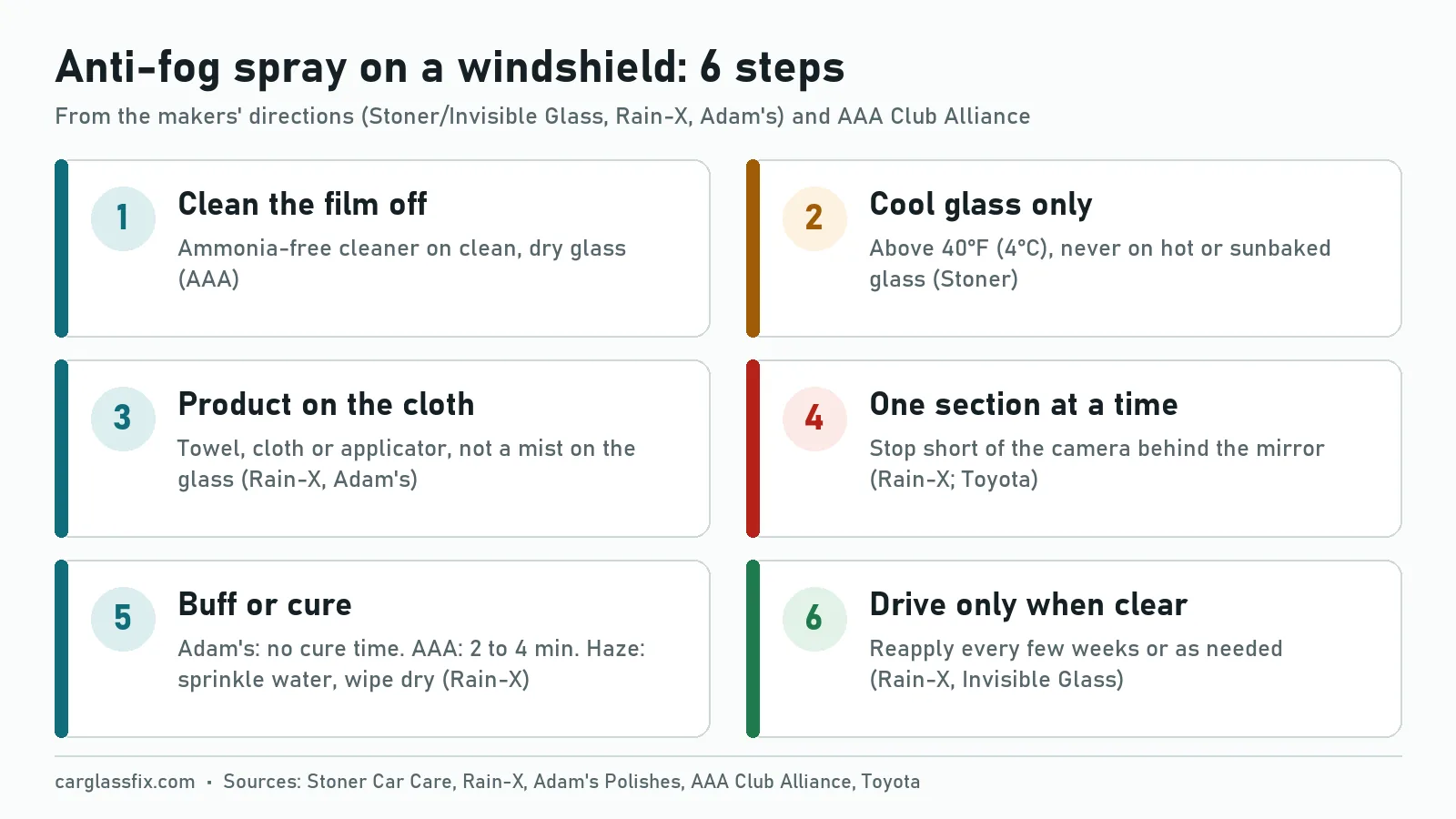
- Clean the film off. Invisible Glass, Nanoskin and the Rain-X EU guide say to start on clean glass. AAA Club Alliance recommends an ammonia-free cleaner.
- Check the glass temperature. Stoner says to apply Invisible Glass Anti-Fog above 40°F (4°C) and never on a hot or sunbaked windshield.
- Put the product on the cloth. Rain-X, Invisible Glass and Adam’s all say to apply with a towel, cloth or applicator.
- Work in sections. Rain-X says to wipe one section at a time. Stop short of the camera housing behind the mirror.
- Cure or buff as the label says. Adam’s says no cure time is needed and to wipe off the haze. AAA Club Alliance suggests letting a treatment cure 2 to 4 minutes before buffing. Rain-X says to sprinkle water and wipe dry if haze remains.
- Do not drive until the glass is clear. The Rain-X anti-fog wipes data sheet says not to drive until the windscreen is completely clear.
For the full method with every maker’s wait times, see how to use anti-fog spray on windshield.
Camera Zone, Heated Glass and the Defroster
Keep anti-fog out of the camera zone, wipe heated glass gently, and keep using the defroster, which every car must have by federal law.
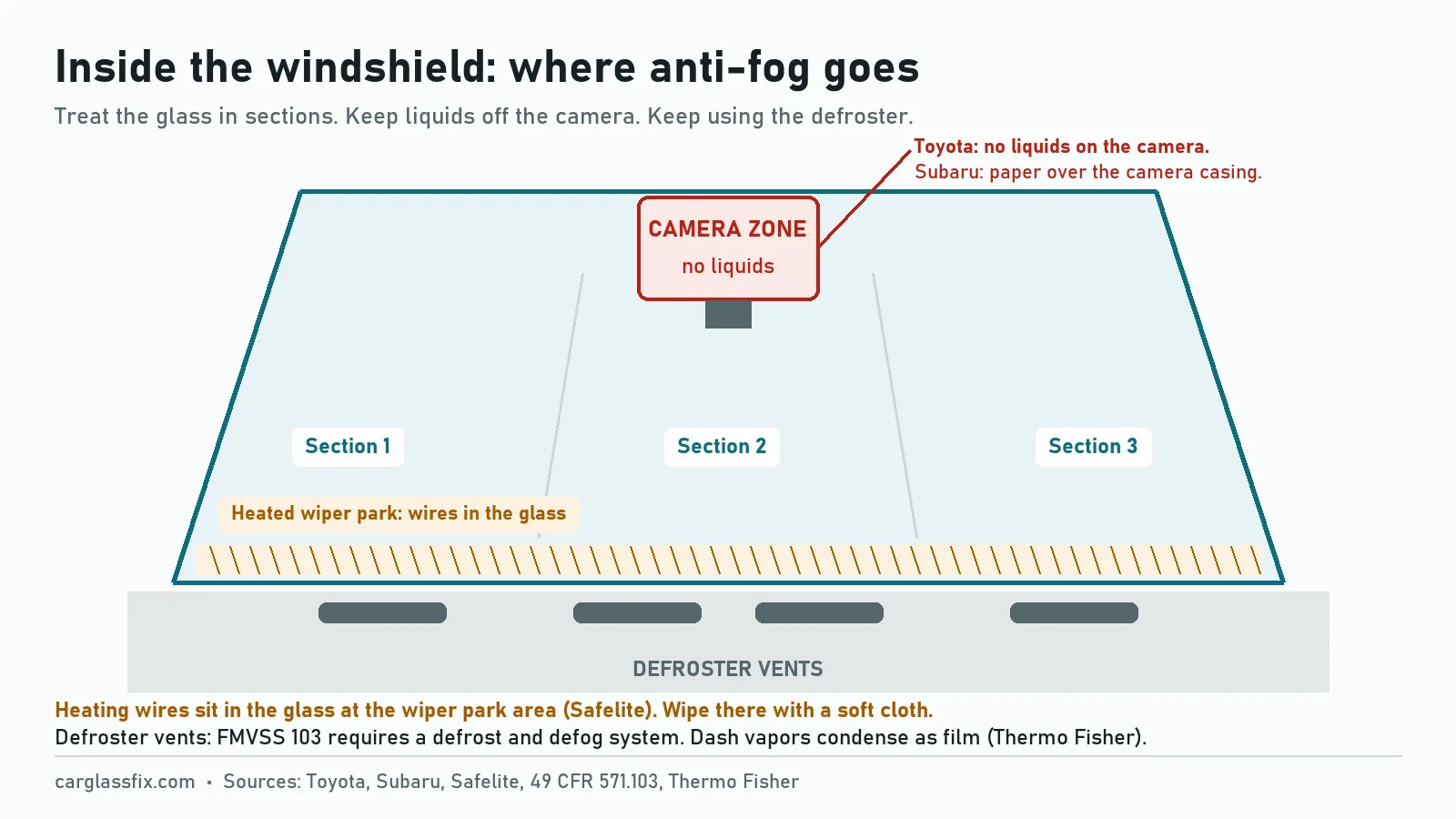
The camera area behind the mirror
The forward camera looks through the windshield, so liquids must stay off it. Toyota’s 2026 RAV4 PHEV manual says not to let liquids contact the front camera and to see a Toyota dealer if the inside glass in front of the camera is dirty. Subaru’s EyeSight supplement says to cover the camera casing with paper when cleaning the windshield and not to use glass coating agents on the windshield. If you drive a Subaru with EyeSight, ask Subaru before you treat the windshield at all. Not sure you have a camera? See how to tell if your windshield has a camera behind it.
Heated windshields
Safelite says heated windshields use a thin web of tungsten wire layered in the glass, often visible at the bottom where the wipers sit. Safelite adds that a scratched or chipped heating grid may lose electrical contact. None of the eight spray makers on this page mention heated windshields. Wipe heated glass with a soft cloth only, and follow your owner’s manual if it gives a cleaning rule.
Defroster use and FMVSS 103
Federal Motor Vehicle Safety Standard 103 requires every passenger car, truck and bus to have a windshield defrosting and defogging system. No federal standard rates aftermarket anti-fog sprays. Toyota says to use the windshield defogger when the camera area fogs. A spray is a backup to the defroster, not a replacement. If the defroster does not clear the glass, start with windshield defroster not working.
The rear window grid
If you also treat the back glass, be gentle. A 2024 Kia owner’s manual warns that scraping or scratching the inside of the rear window may damage the defroster grid. Our guide on how to clean the rear windshield inside covers that glass.
Who Should NOT Buy an Anti-Fog Spray for the Windshield
An interior anti-fog spray is the wrong purchase for three problems. Here is what each needs instead.
Your Fog Is on the Outside
Interior anti-fog does nothing for fog on the outside of the glass. An Invisible Glass article explains that outside fog forms on warm, humid days when air conditioning cools the glass. Your wipers and HVAC settings fix that, as covered in how to fix windshield fog on the outside.
Your Windshield Fogs Every Day
Daily fog points to a moisture source or an HVAC problem, not missing anti-fog. Wet floor mats and recirculation mode keep humidity high, as Invisible Glass notes. Read why is my windshield always foggy before you treat the glass.
Your Car Warns Against Glass Coatings
Some camera-equipped cars carry a manual warning against glass coating agents on the windshield, as Subaru’s EyeSight supplement does. If your manual says that, use the defroster and an ammonia-free cleaner instead of a treatment.
Final Verdict
The Invisible Glass 92472 Anti-Fog Interior Windshield Treatment is our top pick for most windshields. Its maker labels it for inside glass only, gives a 40°F (4°C) minimum, rules out hot glass and says to apply it with a cloth.
Have untinted glass and more than one car? Get the Rain-X 630543 Anti-Fog Spray, two 12 oz bottles with Rain-X’s published haze fix.
Have tint film or a tint strip? The Adam's Polishes Anti-Fog carries a tint-safe statement, a contact angle under 10° and no cure time.
Starting from a filmy windshield? The Invisible Glass 99016 Windshield Kit pairs a film cleaner and interior anti-fog with an outside rain repellent.
Still not sure a spray fits your problem? Check Who Should NOT Buy above.
FAQ
What is the best anti fog spray for windshield use?
For most windshields, the Invisible Glass 92472 Anti-Fog, because its maker labels it for interior glass only, gives a 40°F (4°C) minimum and says to apply it with a cloth. For untinted glass and a larger supply, the Rain-X 630543 Anti-Fog Spray is the alternative.
Does anti-fog spray work on a windshield?
It reduces fog but does not replace the defroster. Rain-X says its anti-fog applies a hydrophilic coating, and MIT researchers describe how such coatings flatten droplets into a clear sheet. MotorHome Magazine reported that Rain-X anti-fog did not stop fog completely but greatly reduced it when applied correctly.
Can I use anti-fog spray on a windshield with a camera?
Yes, if you keep it off the camera area. Toyota says not to let liquids contact the front camera, and Subaru says to cover the EyeSight camera casing with paper when you clean the windshield and not to use glass coating agents on it. Check whether your windshield has a camera behind it first.
Is anti-fog spray safe on a heated windshield?
None of the eight makers on this page mention heated windshields, so follow your owner’s manual. Safelite says heated windshields carry thin tungsten wires layered in the glass and that a scratched or chipped heating grid may not heat properly. Use a soft cloth and never a scraper on the inside glass.
How long does anti-fog spray last on a windshield?
It depends on the product. Rain-X US says to re-apply as needed, and the Rain-X EU guide says every few weeks. An Invisible Glass article says every few weeks or after a deep cleaning of the inside glass. Adam’s says its effect lasts until the glass is touched or rubbed.
Should I spray anti-fog onto the glass or onto the cloth?
Onto the cloth for a windshield. Rain-X, Invisible Glass and Adam’s all direct application with a towel, cloth or applicator. Nanoskin’s listing and Boat Juice say to spray onto the glass, but on a windshield that mist can land on the dash and the camera housing.
Does Rain-X work as an anti-fog?
Only the Rain-X Interior Glass Anti-Fog line does. That product is for interior glass and mirrors. Rain-X Original Glass Treatment is a water repellent for the outside of the windshield and is not an anti-fog.
Is Dawn dish soap good for windshield fog?
Not as a lasting fix. An Invisible Glass article says home tricks such as dish soap or shaving cream help only briefly and leave streaks or residue. A spray made for interior glass, applied to clean, dry glass, is the more reliable route.
Sources
- Rain-X Interior Glass Anti-Fog directions (checked October 29, 2026)
- Rain-X help center: anti-fog on tinted windows (checked October 29, 2026)
- Rain-X help center: what is an auto anti-fog spray
- Rain-X Europe: how to apply Rain-X Anti-Fog
- Rain-X Anti-Fog Wipes technical data sheet (EU)
- Stoner Car Care: Invisible Glass Anti-Fog directions (checked October 29, 2026)
- Invisible Glass: Anti-Fog Car Defogger Windshield Treatment (checked October 29, 2026)
- Invisible Glass: DIY anti-fog hacks and what works better
- Adam’s Polishes Anti-Fog product page
- MIT News: anti-fog coating research (2005)
- 49 CFR 571.103, FMVSS 103: windshield defrosting and defogging systems (checked October 2026)
- Thermo Fisher: fogging test application note (SAE J1756, DIN 75201)
- Nissan owner’s manual: cleaning glass
- AAA Club Alliance: defog your vehicle’s windows
- 3M automotive window film product care
- Toyota 2026 RAV4 PHEV owner’s manual excerpt, driving support systems
- Subaru EyeSight owner’s manual supplement
- Safelite: heated windshields (checked October 29, 2026)
- Kia 2024 owner’s manual: cleaning the interior window glass
- MotorHome Magazine: Tested, Rain-X cleaning and treatment products

Similar Posts