How to Remove Water Spots From a Windshield
Senior Automotive Glass Diagnostic Specialist & Master Technician at CarGlassFix · AGSC Master Certified Auto Glass Technician, NGA Certified Installer, I-CAR Automotive Safety Specialist · 12+ Years in Automotive Glazing, Windshield Structural Bonding, ADAS Camera Calibration & Precision Chip Restoration
To remove water spots from a windshield, wash the glass, then dissolve the minerals with dilute white vinegar or an acid water-spot remover on cool, shaded glass. Rinse and dry the glass. Spots that stay after that may be etched into the surface, which calls for a cerium oxide glass polish.
What water spots are: mineral deposits vs etching
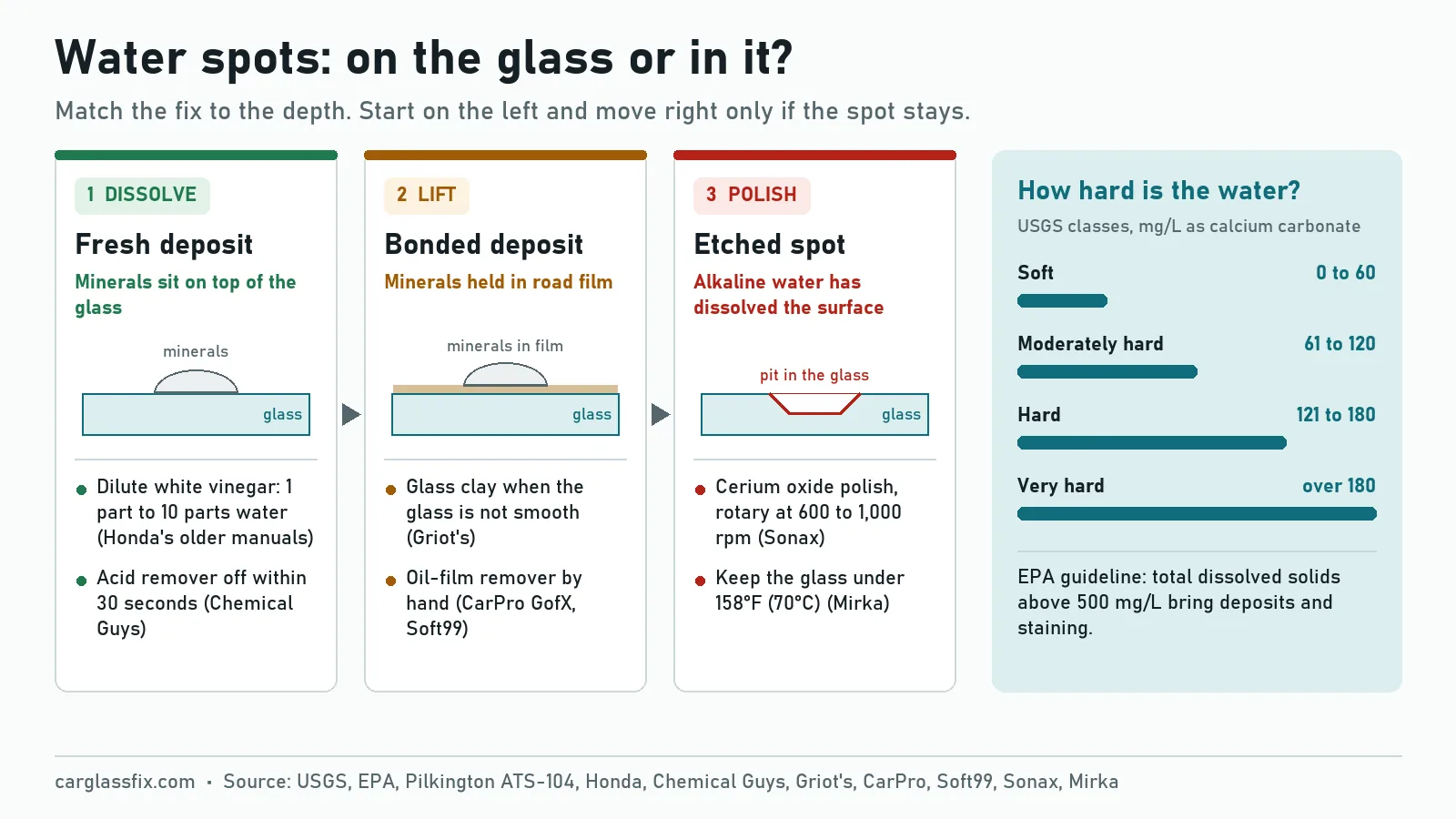
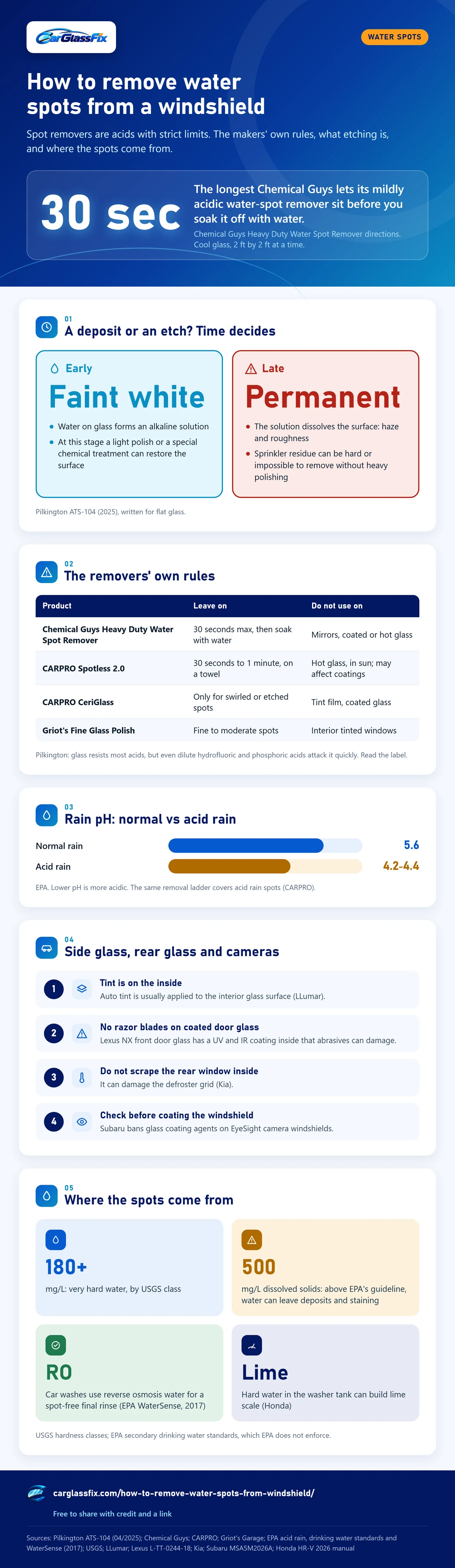
Water spots are the minerals that stay on the glass after a drop of water evaporates. The USGS says water hardness comes from calcium and magnesium, which water dissolves as it moves through soil and rock. The USGS classes water above 120 mg/L, measured as calcium carbonate, as hard or very hard. Hard water is most common in the east-central and western United States, according to the USGS. The EPA links total dissolved solids above 500 mg/L with deposits and staining.
Etching is damage to the glass itself. Pilkington, a glass maker, describes the chemistry for flat glass. Water in contact with glass forms alkaline solutions, and those solutions dissolve the glass surface. The result is haze and roughness. Pilkington says early attack shows as faint whitening that light polishing can restore, while the final stages are permanent.
| Spot type | What it is | How it looks or feels | What removes it |
|---|---|---|---|
| Fresh mineral deposit | Calcium and magnesium left by dried water (USGS) | White dots or rings on top of the glass; smooth to the touch | Dilute vinegar or an acid water-spot remover |
| Heavy or bonded deposit | Thick mineral buildup, often mixed with road film | Feels rough (Chemical Guys); stays after a vinegar wipe | An acid remover, glass clay, then an oil-film remover |
| Etched spot | The glass surface dissolved by alkaline water (Pilkington) | The outline stays on clean, dry glass | A cerium oxide glass polish |
The removal ladder, mildest method first
Start with the mildest method that could work, and move up one step only if the spots stay. Each step removes more than the last, and each product carries its maker’s own limits. CarPro, which sells both a film remover and a cerium polish, says its cerium polish is only needed for swirled or etched spots.
| Step | What it removes | Maker’s directions | Maker’s limits |
|---|---|---|---|
| 1. Wash | Loose dirt and grit | Pilkington: a soft, grit-free cloth and a mild, non-alkaline cleaner, then a clean-water rinse | Pilkington: remove excess rinse water promptly with a squeegee |
| 2. Dilute white vinegar | Fresh mineral deposits | Honda’s older manuals: 1 part white vinegar to 10 parts water | AAA reports a caution from glass professionals that long exposure may cause micro pitting |
| 3. Acid water-spot remover | Alkaline mineral stains (Chemical Guys) | Chemical Guys: on a pad, a 2 ft by 2 ft area, off within 30 seconds, then soak with water. CarPro Spotless 2.0: on a towel, 30 seconds to 1 minute | Not in sun or on hot glass. Chemical Guys: not on mirrors or coated glass. CarPro: may affect window coatings |
| 4. Glass clay | Bonded residue that makes glass feel rough | Griot’s: clay when the glass does not feel smooth, in the shade on cool glass | Griot’s follows clay with its Fine Glass Polish for water spots |
| 5. Oil-film remover or fine glass polish | Road film, water spots, mineral deposits (CarPro GofX); limescale (Soft99) | By hand; CarPro allows a machine at no more than medium speed | Soft99: do not let it dry. Griot’s Fine Glass Polish: not for interior tinted windows |
| 6. Cerium oxide polish | Etched spots, hard water and acid rain spots (CarPro CeriGlass) | Sonax: rotary at about 600 to 1,000 rpm on a moistened felt pad | Mirka: keep glass under 158°F (70°C). CeriGlass stains black trim |
Read the label of any acid product before it touches the glass. Pilkington says glass resists most acids, but even dilute hydrofluoric and phosphoric acids quickly react with the silica in glass. Mixing ratios and the places vinegar should not go are covered in how to clean a windshield with vinegar.
How to remove water spots step by step
Work on cool, shaded glass, one small section at a time, and stop at the first step that clears the spots. The steps below combine the makers’ directions quoted above, and the label on your product always overrides them. Chemical Guys says to test its remover on a small, hidden area first and not to rub with excessive force. CarPro tells users to buff Spotless 2.0 in and off at once and to neutralize it. Chemical Guys recommends nitrile gloves for its remover.
How to remove water spots from a windshield
Park in the shade and let the glass cool
Kia’s manual says not to wash a vehicle in direct sunlight or when the body is warm. Chemical Guys and CarPro say not to use their removers in the sun or on hot glass.
Wash off grit
Rinse the glass, then wash it with a soft, clean cloth and a mild cleaner, as Pilkington advises.
Protect the trim and the camera area
CarPro says CeriGlass stains black trim, so mask the trim before any polish. Subaru tells EyeSight owners to cover the camera casing with paper when they clean the windshield.
Try dilute vinegar
Wipe the mix on with a soft cloth, work it over the spots, then rinse before it dries.
Move up to an acid water-spot remover
Put the product on a towel or pad and work a 2 ft by 2 ft section. CarPro says not to spray Spotless 2.0 directly on glass. Chemical Guys says to take its gel off within 30 seconds and soak the area with water to neutralize it.
Clay any rough patches
Griot’s uses glass clay when the glass still does not feel smooth after cleaning.
Use an oil-film remover or fine glass polish by hand
Griot’s says its Fine Glass Polish removes fine to moderate water spots and haze. Soft99 says not to let its compound dry on the glass.
Rinse, dry and inspect
CarPro says to rinse the glass and the nearby panels with running water. Dry with a clean microfiber towel and look through the glass toward the light.
A spot outline that remains on clean, dry glass is likely etching, and the next section covers it. Marks on the inside of the windshield are a different film. Nissan says glass cleaner and a soft cloth remove the film that forms after parking in hot sun. For the final wipe, follow how to clean a windshield without streaks.
Etched water spots: when only a polish works
Etched spots need an abrasive glass polish, because the mark is part of the glass surface. Patrick Peterson of Goodcar.com, quoted by Martha Stewart Living, says spots that survive repeated cleaning may need polishing. Pilkington says early water attack can be restored by light polishing, while late stages cannot.
Cerium oxide polishes are made for this job. CarPro says its CeriGlass removes hard water and acid rain spots, and its hand block handles mild water spots. A rotary machine removes swirls and only sometimes tiny pits, according to CarPro. Sonax specifies a rotary at about 600 to 1,000 rpm and at least 30 minutes per windshield for its cerium polish.
Heat is the main risk. Mirka says glass must not exceed 158°F (70°C) during reconditioning, because of the risk of cracking. Pads, machines and product types are compared in what to use to polish a windshield.
Deep etching and pitting may not polish out. GEICO says policies typically do not cover wear and tear such as small pits, scratches or hazing that develop over time.
Side windows, rear glass and tint film
Side and rear windows take the same ladder on the outside, and the cautions concern film and coatings on the inside. LLumar says auto window tint is typically applied to the interior glass surfaces of a vehicle. Water spots form on the outside, so treat only the outer face of tinted glass.
Several polishes rule out tint film by name. Griot’s says its Fine Glass Polish is not for interior tinted windows. CarPro says CeriGlass is not for exterior window tint film, and Autoglym says its Car Glass Polish is not suitable for aftermarket tinted windows. XPEL allows only mild, non-ammonia cleaners on its film and warns against abrasives.
Factory coatings matter too. A Lexus tech tip says the front door glass of the 2018 to 2021 NX300 has a UV and IR cut coating inside, and rules out abrasives such as a razor blade. On the rear window, Kia warns that scraping the inside can damage the defroster grid. For film care, see how to clean tinted side glass.
Sprinkler water, rain spots and car-wash water
Sprinkler, rain and rinse water all leave spots the same way: the water evaporates and its dissolved solids stay. Pilkington names lawn sprinklers as a source of hard-water deposits on glass. It says such residue is difficult or impossible to remove without excessive polishing. Move the car or redirect the sprinkler head.
Pinellas County Utilities in Florida recommended in its 2020 report that vehicles washed with reclaimed water be rinsed with drinking water and towel dried to prevent spotting. Its current page lists car washing as an unacceptable use of reclaimed water, so check local rules.
Rain itself is mildly acidic. The EPA says normal rain has a pH of about 5.6, and acid rain usually falls between 4.2 and 4.4. Pilkington says glass resists most acids, and CarPro lists acid rain spots among the marks its cerium polish removes.
A car wash spot-free rinse is treated water. An EPA WaterSense case study on H.E.B. car washes says reverse osmosis units make that final rinse. The units remove the minerals that leave a blotchy finish when water dries.
How to prevent water spots on a windshield
Dry the glass before the water evaporates, and keep hard water off it. Pilkington tells glass users to rinse with clean water and remove excess rinse water promptly with a squeegee. IGL Coatings, a coating maker, advises drying with a microfiber towel right after washing or rain, and parking in shade. Fill the washer reservoir with commercial washer fluid. Honda says prolonged use of hard water causes lime scale.
A rain repellent makes water bead and run off. Rain-X says to apply its Original Glass Water Repellent to clean, dry glass above 40°F with a folded dry cloth, in firm, circular, overlapping strokes. Let it dry to a haze, apply a second coat, then remove the haze. IGL says ceramic coatings are not immune to hard water. Subaru says not to use any glass coating agents on the windshield of an EyeSight car, because they can interfere with the system. DIY options are in how to make car glass water repellent at home, and removal steps are in how to remove a hydrophobic coating from a windshield.
Frequently asked questions
Why won’t the water spots come off my windshield?
Spots that stay after vinegar and an acid remover are probably etched into the glass. Pilkington says light polishing can restore early water damage. CarPro says its cerium oxide polish is the product for etched spots.
Are hard water spots on a windshield permanent?
Fresh deposits are not, because acids dissolve them. Etching can be. Pilkington says the final stages of water attack on glass are permanent.
Does vinegar remove water spots from a windshield?
Yes, for fresh deposits. The American Chemistry Council says acids such as the acetic acid in vinegar dissolve mineral deposits and hard-water stains. Rinse the glass afterward, because AAA reports a micro-pitting caution for long exposure.
Can a water spot remover damage tint or paint?
Chemical Guys says its remover works on paintwork, glass and polished metal, but not on mirrors, coated glass or coated metal. Tint film usually sits on the inside of the glass, so keep removers and polishes on the outside.
What is the best product for water spots on a windshield?
The best product is the mildest one that clears the spots: an acid remover for deposits and a cerium oxide polish for etching. Product picks are in the best auto glass cleaner for hard water spots.
Sources
- USGS Water Science School: Hardness of Water (checked 24 October 2026)
- EPA: Secondary Drinking Water Standards, guidance for nuisance chemicals (checked 24 October 2026)
- EPA: What is Acid Rain?
- Pilkington North America, Technical Bulletin ATS-104: Protecting Flat Glass Surfaces (April 2025)
- American Chemistry Council: Chemistry in Cleaning Products
- Chemical Guys Heavy Duty Water Spot Remover and Chemical Guys: how to remove water spots from car windows
- CARPRO Spotless 2.0, CARPRO GofX and CARPRO CeriGlass
- Griot’s Garage: how to care for glass and Griot’s Garage glass care guide
- Soft99 Glaco Glass Compound Roll On
- Sonax PROFILINE Glass Polish
- Mirka: glass sanding and glass polishing for car windows
- Autoglym Car Glass Polish
- Honda owner’s manuals: 1995 Civic, Interior Care and 2026 HR-V, Refilling Window Washer Fluid
- Nissan owner’s manual: cleaning glass
- AAA: How to deice your car’s windshield
- Martha Stewart Living via Yahoo Autos: Can you use white vinegar to clean a car windshield? (September 2026)
- Kia 2026 Tasman owner’s manual: vehicle care precautions
- Subaru EyeSight owner’s manual supplement (2026)
- Lexus Tech Tip L-TT-0244-18: Glass Cleaning Precaution, 2018 to 2021 NX300 and NX300h (July 2020), via NHTSA
- LLumar automotive tint FAQ and XPEL product care
- GEICO: does car insurance cover windshield damage
- Pinellas County Utilities: 2020 Reclaimed Water Consumer Confidence Report and Pinellas County: reclaimed water
- EPA WaterSense: Car Wash Chain Drives Down Water Use With Efficiency Upgrades (EPA-832-F-17-002A, February 2017)
- Rain-X Original Glass Water Repellent directions
- IGL Coatings: removing water spots on ceramic-coated cars (September 2024)

Similar Posts