How to Clean a Windshield With Vinegar, Safely
Senior Automotive Glass Diagnostic Specialist & Master Technician at CarGlassFix · AGSC Master Certified Auto Glass Technician, NGA Certified Installer, I-CAR Automotive Safety Specialist · 12+ Years in Automotive Glazing, Windshield Structural Bonding, ADAS Camera Calibration & Precision Chip Restoration
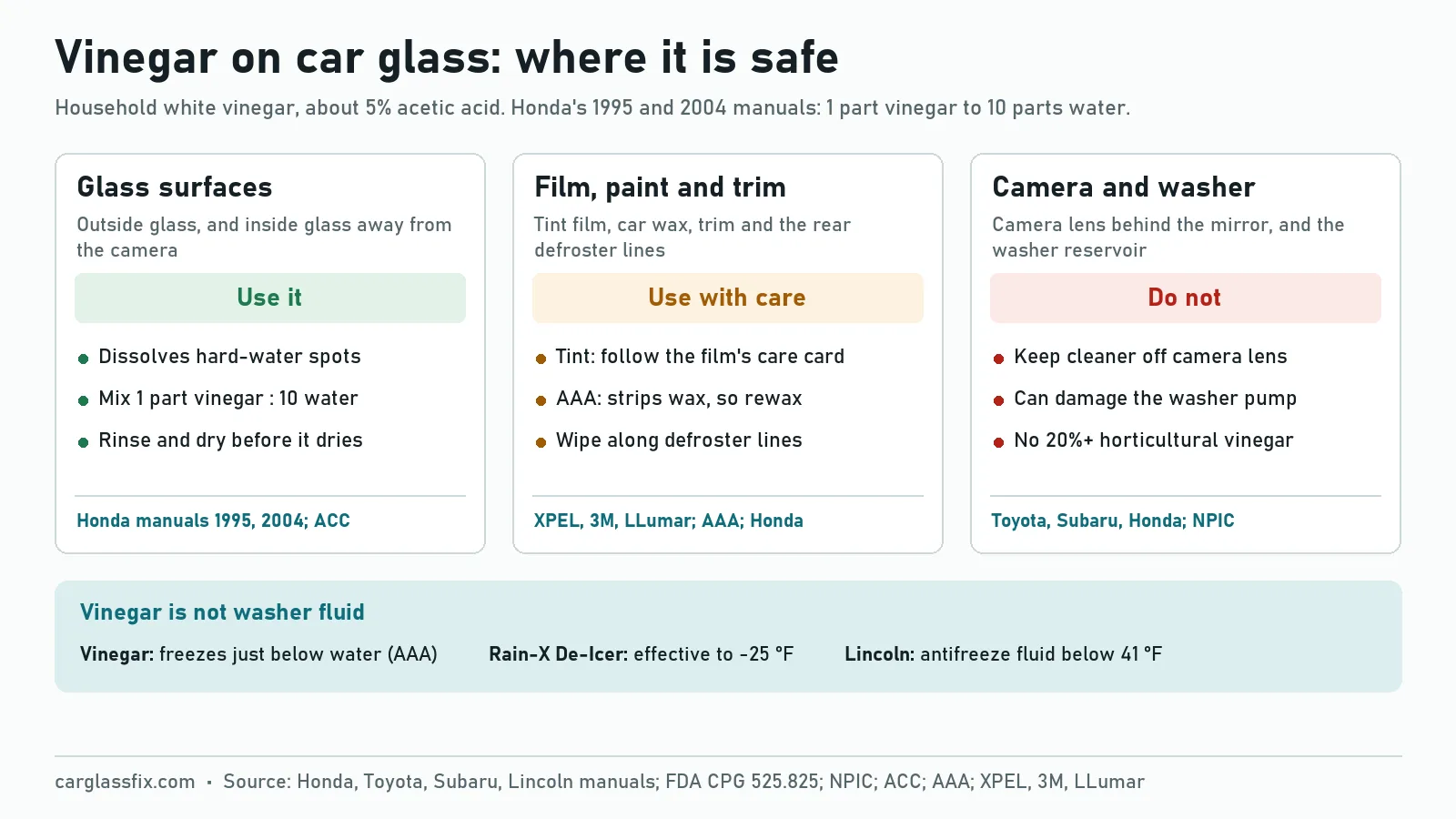
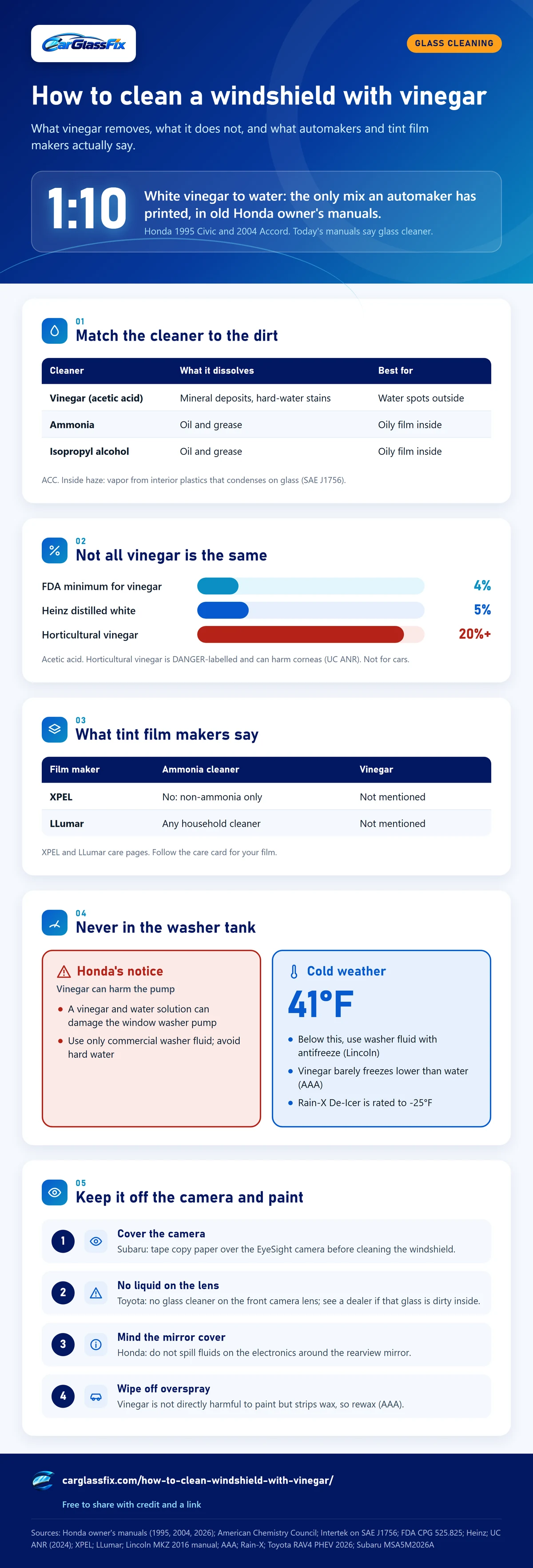
Clean a windshield with plain household white vinegar, which is about 5% acetic acid, diluted with water. Honda’s older owner’s manuals give one part vinegar to ten parts water. Wipe it on with a soft cloth, rinse and dry the glass, and keep it off paint, tint film and the windshield camera. Never put vinegar in the washer reservoir.
As an Amazon Associate, CarGlassFix earns from qualifying purchases. Amazon links on this page open a product search on Amazon. They are not products we tested.
What household vinegar is and why it cleans glass
Household white vinegar is acetic acid diluted in water, commonly sold at 5% acidity. The FDA’s labeling policy says vinegar should contain 4 grams of acetic acid per 100 mL. A diluted vinegar must state its acid strength on the label, and that strength should never be below 4 percent. The FDA lists distilled vinegar as another name for spirit vinegar, which is made by fermenting dilute distilled alcohol.
Heinz Distilled White Vinegar is one example. Its label reads “diluted with water to 5% (50 grains) acidity.” The National Pesticide Information Center puts household vinegar at 4 to 6% acetic acid.
Acetic acid does the cleaning. The American Chemistry Council lists acids, including the acetic acid in vinegar, as the ingredients that dissolve mineral deposits and hard-water stains.
Strength matters for safety. Horticultural vinegar is 20% acetic acid or more, and every registered acetic acid herbicide carries the signal word DANGER. A UC ANR article written by NPIC warns that acetic acid can permanently damage the corneas. Use only plain household white vinegar on a car.
What vinegar removes from a windshield, and what it leaves
Vinegar is made for mineral deposits, and oily film calls for a different cleaner. Hard-water spots are minerals left behind when water dries. The USGS says water hardness comes from calcium and magnesium, and hard water leaves spots or film on glassware. Oily film is a different kind of dirt. Interior plastics can release substances that condense on nearby glass, which is what the SAE J1756 fogging test measures. The American Chemistry Council classes ammonia and isopropyl alcohol as solvents that dissolve oil and grease. It lists acetic acid only for mineral deposits.
| Deposit on the glass | Where it comes from | Does vinegar remove it? | Better match |
|---|---|---|---|
| Hard-water spots | Calcium and magnesium left by dried water (USGS) | Yes. Acids dissolve mineral deposits (ACC) | A vinegar mix. Spots that stay after several tries may be etched into the glass |
| Haze on the inside | Substances released by interior materials (SAE J1756), plus smoke and dust film (Nissan) | Partly. Honda’s 1995 Civic manual said a 1:10 mix removes it | A glass cleaner, as current Honda and Nissan manuals say |
| Road film, bugs and tar | Oily and organic residue | Not listed for it. ACC names ammonia and alcohol as the oil solvents | Car-wash soap, then bug and tar remover for heavy spots (Peterson) |
Patrick Peterson of Goodcar.com, quoted by Martha Stewart Living, says spots that survive repeated cleaning may need glass polishing. Our guide on how to remove water spots from a windshield covers that next step. Sticker glue is a separate job, explained in how to remove adhesive from a windshield.
How to clean a windshield with vinegar, step by step
Use a weak mix, apply it with a soft cloth and dry the glass before the vinegar dries on it. Honda’s 1995 Civic and 2004 Accord owner’s manuals give a ratio of one part white vinegar to ten parts water. Current Honda manuals only say to use a glass cleaner. Many cleaning guides use 50/50 instead, and Peterson recommends 50/50 with distilled water for light mineral buildup. The weaker Honda mix is the cautious place to start.
How to clean a windshield with vinegar
Pick the right vinegar
Use plain distilled white vinegar labeled at about 5% acidity. Never use horticultural vinegar, which is 20% acetic acid or more.
Mix it in a spray bottle
One part vinegar to ten parts water follows Honda’s older manuals. Distilled water adds no new minerals to the glass.
Work on cool glass in the shade
Peterson advises a cool windshield out of the sun, so the mix does not dry on the glass.
Wash off loose dirt first
Peterson starts the outside with car-wash soap and a wash mitt to lift bugs, sap and mud.
Spray the cloth for edge areas
Spraying a microfiber cloth keeps overspray off paint and trim. Honda says to wipe cleaner spills off the paint immediately.
Wipe, rinse and dry
Work one section at a time. Rinse with distilled water and dry with a low-lint towel before the mix dries.
Clean the inside with a damp cloth only
Spray the cloth, never the glass, near the dashboard and mirror. Keep all liquid away from the camera housing.
Wipe the rear window along the lines
Honda says to wipe along the defroster wires with a soft cloth so they are not damaged.
Honda’s washer fluid notice also warns that prolonged use of hard water causes lime scale, one more reason to mix and rinse with distilled water. Subaru notes that worn wiper blades may leave streaks on the windshield. If lines remain after the vinegar clean, follow how to clean a windshield without streaks.
Vinegar vs. an ammonia glass cleaner
Vinegar and ammonia glass cleaners dissolve different things, so the right choice depends on the dirt. The American Chemistry Council lists acetic acid for mineral deposits and hard-water stains. It lists ammonia as a solvent that dissolves oil and grease, and it lists isopropyl alcohol the same way. That split explains why vinegar works on spotty outside glass and struggles with greasy inside haze. The ACC also lists both ammonia and acetic acid as water softeners that neutralize minerals in water.
| Question | Vinegar and water | Ammonia glass cleaner | Non-ammonia glass cleaner |
|---|---|---|---|
| What it dissolves | Mineral deposits and hard-water stains (ACC) | Oil and grease (ACC) | Depends on the formula. Isopropyl alcohol dissolves oil and grease (ACC) |
| Tint film | Not mentioned by XPEL or LLumar | XPEL says non-ammonia | The type XPEL names |
| Automaker advice | Honda 1995 and 2004: 1 part vinegar to 10 parts water | Current Honda and Nissan manuals say “glass cleaner” without naming a type | Same as ammonia cleaners |
| Washer reservoir | No. Honda says it can damage the pump | No. Honda says to use only washer fluid | No. Use washer fluid |
Vinegar suits the outside glass, where hard-water spots form. An ammonia-free automotive glass cleaner is the better match for the oily film on the inside, and our glass cleaner guide compares them. To mix your own from household products, see how to make car glass cleaner at home.
Is vinegar safe on window tint?
The film makers’ own care pages do not mention vinegar, so the care card for your film decides. The two brands below publish care rules for automotive tint. XPEL names a non-ammonia cleaner, LLumar allows any household cleaner, and both avoid abrasives.
| Film maker | Wait before cleaning | Cleaner the maker allows | Vinegar mentioned? |
|---|---|---|---|
| XPEL | About 1 to 5 days, depending on climate | Microfiber dampened with water; mild non-ammonia glass cleaner if needed | No |
| LLumar | Not stated on the FAQ | Any household cleaner with non-abrasive paper towels or cotton cloths | No |
Ask the installer for the care card and follow it. XPEL notes that new tint can look hazy or show moisture bubbles for up to ten days after installation. Melanie Musson of AutoInsurance.org, quoted by Martha Stewart Living, advises against vinegar or homemade mixes on aftermarket tint and rain-repellent coatings. Tint on the windshield itself is a separate issue. Toyota tells owners of cars with a windshield camera not to attach window tint to the windshield. For other products that can harm film and glass, read what not to use to clean car windows.
Paint, trim and the dashboard
AAA says vinegar-based mixes do not directly harm paint, and it notes that they remove car wax. AAA’s advice covers vinegar-based de-icing mixes, alcohol de-icers and dish soap. Drivers who use them often should wash and rewax the treated areas when the weather allows.
Automakers treat all strong cleaners with caution. Honda’s 2026 HR-V manual says chemical solvents and strong cleaners can damage the paint, metal and plastic on a vehicle. It tells owners to wipe away spills immediately. Jalopnik’s guide adds that vinegar left to sit can discolor chrome, rubber and aluminum trim, citing Kelley Blue Book.
The dashboard needs the same care. Honda warns that chemicals can discolor, wrinkle or crack resin parts and textiles inside the car. It says to wipe chemicals away gently with a dry cloth and not to spill liquids inside the vehicle. Subaru adds that polishing the top of the instrument panel with chemicals can cause reflections in the windshield that confuse the EyeSight camera. Lay a towel over the dash before you clean the inside glass.
The camera window behind the mirror
Keep vinegar and every other cleaner off the camera lens and its housing. Toyota, Subaru and Honda mount the forward camera behind the windshield, near the rearview mirror, and each gives rules for cleaning around it.
- Toyota (2026 RAV4 Plug-in Hybrid): do not let liquids contact the front camera, and do not let glass cleaner touch its lens. If the inside of the windshield in front of the camera is dirty, contact a Toyota dealer.
- Subaru (EyeSight manual): never touch or wipe the stereo camera lenses. Before cleaning the windshield, cover the front of the camera casing with copy paper. The tape must not touch the glass or the lens, and the paper comes off afterward.
- Honda (2026 HR-V): do not spill water or glass cleaner on or around the electrical cover near the rearview mirror.
Subaru also says a dirty, fogged or oily windshield can stop the camera from detecting objects. Our guide on how to clean the inside of a windshield covers the rest of the cabin side.
Why vinegar does not belong in the washer reservoir
Vinegar makes a poor washer fluid because it can damage the washer pump and gives almost no freeze protection. Honda’s owner’s manuals carry a direct notice: “A vinegar/water solution can damage the window washer pump.” Honda tells owners to use only commercially available windshield washer fluid.
Freezing is the second problem. AAA says vinegar’s freezing point is “just barely lower than that of water.” Lincoln’s manual says to use washer fluid with antifreeze protection below 41 °F (5 °C). It warns that skipping it in cold weather could impair windshield vision. Kia and Mazda allow plain water only when washer fluid is unavailable, and both call for freeze-protected fluid in cold weather.
| Fluid | Freeze protection | Source |
|---|---|---|
| Plain water | Freezes at 32 °F | Kia and Mazda manuals: avoid in cold weather |
| Household vinegar mix | Freezing point “just barely lower” than water | AAA |
| Rain-X De-Icer washer fluid | Effective to -25 °F, used without diluting | Rain-X product label |
| Prestone 2-in-1 All Season | Frost free to -27 °F (-33 °C) | Prestone product page |
AAA also reports that some glass professionals warn long exposure to liquid vinegar may cause micro pitting of windshield glass. For winter fluid tips, see how to prevent windshield washer freezing.
Frequently asked questions
Can you put vinegar in windshield washer fluid?
Honda’s owner’s manuals say no, because a vinegar and water solution can damage the washer pump. In cold weather, use a washer fluid rated below your lowest temperature, such as Rain-X De-Icer at -25 °F.
What ratio of vinegar to water is best for car windows?
Honda’s 1995 Civic and 2004 Accord manuals used one part white vinegar to ten parts water. Many cleaning guides use a 50/50 mix for hard-water spots. For other recipes, see how to make car windshield cleaner.
Does vinegar damage car paint?
AAA says vinegar-based mixes do not directly harm paint. They do strip wax, so treated areas need rewaxing. Honda says to wipe cleaner spills off paint immediately.
Is vinegar safe on tinted windows?
The XPEL and LLumar care pages do not mention vinegar. Follow the care card from your installer, and never use abrasive pads on film.
Will vinegar remove the haze on the inside of the windshield?
Honda’s 1995 Civic manual said a 1:10 vinegar mix removes inside haze. Current Honda and Nissan manuals call for a glass cleaner instead. Read how to remove haze from a windshield for stubborn film.
Sources
- FDA Compliance Policy Guide Sec. 525.825, Vinegar, Definitions (checked 22 October 2026)
- Heinz Distilled White Vinegar, 5% acidity
- National Pesticide Information Center via UC ANR: Can I use vinegar to control weeds? (July 2024)
- American Chemistry Council: Chemistry in Cleaning Products
- USGS Water Science School: Hardness of Water
- Intertek: fogging of interior automotive materials, SAE J1756
- Honda owner’s manuals: 1995 Civic, Interior Care, 2004 Accord, Appearance Care, 2026 HR-V Interior Care, Exterior Care and Refilling Window Washer Fluid
- Nissan owner’s manual: cleaning glass
- Toyota 2026 RAV4 Plug-in Hybrid owner’s manual excerpt: driving support systems
- Subaru EyeSight owner’s manual supplement
- XPEL product care and LLumar automotive tint FAQ
- AAA: How to deice your car’s windshield
- Lincoln MKZ Hybrid owner’s manual: washer fluid check, Kia owner’s manual: washer fluid and Mazda CX-3 owner’s manual: washer fluid
- Rain-X De-Icer washer fluid and Prestone 2-in-1 washer fluid
- Martha Stewart Living via Yahoo Autos: Can you use white vinegar to clean a car windshield? (September 2026) and Jalopnik: vinegar on windshields and mirrors (September 2026)

Similar Posts