North Dakota Window Tint Laws: 35% Front Since 2025
Senior Automotive Glass Diagnostic Specialist & Master Technician at CarGlassFix · AGSC Master Certified Auto Glass Technician, NGA Certified Installer, I-CAR Automotive Safety Specialist · 12+ Years in Automotive Glazing, Windshield Structural Bonding, ADAS Camera Calibration & Precision Chip Restoration
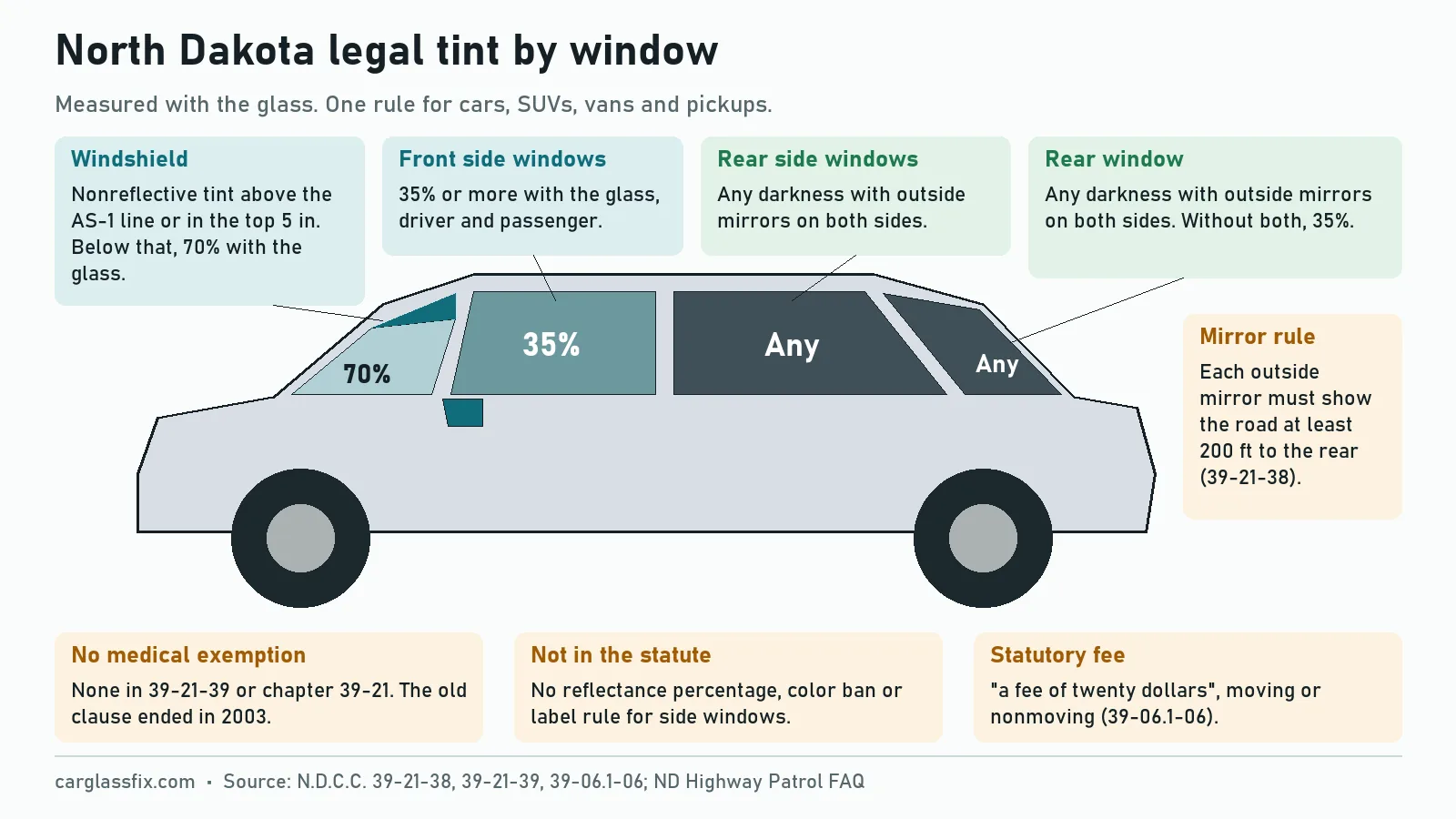
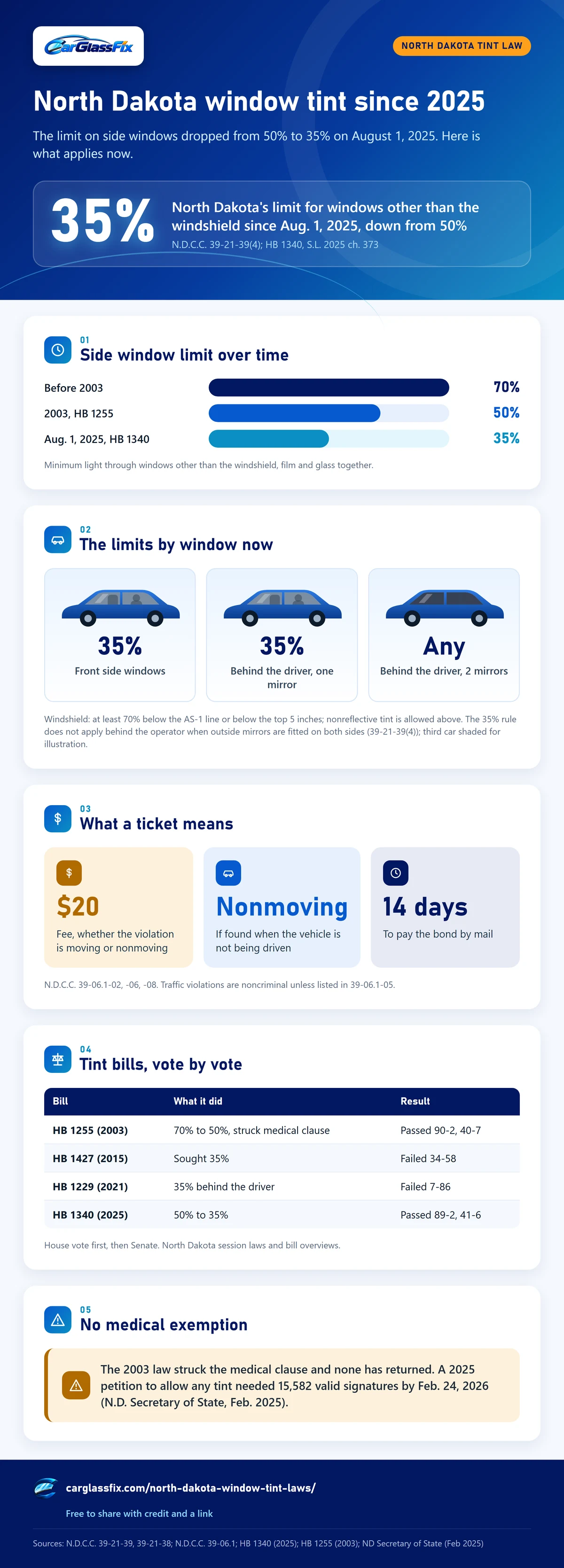
North Dakota window tint laws require at least 35% light transmittance on the front side windows, measured with the glass. Windows behind the driver may be any darkness if the vehicle has outside mirrors on both sides. Windshield tint must stay above the AS-1 line or in the top 5 inches unless the glass still passes 70%.
North Dakota window tint limits by window
North Dakota allows 35% tint on the front side windows, 70% on the windshield below the top strip, and any shade behind the driver with two outside mirrors. All three rules sit in one section, N.D.C.C. 39-21-39. It speaks of “a motor vehicle” and “a window other than the windshield”, so the law has no separate class for multipurpose vehicles. A sedan and a full-size pickup follow the same table. The statute says “at least”, so a window that reads exactly 35% meets the limit. The number comes from the finished window, and the film box does not settle it. A few pages online still show the old 50% figure, which ended on August 1, 2025.
| Window | Sedan | SUV, van, pickup |
|---|---|---|
| Windshield, top strip | Nonreflective tint above the AS-1 line or within the top 5 in | Same |
| Windshield, below the strip | 70% or more with the glass | Same |
| Front side windows | 35% or more with the glass | Same |
| Side windows behind the driver | Any darkness with outside mirrors on both sides; otherwise 35% | Same |
| Rear window | Any darkness with outside mirrors on both sides; otherwise 35% | Same |
| Reflectance percentage | None in the statute | Same |
| Tolerance | None in the statute | Same |
How North Dakota measures the 35% limit
North Dakota measures the tint and the glass together, so 35% is the reading of the whole window. The statute tests the material “in conjunction with” the window it sits on.
Glass and film multiply. For example, a 40% film on glass that passes 80% of light reads about 32%, which is under the limit. The same math means a film sold as 35% reads below 35% on any glass that blocks some light. Our guide on how to measure window tint walks through that math, and the window tint percentage chart shows how each shade looks. The statute names no tolerance, so a reading of 34% has no written margin. A window tint meter gives the combined figure before you leave the shop. The Patrol’s FAQ also counts tint share, so its “no more than 65% tint” equals 35% light transmittance.
Windows behind the driver and the two-mirror rule
Windows behind the driver may be any darkness only if the vehicle has outside mirrors on both sides. The statute says the 35% rule “does not apply to windows behind the operator” when those mirrors are fitted. That covers the rear side windows and the rear window.
The mirrors must meet 39-21-38, which requires a view of the highway “for a distance of at least two hundred feet” to the rear. A vehicle missing one outside mirror loses the exemption, and the 35% limit then applies behind the driver as well. So a vehicle with very dark rear glass that loses a mirror no longer fits the exemption until the mirror is replaced. The front passenger window sits beside the driver, so it stays at 35% whatever mirrors are fitted.
Windshield tint: AS-1 line, top 5 inches and 70%
North Dakota allows nonreflective tint above the AS-1 line or within the top 5 inches of the windshield, and anything lower must leave 70% with the glass. Subsection 5 frees that strip from the light test, and it names no darkness limit for the strip. The text gives two markers with no “whichever” rule, so a driver whose AS-1 mark sits lower than 5 inches gets no tie-breaker from the wording. The higher of the two markers is the cautious choice. You can find the mark with our guide to the AS-1 line on a windshield.
Below the strip, the law sets a number instead of a flat ban. Rep. Steve Vetter told senators in 2025 that “New car windshields are usually at 70%”, so a clear film can leave little or no margin. The wider question is covered in is it illegal to have tint on a windshield.
Reflectance appears only once. “Nonreflective” limits the strip, and 39-21-39 sets no reflectance percentage or color ban for other windows. Any mirrored or colored film still has to pass the light number. Subsection 1 separately bars any sign, poster or other nontransparent material that obstructs the driver’s clear view.
What changed: from 50% to 35% in 2025
House Bill 1340 changed the limit for windows other than the windshield from 50% to 35%, effective August 1, 2025. The bill was approved on March 21, 2025, and filed on March 24 (S.L. 2025, ch. 373). It passed 89 to 2 in the House and 41 to 6 in the Senate. It changed one number and one word, so every other part of the section stayed as it was.
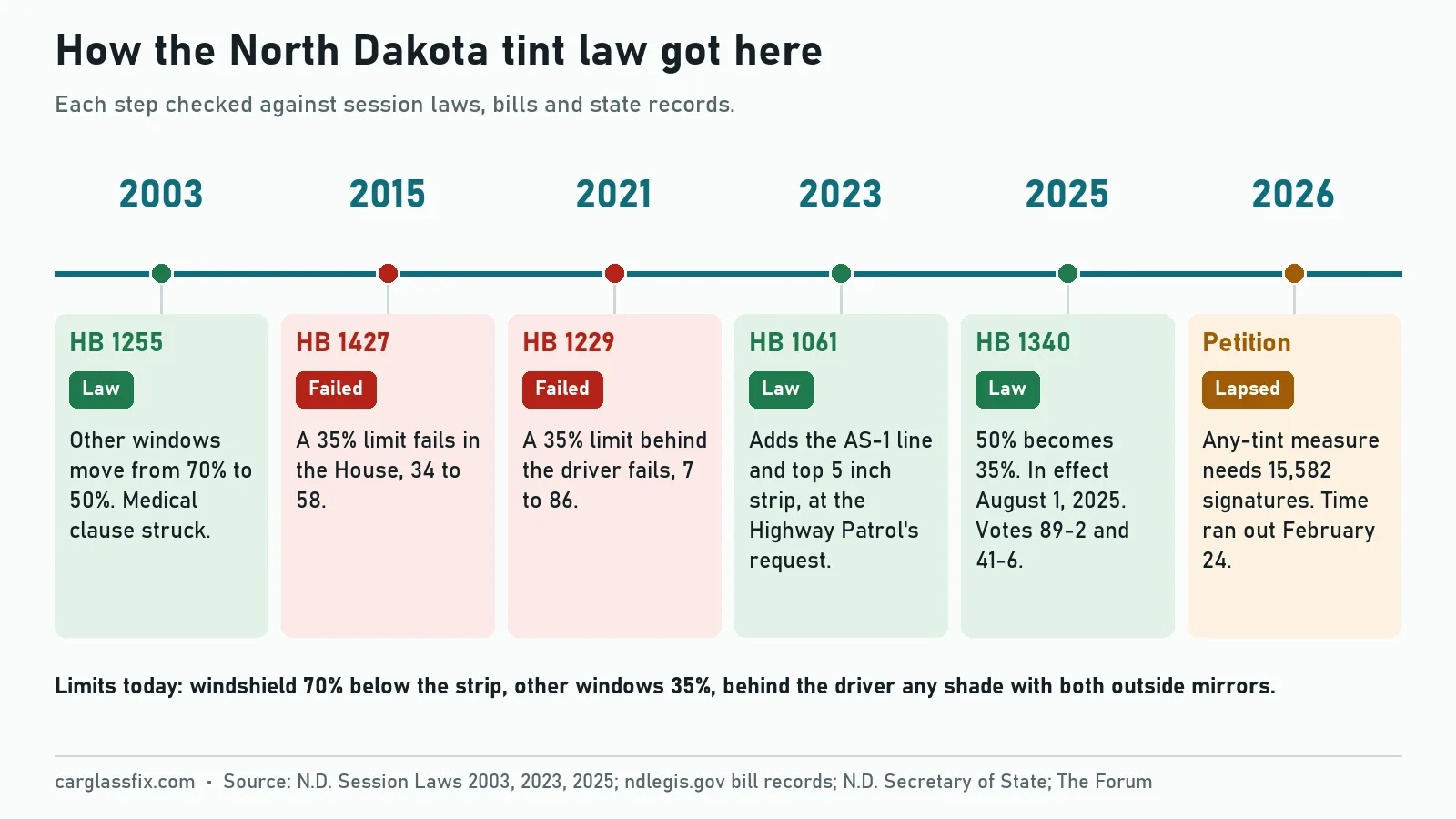
The road there took more than 20 years. Before 2003, the 70% figure covered the windshield and the other windows alike. HB 1255 kept 70% for the windshield and created the 50% limit. A 35% bill, HB 1427, failed in the House 34 to 58 in 2015. HB 1229 would have added a 35% limit behind the driver, and it failed 7 to 86 in 2021. HB 1061 added the windshield strip in 2023, at the request of the Highway Patrol.
A petition to allow any tint on any window followed. It needed 15,582 valid signatures by February 24, 2026, according to the North Dakota Secretary of State.
Is there a medical exemption in North Dakota?
North Dakota has no medical exemption for window tint. Section 39-21-39 lists no medical exception, and a search of chapters 39-21, 39-01, 39-06.1 and 39-12 found none for tint.
The law did once have one. Until 2003, the section exempted “front side windows displaying transparent sunscreening material as authorized by competent medical authority”. HB 1255 struck those words. HB 1427 as introduced in 2015 would have let the director grant exemptions “for medical reasons”, but the amended version dropped that sentence and the bill failed.
That history explains why older pages still describe a medical waiver. The North Dakota Administrative Code was not part of this check, so ask the Highway Patrol in writing before installing darker film. A doctor’s note has no stated effect under 39-21-39.
Fines and how a North Dakota tint ticket works
A North Dakota tint ticket carries a statutory fee of $20. N.D.C.C. 39-06.1-06 sets “a fee of twenty dollars” for a nonmoving violation and the same words for most moving violations. Tint counts as nonmoving when “discovered at a time when the vehicle is not actually being operated” (39-06.1-08), and as moving otherwise (39-06.1-09). Either route leads to the same fee.
The offense is handled as a noncriminal traffic violation under 39-06.1-02. The driver may pay the fee or post bond, or may ask for a hearing. At the hearing, the official “may at that time waive, reduce, or suspend the statutory fee or bond”. A bond posted by mail must be submitted within 14 days of the citation.
Points are less clear. The demerit schedule in 39-06.1-10 lists 2 points for “knowingly driving with defective, nonexistent, or unlawful equipment” under 39-21-46. That entry turns on knowledge and cites a different section, so ask the court whether it applies to your ticket. Section 39-21-39 contains no fix-it clause. Court costs, if any, are outside this section.
Out-of-state and commercial vehicles
North Dakota’s tint rule has no exception for vehicles registered elsewhere. Section 39-21-39(4) says “An individual may not operate a motor vehicle”, while other sections of the chapter limit themselves to vehicles “registered in this state”. Rep. Vetter raised this in 2025, telling senators “We don’t want to punish out of state travelers for following their laws but not our law.” He listed South Dakota at 35%, Montana at 24% and Minnesota at 50%. Drivers crossing east should read the Minnesota window tint laws, and the what car window tint is legal guide explains how state rules differ.
Commercial vehicles can face a stricter federal rule. 49 CFR 393.60(d) requires 70% on the windshield and the windows to the immediate right and left of the driver. N.D.C.C. 39-21-46 tells the Highway Patrol superintendent to keep state motor carrier rules consistent with federal ones. You can preview a legal shade in the window tint simulator before buying film.
Rules change, so check the current North Dakota Century Code or the Highway Patrol before you tint. This page is general information, not legal advice.
Frequently asked questions
Is 35% tint legal in North Dakota?
Yes, if the finished window reads at least 35% with the glass. Since August 1, 2025, that is the limit for front side windows. A 35% film on factory glass reads lower than 35%, so meter the window.
Is 35% or 20% tint darker?
A 20% tint is darker, because it passes 20% of visible light against 35%. In North Dakota, 20% is too dark for the front side windows but allowed behind the driver with outside mirrors on both sides.
Can you get a medical exemption for tint in North Dakota?
No exemption appears in N.D.C.C. 39-21-39 or chapter 39-21. The old medical clause was struck by HB 1255 in 2003, and a doctor’s note has no stated effect under the section.
How much is a tint ticket in North Dakota?
The statutory fee is twenty dollars under N.D.C.C. 39-06.1-06, for a moving or a nonmoving violation. A hearing official may waive, reduce or suspend it.
Which window tint is illegal in North Dakota?
Tint is illegal if a front side window reads under 35%, if the windshield below the strip reads under 70%, or if windows behind the driver read under 35% on a vehicle without outside mirrors on both sides.
Sources
- N.D.C.C. chapter 39-21, including 39-21-38, 39-21-39 and 39-21-46 (checked October 30, 2026)
- N.D.C.C. chapter 39-06.1, including 39-06.1-02, -06, -08, -09 and -10 (checked October 30, 2026)
- 2025 Session Laws, chapter 373 (HB 1340)
- HB 1340, enrolled bill with votes
- Legislative Council: Effective Dates of 2025-26 Legislation
- 2023 Session Laws, chapter 350 (HB 1061)
- HB 1255 (2003), enrolled bill and 2003 Session Laws, chapter 333
- HB 1427 (2015) overview, with the introduced and engrossed texts
- HB 1229 (2021) overview and bill text
- Rep. Steve Vetter, Senate Transportation testimony on HB 1340
- North Dakota Secretary of State: window tint initiative petition
- 49 CFR 393.60, glazing in specified openings (checked October 30, 2026)

Similar Posts