Alaska Window Tint Laws: 70% Front, 40% Rear by Window
Senior Automotive Glass Diagnostic Specialist & Master Technician at CarGlassFix · AGSC Master Certified Auto Glass Technician, NGA Certified Installer, I-CAR Automotive Safety Specialist · 12+ Years in Automotive Glazing, Windshield Structural Bonding, ADAS Camera Calibration & Precision Chip Restoration
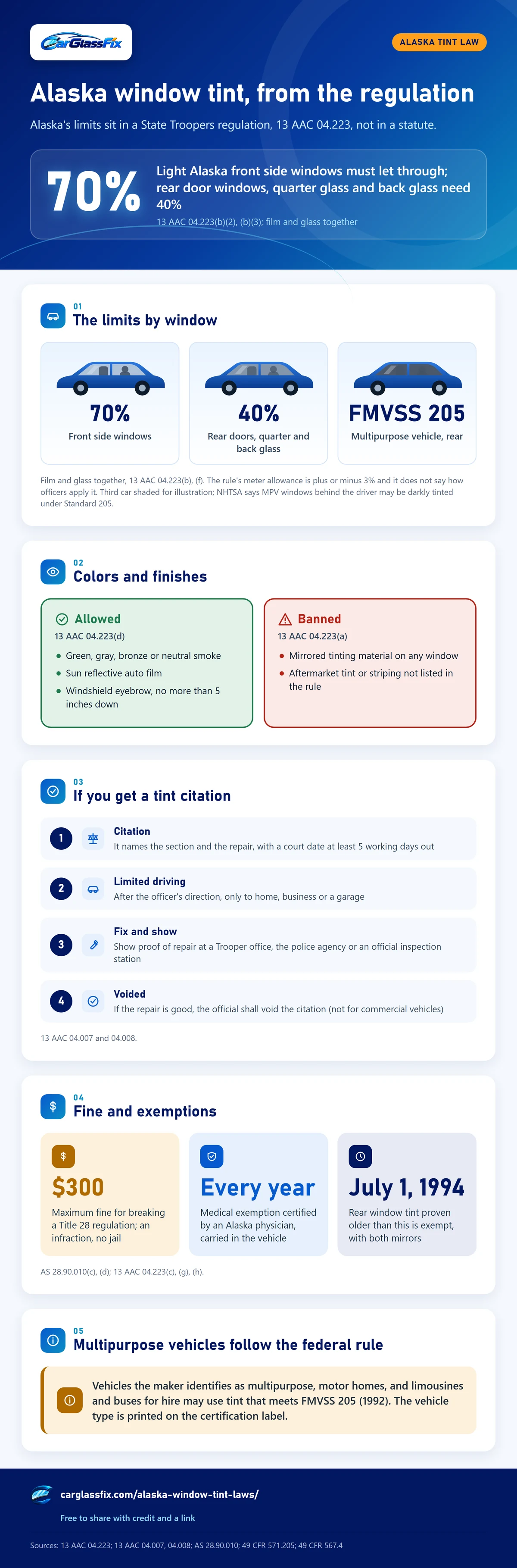
In Alaska, the driver and front passenger windows must pass at least 70% of light, and rear door windows, quarter glass and back glass at least 40%. A windshield may carry only a strip reaching 5 inches down from the top. Vehicles the maker identifies as multipurpose follow federal Standard 205 instead.
Alaska window tint limits by window
Alaska allows 70% on the front side windows and 40% on all glass behind them. The source is 13 AAC 04.223, “Tinted vehicle windows”, a regulation in the part of the Alaska Administrative Code covering the Division of Alaska State Troopers. The rule took effect on October 2, 1992, and was last amended on February 8, 1998. Its opening clause bans all aftermarket tint and “aftermarket striping material” unless the section allows it. The ban covers driving on “a highway, public road, street, or parking lot”, so a parking lot counts. The table reads the rule for each vehicle type. Homer Police publish the same 70% and 40% figures. To compare states, start with what car window tint is legal.
| Window | Sedan | SUV, van, pickup |
|---|---|---|
| Windshield | Eyebrow strip only, at most 5 in down from the top | Same |
| Driver and front passenger windows | 70% or more | 70% or more |
| Rear door windows and quarter glass | 40% or more | Multipurpose SUV or van: no percent in the rule, Standard 205 applies. Pickup: 40% or more |
| Back glass | 40% or more | Multipurpose SUV or van: no percent in the rule, Standard 205 applies. Pickup: 40% or more |
| Mirrored tint | Banned on every window | Same |
| Measured as | Film and glass together | Same |
| Meter allowance | Plus or minus 3% | Same |
How Alaska measures the 70% and 40% limits
Alaska measures the whole window, so the limit applies to film and glass together. Subsection (f) defines light transmittance as the share of light that passes “through a window, including glazing”. The percentage printed on a film box is therefore not the number that counts.
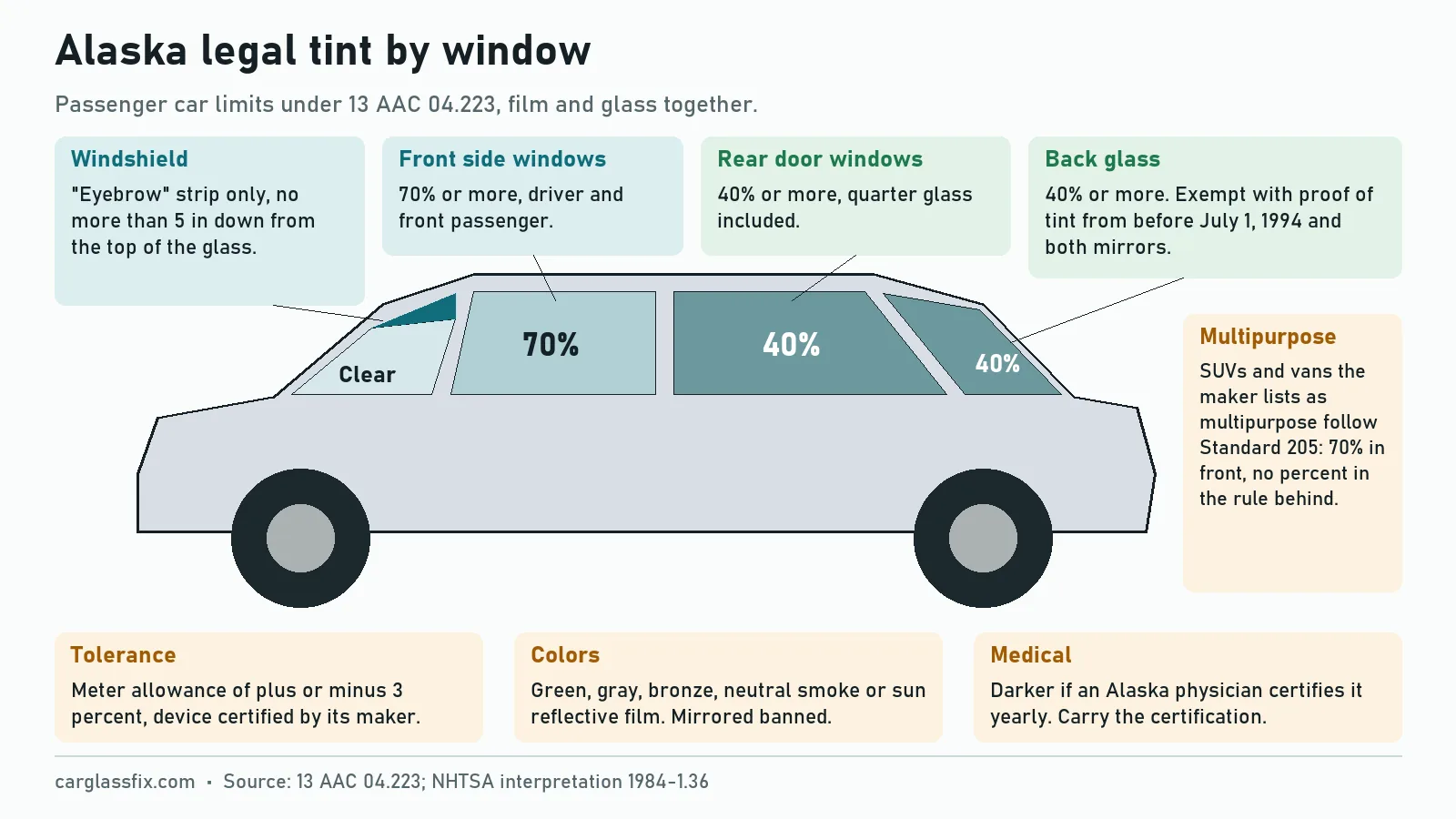
The 70% limit leaves very little room on a passenger car. NHTSA says federal Standard 205 already holds passenger car windows to at least 70%, so bare factory glass can sit close to the Alaska limit before any film goes on. As a worked example, glass passing 80% with a film passing 80% nets 64%, which is below the limit. The two values multiply, as our guide on how to measure window tint explains.
Subsection (e) requires a measuring device “with an allowance for manufacturing variances of plus or minus three percent”, and its maker must certify its accuracy. The rule does not say how an officer applies that allowance, so treat 70% and 40% as the safe targets. A window tint meter reads the same net figure, and the window tint percentage chart shows how each shade looks.
Alaska windshield, color and mirror rules
An Alaska windshield may carry one tinted strip at the top and nothing else. Subsection (b)(1) calls it an “eyebrow” and says it may not extend “downward more than five inches from the top of the glass”. The rule measures in inches only. It never mentions the AS-1 line, so the marking used in other states does not set the Alaska limit. It also sets no percentage for the strip.
Alaska also restricts color by listing what is allowed, and it does not list banned colors. Subsection (d) says tint “must be green, gray, bronze, or neutral smoke in color, or a sun reflective auto film”. Any other shade falls outside the list. Mirrored material is banned on every window under subsection (a). The rule gives no reflectance percentage, so it does not define where a sun reflective film ends and a mirrored one begins. Ask the installer for the film’s specification before choosing a reflective product. The window tint simulator previews darkness, though it cannot show whether a film is legal. For how other states treat the same glass, read is it illegal to have tint on windshield.
Alaska tint rules for SUVs, vans and pickups
Alaska’s rule turns on how the maker classifies the vehicle, and body style alone does not decide it. Subsection (b)(4) says limousines and passenger buses for hire, motor homes, and “vehicles identified by the vehicle manufacturer as multipurpose” may use tint that “complies with Standard No. 205”. That is the federal glazing standard, cited in its 1992 edition. Alaska states no percent here.
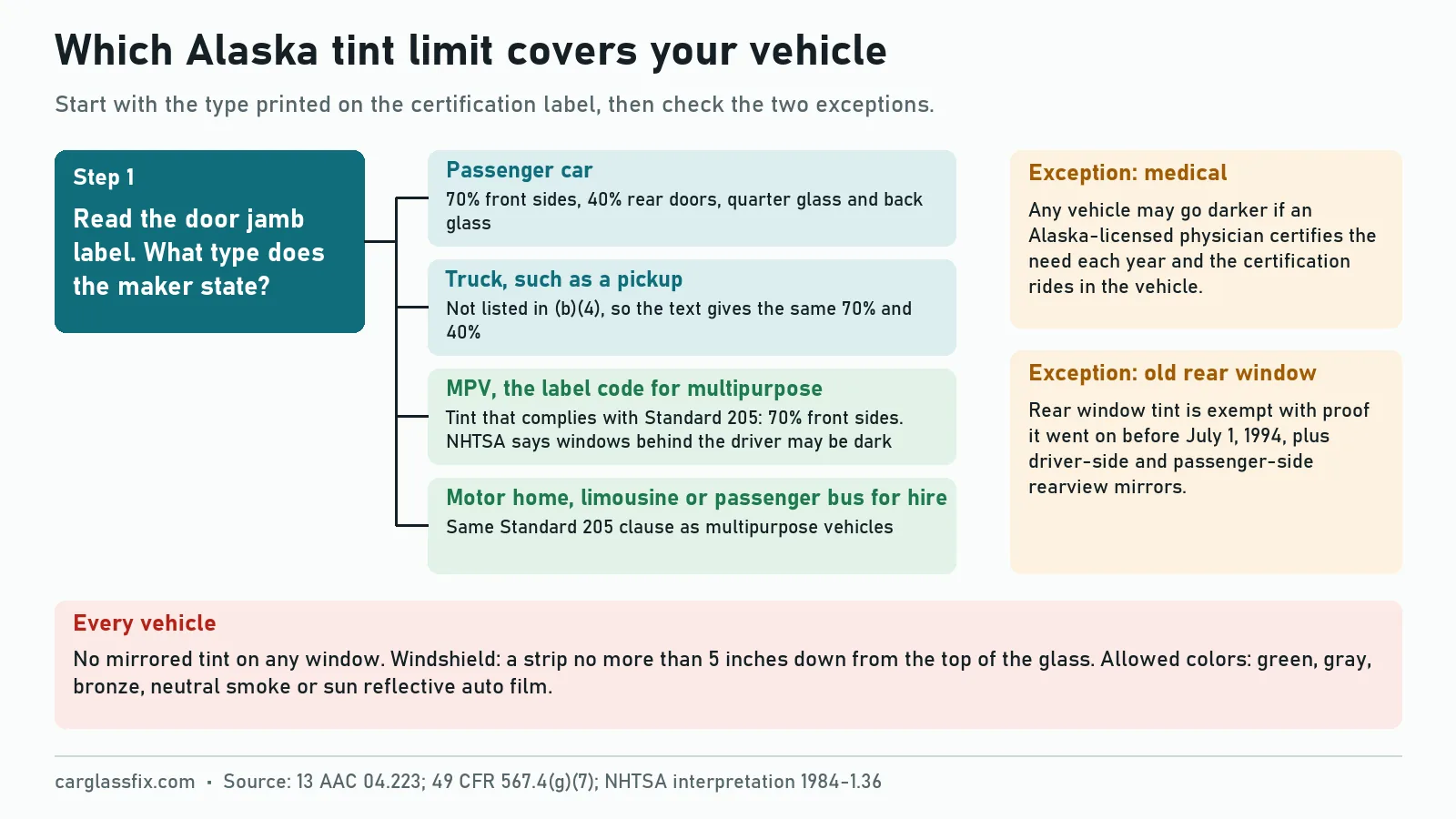
NHTSA letter 1984-1.36 says that for trucks, buses and multipurpose vehicles, the federal 70% applies “only” to the windshield and the windows to the driver’s immediate right and left. Windows behind the driver “may be darkly tinted”. A 2004 NHTSA letter treats a rear window used for driving visibility as covered, then says NHTSA chose in 1998 not to regulate that glass. These letters interpret federal law, so an Alaska officer or court may read the rule differently.
The certification label, usually on the driver’s door jamb, is the practical check. Federal rule 49 CFR 567.4(g)(7) requires it to state the vehicle’s type, such as “truck, MPV, bus, trailer”. MPV means multipurpose passenger vehicle. Trucks are not in the (b)(4) list, so by the text a pickup stays at 40% behind the front seats, even though the NHTSA letter covers trucks.
Alaska medical exemption for window tint
Alaska allows darker tint on medical grounds with a yearly physician certification, and the rule names no state permit or form. Subsection (c) covers a driver or “a passenger who frequently travels in the vehicle”, so a regular passenger can qualify. The medical need is that the person must “be shielded from the direct rays of the sun”. The wording sets no percentage floor.
How to meet the Alaska medical tint exemption
See a physician licensed in Alaska
The rule says “a physician licensed to practice in this state”, so an out-of-state doctor’s note does not fit its words.
Get the medical reason certified
The certification must show the person needs shielding from direct sun for medical reasons.
Carry it in the vehicle
Subsection (c)(3) requires the certification to be in the vehicle, so a copy at home does not meet the rule.
Renew every year
The rule says “certified annually”, so an old note lapses.
Take the paperwork seriously. The Anchorage Daily News reported in 2009 that an Anchorage driver was charged with second-degree forgery after police doubted a doctor’s note for very dark tint. Before you install, ask your local police department or the Alaska State Troopers how they want the certification shown.
Alaska tint tickets and how to clear one
An Alaska tint ticket is normally a noncriminal infraction with a fine of up to $300. AS 28.90.010(c) says a person convicted of violating a regulation adopted under Title 28 is “punishable by a fine not to exceed $300”, unless another law says otherwise. The tint rule was adopted under AS 28.05.011, which sits in that title. Subsection (d) adds that an infraction “is not considered a criminal offense” and cannot bring jail time. The amount paid without a court appearance comes from the Alaska Court System’s bail schedule, so check your citation or the court.
A tint citation may be cleared by fixing the car. Administrative Rule 43.1, in its 2013-2014 edition, lists 13 AAC 04.223 as a correctable offense. It says such a citation “must be dismissed (or voided) if proof of correction is presented” in time. Under 13 AAC 04.008, a driver cited under 04.007 can show the repair at a Trooper office, the police agency that inspected the vehicle, or an official inspection station before the court date. An official who finds the vehicle compliant “shall void the citation”. The rule excludes commercial motor vehicles. Officers can stop a vehicle for a check when they have reasonable cause, under 13 AAC 04.006. Confirm the current process on your citation, because the schedule has changed over time.
What older Alaska tint pages get wrong
Most errors about Alaska tint come from other states’ rules or from bills that never became law. Three bills tried to change the rules, and none became law. S.B. 78 in 2008 and S.B. 51 in 2009 would have made improper installation an infraction and required a “window tint hologram” on paid installs. H.B. 211, introduced in January 2020, would have set a single 35% limit on side and back glass. The rule on the Alaska Legislature’s site still says 70% and 40% as of October 30, 2026.
Claims that Alaska requires a compliance sticker, film receipts or certified film do not appear in 13 AAC 04.223. Neither do the AS-1 line or a banned list of red and amber. The Alaska DMV road test page says it is illegal to have “aftermarket tint on any of your windows”, citing the state rule and Anchorage Municipal Code 09.36.045. That line is shorter than the state rule, which lists allowed tint, so call the DMV first if your test vehicle has tint. The section lists no exception for vehicles registered elsewhere, so drivers from other states should check their glass.
Rules change. Check the current 13 AAC 04.223 or ask the Alaska DMV before you tint. This article is general information, not legal advice.
Frequently asked questions
What is the darkest legal tint in Alaska?
On a sedan, the darkest legal reading is 70% on the front side windows and 40% on all windows behind them, film and glass together. A multipurpose SUV or van has no stated percent behind the driver, and a medical certification can allow darker tint.
Is 35% tint legal in Alaska?
No on a sedan or pickup, because 35% is below both the 70% front limit and the 40% rear limit. A multipurpose SUV or van may differ behind the driver. H.B. 211 proposed a 35% limit in 2020, but it did not become law.
Is 35% or 20% tint darker?
A 20% tint is darker, because it passes 20% of visible light against 35% for the lighter film. The window tint percentage chart shows the shades side by side.
Are Alaska window tint laws different for trucks?
The front limit is the same, 70%. Pickups are not in the list of vehicles under 13 AAC 04.223(b)(4), so by the text they stay at 40% behind the front seats. A vehicle labelled MPV falls under Standard 205 instead.
Can I keep old tint on my back window in Alaska?
Yes, if you have proof it was installed before July 1, 1994, and the vehicle has driver-side and passenger-side rearview mirrors. Subsection (h) covers the rear window only.
Sources
- Alaska Administrative Code, 13 AAC 04.223, Tinted vehicle windows, with 04.225 (checked 30 October 2026)
- Cornell LII copy of 13 AAC 04.223, with history note (checked 30 October 2026)
- Alaska Administrative Code, 13 AAC 04.001 to 04.009, inspections and equipment citations (checked 30 October 2026)
- Alaska Statutes, AS 28.90.010, Penalties (checked 30 October 2026)
- Alaska Rules of Administration, Rule 43.1, Traffic Bail Forfeiture Schedule, 2013-2014 edition (older edition, current version not read)
- Alaska DMV: Road Test (checked 30 October 2026)
- Homer Police Department: How much window tint can I have on my vehicle? (checked 30 October 2026)
- NHTSA interpretation 1984-1.36 on Standard No. 205 (checked 30 October 2026)
- NHTSA interpretation letter to Morgenstern on Standard No. 205 (2004) (checked 30 October 2026)
- 49 CFR 567.4, Requirements for manufacturers of motor vehicles and 49 CFR 571.3, Definitions (checked 30 October 2026)
- Alaska S.B. 78, 25th Legislature, S.B. 51, 26th Legislature and H.B. 211, 31st Legislature (bill texts, status checked 30 October 2026)
- Anchorage Daily News: Prescription window tints do not fly with policeman (2009)

Similar Posts