West Virginia Window Tint Laws: The 35% Rule by Window
Senior Automotive Glass Diagnostic Specialist & Master Technician at CarGlassFix · AGSC Master Certified Auto Glass Technician, NGA Certified Installer, I-CAR Automotive Safety Specialist · 12+ Years in Automotive Glazing, Windshield Structural Bonding, ADAS Camera Calibration & Precision Chip Restoration
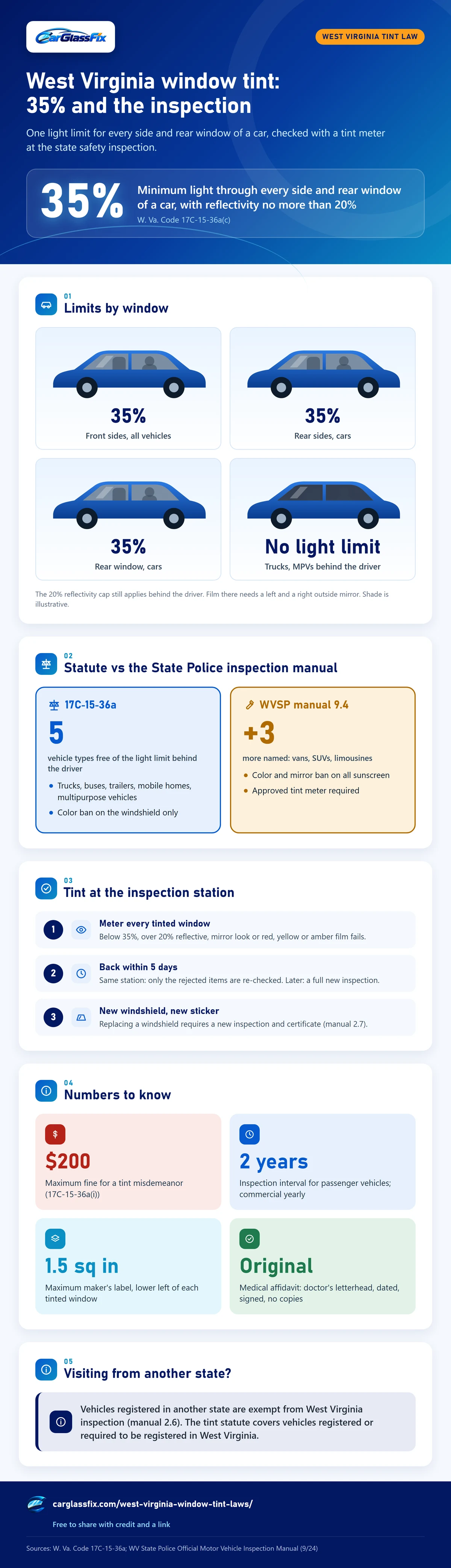
West Virginia window tint laws require at least 35% light transmission and no more than 20% reflectivity on the front side windows of every vehicle. Cars need the same 35% on the rear side and back windows, while trucks, SUVs and other multipurpose vehicles have no light limit there. Windshield film is allowed only as a nonreflective top strip.
West Virginia window tint limits by window
West Virginia sets one number for darkness, 35%, and one for shine, 20%, and applies them by window and vehicle type. The rules sit in a single section of the state code, W. Va. Code 17C-15-36a, titled “Sun-screening devices; penalty.” The front rule covers the side wings and side windows “at the immediate right and left of the driver”, so the front passenger window follows it too. Film on those windows must be “a nonreflective type” with reflectivity of no more than 20%. The rear rule covers the side windows behind the driver and “the rear most windows”. On a passenger car, those windows take the same 35% and 20% limits. Subsection (g) lifts the light limit behind the driver on trucks, buses, trailers, mobile homes and multipurpose passenger vehicles. Any film behind the driver brings a mirror rule: the vehicle needs one right and one left outside rear view mirror.
| Window | Sedan | SUV, van, pickup |
|---|---|---|
| Windshield | Nonreflective strip along the top only, not below the AS-1 line or more than 5 inches down, whichever is closer to the top; not red, yellow or amber | Same |
| Front side windows | 35% or more, reflectivity 20% or less | Same |
| Side windows behind the driver | 35% or more, reflectivity 20% or less | Any light level if a truck or multipurpose passenger vehicle; reflectivity 20% or less |
| Rear window | 35% or more, reflectivity 20% or less | Any light level if a truck or multipurpose passenger vehicle; reflectivity 20% or less |
| Outside mirrors | Left and right required if any film is behind the driver | Same |
| Tolerance | None written in the statute | Same |
How West Virginia measures tint and labels the film
West Virginia writes its limits for the film product, and the statute does not say plainly whether the glass counts. Subsection (h)(2) defines light transmission as the share of light that passes “through a product or material” compared with the light falling on it. Subsection (c) describes the film as one “used in conjunction with the automotive safety glazing materials” of the window. The text gives no tolerance, so 35% works as a hard floor.
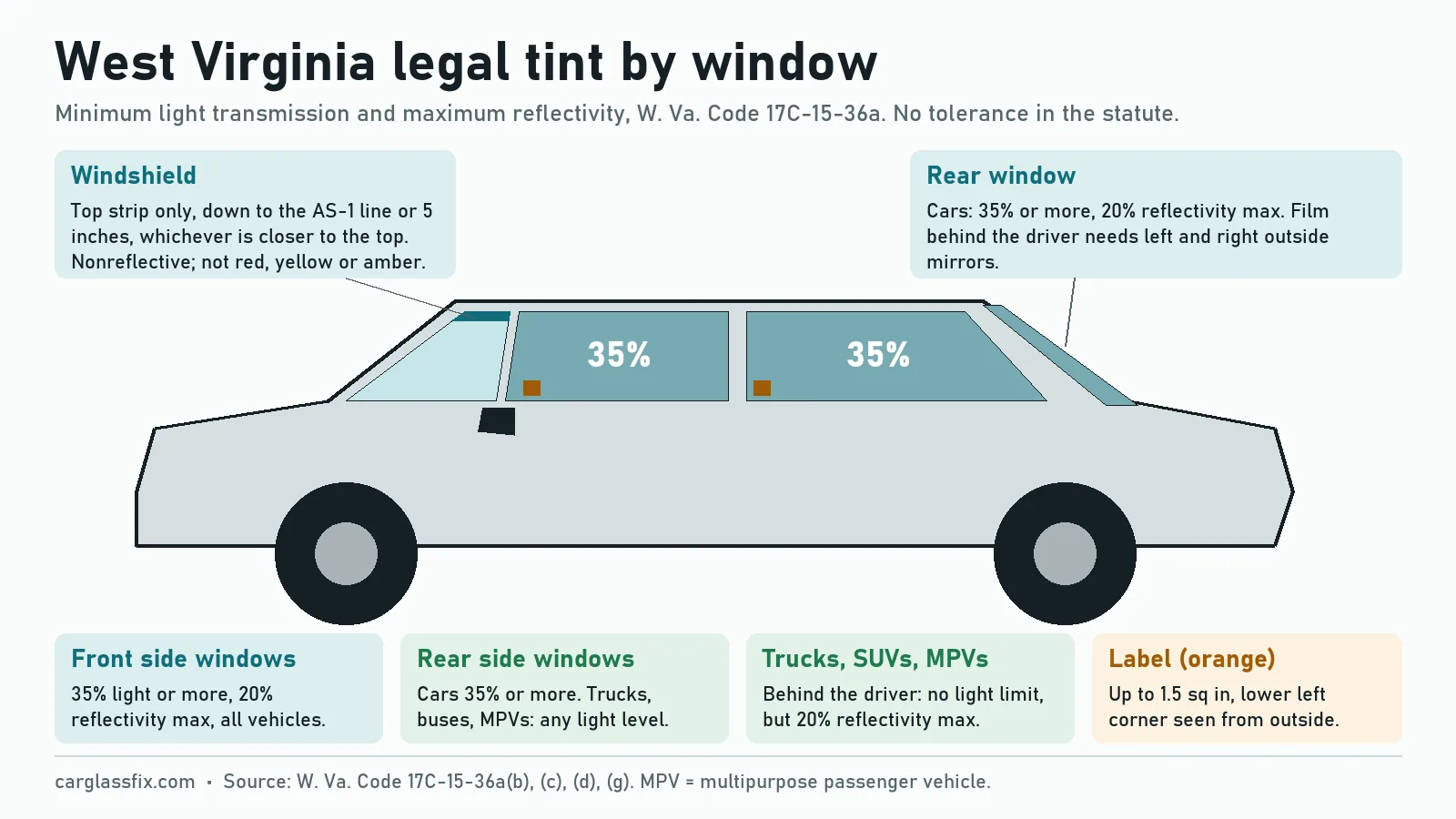
In practice, the State Police inspection manual tells inspectors to read the installed window with an approved tint meter. A meter reads film and glass together, so a 35% film on factory glass will read below 35% and can fail. Our guide on how to measure window tint shows the glass-times-film math, and the window tint meter page explains what the reading means. Each film maker must certify its product to the West Virginia State Police and the Division of Motor Vehicles. The maker also supplies a label no larger than 1.5 square inches with its name and the film’s light transmission. The installer must fix it between film and glass in “the left lower corner of each glazing surface” seen from outside.
Windshield tint in West Virginia: the top strip only
A West Virginia windshield may carry film only as a strip along the top edge. Subsection (b) says the strip may not reach below the “ASI line” or more than five inches from the top, “whichever is closer to the top of the windshield.” The statute’s “ASI” is read as the AS-1 mark that glass makers print near the top corner; the State Police manual writes it as “AS-1”. If the AS-1 mark sits 6 inches down, the 5 inch limit controls. If it sits 4 inches down, the AS-1 line controls. To find the mark on your glass, see the AS-1 line on a windshield.
The strip must be nonreflective, which the statute defines as a material “designed to absorb light rather than to reflect it.” It may not be red, yellow or amber. The statute sets no light-transmission percentage for the strip itself, so any shade is allowed inside that band. A clear film below the band is still a sun-screening device under the definition in (h)(9), and the statute gives no clear-film exception. The general rules on whether windshield tint is illegal in other states differ, so use the West Virginia wording here.
Trucks, SUVs and vans: the behind-the-driver exception
Trucks and multipurpose passenger vehicles in West Virginia may use any darkness on the windows behind the driver. Subsection (g) says the light transmittance requirement “does not apply to windows behind the driver” on trucks, buses, trailers, mobile homes and multipurpose passenger vehicles. The exception covers light only. The 20% reflectivity cap and the outside mirror rule in (c) still apply behind the driver, so a mirror-finish film stays illegal on a pickup’s back glass.
The statute defines each class. A multipurpose passenger vehicle carries ten persons or less and is built “either on a truck chassis or with special features for occasional off-road operation.” A truck is designed primarily to carry property or special purpose equipment. A passenger car is any motor vehicle for ten or fewer people that is not a multipurpose passenger vehicle. Whether a given SUV or van qualifies depends on how it is built. The statute does not name vans or SUVs. The State Police manual does: its section 9.4(e) lists “Trucks, Buses, Vans, SUV’s or Multipurpose Passenger Vehicles, Trailers, Limousines, Mobile Homes” as exempt behind the driver. The front side windows of all of them still need 35%.
The tint check at West Virginia State Police inspection
West Virginia checks window tint during the state safety inspection run by the West Virginia State Police. Section 9.4 of the Official Motor Vehicle Inspection Manual, in its 9/24 edition, says inspectors “shall use an approved tint meter” on any vehicle presented with installed window tint. A tint meter is on the required equipment list for inspection stations, with an exception for motorcycle and trailer stations.
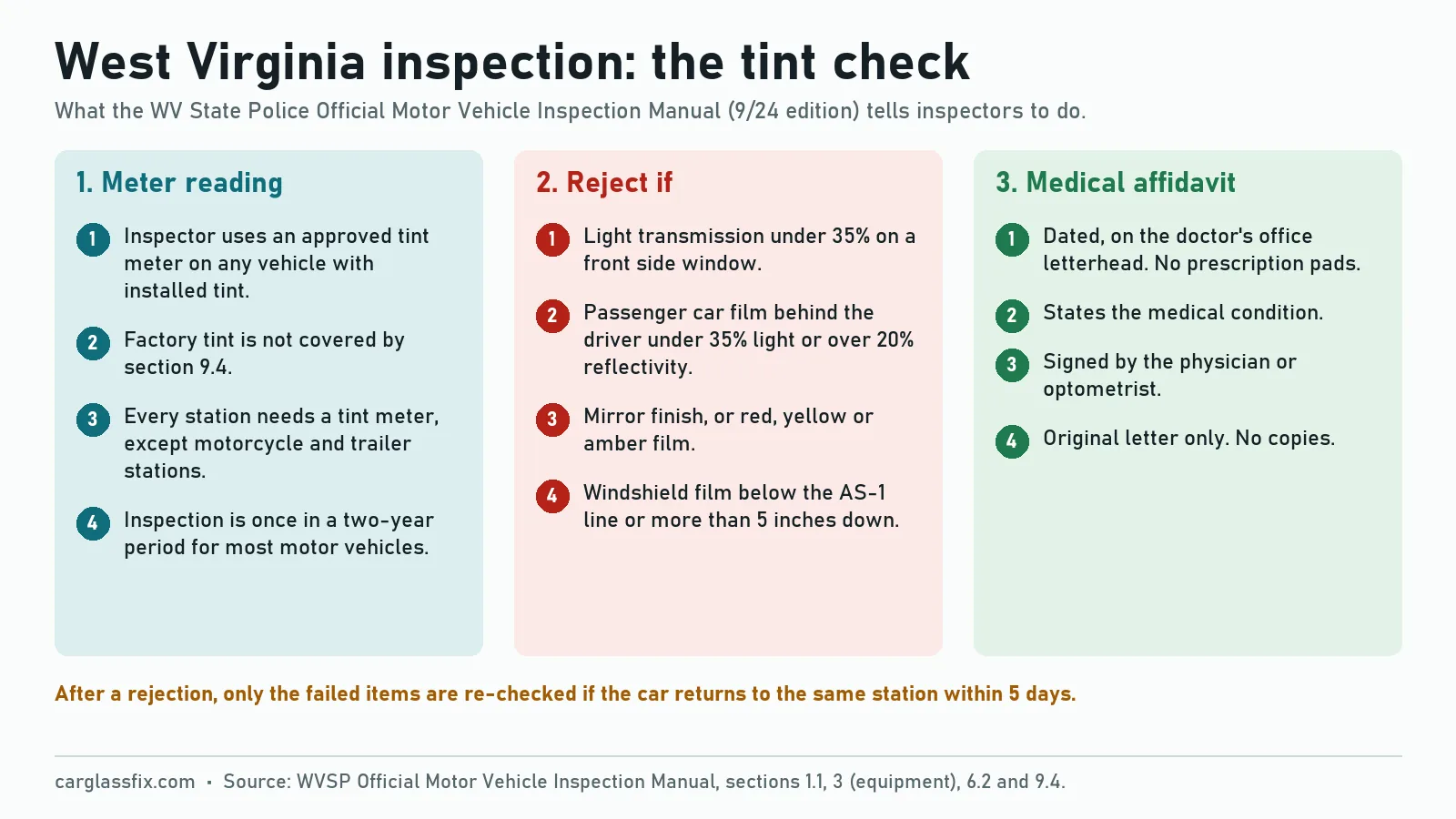
The manual tells inspectors to reject a vehicle for film under 35% on a front side window or on any window of a passenger car. It also rejects any film with a “mirror” appearance and any red, yellow or amber film. That color rule is wider than the statute, which names those colors only for the windshield. The manual sets inspection once in a two-year period for most motor vehicles. A rejected car needs only the failed items re-checked if it returns to the same station within five days. After a windshield replacement, the manual requires a new inspection and certificate.
West Virginia medical exemption for darker tint
West Virginia lifts its tint rules for a person whose doctor signs an affidavit that a physical condition requires darker or more reflective film. Subsection (f) says the section does not apply to a vehicle registered in West Virginia to that person or to the person’s legal guardian. The affidavit must come from “a physician or an optometrist licensed to practice in this state.” The statute names no state form and no filing with the Division of Motor Vehicles, and no DMV page offering one was found. The inspection manual lets a vehicle with a valid medical exemption carry film on the windshield as well.
The steps below come from the statute and the State Police manual.
How to use the West Virginia medical tint exemption
Register the vehicle in your name
The exemption covers a vehicle registered in West Virginia to the person with the condition, or to that person’s legal guardian.
Get the affidavit
A physician or optometrist licensed in West Virginia signs a statement that your condition makes darker or more reflective film necessary.
Check the inspection details
The manual accepts a dated original on the doctor’s office letterhead that names the condition and carries the doctor’s signature; prescription pads and copies are refused.
Carry the original
The affidavit must be with the person, or the legal guardian, at all times while that person rides in the vehicle.
Keep the original in the car and bring it to every inspection.
Penalties, exemptions and common mistakes
A West Virginia tint violation is a misdemeanor with a fine of not more than $200 on conviction, under subsection (i). The same penalty covers the installer rules in (e): selling film that does not comply, or installing film without fixing the required label. Subsection (a) exempts law-enforcement K-9 and other emergency vehicles built to haul animals, unmarked covert police vehicles, and “automobiles that have sun-screening devices installed at the factory.” The rule reaches vehicles registered or required to be registered in West Virginia.
Several common answers are wrong. Search results often mix West Virginia with Virginia, whose front-window rule is different; see Virginia window tint laws for that state. One AI answer said the windshield strip follows “whichever is specified by the manufacturer”; the statute says whichever is closer to the top. A truck-accessory blog claims the strip needs 70% light, which the statute does not say. The code history lists 2012 Senate Bill 493 as the latest amendment. To compare other states, use what car window tint is legal, and preview a 35% shade with the window tint simulator. Rules change, so check the current W. Va. Code 17C-15-36a or ask the West Virginia State Police before you tint. This article is general information, not legal advice.
Frequently asked questions
How dark can tint be in WV?
The darkest legal film on the front side windows of any vehicle lets through 35% of light. Cars need 35% on every other window too, while trucks, SUVs and other multipurpose vehicles may go darker behind the driver.
Is 20% tint legal in West Virginia?
A 20% film is illegal on the front side windows and on every window of a passenger car. It is legal behind the driver on trucks and multipurpose passenger vehicles if its reflectivity is 20% or less.
What are the West Virginia tint laws for trucks?
A truck’s front side windows need 35% light and 20% maximum reflectivity. Behind the driver there is no light limit, but reflectivity stays capped at 20% and the truck needs left and right outside mirrors.
Is windshield tint legal in West Virginia?
Only as a nonreflective strip along the top, down to the AS-1 line or 5 inches, whichever is closer to the top, in any color except red, yellow or amber. A medical affidavit can allow film beyond the strip.
Is 15% or 30% tint darker?
A 15% film is darker, since it lets through 15% of visible light against 30%. Both are below West Virginia’s 35% floor for front side windows; the window tint percentage chart shows each shade.
Sources
- W. Va. Code 17C-15-36a, Sun-screening devices; penalty (official page blocked from our network; read on the archived copy dated 9 June 2026, checked 29 October 2026)
- West Virginia State Police, Official Motor Vehicle Inspection Manual (9/24 edition; read 29 October 2026)

Similar Posts