How to Clean a Windshield Without Streaks
Senior Automotive Glass Diagnostic Specialist & Master Technician at CarGlassFix · AGSC Master Certified Auto Glass Technician, NGA Certified Installer, I-CAR Automotive Safety Specialist · 12+ Years in Automotive Glazing, Windshield Structural Bonding, ADAS Camera Calibration & Precision Chip Restoration
To clean a windshield without streaks, work on cool glass in the shade. Spray an automotive glass cleaner, wipe the wet glass with one clean microfiber towel, then dry it completely with a second, dry towel. Wipe the outside up and down and the inside side to side, and clean the wiper rubber too.
What to use: glass cleaner and two microfiber towels
Use an automotive glass cleaner and two clean microfiber towels, one to wipe and one to dry. Invisible Glass, an ammonia-free auto glass cleaner, says to use lint-free or microfiber towels that are free of residual detergents and fabric softeners. Ford and Honda tell owners to clean windows with a glass cleaner, and Ford specifies a non-abrasive one.
Some makers allow paper towels. Honda mentions them for glass and wiper blades, and LLumar suggests non-abrasive paper towels on its tint. Invisible Glass warns that paper towels tend to smear. Laminated glass needs no special cleaner. NHTSA describes a laminated windshield as a sheet of plastic bonded between two sheets of glass, so a cleaner only touches glass. For a brand-name product such as 3M Glass Cleaner, follow the directions on the can.
| Cleaner | What it removes | Best use | Watch out for |
|---|---|---|---|
| Ammonia-free automotive glass cleaner | Road film, interior haze and grime (Invisible Glass) | Inside and outside glass, tint film | Do not dilute it or mix it with other cleaners |
| Household glass cleaner with ammonia | Oil and grease, per the American Chemistry Council | Untinted glass | XPEL allows only mild, non-ammonia cleaners on its tint film |
| 50/50 alcohol and water | Film on the glass and the wiper rubber (FCA) | Windshield and wiper blades | Tesla warns unapproved alcohol wipes may damage its hydrophobic windshield coating |
| White vinegar and water, 1 to 10 (Honda’s 1995 manual) | Mineral deposits and hard-water stains, per the American Chemistry Council | Water spots on the outside | Honda says a vinegar mix can damage the washer pump |
The vinegar method has its own guide: how to clean a windshield with vinegar. Side windows with aftermarket film follow the film maker’s rules, covered in how to clean tinted side glass.
Step by step: the two-towel method
The two-towel method wipes the glass with one damp microfiber towel and removes the last film of cleaner with a second, dry towel. Tesla’s service procedure for its windshields follows this order: glass cleaner on a microfiber towel, a wipe, then a second towel to dry. The Invisible Glass label says the glass must be dried completely with a new, dry towel.
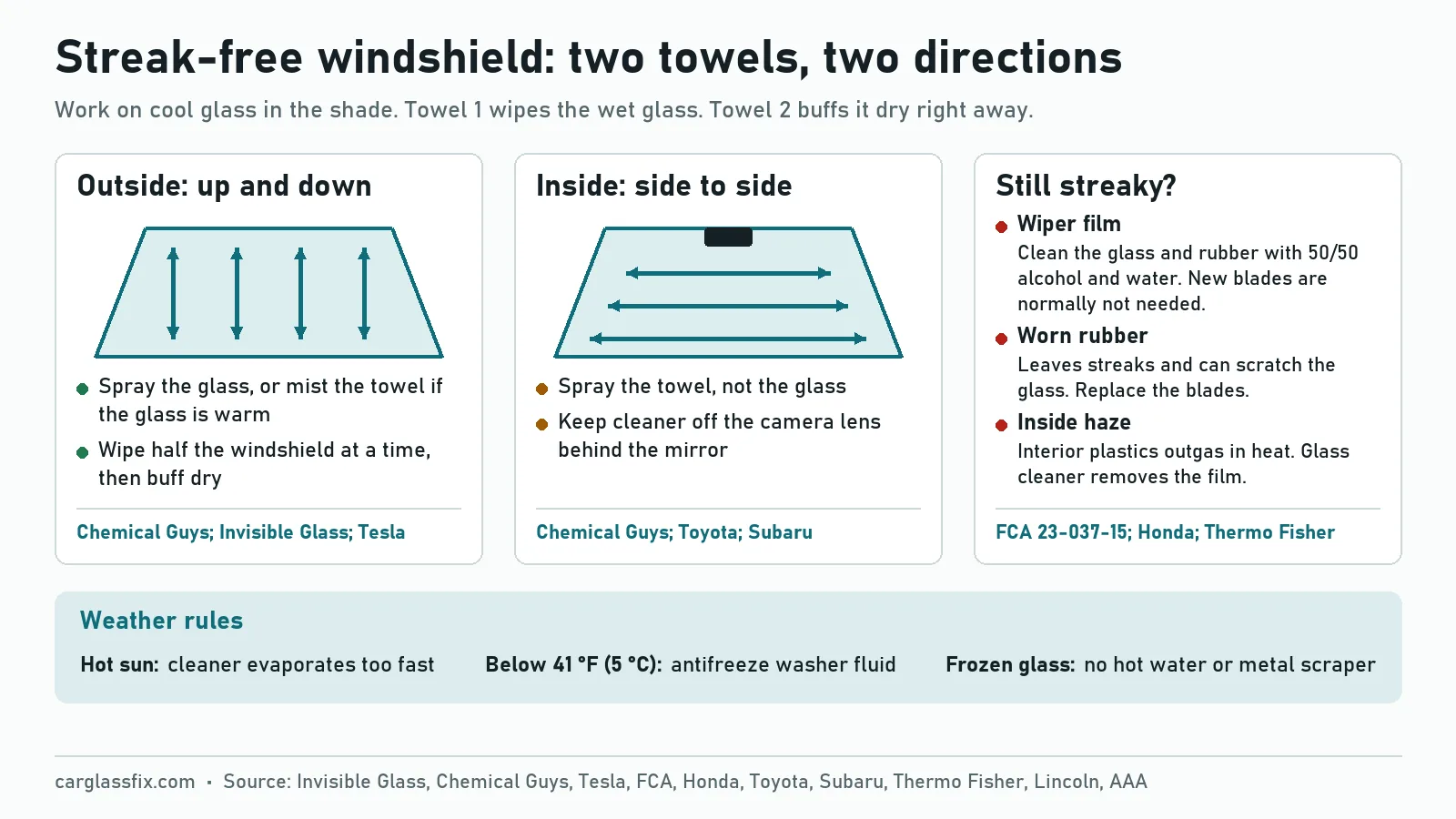
Wiping direction helps you find a leftover streak. Chemical Guys suggests up-and-down strokes on the outside and side-to-side strokes on the inside. A streak that runs up and down is then on the outside. Invisible Glass suggests overlapping strokes over small sections.
How to clean a windshield without streaks
Park in the shade
Start with cool glass out of direct sun, as Invisible Glass advises.
Clean the wiper rubber
Wipe each blade’s rubber edge with washer fluid or a 50/50 mix of alcohol and water until the cloth comes away clean.
Remove loose dirt
Rinse the glass or lift dust with a dry towel first.
Apply a light mist
Spray the glass lightly, or mist the towel if the glass is warm. Invisible Glass says excess cleaner raises the chance of leaving residue as it dries.
Wipe while wet
Clean half the windshield at a time with overlapping up-and-down strokes. Refold the towel to a clean face as it gets dirty.
Dry right away
Buff each section dry with the second towel before the cleaner evaporates.
Clean the inside
Mist the towel, not the glass, and wipe side to side. Keep cleaner away from the camera behind the mirror.
Do the side windows
Lower each window a few inches to reach the top edge inside the seal.
Check against the light
Look through the glass toward a light, or inspect it with a flashlight, as Tesla’s technicians do, and buff any streak.
Dry the glass the same way after a car wash. Water left to dry on the glass can leave minerals behind, and the USGS says hard water leaves spots or film. Marks that survive a normal clean are covered in how to remove water spots from a windshield.
Why windshields streak, and the fix for each cause
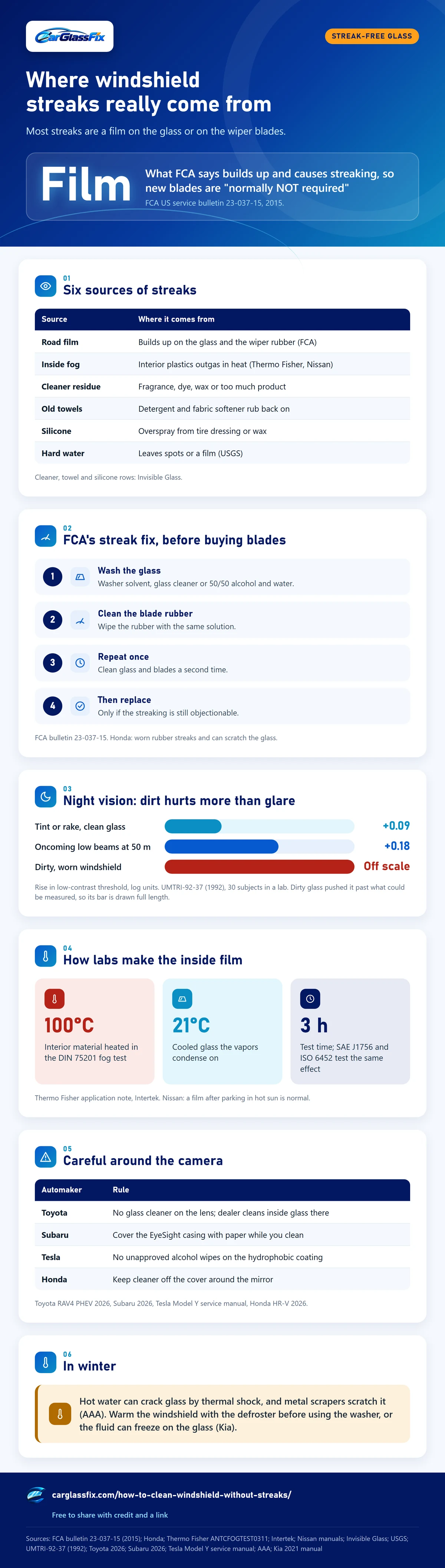
Most streaks are cleaner residue that dried on the glass. Invisible Glass defines residue as a thin film left behind after the liquid part of a cleaner evaporates. Too much product, additives such as fragrances or waxes, and towels that carry detergent or fabric softener all leave it. Streaks that appear only when the wipers run have a different source.
FCA, the maker of Jeep, Ram, Dodge and Chrysler vehicles, covered wiper streaks in service bulletin 23-037-15 in October 2015. The bulletin says wiper blades are often replaced unnecessarily. A film can build up on both the windshield and the wiper rubber and cause streaking. FCA says a normal cleaning of the blades and the windshield is all that is required. Honda sets the limit: rubber that has deteriorated will leave streaks and can scratch the glass.
| Cause | What you see | Fix | Source |
|---|---|---|---|
| Too much cleaner, or a cleaner with soaps, scents or waxes | Clear while wet, streaky once dry | A lighter mist, buffed dry at once | Invisible Glass |
| Towels holding detergent or fabric softener | Smears that keep coming back | Glass-only towels washed without softener | Invisible Glass |
| Hot glass or direct sun | Cleaner dries before you wipe | Shade and cool glass | Invisible Glass, Chemical Guys |
| Film on the glass and wiper rubber | Streaky wipe pattern or chatter | Clean both with washer solvent or 50/50 alcohol and water | FCA bulletin 23-037-15 |
| Worn wiper rubber | Streaks that cleaning does not fix | New blades | Honda, AAA |
| Car-wash hot wax, tire-dressing overspray, insects, tree sap | Wipers smear after a wash or a trip | Clean glass and blades with a good cleaner or mild detergent, then rinse | Mazda, Invisible Glass |
| Interior plastics outgassing | Haze inside, worse at night | Glass cleaner on the inside | Thermo Fisher, Nissan |
| Hard water in the washer or rinse | Spots or a film | Commercial washer fluid in the reservoir | Honda, USGS |
| Fingers on the inside glass | Smudges in headlights | Keep bare hands off the glass | AAA |
Cleaning the inside of the windshield
Clean the inside with the same two towels, but spray the cleaner onto the towel instead of the glass. Chemical Guys gives this advice for interior glass, and it keeps overspray off the dashboard and the camera behind the mirror.
The haze is a real film. A Thermo Fisher note on fog testing says heat makes the plastics, textiles and natural materials in a cabin outgas volatile and semi-volatile compounds. Those compounds condense on the cooler windshield. Interior materials are tested for this under SAE J1756. Nissan calls the film normal after parking in hot sun and says glass cleaner and a soft cloth remove it.
Toyota says not to let glass cleaner touch the front camera lens, and to see a dealer if the inside glass at the camera is dirty. Subaru tells EyeSight owners to cover the camera with paper while they clean. Honda says to wipe the rear window along the defroster wires. For heavy film, see how to get rid of haze on the inside of a windshield. Dust has its own guide: how to remove dust from car glass.
Cleaning to cut night glare
Clean both sides of the windshield before night driving, because dirt and film scatter the light from oncoming headlights. A 1992 lab study at the University of Michigan Transportation Research Institute (UMTRI-92-37) measured the effect. Light scattered by dirty windshields raised the contrast drivers needed to see low-contrast targets beyond what the test could measure. Simulated glare from oncoming low beams raised the same threshold by 0.18 log units. The authors rated the effect of tinted or steeply angled clean glass as small next to scatter from heavy dirt and wear.
Thermo Fisher notes that interior film both limits light and bends the light that passes through. AAA says night driving reveals streaks that are not visible in daylight. It advises wiping the inside with a microfiber cloth and glass cleaner, and never touching the glass with bare hands, because skin oil leaves smears. Subaru warns that polishing the top of the dashboard with chemicals can cause reflections, and AAA suggests dimming the dashboard lights. Tint, visors and other fixes are covered in how to stop windshield glare.
Cleaning in freezing weather and in hot sun
In freezing weather, clear the ice before you clean, and in hot sun, move to shade and let the glass cool.
AAA says never to pour hot water on a frozen windshield, because thermal shock can crack it. AAA also rules out metal scrapers, which can scratch the glass and damage the wiper blades. Use the defroster and a plastic scraper or a soft brush. A 2021 Kia owner’s manual warns not to run the washer in freezing temperatures until the defroster has warmed the windshield, because the fluid can freeze on the glass. Lincoln calls for washer fluid with antifreeze protection below 41°F (5°C). Rain-X rates its De-Icer fluid to -25°F, and Prestone rates its 2-in-1 fluid to -27°F. For the reservoir itself, see how to prevent windshield washer freezing.
Heat causes the opposite problem. Invisible Glass and Chemical Guys both say heat makes cleaner evaporate too fast, which leaves streaks. Chemical Guys suggests spraying the towel when the glass is warm. Tesla’s service procedure requires a roofed or shaded spot when its technicians clean a windshield on a mobile visit.
A quick clean on a road trip
On a road trip, clean the glass at fuel stops with washer fluid or a squeegee, then dry it with a microfiber towel you keep in the car. Before you leave, AAA says to fill the reservoir with fluid made to remove insects and other debris, and to test that the nozzles spray properly. AAA also says to replace the blades if they streak or fail to clear the windshield. Mazda names insects and tree sap as common contaminants that reduce wiper performance.
A small kit covers most stops: a bottle of automotive glass cleaner, two microfiber towels and a spare cloth for the wiper rubber. Honda suggests cleaning streaking blades with a paper towel or soft cloth and washer fluid before you replace them. Clean the inside at the end of the day, when the car is parked and the glass is cool. Dried-on insects need more than a quick wipe, so see how to remove bugs from a windshield.
Frequently asked questions
Why is my windshield streaky after cleaning?
Most streaks are cleaner residue from too much product, towels that hold detergent or fabric softener, or cleaner that dried on hot glass. If the streaks follow the wiper path, clean the wiper rubber too.
Why do my wipers leave streaks with new blades?
FCA’s bulletin 23-037-15 says film on the windshield and the wiper rubber causes streaking. Clean both with washer solvent or a 50/50 mix of alcohol and water. Mazda adds that car-wash hot wax can affect how well wipers clean.
Should I wipe the windshield in circles or straight lines?
The cleaner makers describe straight, overlapping strokes. Chemical Guys suggests up and down on the outside and side to side on the inside, so the direction of a leftover streak shows which side it is on.
Can I use Windex on my car windshield?
Honda’s manuals ask only for a glass cleaner. On aftermarket tint, follow the film maker, because XPEL allows only mild, non-ammonia cleaners. See car glass cleaner vs. Windex for a side-by-side look.
Can I clean my windshield with rubbing alcohol?
Yes. FCA’s bulletin lists a 50/50 mix of alcohol and water for the windshield and the wiper rubber. Tesla warns that unapproved alcohol wipes may damage the hydrophobic coating on its windshields, so check your manual if the glass has a factory coating.
Sources
- Invisible Glass: Auto Glass Cleaner directions, how to remove glass cleaner residue and windshield water beading vs. streaking
- Chemical Guys: How to Clean Your Windshield With No Streaks (updated October 2025)
- Tesla Model Y Service Manual: Clean Forward Camera View
- FCA US service bulletin 23-037-15, Windshield Wiper Blade/Element Maintenance (October 14, 2015), via NHTSA
- Honda owner’s guide: Changing Wiper Blades
- Honda HR-V 2026 owner’s manual: Interior Care and Refilling Window Washer Fluid
- Honda 1995 Civic owner’s manual: Interior Care
- Toyota 2026 RAV4 Plug-in Hybrid owner’s manual: Driving Support Systems excerpt
- Subaru EyeSight owner’s manual supplement
- Nissan Juke 2025 owner’s manual: Cleaning glass
- Mazda CX-30 owner’s manual: Wiper Blades
- Kia 2021 owner’s manual: wiper and washer warnings
- Lincoln MKZ Hybrid 2016 owner manual: Washer Fluid Check and Ford: How do I clean my Ford?
- Thermo Fisher Scientific application note ANTCFOGTEST0311: Understanding a Fog Testing System
- Intertek: fogging of interior automotive materials, SAE J1756, ISO 6452, DIN 75201 (checked 23 October 2026)
- Owens, Sivak et al., Effects of Light Transmittance and Scatter by Windshields on Nighttime Visual Performance, UMTRI-92-37 (1992)
- AAA Club Alliance: Driving at Night (November 2024)
- AAA: How to Deice Your Car’s Windshield and AAA: Prepare Your Car for Summer Travel
- Rain-X De-Icer washer fluid and Prestone 2-in-1 washer fluid
- XPEL product care and LLumar automotive tint FAQ
- American Chemistry Council: Chemistry in Cleaning Products
- USGS Water Science School: Hardness of Water
- NHTSA, 54 FR 41636, windshield glazing (October 11, 1989) (checked 23 October 2026)

Similar Posts