Missouri Window Tint Laws: 35% Front, No Rear Limit
Senior Automotive Glass Diagnostic Specialist & Master Technician at CarGlassFix · AGSC Master Certified Auto Glass Technician, NGA Certified Installer, I-CAR Automotive Safety Specialist · 12+ Years in Automotive Glazing, Windshield Structural Bonding, ADAS Camera Calibration & Precision Chip Restoration
Missouri window tint laws allow film on the front side windows that lets through at least 35% of light, plus or minus 3%, measured with the glass. The back side windows and rear window have no limit. Applied windshield film is banned; only the factory top band is allowed. Darker front tint needs a Highway Patrol medical permit.
Missouri window tint limits by window
Missouri sets one tint limit, 35% light transmission on the two windows beside the driver, and no limit on any window behind them. The rule is Revised Statutes of Missouri section 307.173, in force in its current form since August 28, 2010. The section covers only the “front sidewing vents or windows located immediately to the left and right of the driver” and the windshield. It never mentions the back side windows or the rear window, so no number applies to them. The Missouri State Highway Patrol says the same in its tint brochure: windows behind the driver and the rear glass “are not subject to tint limitations”. Sedans, SUVs, vans and pickups follow the same rule, because the statute speaks of a “motor vehicle” without any vehicle class. The limit also comes with a reflectance cap of 35%, plus or minus 3%, which is the figure that rules out mirror-look film on the front doors.
| Window | Sedan | SUV, van, pickup |
|---|---|---|
| Windshield | No applied film; only the glass maker’s factory top band | Same |
| Front side windows (left and right of the driver) | 35% light or more, plus or minus 3%; 35% reflectance or less, plus or minus 3% | Same |
| Side windows behind the driver | Any darkness | Any darkness |
| Rear window | Any darkness, no mirror condition | Any darkness, no mirror condition |
| Measured as | Film and glass together | Same |
| Colors, labels, certificates | None required or banned by 307.173 | Same |
How Missouri measures the 35% limit: film plus glass, plus or minus 3%
Missouri measures the film and the window glass together, and it writes a 3% margin into the statute itself. Section 307.173 requires a sun-screening device “in conjunction with safety glazing material” to have “a light transmission of thirty-five percent or more plus or minus three percent”. The reflectance rule uses the same form: 35% or less, plus or minus 3%.
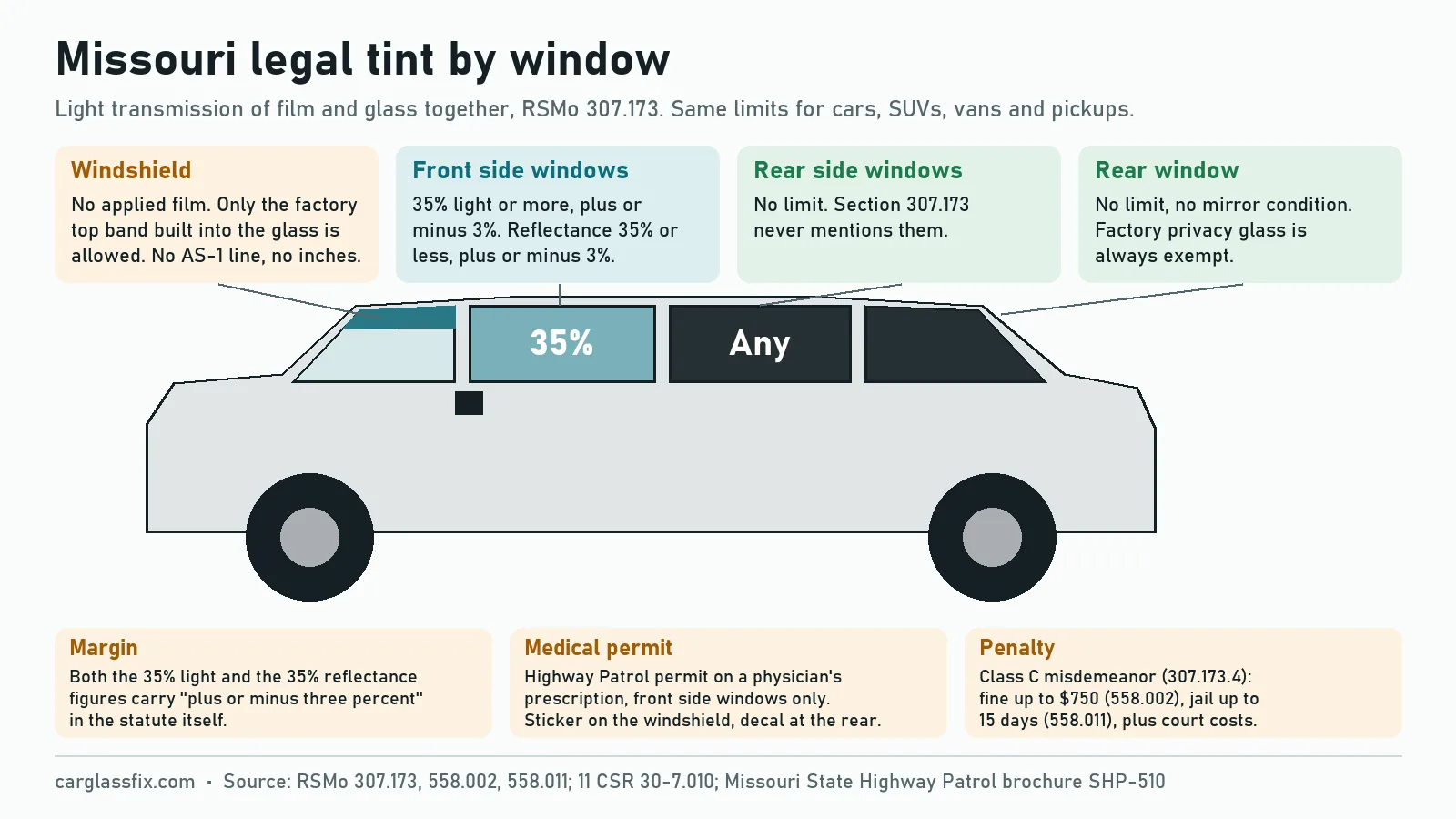
Because the reading is taken through the finished window, a film sold as 35% reads lower once it sits on factory glass that already blocks a few percent of light. Our how to measure window tint guide explains the glass-times-film math, and the window tint percentage chart shows what each shade looks like. The plus or minus 3% wording means a meter reading of 32% can still satisfy the statute. The Highway Patrol brochure repeats the figure as “35 percent, plus or minus three percent”. Missouri puts the margin in the law, where many states leave it to an agency rule or to officer discretion. An officer checks the door glass with a window tint meter at a traffic stop, so the number that counts is the net reading of film and glass, not the percentage printed on the film box.
Windshield tint in Missouri: no AS-1 line, no inches
Missouri bans every applied sun-screening device on the windshield, with one exception for the tint band the glass maker builds in. Subsection 1 of 307.173 ends with the words “all sun-screening devices applied to the windshield of a motor vehicle are prohibited”. Subsection 2 then allows “tinting material applied to the upper portion of the motor vehicle’s windshield which is normally tinted by the manufacturer of motor vehicle safety glass”. That is the factory shade band and nothing more. The statute names no AS-1 line and no inch figure, so pages that promise non-reflective tint above the AS-1 line, or film in the top 5 or 6 inches, describe another state’s rule. The AS-1 line on a windshield matters in Texas and Virginia, not in Missouri. The medical permit does not open the windshield either. The Department of Public Safety rule, 11 CSR 30-7.010, limits permits to the front side vents and windows, and only permits issued before August 28, 2001 could cover windshield tint. The statute does not address clear film, so whether an untinted film counts as a sun-screening device is a question for the Highway Patrol. For other states, read is it illegal to have tint on a windshield.
Missouri medical exemption: the Highway Patrol tint permit
Missouri issues a tint permit for darker front side windows only to a person with “a serious medical condition” and a physician’s prescription. Section 307.173 places the permit with the Department of Public Safety, and the department’s rule, 11 CSR 30-7.010, hands the work to the Highway Patrol’s Motor Vehicle Inspection Division.
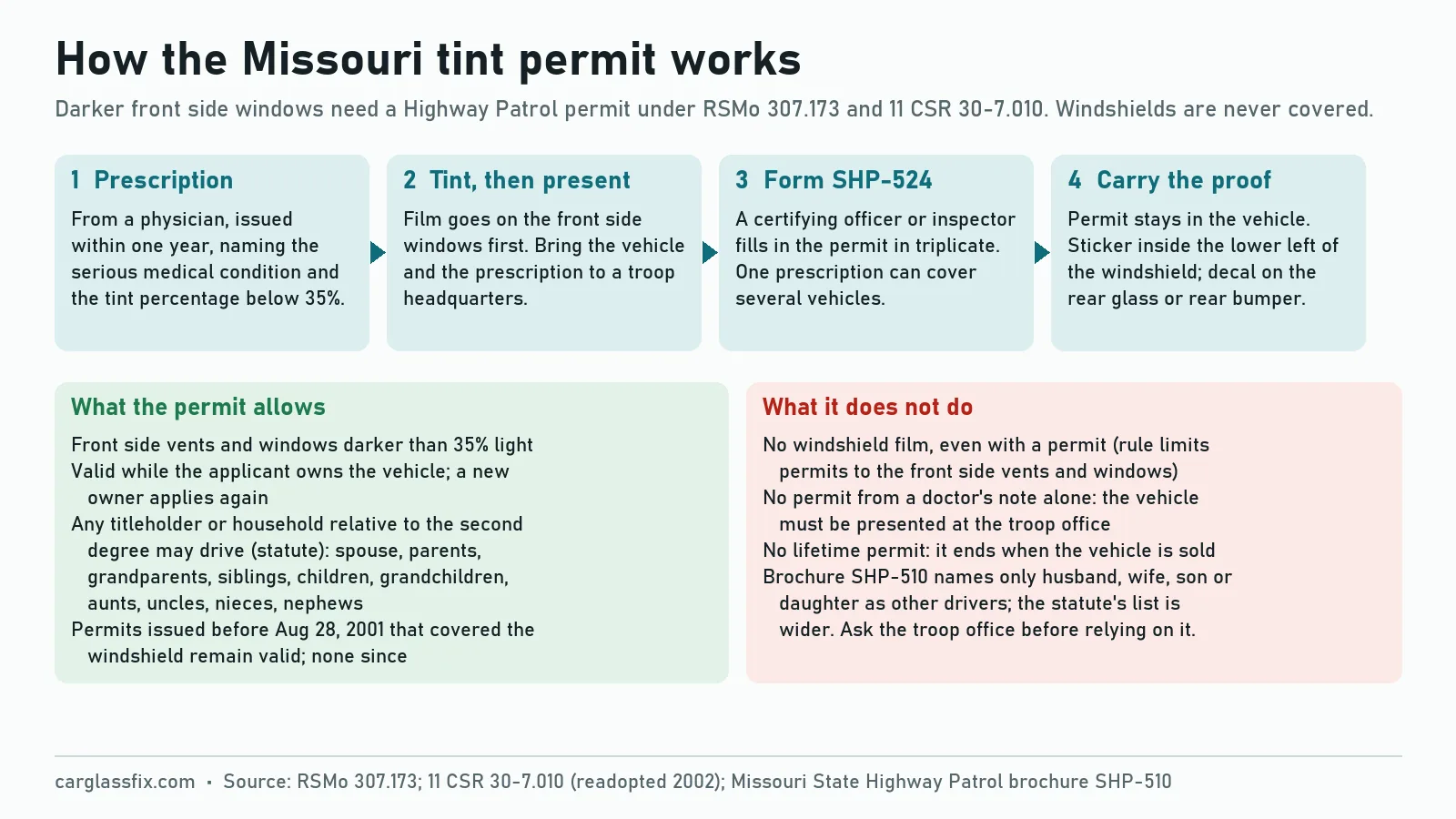
The prescription must be issued within one year of the application and must state that the condition needs less than 35% light transmission on the front side windows. The Patrol brochure adds that it should name the specific tint percentage and be in the vehicle owner’s name. The permit, form SHP-524, stays valid while the applicant owns the vehicle; a new owner starts over. One prescription can cover several vehicles, but each vehicle must be presented. Who may drive the car is where the statute and the brochure differ. The statute allows “any titleholder or relative within the second degree” who lives in the household, and it lists spouse, grandparents, parents, siblings, nieces, nephews, aunts, uncles, children and grandchildren. The brochure names only “husband, wife, son, or daughter”. The statute is the law; ask the troop office before a wider relative drives the car.
How to get a Missouri window tint permit
Get the prescription
A physician, not an optometrist, writes it within one year of the application, naming the serious medical condition and the tint percentage needed below 35% (11 CSR 30-7.010; SHP-510).
Tint the front side windows
The vehicle must be presented with the film already on, because the inspector records the vehicle on the permit form.
Visit a troop headquarters
Bring the vehicle and the prescription to the local Highway Patrol troop headquarters, where a certifying officer or inspector completes form SHP-524.
Keep the permit and the markers
Carry the permit in the vehicle at all times; a sticker goes inside the lower left corner of the windshield and a decal on the rear glass or rear bumper.
Penalties for illegal tint in Missouri, and what inspection checks
An illegal tint charge in Missouri is a class C misdemeanor under subsection 4 of 307.173. The section sets no fine of its own. The sentencing statutes do: 558.002 caps a class C misdemeanor fine at “seven hundred fifty dollars”, and 558.011 caps jail at “a term not to exceed fifteen days”. Court costs come on top, and a judge can impose far less. The Patrol brochure warns that officers “will strictly enforce the window tint law”. Missouri has no fix-it ticket rule for tint in the statute, so dismissal after the film comes off is up to the court. The biennial safety inspection is a separate check. Under 11 CSR 50-2.270, a station rejects a vehicle when “after-market vision reducing material” is on the windshield, but the glazing rule has no item for side windows. The Patrol confirms that stations do not inspect side or rear tint. Since August 28, 2019, section 307.350 has also excused vehicles under ten model years old with fewer than 150,000 miles from the inspection, so most newer cars meet the tint law only at the roadside.
Vehicles and glass the Missouri tint limits do not cover
Four exceptions sit inside 307.173 itself: factory tinted glass, recreational vehicles, labels and stickers, and vehicles on historical plates. Subsection 2 says the section “shall not prohibit factory-installed tinted glass, the equivalent replacement thereof”, so the dark privacy glass an SUV gets at the factory is never measured against the 35% rule, and a replacement pane made to the same specification is treated the same way. The same subsection allows “labels, stickers, decalcomania, or informational signs” and tinted or solar material on a recreational vehicle as defined in section 700.010, as long as the material “does not interfere with the driver’s normal view of the road”. Subsection 5 exempts “any vehicle licensed with a historical license plate” from the whole section. Out-of-state cars get no written exemption. The Patrol brochure speaks of “vehicles registered in Missouri”, but the statute itself does not say so, so a visitor with dark front windows should not count on it. Before choosing a shade, try the window tint simulator, and compare neighbouring states in what car window tint is legal.
What changed in Missouri tint law, and what older pages get wrong
The Missouri numbers have not changed in any statute version since February 14, 2002. The Revisor of Statutes lists five versions of 307.173, from 1997 to 2010, and the 2002 text already carries 35% light, 35% reflectance, the 3% margin and the windshield ban. The 2009 (H.B. 683) and 2010 (H.B. 1540) versions changed cross-references, not limits. In 2026 the legislature passed S.B. 1408, a transportation bill that news outlets reported Governor Kehoe signed on July 13, 2026. The House version would have ended most safety inspections, and ABC17 reported that the signed version dropped that part. The bill does not amend 307.173; the Revisor’s copy of the tint section read for this article still shows the 2010 text, so a page that promises a 2026 update to Missouri tint limits has nothing behind it. Other common errors: a Bing AI answer checked for this article said Missouri requires dual mirrors for dark rear tint and bans red and amber film; neither rule exists in 307.173. Several pages say darker tint is allowed above the AS-1 line; the statute never uses that line. Rules change with each session, so check the current 307.173 or the Highway Patrol before you tint. This article is general information, not legal advice.
Frequently asked questions
What is the legal tint limit in Missouri?
The front side windows must let through at least 35% of light, plus or minus 3%, measured with the glass, and reflect no more than 35%. The back side windows and rear window have no limit, and applied windshield film is banned.
Is 20% tint legal in Missouri?
A 20% reading is illegal on the front side windows without a Highway Patrol medical permit, because 35% plus or minus 3% is the floor. It is legal on the side windows behind the driver and on the rear window, which section 307.173 does not regulate.
Can a cop pull you over for tint in Missouri?
Yes. A front side window darker than the 35% rule is a class C misdemeanor under 307.173, which is a reason for a stop on its own, and the Highway Patrol says officers enforce it. Safety inspection stations do not check side-window tint, so the roadside meter is the main check.
How do I get a window tint exemption in Missouri?
Get a prescription from your physician, issued within the past year, stating the serious medical condition and the tint percentage you need, then take the tinted vehicle and the prescription to your local Highway Patrol troop headquarters. The Patrol issues the permit, a windshield sticker and a rear decal; keep the permit in the vehicle.
Is 35% tint darker than 20%?
No. A 35% film lets through 35% of visible light and a 20% film only 20%, so 20% is the darker shade. The window tint percentage chart shows the shades side by side.
Sources
- Revised Statutes of Missouri 307.173, Specifications for sun-screening device applied to windshield or windows (effective 28 August 2010; archived copy read 29 October 2026)
- FindLaw: Mo. Rev. Stat. 307.173 (current as of 1 January 2025; cross-check, checked 29 October 2026)
- RSMo 558.002, Fines and RSMo 558.011, Sentence of imprisonment, terms (checked 29 October 2026)
- RSMo 307.350, Motor vehicles, biennial inspection required, exceptions (effective 28 August 2019; checked 29 October 2026)
- 11 CSR 30-7.010, Motor Vehicle Window Tinting Permits (readopted effective 30 August 2002; checked 29 October 2026)
- 11 CSR 50-2.270, Glazing (Glass) (amended effective 30 June 2021; checked 29 October 2026)
- Missouri State Highway Patrol: Window Tinting, What’s Legal? (brochure SHP-510) (archived copy of 7 October 2026 read)
- Missouri Senate: S.B. 1408 (2026) bill information (checked 29 October 2026)
- ABC17 News: Rural speed limit increase signed into law by Kehoe (13 July 2026)
- FOX 2: Missouri advances bill to raise speed limit, end most vehicle safety inspections (1 May 2026) and News Tribune: Missouri House approves bill to raise speed limit to 75 (2 May 2026)

Similar Posts