Maryland Window Tint Laws: 35% Limits by Window
Senior Automotive Glass Diagnostic Specialist & Master Technician at CarGlassFix · AGSC Master Certified Auto Glass Technician, NGA Certified Installer, I-CAR Automotive Safety Specialist · 12+ Years in Automotive Glazing, Windshield Structural Bonding, ADAS Camera Calibration & Precision Chip Restoration
Maryland window tint laws require at least 35% light transmittance, film and glass together, on every window of a passenger car. On SUVs, vans and light trucks, only the two windows beside the driver must pass 35%; windows behind the driver may be any darkness. Windshield tint may not go below the AS-1 line or 5 inches from the top.
Maryland window tint limits by window
Maryland allows 35% light transmittance or more on every tinted window of a passenger car, and the same 35% on the front side windows of an SUV, van or pickup. The rule is Maryland Code, Transportation 22-406(i). It bars a Class A vehicle from the highway if any window carries tint “added to the window after manufacture” that does “not allow a light transmittance through the window of at least 35%”. The number describes the finished window, so factory glass and film are read together. The inspection regulation, COMAR 11.14.02.14D, repeats the limit as “at least 35 percent light transmittance after the application of post manufacture window tint”. Neither text names a tolerance, so a reading of 34% is below the limit. Windshields follow a separate position rule rather than a percentage, covered below.
| Window | Sedan | SUV, van, pickup |
|---|---|---|
| Windshield | No added tint below the AS-1 line or below 5 inches from the top; no light figure set for the strip | Same |
| Front side windows (right and left of the driver) | 35% light or more | 35% light or more |
| Side windows behind the driver | 35% light or more | Any darkness |
| Rear window | 35% light or more; no tint in front of an inside high-mounted stop lamp | Any darkness; same stop lamp rule |
| Measured as | Film and glass together | Same |
| Mirrors | Outside mirror on each side when any side or rear window is tinted | Same |
| Colors and finish | No red, yellow or amber; no mirrored, one-way or sparkling effect | Same |
Which Maryland vehicles may go darker behind the driver
The registration class decides whether the windows behind the driver must pass 35%. Section 22-406(i)(1) splits vehicles into two groups. A vehicle registered under 13-912, “every passenger car and station wagon” (Class A), must meet 35% on “any window”. A vehicle registered under 13-913 (Class B, for hire), 13-917 (Class E trucks rated 3/4 ton or less and 7,000 pounds or less) or 13-937 (Class M, multipurpose) is limited only on “any window to the immediate right or left of the driver”.
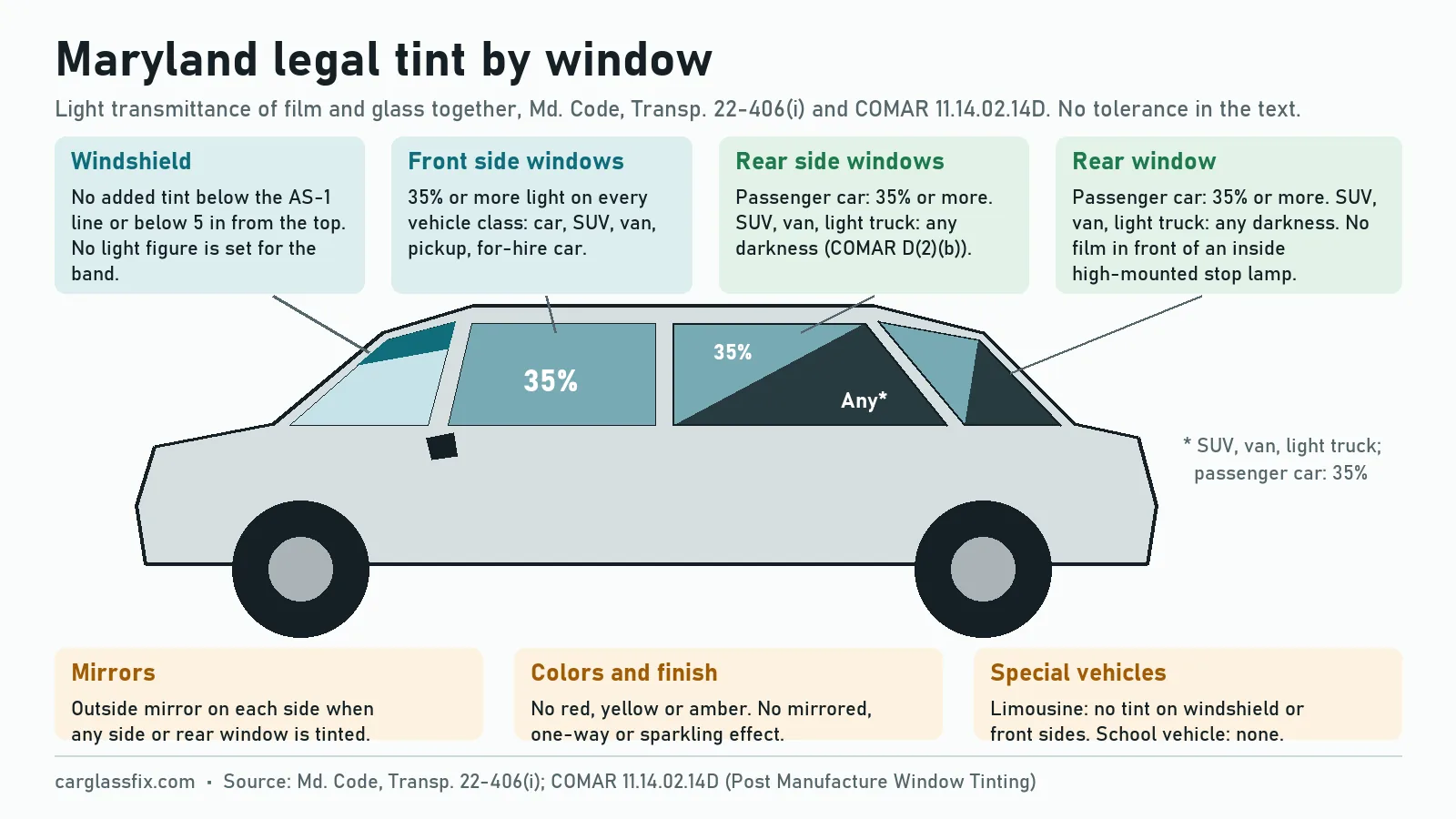
COMAR puts the same split in plainer words. For “light trucks, vans, and multipurpose passenger vehicles”, the windows “to the rear of the driver may be tinted with post manufacture window tint to any degree of darkness”, as long as the vehicle has “an outside rearview mirror on each side”. Most SUVs and minivans register as Class M in Maryland, so their rear doors and back glass can take privacy-level film. The statute names only 13-917 for trucks, so ask the State Police before tinting a heavier pickup. COMAR adds two special cases: a limousine may carry no tint on the windshield or the front side windows, and a school vehicle none at all. To compare 35% with darker shades, use the window tint percentage chart.
Windshield tint in Maryland: the AS-1 line or 5 inches
Maryland allows added windshield tint only in a band at the top, never “below the AS1 line or below 5 inches from the top of the windshield”. The statute states that boundary inside the medical subsection, 22-406(i)(4)(iv), so even an exemption cannot move it. COMAR 11.14.02.14D(2) repeats it for every vehicle class and adds “whichever is less”. The texts set no light transmittance figure for the band, so the only windshield test is position. The AS-1 mark is etched near the top corners of the glass; see what the AS-1 line on a windshield is to find it.
The finish and color rules apply to every window. COMAR D(1) rejects any tint that “Has a mirrored or one-way vision effect or a sparkling effect”, that “Is red, yellow, or amber in color”, or that changes to one of those colors. Blue is not on the list. Two more COMAR items apply: no film may cover the rear window area “in front of the high mounted stop lamp” when the lamp sits inside the car, and a tint maker’s label may not block the driver’s view or hide the glass AS mark. Other states’ windshield rules are compared in is it illegal to have tint on a windshield.
Maryland medical exemption for window tint
A Maryland owner with a medical need can run darker tint on the side and rear windows by keeping a physician’s written certification in the vehicle. Section 22-406(i)(4) requires the paper to be “in the vehicle at the time the vehicle is stopped by a police officer”, in “the manner and format required by the Automotive Safety Enforcement Division of the Department of State Police”, and signed by “a physician licensed to practice medicine in the State”. House Bill 436 of 2025 (chapter 452, effective October 1, 2025) changed the validity period: the certification lasts as long as the physician determines, “not to exceed 2 years”, or “indefinitely” when the physician finds the condition permanent.
How to get a Maryland window tint medical exemption
Download form ASED 23-04B
The State Police “Physician’s Written Certification of Necessity for Medical Exemption” is a one-page PDF on the ASED Safety Equipment Repair Order page.
Fill in the owner section
Vehicle year, make, model, plate and VIN, plus the owner’s name, license soundex number, address and county. The exemption is non-transferable and names the owner only.
Have a Maryland-licensed physician complete the medical section
The physician writes the clinical diagnosis, sets the time period (up to two years) or ticks the permanent box, and signs under penalty of perjury.
Keep the original in the vehicle
The form says the original “Must be kept in vehicle at all times”. The car may be driven without the named person aboard as long as the paper is inside.
Show it at inspection if asked
A station that sees darker tint refers the owner to ASED, which checks the papers and the film, then issues an exemption form to the station or certifies the repair order.
The exemption covers the regulated side and rear windows only. It does not allow windshield tint below the AS-1 line or 5 inches, and it does not lift the color or reflectivity bans. Easily removable sun shades used “to protect a child less than 10 years of age” fall outside the tint rule without any form. The ASED form, revised October 2025, lists “physician or optometrist” as signers, while the statute names a physician; follow the statute wording if in doubt.
Safety Equipment Repair Order (SERO) for tint: 10 days and 30 days
A Maryland tint stop can end with two papers: a citation and a Safety Equipment Repair Order, or SERO. Section 22-406(i)(2) says an officer who “observes” a violation “may stop the driver” and, “in addition to a citation”, issue a repair order under 23-105. That wording makes tint a reason for the stop itself, contrary to the “secondary offense” claim on Reddit. The SERO lists tint as defect 61, light “less than 35%” through the glass.
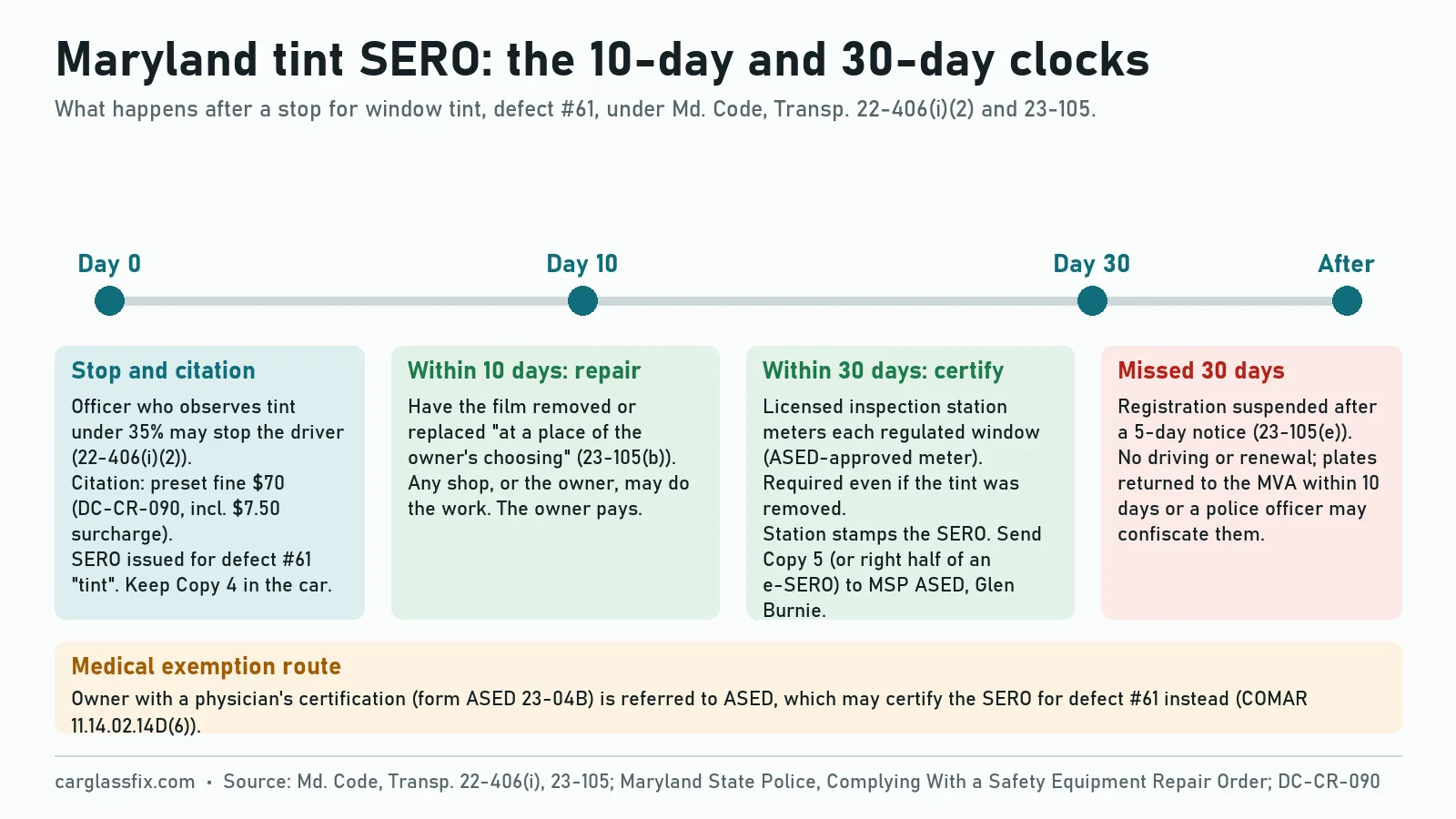
Section 23-105(b) gives the owner 10 days from issuance to have the equipment “corrected as necessary”, then a repair order certification goes to the Division. The State Police set the second clock: the certified copy must reach ASED “no later than 30 days after the date on which the SERO was issued”. Tint is not a visual defect, so a trooper cannot sign it off; “All window tint repairs must be certified at a licensed inspection station, even if the tint has been removed.” The owner sends the stamped Copy 5, or the right half of an electronic SERO, to ASED in Glen Burnie and keeps Copy 4 in the car. Missing the 30 days means a registration suspension after a 5-day notice.
How much is a tint ticket in Maryland
A Maryland tint citation carries a preset fine of $70 under the District Court schedule that took effect October 1, 2026. The Schedule of Preset Motor Vehicle Fines lists 22-406(i)(1), “Operating veh. on hwy. with unauthorized window tinting material”, at $70.00, and 22-406(i)(3), installing non-compliant film, at the same $70.00. Every amount in the schedule includes “a Special Funds surcharge of $7.50”, and the point columns beside both entries read zero. The ceiling behind the preset amount is 27-101(b), which makes a Vehicle Law violation a misdemeanor with “a fine not exceeding $500”.
The fine is the smaller cost in most cases. The SERO forces removal or replacement of the film, an inspection station visit, and the risk of a suspended registration. Sites that quote a fine that “varies by county” describe older schedules; the current one is statewide. The same list fines the installer under (i)(3), so a shop that applies 20% film to a sedan’s rear doors is exposed as well. A reading with a window tint meter on the finished window shows whether the car would pass defect 61, and how to measure window tint explains the glass-times-film math behind a 35% result.
Tint at the Maryland state inspection
Maryland checks tint at the state safety inspection, which happens before a used vehicle is sold or registered rather than every year. COMAR 11.14.02.14D tells the mechanic to inspect “all glazing for the application of post manufacture window tint” and to meter each regulated window. Bulletin ASED-015, dated March 7, 2023, approves five meters: the Advanced Tint Meter, the Pocket Detective, the Laser Labs 400 and Inspector II, and the Tint-Chek Pro. Readings go on form MSP ASED 23-04, which also certifies a tint SERO.
A car that fails only on tint can be fixed and re-inspected by the same mechanic; a re-inspection within 30 days and under 1,000 miles covers only the failed items. An owner who claims a medical exemption at the station is referred to ASED under COMAR D(6). Three claims on older pages do not match the texts: no 3% tolerance exists in 22-406 or COMAR, no film maker certification or installer sticker is required, and the fine is statewide. Preview a legal shade with the window tint simulator, and compare other states in what car window tint is legal. Rules change; check the current 22-406, COMAR 11.14.02.14 and the State Police ASED pages before you tint. This article is general information, not legal advice.
Frequently asked questions
Is 25% tint illegal in Maryland?
Yes on any window of a passenger car and on the front side windows of every vehicle, because the finished window must pass at least 35% light. A 25% film is legal only on the windows behind the driver of an SUV, van or light truck that has an outside mirror on each side.
Is 35 or 20 tint darker?
A 20% tint is darker, since it lets through 20% of visible light against 35% for the lighter film. Maryland’s limit is 35% with film and glass together, so a 20% film fails on every regulated window; the window tint percentage chart shows the two side by side.
How do I get a tint exemption in Maryland?
Have a physician licensed in Maryland complete State Police form ASED 23-04B, which states your diagnosis and the period of need, then keep the original in the vehicle. There is no fee listed on the form, and since October 1, 2025 a permanent condition can carry an exemption with no expiry.
Is tint a secondary offense in Maryland?
No. Section 22-406(i)(2) says an officer who observes the violation “may stop the driver” and issue a citation together with a Safety Equipment Repair Order, so the tint itself is enough for the stop.
Can an SUV have 5% tint in Maryland?
Only on the windows behind the driver. COMAR lets light trucks, vans and multipurpose vehicles tint those windows “to any degree of darkness” with outside mirrors on both sides; the front side windows must still pass 35%.
Sources
- Maryland Code, Transportation 22-406, Safety Glazing (subsection (i), window tinting) (checked 29 October 2026)
- 2025 Laws of Maryland, Chapter 452 (House Bill 436): Medical Exemption for Enhanced Tinted Windows, Repeal of Time Limitation (effective 1 October 2025; checked 29 October 2026)
- Maryland Code, Transportation 23-105, Safety Equipment Repair Orders and 27-101, Penalties (checked 29 October 2026)
- Maryland Code, Transportation 13-912 (Class A), 13-913 (Class B), 13-917 (light Class E trucks) and 13-937 (Class M) (checked 29 October 2026)
- COMAR 11.14.02.14, Vehicle Glazing (section D, Post Manufacture Window Tinting) (Cornell LII copy; checked 29 October 2026)
- Maryland State Police: Complying With a Safety Equipment Repair Order (checked 29 October 2026)
- Maryland State Police form ASED 23-04B: Physician’s Written Certification of Necessity for Medical Exemption, Maryland Window Tint Limitations (revision 10-25; checked 29 October 2026)
- Maryland State Police Bulletin ASED-015: Approved Window Tint Meters for Vehicle Safety Inspections (7 March 2023) and form MSP ASED 23-04: Post Manufacture Window Tint Inspection Report
- Maryland State Police: Vehicle Inspections (checked 29 October 2026)
- District Court of Maryland: Schedule of Preset Motor Vehicle Fines (DC-CR-090) (effective 1 October 2026; checked 29 October 2026)

Similar Posts