Tennessee Window Tint Laws: The 35% Rule by Window
Senior Automotive Glass Diagnostic Specialist & Master Technician at CarGlassFix · AGSC Master Certified Auto Glass Technician, NGA Certified Installer, I-CAR Automotive Safety Specialist · 12+ Years in Automotive Glazing, Windshield Structural Bonding, ADAS Camera Calibration & Precision Chip Restoration
Tennessee window tint laws set one darkness limit: film on any window must have a visible light transmittance of at least 35%, and that limit applies to the front door windows of every vehicle. The windshield may not drop below 70% except for the factory shade band. A violation is a Class C misdemeanor under Tenn. Code Ann. 55-9-107.
Tennessee window tint limits by window
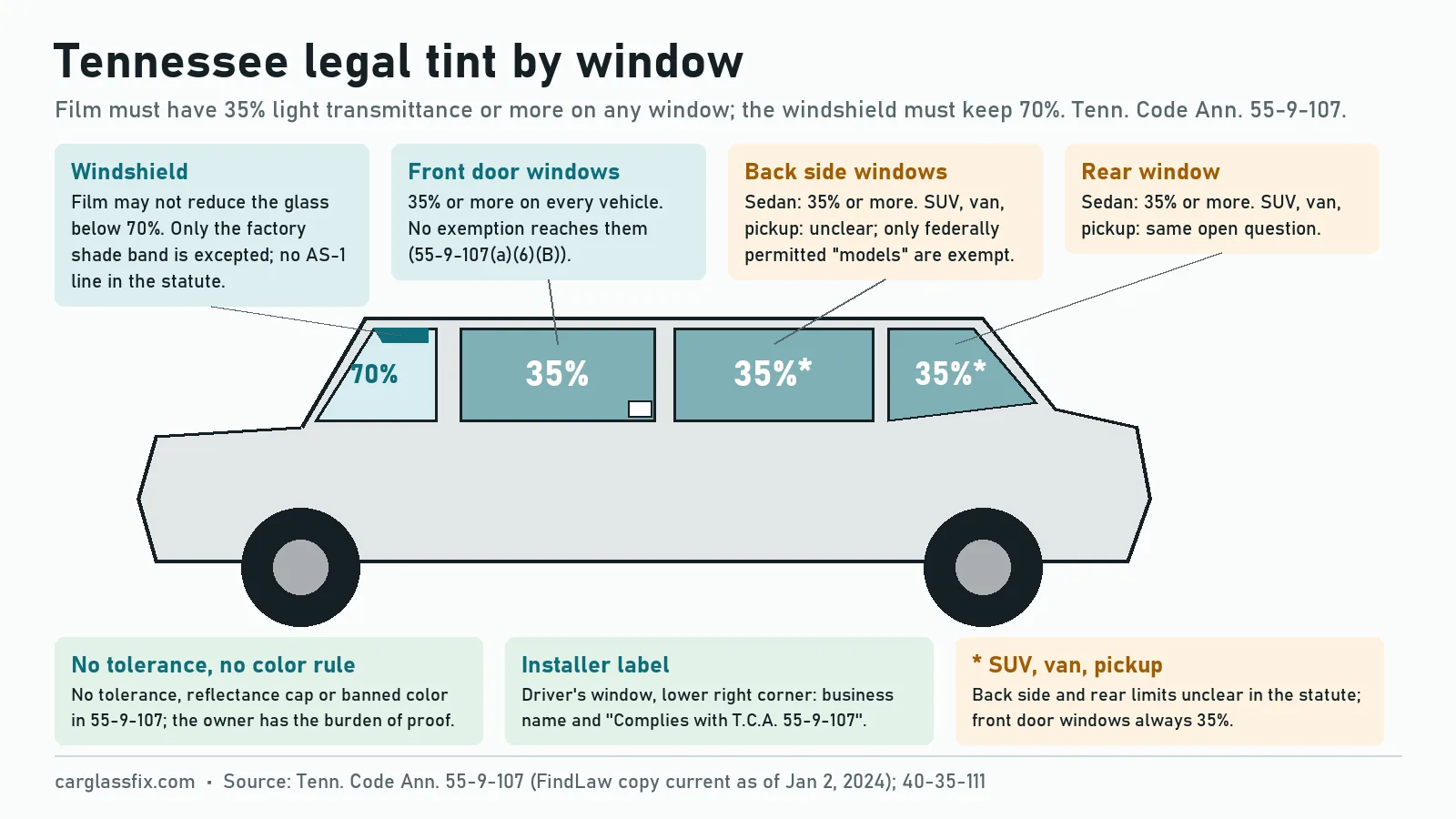
Tennessee allows 35% as the darkest legal tint on every window other than the windshield, and the same number applies to sedans and to SUVs unless a federal exemption covers a specific window. The rule is Tennessee Code Annotated 55-9-107, read on FindLaw’s copy of the code current as of January 2, 2024. Subsection (a)(1) makes it unlawful to drive a vehicle whose windows were altered with “any material that: (A) Has a visible light transmittance of less than thirty-five percent (35%)”. The same subsection adds the windshield rule at (B). Unlike Texas or Florida, Tennessee writes no separate line for front side, back side and rear windows. One number covers them all. The table below shows the limits as the statute states them, with the SUV column marked where the text is silent.
| Window | Sedan | SUV, van, pickup |
|---|---|---|
| Windshield | Film may not reduce the windshield below 70% light transmittance; the manufacturer’s standard shade band is the only exception | Same |
| Front door windows | Film of 35% light transmittance or more | Same; (a)(6)(B) says no exemption reaches the front door windows “of any motor vehicle of any kind” |
| Back side windows | 35% or more | 35% unless the vehicle model is “permitted by federal regulations” to have those windows darker (a)(6)(A)(i); the statute does not name SUVs |
| Rear window | 35% or more | Same as back side windows: unclear in the statute |
| Measured as | The 35% is written for the “material”; the 70% is the windshield’s resulting transmittance | Same |
| Reflectance, colors, tolerance | None stated in 55-9-107 | Same |
How the 35% rule is measured and checked
Tennessee writes the 35% limit for the film itself, and it leaves the roadside test method to the commissioner of safety. Subsection (a)(1) targets “any material” with a transmittance under 35%, and subsection (e) says the commissioner “shall establish a standardized method and procedure” for a field comparison test. We read every Department of Safety rule chapter listed by the Secretary of State and found no published tint procedure, no meter specification and no tolerance.
In practice a trooper reads the finished window with a meter, so a film sold as 35% on factory glass that already blocks some light can read lower. Our how to measure window tint guide explains the glass-times-film math, and the window tint meter page shows what the officer’s device reports. Two parts of the statute matter at a stop. Subsection (c) gives a POST-certified officer probable cause to detain a vehicle on “a reasonable belief” that the tint breaks the rule, and subsection (a)(5) puts “the burden of proof” on the owner to show the vehicle complies. Many shop pages mention a 3% meter allowance. The statute contains no tolerance, and we found no state rule or police page that grants one, so treat 35% as the floor.
Windshield tint in Tennessee: 70% and the factory shade band
A Tennessee windshield may carry film only if the glass still passes at least 70% of visible light, and the sole exception is “the manufacturer’s standard installed shade band”. That is the full windshield rule in 55-9-107(a)(1)(B). The statute never mentions an AS-1 line, a five-inch strip or an eyebrow. Pages that give Tennessee a strip “above the AS-1 line” or “the top five inches” are importing wording from other states. The shade band the statute excepts is the tinted strip the glass maker builds into the windshield, not a strip an installer adds.
Two readings follow from the text. A clear or very light film can be legal if the windshield still reads 70% or more afterward, because the rule limits the result, not the film. Any film that reads under 35% on its own also fails (a)(1)(A), which covers “any window”. The state’s own help center adds a limit on the medical route: the Driver Improvement office says it “CANNOT exempt the windshield”. For the picture across other states, see is it illegal to have tint on a windshield.
SUVs, vans and pickups: what the Tennessee statute does not say
Tennessee’s statute never names SUVs, vans or pickups, so the back side and rear window limits for those vehicles are unclear in the text. The only body-style exemption is 55-9-107(a)(6)(A)(i), which lifts the 35% rule for “any motor vehicle model permitted by federal regulations to be equipped with certain windows tinted” darker, and only “with respect to those certain windows”. Federal glazing standard FMVSS 205 lets automakers fit dark privacy glass behind the driver on many SUVs and vans, which is why that factory glass is legal in Tennessee.
Whether aftermarket film on those same windows is covered is the open question. Tint shops and some officers read (a)(6)(A)(i) as “any darkness behind the driver on an SUV”, and posts from Tennessee shops repeat it. Other shops, and the aggregator pages they copy, say 35% on every window of every vehicle. The statute supports neither reading cleanly: it exempts a “model” and “certain windows”, not a vehicle class. What is clear is (a)(6)(B): no exemption reaches “the front door windows of any motor vehicle of any kind”. Our North Carolina window tint laws page shows a neighboring statute with a named vehicle exemption, which Tennessee lacks. If you want film behind the driver on an SUV, keep the installer’s receipt and ask the shop which reading it relies on.
What tint websites get wrong about Tennessee
Most pages ranking for Tennessee tint law add rules the statute does not contain. We compared the top Google and Bing results, and Bing’s Copilot answer, against the text of 55-9-107 on October 29, 2026. Five claims appear again and again, and none has a source in the statute.
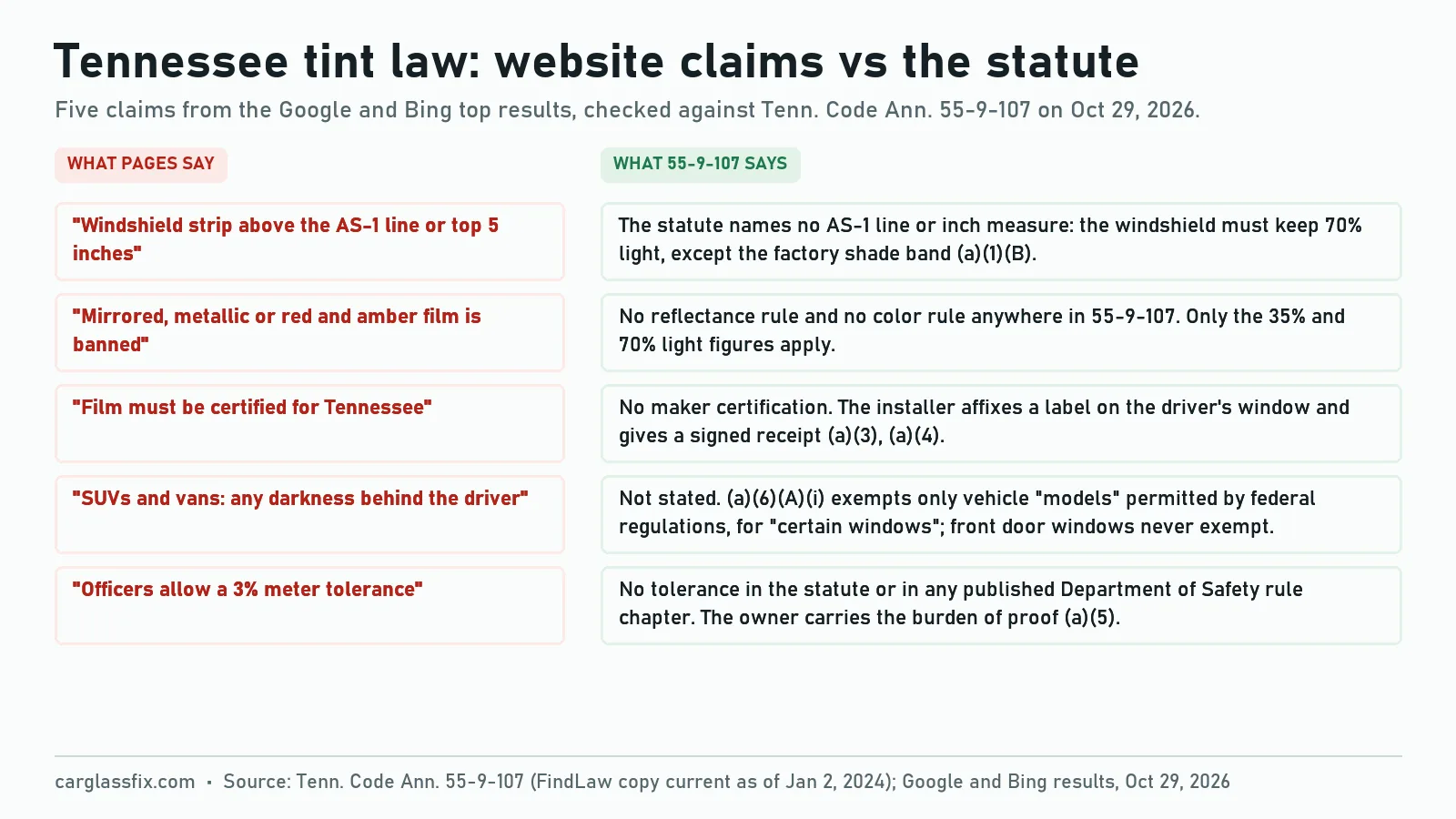
The AS-1 line claim comes from states such as Texas and Virginia, whose statutes name it. The “no mirrored or metallic film” claim and the “no red or amber” claim come from aggregator tables that fill every state’s row; Tennessee’s text has no reflectance or color rule, as recordinglaw.com also notes. The “film must be certified for Tennessee” claim confuses the installer’s label with a maker’s certification. Some pages date the law to 1990; the FindLaw copy shows no history line, so we do not repeat the year. One law-firm snippet put a ticket at “$100 to $230”; the statute caps the fine at $50, and anything above that would be court costs the statute does not set. The window tint percentage chart shows what each legal shade looks like.
Tennessee medical exemption for window tint
Tennessee grants a medical tint exemption through the Department of Safety and Homeland Security, and the proof is a state decal and certificate, not a doctor’s letter kept in the car. Subsection (b)(1) of 55-9-107 covers “a medical condition that is adversely affected by ultraviolet light”. The physician’s statement goes to the commissioner, who sends it to the department’s medical review board. If the board finds the exemption warranted, it recommends “the degree of tinting exemption”, and the commissioner issues “a certificate or decal, indicating the degree of exemption” for display in the vehicle.
How to apply for a Tennessee medical window tint exemption
Get a physician’s statement
The statute requires a statement from the applicant’s physician certifying a condition that needs light transmission below the 35% standard.
Email the Driver Improvement office
The state help center says to send the request to Driver.Improvement@tn.gov with the doctor’s note, a copy of the registration and the driver license number.
Wait for the medical review board
The board evaluates the statement and recommends the degree of exemption; the help center says processing takes about 3 to 4 weeks.
Display the decal and certificate
The applicant receives a decal and a certificate signed by the commissioner and must display it in the vehicle (55-9-107(b)(1)).
The help center states that the department cannot exempt the windshield. An applicant refused by the board or the commissioner may appeal under the Uniform Administrative Procedures Act, including to the chancery court of the county where the applicant lives (55-9-107(b)(2)).
Penalties, the installer’s label and who is exempt
Breaking Tennessee’s tint law is a Class C misdemeanor, the lowest criminal class in the state. Subsection (d) of 55-9-107 covers anyone who violates “any provisions of this section”, and refusing the field comparison test is a separate Class C misdemeanor. Tennessee Code Annotated 40-35-111(e)(3) sets the range: “not greater than thirty (30) days or a fine not to exceed fifty dollars ($50.00), or both”. Court costs vary by county. Enforcement happens at traffic stops.
Anyone who tints “for profit, barter, or wages or commissions” is a professional installer and may not apply film that puts a vehicle in violation. The installer must affix “to the lower right corner of the driver’s window an adhesive label” with the business name and the legend “Complies with Tennessee Code Annotated, § 55-9-107”, and must give a signed receipt, kept “with motor vehicle registration documents”. Exempt vehicles are law enforcement vehicles on commercial or government plates (windows behind the front doors), vehicles “registered in another state” that meet that state’s rules, and licensed private investigators’ vehicles. Try the window tint simulator first, and compare states in what car window tint is legal.
Rules change; the code copy we read is current as of January 2, 2024. Check the current 55-9-107 before you tint. This is not legal advice.
Frequently asked questions
What is the legal tint limit in Tennessee?
Film on any window must have a visible light transmittance of at least 35%, and the windshield must keep at least 70% except for the factory shade band (Tenn. Code Ann. 55-9-107(a)(1)). The 35% rule always applies to the front door windows.
Is 20% tint legal in Tennessee?
No on the front door windows and, for a sedan, on every other window, because the statute bans film under 35%. On the rear windows of an SUV the statute is unclear, since it exempts only vehicle models “permitted by federal regulations” to have certain windows darker.
Can you tint your front windshield in Tennessee?
Only if the windshield still passes at least 70% of visible light afterward; the manufacturer’s shade band is the one exception. The state’s Driver Improvement office says it cannot grant a medical exemption for the windshield.
How do police check tint in Tennessee?
A POST-certified officer may stop a vehicle on a reasonable belief that the tint is too dark and run a field comparison test with a meter. Refusing the test is a Class C misdemeanor, and the owner has the burden of proving the vehicle complies. The window tint meter page explains the reading.
How much is a tint ticket in Tennessee?
The statute makes the offense a Class C misdemeanor, which carries up to 30 days or a fine of up to $50, or both (40-35-111(e)(3)). Court costs are added by the county court and are not set in the tint statute.
Sources
- Tennessee Code Annotated 55-9-107, Tinted motor vehicle windows (FindLaw, current as of January 2, 2024) (checked 29 October 2026)
- Tennessee Code Annotated 40-35-111, Authorized terms of imprisonment and fines (FindLaw) (checked 29 October 2026)
- Tennessee Department of Safety and Homeland Security: How do I obtain a window tint exemption? (checked 29 October 2026)
- Tennessee Secretary of State: Rules of the Department of Safety and Homeland Security, chapter index (checked 29 October 2026; no tint rule found)
- 49 CFR 571.205, FMVSS 205 Glazing materials (Cornell LII)
- Recording Law: Tennessee Window Tint Laws (secondary; read 29 October 2026 for the SERP comparison)

Similar Posts