Michigan Window Tint Laws: No Front Film, Any Rear Shade
Senior Automotive Glass Diagnostic Specialist & Master Technician at CarGlassFix · AGSC Master Certified Auto Glass Technician, NGA Certified Installer, I-CAR Automotive Safety Specialist · 12+ Years in Automotive Glazing, Windshield Structural Bonding, ADAS Camera Calibration & Precision Chip Restoration
Michigan window tint laws allow no film on the windshield or the front side windows, except a tinted strip in the top 4 inches. Side windows behind the driver and the rear window may be any darkness, but their total solar reflectance must stay below 35%. The rule is MCL 257.709, and it sets no legal percentage.
Michigan window tint limits by window
Michigan allows aftermarket tint on the windows behind the driver and bans it on the windshield and the front side windows, apart from a strip in the top 4 inches. The rule is section 709 of the Michigan Vehicle Code, MCL 257.709, last amended by 2010 PA 258. The section first lists what a driver may not operate a vehicle with, then lists the exceptions. It names no vehicle classes, so sedans, SUVs, vans and pickups follow the same rules, and the table below repeats one answer in both columns. The statute also sets no light-transmittance percentage for any window. A vehicle registered in another state, territory, country or province is exempt under 257.709(3)(d), so a visitor’s car follows its home-state rule while in Michigan.
| Window | Sedan | SUV, van, pickup |
|---|---|---|
| Windshield | Tinted strip only, not more than 4 in from the top of the windshield or lower than the shade band, whichever is closer to the top | Same |
| Front side windows and sidewings | No film at any darkness below the same 4 in strip | Same |
| Side windows behind the driver | Any darkness; total solar reflectance under 35% | Same |
| Rear window | Any darkness; reflectance under 35%; two outside mirrors if the view through it is obstructed | Same |
| Legal percentage | None in the statute | None |
| Colors | No color ban; silver or gold reflective film is named in the 35% reflectance rule | Same |
Michigan is one of the strictest states for the front doors and one of the loosest for the back. To see how it compares with states that use percentages, read what car window tint is legal.
Why Michigan has no legal tint percentage
Michigan sets no visible light transmission (VLT) percentage for any window. For the windshield and the front side windows, 257.709(1)(a) bans a “sign, poster, nontransparent material, window application, reflective film, or nonreflective film” outright. A 70% film and a 5% film are equally illegal there, because the ban is on the film, not on its shade. Behind the driver, 257.709(3)(b) exempts “nonreflective, smoked or tinted glass, nonreflective film, perforated window screen, or other decorative window application”, so no darkness limit applies.
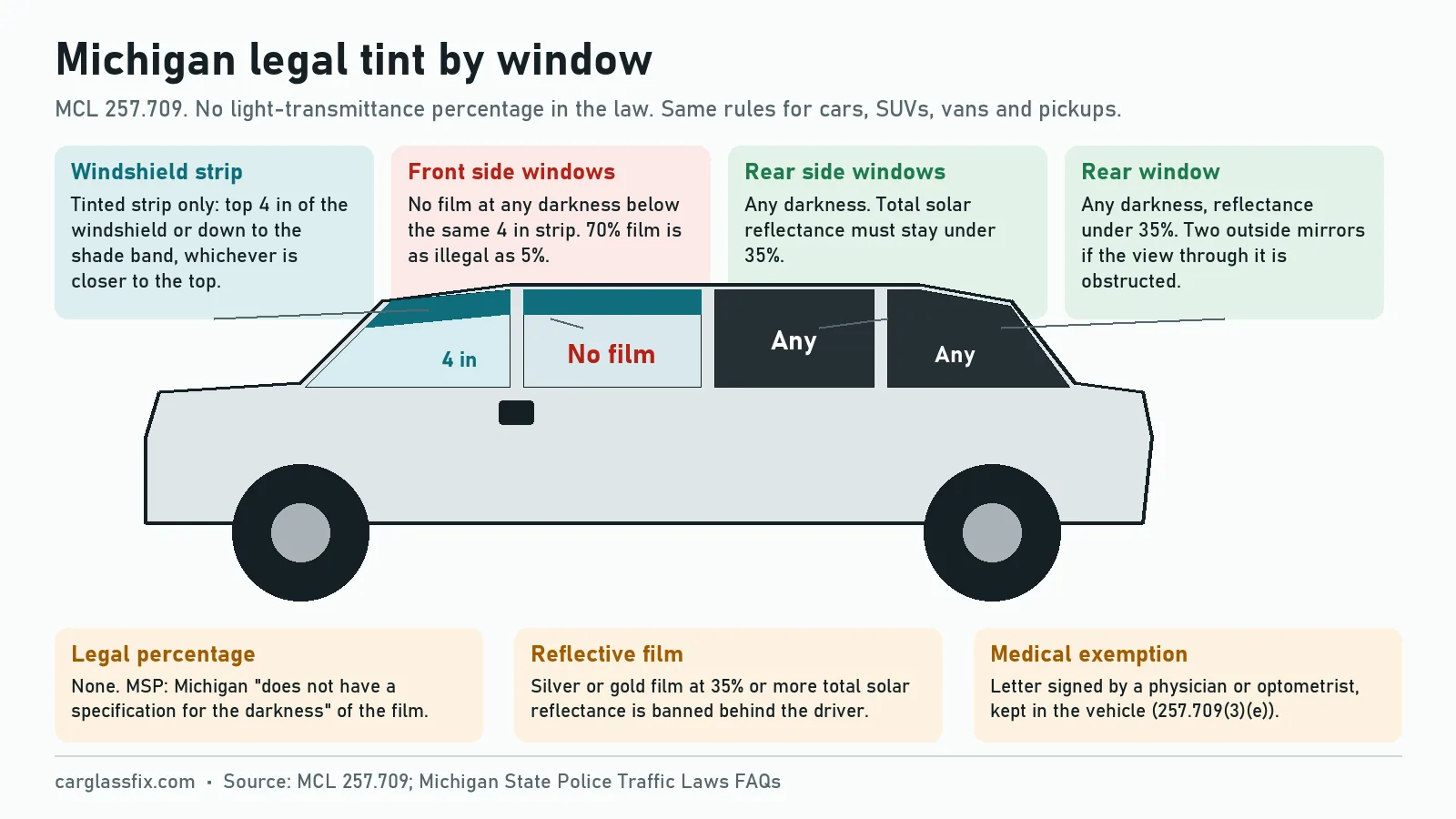
The 35% figure that appears on many Michigan tint pages is not a darkness limit. It comes from 257.709(1)(b), which bans rear and rear side glass with “a total solar reflectance of 35% or more in the visible light range, including a silver or gold reflective film”. The Michigan State Police puts it plainly in its Traffic Laws FAQs: Michigan “does not have a specification for the darkness of the window application”. The window tint percentage chart explains what VLT numbers mean in states that use them, and how to measure window tint shows how a meter reads film and glass together. In Michigan, a meter reading on a front side window settles nothing; the question is whether film is present below the strip.
The 4-inch strip, reflectance and mirror rules
The only tint allowed on the windshield and the front side windows is a strip along the top edge that stops 4 inches from the top of the windshield or at the shade band, whichever is closer to the top. The statute applies one measure to the windshield, the side windows and the sidewings “immediately adjacent to the driver or front passenger”. The 4 inches are measured from the top of the windshield, so the side window strip is measured against the windshield’s top line, not the top of the door glass. If the factory shade band ends above the 4-inch line, the band sets the limit. Michigan does not use the AS-1 line; see is it illegal to have tint on a windshield for the state-by-state windshield rules.
Behind the driver, the limit is reflectance. Film that creates a total solar reflectance of 35% or more is banned, and the statute names “silver or gold reflective film” as examples. Under 257.709(2), a driver whose view through the rear window is obstructed must have “2 rearview mirrors, 1 on each side”. Under 257.709(3)(a), draperies, louvers and other special window treatments on the rear glass are allowed only with two outside mirrors. Factory privacy glass is “smoked or tinted glass” under (3)(b), not a window application.
Michigan medical exemption for window tint
Michigan’s medical exemption is a letter, not a permit. Under 257.709(3)(e), the section does not apply to a “special window treatment or application determined necessary by a physician or optometrist, for the protection of a person who is light sensitive or photosensitive”, as long as the owner or operator “has in possession a letter signed by a physician or optometrist” stating that the treatment is a medical necessity. The statute sets no darkness limit for the exempt film and no expiry date, but the treatment “shall not interfere with or obstruct the driver’s clear vision”. Section 709(7) defines physician and optometrist by reference to the Public Health Code, so an MD, a DO or an optometrist can sign. The Michigan State Police says the exception allows tint on the front side windows, and that another person may drive the vehicle as long as the letter is in it.
How to use the Michigan medical exemption for window tint
See a physician or optometrist
Only these two professions, as defined in the Public Health Code, can determine that the window treatment is necessary for a light-sensitive or photosensitive person (257.709(3)(e) and (7)).
Get a signed letter
The letter must say that the special window treatment or application is a medical necessity. No state form exists and no agency issues a certificate.
Keep the letter in the vehicle
The owner or operator must have it “in possession” while driving; MSP says this covers other drivers of the same vehicle.
Keep the driver’s view clear
The treatment must not obstruct the driver’s clear vision of the highway, so an officer can still cite a windshield film that blocks the view.
Local enforcement watches this exemption. WDIV reported in August 2025 that Dearborn had sent local optometrists a letter urging them to limit tint exemptions and warning of consequences for fraud.
What older Michigan tint pages get wrong
Most Michigan tint pages that give a percentage are wrong, because the statute gives none. The common claims are a 35% VLT minimum for the front side windows, tint “above the AS-1 line” on the windshield, two license points per ticket, and fines of $95 or $115. None of these appears in MCL 257.709, 257.907 or 257.320a. The law has not changed since 2010 PA 258 took effect on December 14, 2010, so a page dated 2026 describes the same text as one from 2011.
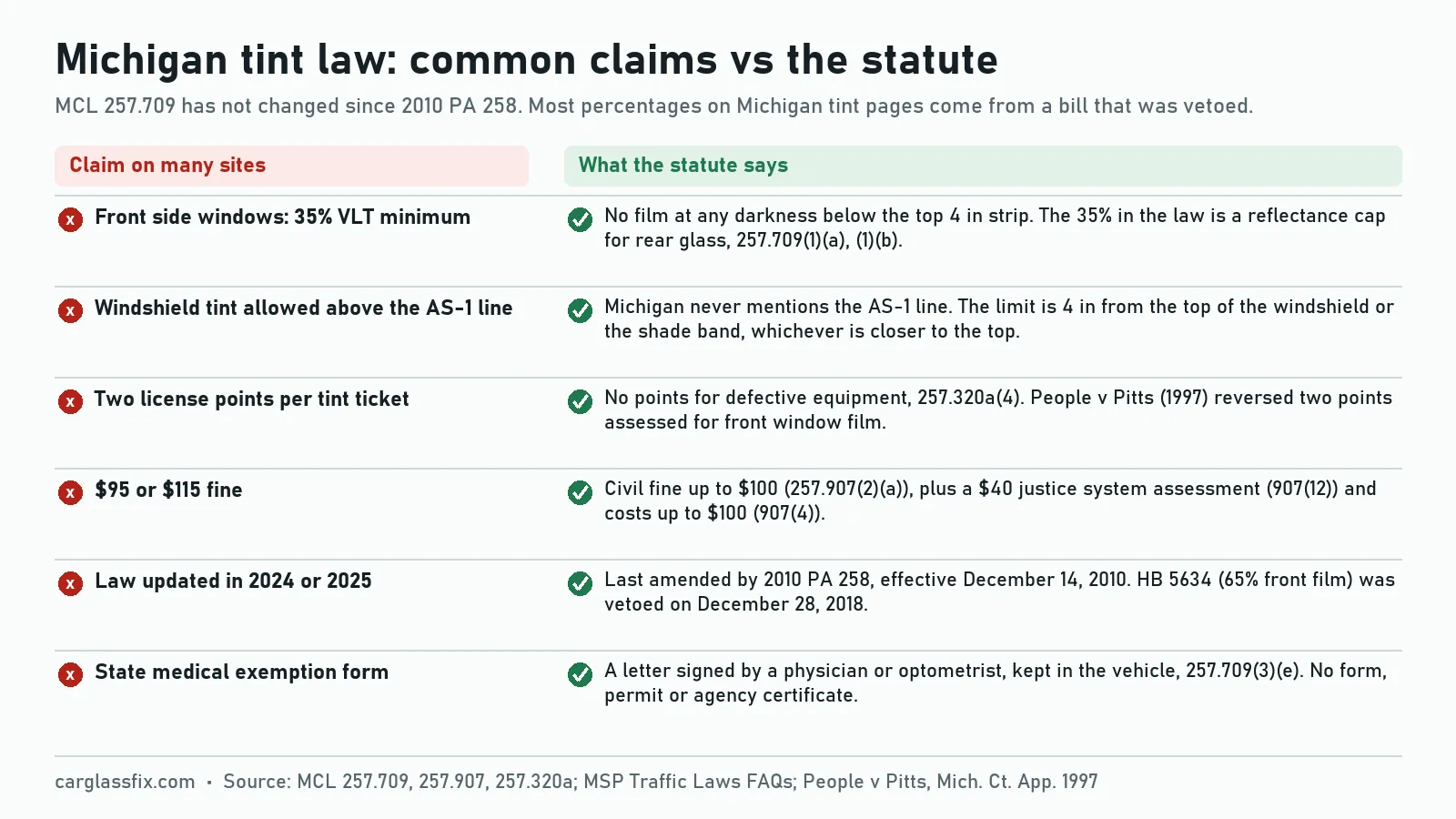
Many percentage pages echo a bill that never became law. House Bill 5634 of 2018 would have allowed film with 65% or more light transmittance on the front side windows. The House passed it 72 to 36 on December 11, 2018, the Senate passed it 20 to 18 on December 18, and Governor Rick Snyder vetoed it on December 28, 2018. The same sponsor filed House Bill 5100 in October 2019; it left the Transportation Committee on November 5, 2019 and died in Ways and Means. Research for this page found no 2025 or 2026 bill amending section 709. Neighboring Ohio does set percentages; see Ohio window tint laws.
How much is a tint ticket in Michigan
A Michigan tint ticket is a civil infraction with a fine of up to $100, plus a $40 justice system assessment and court costs of up to $100. MCL 257.683(6) makes a violation of sections 683 to 711 “with respect to equipment on vehicles” a civil infraction, and MCL 257.907(2)(a) sets the general civil fine at “not more than $100.00”. Section 907(12) adds a “justice system assessment of $40.00 for each civil infraction determination”, and 907(4) caps costs at $100.
No license points follow. MCL 257.320a(4) says points must not be entered “for defective equipment”, and in People v Pitts (1997) the Court of Appeals reversed two points assessed for front side window film, holding that “tinted windows are equipment violations for which no points may be assessed”. One waiver is narrow: 257.907(9) makes a court waive the fine, costs and assessments for a defective safety equipment citation “under section 683” when a law enforcement agency certifies the repair was made before the appearance date. Whether a court applies it to a section 709 citation depends on the court. Preview shades for the back glass with the window tint simulator. Rules change; check the current MCL 257.709 or the Michigan State Police FAQ before you tint. This is general information, not legal advice.
Frequently asked questions
Is 35% tint legal in Michigan?
On the side windows behind the driver and the rear window, yes, because Michigan sets no darkness limit there. On the front side windows, no film of any shade is legal below the top 4 inches, so 35% film is as illegal as 5% film. The 35% in the statute is a reflectance cap for rear glass, not a VLT minimum.
What are the window tint laws in Michigan for 2026?
The same as since 2010: MCL 257.709 was last amended by 2010 PA 258, and no 2025 or 2026 bill changing it was found. Front side windows and the windshield may carry only a tinted strip in the top 4 inches; windows behind the driver may be any darkness with reflectance under 35%.
Do you get points for a tint ticket in Michigan?
No. MCL 257.320a(4) bars points for defective equipment, and the Court of Appeals in People v Pitts (1997) reversed two points assessed for front window tint. The ticket is a civil infraction with a fine of up to $100, a $40 assessment and costs of up to $100.
Does Michigan have a medical exemption form for window tint?
No form exists. MCL 257.709(3)(e) requires only a letter signed by a physician or optometrist stating that the window treatment is a medical necessity, kept in the vehicle. The Michigan State Police confirms that no state agency issues a certificate.
Do Michigan police enforce the tint law?
Yes. Enforcement happens at traffic stops and varies by city. WILX reported in July 2025 that Dearborn police had issued about 850 tint tickets early that year, and WDIV reported the city had warned local optometrists about exemption fraud.
Sources
- Michigan Legislature: MCL 257.709, Windshields and windows; prohibitions; rearview mirrors; exceptions (history through 2010 PA 258; official page read through an archived copy of 8 February 2026, text matched the FindLaw copy current as of 1 January 2025, checked 29 October 2026)
- FindLaw: Michigan Compiled Laws 257.709 (current as of 1 January 2025, checked 29 October 2026)
- MCL 257.683, Equipment; civil infraction (subsection 6) (checked 29 October 2026)
- MCL 257.907, Civil infraction fines, costs and assessments (checked 29 October 2026)
- MCL 257.320a, Points (subsection 4, defective equipment) (checked 29 October 2026)
- Michigan State Police: Traffic Laws FAQs, Vehicle Equipment (tinted windows) (updated 22 September 2026, read 29 October 2026)
- People v Pitts, Michigan Court of Appeals, Docket No. 186260 (14 March 1997)
- MichiganVotes: 2018 House Bill 5634, history and votes and 2019 House Bill 5100 (checked 29 October 2026)
- WILX: Are your tinted windows legal? (29 July 2025)
- WDIV: How Dearborn is cracking down on tinted car windows (18 August 2025)

Similar Posts