Georgia Window Tint Laws: 28% Front, 15% Rear From 2026
Senior Automotive Glass Diagnostic Specialist & Master Technician at CarGlassFix · AGSC Master Certified Auto Glass Technician, NGA Certified Installer, I-CAR Automotive Safety Specialist · 12+ Years in Automotive Glazing, Windshield Structural Bonding, ADAS Camera Calibration & Precision Chip Restoration
In Georgia, front side windows must pass at least 28% of light with film and glass together, and a car’s rear window and rear side windows at least 15%, each with a 3% tolerance and 20% maximum reflectance. The windshield may carry only a transparent, non-red, non-amber item in its top 6 inches. These limits took effect July 1, 2026.
What changed in Georgia tint law on July 1, 2026
Georgia lowered its front side window limit from 32% to 28% and set a separate 15% limit for the windows behind the driver on July 1, 2026. The change is Section 3 of House Bill 1161, which the Governor signed on May 12, 2026 as Act 640. Before that date, O.C.G.A. 40-8-73.1 held every side window and the rear window to 32%, plus or minus 3%. The amended section sorts the glass into two groups. “Front side and door windows” are the windows “directly to the right and left of the driver”. “Rear side and door windows” are the side windows that are not. The tint change rode on a bill about traffic stops, so the bill title never mentions tint.
| Window | Before July 1, 2026 | From July 1, 2026 |
|---|---|---|
| Front side windows | 32%, plus or minus 3% | 28%, plus or minus 3% |
| Rear side windows (car) | 32%, plus or minus 3% | 15%, plus or minus 3% |
| Rear window (car) | 32%, plus or minus 3% | 15%, plus or minus 3% |
| Reflectance, all of the above | 20% max | 20% max |
Most dealer and tint shop pages in the search results still give 32%. A Bing AI answer read for this page gave 32% for the front and said the rear windows had no statewide minimum. The new figures are the same ones Florida uses; see tint laws in Florida.
Georgia tint limits by window, for cars and SUVs
Georgia allows 28% on the front side windows of every vehicle, 15% on the rear side windows and rear window of a car, and any darkness behind the driver on a multipurpose passenger vehicle. The statute defines a multipurpose passenger vehicle as one “designed to carry ten persons or less” that is built “on a truck chassis or with special features for occasional off-road operation” (40-8-73.1(a)(5)). That covers most SUVs, pickups and vans; a crossover on a car platform may not qualify. Subsection (c)(6) exempts “the rear windshield or the rear side or door windows” of those vehicles and keeps the windows “to the right and left of the driver” inside the 28% rule.
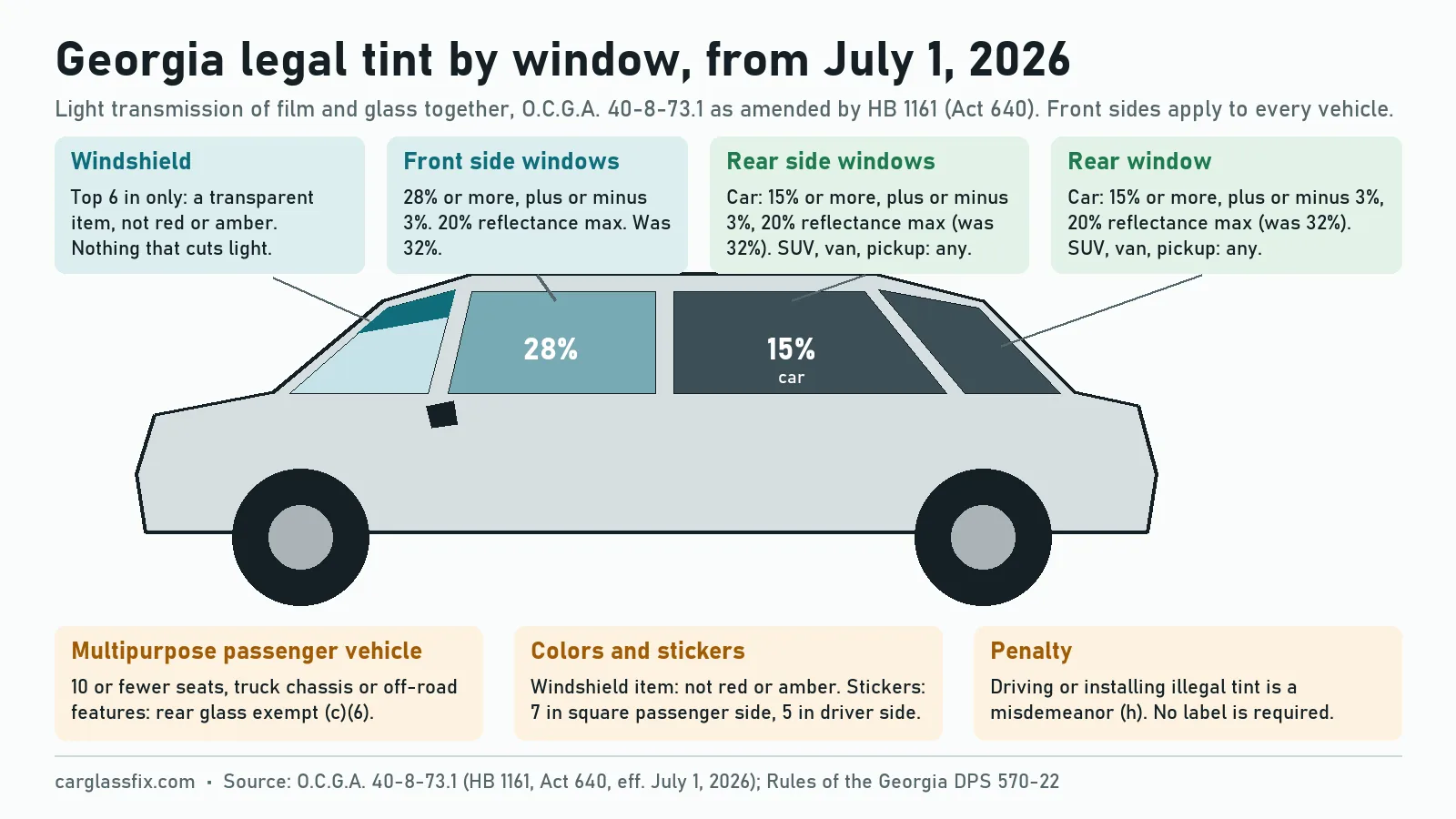
The same subsection exempts the rear glass of school buses, public buses, buses and vans of religious or nonprofit organizations, limousines, and any vehicle whose glass was “tinted or darkened before factory delivery or permitted by federal law or regulation”, which covers factory privacy glass. The window tint percentage chart shows how 28% and 15% look from outside.
| Window | Sedan | SUV, van, pickup |
|---|---|---|
| Windshield | No light-reducing material; a transparent item, not red or amber, in the top 6 in | Same |
| Front side windows | 28% or more, plus or minus 3%; 20% reflectance max | Same |
| Rear side windows | 15% or more, plus or minus 3%; 20% reflectance max | Any darkness (multipurpose vehicle) |
| Rear window | 15% or more, plus or minus 3%; 20% reflectance max | Any darkness (multipurpose vehicle) |
| Measured as | Film and glass together (“material and glazing”) | Same |
How Georgia measures tint: film plus glass, 3% tolerance, 20% reflectance
Georgia measures the film and the window glass together, so the legal number is the reading of the finished window, not the figure on the film box. The statute bars “material and glazing” that “when so applied or affixed” reduce light transmission below the limit. Factory glass already blocks some light. A film sold as 30% on glass that passes 80% of light reads about 24%, below the 28% front side limit. Our how to measure window tint guide shows the math, and the window tint simulator previews the result.
The tolerance is written into the limit itself: “28 percent, plus or minus 3 percent” for the front side windows and “15 percent, plus or minus 3 percent” for the rear glass, so a front side window may read down to 25% and a car’s rear glass to 12%. Reflectance is capped at 20% on every side window and the rear window, so mirror-finish films fail even when they pass enough light. A window tint meter reads the net figure an officer would see. Georgia has no installer label; DPS says labels were “no longer required” after the 2005 law. Rule 570-22-.05(3) instead makes the installer certify that the finished glass meets the statute.
Windshield tint in Georgia: the top 6 inches, no AS-1 line
Georgia bans any material on the windshield that reduces light transmission, with one exception for the top 6 inches. Subsection (b)(1) makes it unlawful to drive with “material and glazing applied or affixed to the front windshield” that “reduce light transmission through the windshield”. Subsection (c)(4) then allows “any transparent item which is not red or amber in color which is placed on the uppermost six inches of the windshield”. The statute never mentions the AS-1 line that many states use as the boundary; see the AS-1 line on a windshield for that mark.
DPS Rule 570-22-.05(1) says no material may be attached to the windshield “which increases light reflectance”, so a mirrored strip fails even inside the top 6 inches. A clear film below the band is barred too, because the statute names any material that reduces transmission. The medical exemption does not open the windshield: form DPS-431 states “Nothing herein shall allow tinting of a windshield”. Stickers follow subsection (c)(2): a 7-inch square in the lower corner farthest from the driver, or a 5-inch square in the corner nearest the driver. For other states, read is it illegal to have tint on a windshield.
Georgia medical exemption for window tint
Georgia’s medical tint exemption comes from the Department of Public Safety, lasts four years, and still caps the front side windows at 23%. Subsection (d) lets DPS issue an exemption “upon application from a person required for medical reasons to be shielded from the direct rays of the sun”, supported by “written attestation” from a licensed physician or a certified optometrist. It covers a vehicle the person owns or one “in which such person is a habitual passenger”. DPS Rule 570-22-.06 and form DPS-431 (Rev. 3/2026) set the conditions.
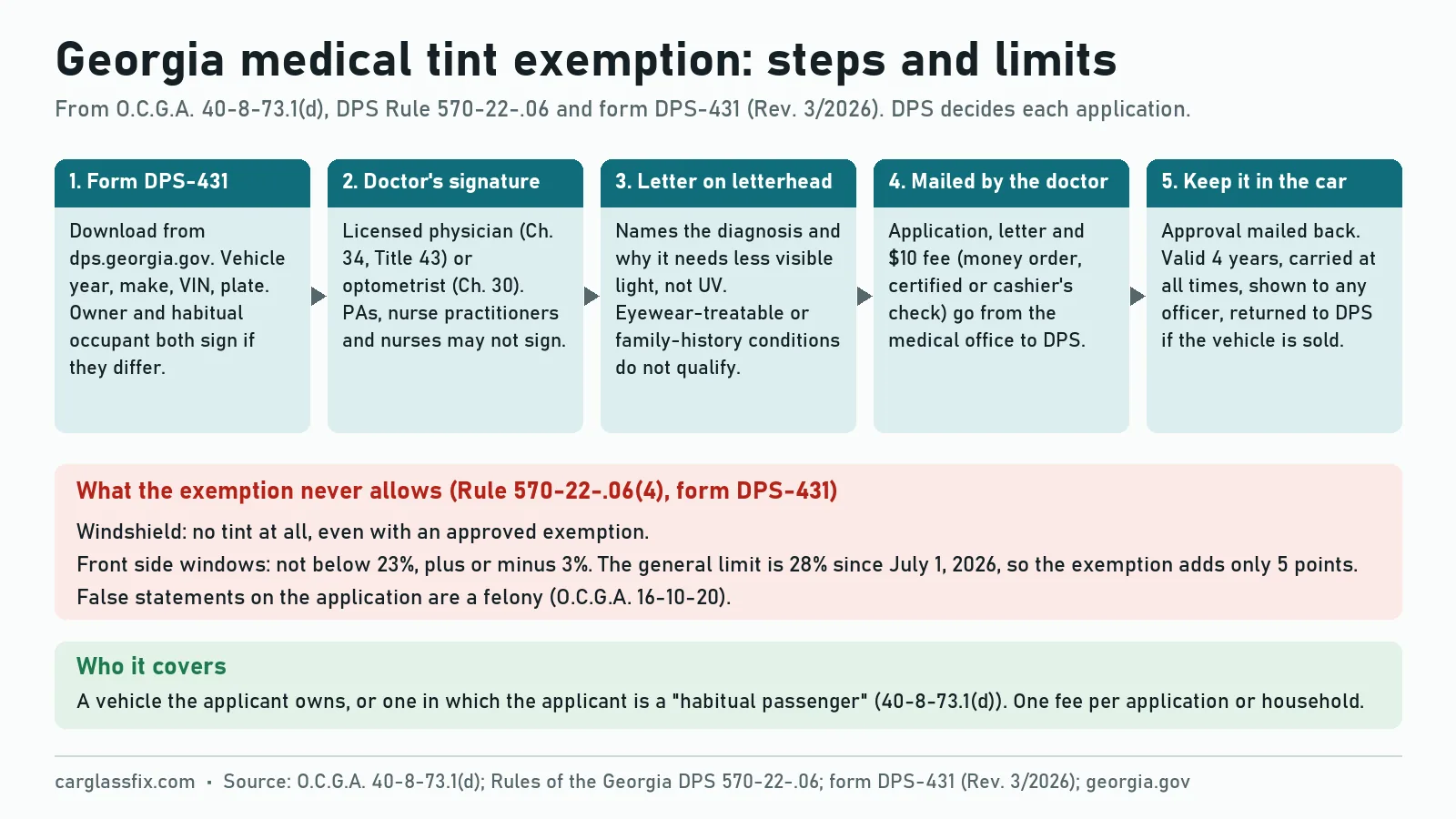
The exemption is narrower than most pages suggest. Rule 570-22-.06(4) says it “shall not allow the reduction of light transmission through the windshield” and shall not take the windows beside the driver “to less than 23 percent, plus or minus 3 percent”. That floor is 5 points below the new 28% limit. DPS also lists conditions that do not qualify: anything that protective eyewear can address, anything that legal tint blocking 99.9% of UV light can address, and conditions that “may occur due to family history”. A false statement on the application is a felony under O.C.G.A. 16-10-20.
How to get a Georgia medical exemption for window tint
Download form DPS-431
The Application for Exemption to the Window Tint Law (Rev. 3/2026) is on dps.georgia.gov. It asks for the vehicle’s year, make, VIN and plate; the owner and the habitual occupant both sign if they differ.
See a physician or optometrist
Only a physician licensed under Chapter 34 of Title 43 or an optometrist certified under Chapter 30 may sign. Physician assistants, nurse practitioners and nurses “are not authorized to sign this form”.
Get the letter on letterhead
It names the diagnosis and explains why the condition “can only be addressed by a 9% reduction of visible light, not ultraviolet light”.
Mail everything from the medical office
The application, the letter and the $10 fee (money order, certified or cashier’s check) go to DPS, Office of Professional Standards, Window Tint, P.O. Box 1456, Atlanta, GA 30371-2303.
Keep the approval in the car
The approved form is valid for four years, must be carried in the vehicle at all times and shown to any police officer on request, and goes back to DPS if the vehicle is sold.
Penalties and enforcement for illegal tint in Georgia
Driving with illegal tint in Georgia is a misdemeanor, and installing it is a separate misdemeanor. Subsection (h) covers anyone who violates subsection (b), the operating rule, or subsection (e), which bars installing material that would break the limits. The section sets no fine of its own. Georgia’s general misdemeanor penalty, O.C.G.A. 17-10-3(a)(1), allows “a fine not to exceed $1,000.00”, confinement for up to 12 months, or both. The Georgia State Patrol cited the same maximums in 2005. The amount on a real ticket is set by the court. Several tint pages quote a flat ticket figure for Georgia; no state source supports one, so none is given here.
Enforcement happens at traffic stops. The DPS rule says an exemption must be shown “upon request of any police officer”. The law reaches out-of-state cars: the earlier statute was struck down because it applied only to vehicles registered in Georgia, and DPS says House Bill 20 of 2005 made the rules apply to “both residents and non-residents”. Commercial motor vehicles follow 49 CFR 393.60 under subsection (f); the DPS Motor Carrier Compliance Division says their windshield and the windows beside the driver must pass “not less than 70 percent”.
Vehicles the Georgia limits do not cover, and what older pages get wrong
The Georgia limits do not apply to law enforcement vehicles, vehicles with a government official’s special plate, state and local government vehicles, or vehicles used in the course of business by licensed private detective and security firms (40-8-73.1(c)(7) to (10)). The (c)(6) exemptions cover only the rear glass; every exempt vehicle still needs 28% beside the driver.
Five claims in the search results do not match the statute. A 32% front limit was correct until June 30, 2026 and is now 28%. “No limit on the rear windows” is true only for multipurpose vehicles; a car’s rear glass needs 15%. A 23% front limit is the medical exemption floor, not the general rule. “Tint to the AS-1 line” is a borrowed phrase; Georgia counts 6 inches from the top. An electric tint ban is not law: House Bill 1022 passed the House on February 17, 2026, left a Senate committee on March 25, 2026, and stopped there. Compare every state in what car window tint is legal.
Georgia tint rules can change with each session of the General Assembly. Check the current O.C.G.A. 40-8-73.1 or the Georgia Department of Public Safety before you tint. This article is general information, not legal advice.
Frequently asked questions
What percentage of tint is allowed in Georgia?
Since July 1, 2026, front side windows must pass at least 28% of light with the glass, and a car’s rear side windows and rear window at least 15%, each plus or minus 3%. The rear glass of a multipurpose passenger vehicle has no limit.
Is 20% tint legal in Georgia?
A 20% reading is illegal on the front side windows, which must pass 28% with a 3% tolerance. It is legal on a car’s rear side windows and rear window (15% limit) and on the rear glass of a multipurpose vehicle.
What is the darkest legal tint in Georgia?
The darkest legal front side window reads 28%, or 25% at the edge of the tolerance. A car’s rear side window or rear window may read 15%, or 12% with the tolerance. The window tint percentage chart shows each shade.
Is 35% tint legal in Georgia?
A 35% film is legal on every side and rear window if the finished front side window still reads 28% or more and reflects 20% or less. Factory glass lowers the reading, so check the finished window with a meter.
What are the Georgia window tint laws for trucks and SUVs?
A pickup, SUV or van built on a truck chassis or with off-road features, carrying ten people or fewer, is a multipurpose passenger vehicle, so its rear side windows and rear window may be any darkness. Its front side windows still need 28%.
Sources
- Georgia HB 1161 as passed House and Senate, Section 3 (amends O.C.G.A. 40-8-73.1) and Section 8 (effective dates) (checked 29 October 2026)
- Georgia General Assembly: HB 1161 status (signed May 12, 2026, Act 640, effective July 1, 2026) (checked 29 October 2026)
- Georgia General Assembly: HB 1022 status (electric tinting; not enacted) (checked 29 October 2026)
- O.C.G.A. 40-8-73.1, pre-amendment text (FindLaw, current as of March 28, 2024) (checked 29 October 2026)
- O.C.G.A. 17-10-3, punishment for misdemeanors (FindLaw) (checked 29 October 2026)
- Rules of the Georgia Department of Public Safety, Chapter 570-22: 570-22-.05 Window Tinting and 570-22-.06 Limited Exemptions (checked 29 October 2026)
- Georgia DPS form DPS-431, Application for Exemption to the Window Tint Law (Rev. 3/2026) (PDF, checked 29 October 2026)
- Georgia DPS: Medical Exemption to Window Tint Law (checked 29 October 2026)
- Georgia.gov: Get an Exemption for Window Tinting (last updated June 2026; checked 29 October 2026)
- Georgia DPS: Georgia’s New Window Tint Law (H.B. 20, effective May 2, 2005) and Georgia State Patrol release: House Bill Restores Georgia’s Window Tint Law (May 6, 2005)
- Georgia DPS Motor Carrier Compliance Division, Fact Sheet #19: Window Tinting on Commercial Vehicles (PDF, checked 29 October 2026)
- 49 CFR 393.60, Glazing in specified openings (checked 29 October 2026)

Similar Posts