Iowa Window Tint Laws: 50% Front Since July 2026
Senior Automotive Glass Diagnostic Specialist & Master Technician at CarGlassFix · AGSC Master Certified Auto Glass Technician, NGA Certified Installer, I-CAR Automotive Safety Specialist · 12+ Years in Automotive Glazing, Windshield Structural Bonding, ADAS Camera Calibration & Precision Chip Restoration
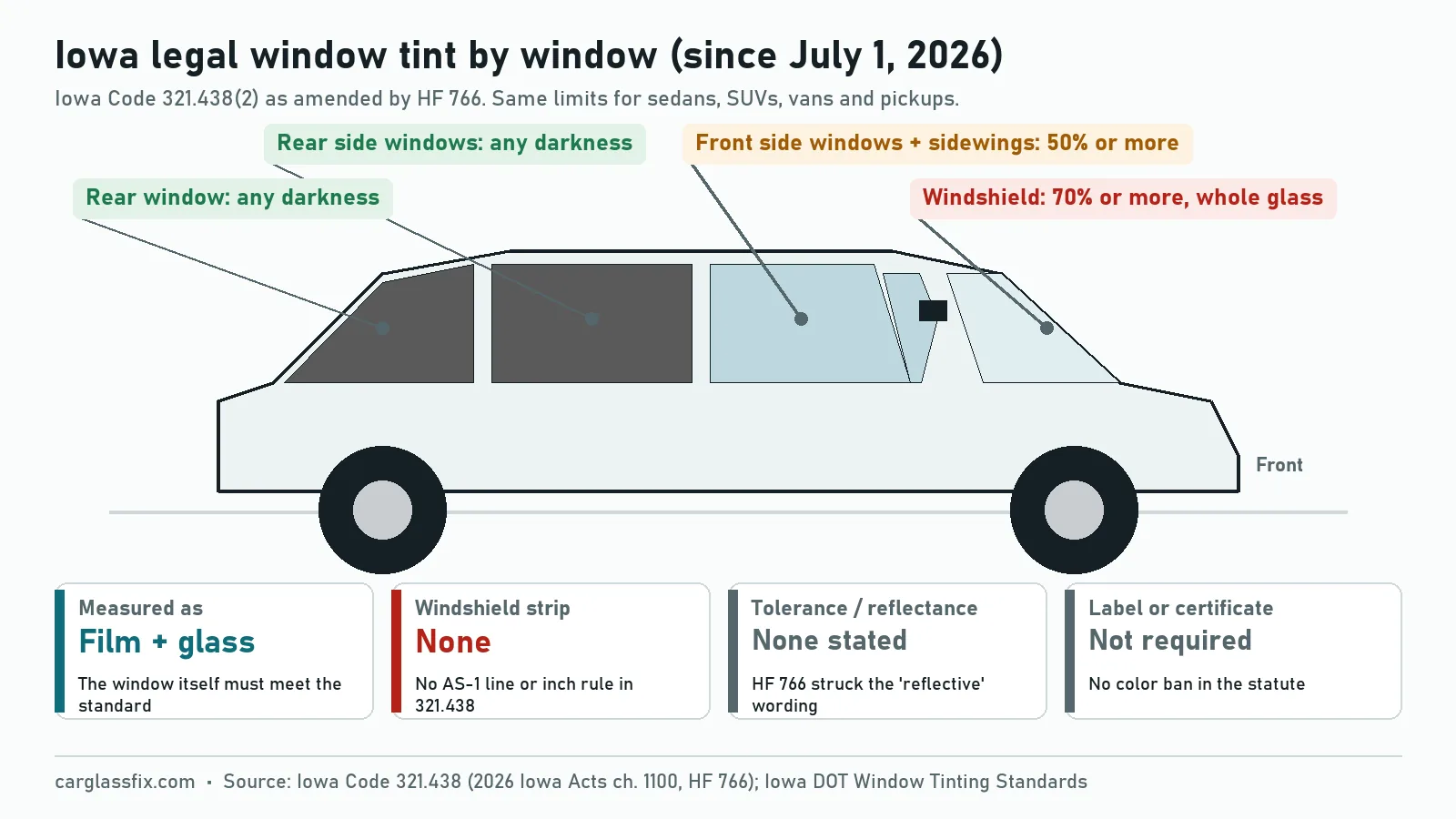
Iowa window tint law allows front side windows that pass at least 50% of light and a windshield that passes at least 70%, measured with the film on the glass. Windows behind the driver have no darkness limit. The 50% figure took effect on July 1, 2026 under House File 766; before then, the front side limit was 70%.
Iowa window tint limits by window
Iowa limits only two areas of glass: the windshield, which must pass at least 70% of light, and the two windows beside the driver, which must pass at least 50%. The rule is Iowa Code 321.438(2). The statute says a person “shall not operate on the highway” a vehicle with a front windshield “of less than seventy percent light transmittance” or a side window “to the immediate right or left of the driver” of less than fifty percent. A sidewing, the small vent window forward of the door glass, follows the 50% figure. Every other window is covered only by subsection 1, which bans windows “which do not permit clear vision” and names no percentage. Iowa uses the same numbers for sedans and for SUVs, vans and pickups. Iowa Code 321.1 defines a multipurpose vehicle as one built to carry ten people or fewer on a truck chassis or with off-road features, but 321.438 never uses that class, so the table has one column of figures that applies to both.
| Window | Sedan | SUV, van, pickup |
|---|---|---|
| Windshield | 70% light transmittance or more over the whole glass; no strip exception | Same |
| Front side windows and sidewings | 50% light transmittance or more | Same |
| Side windows behind the driver | No percentage; must permit clear vision | Same |
| Rear window | No percentage; must permit clear vision | Same |
| Measured as | The window itself, so film and glass together | Same |
| Reflectance, colors, labels, tolerance | None stated in the statute | Same |
What changed on July 1, 2026: House File 766
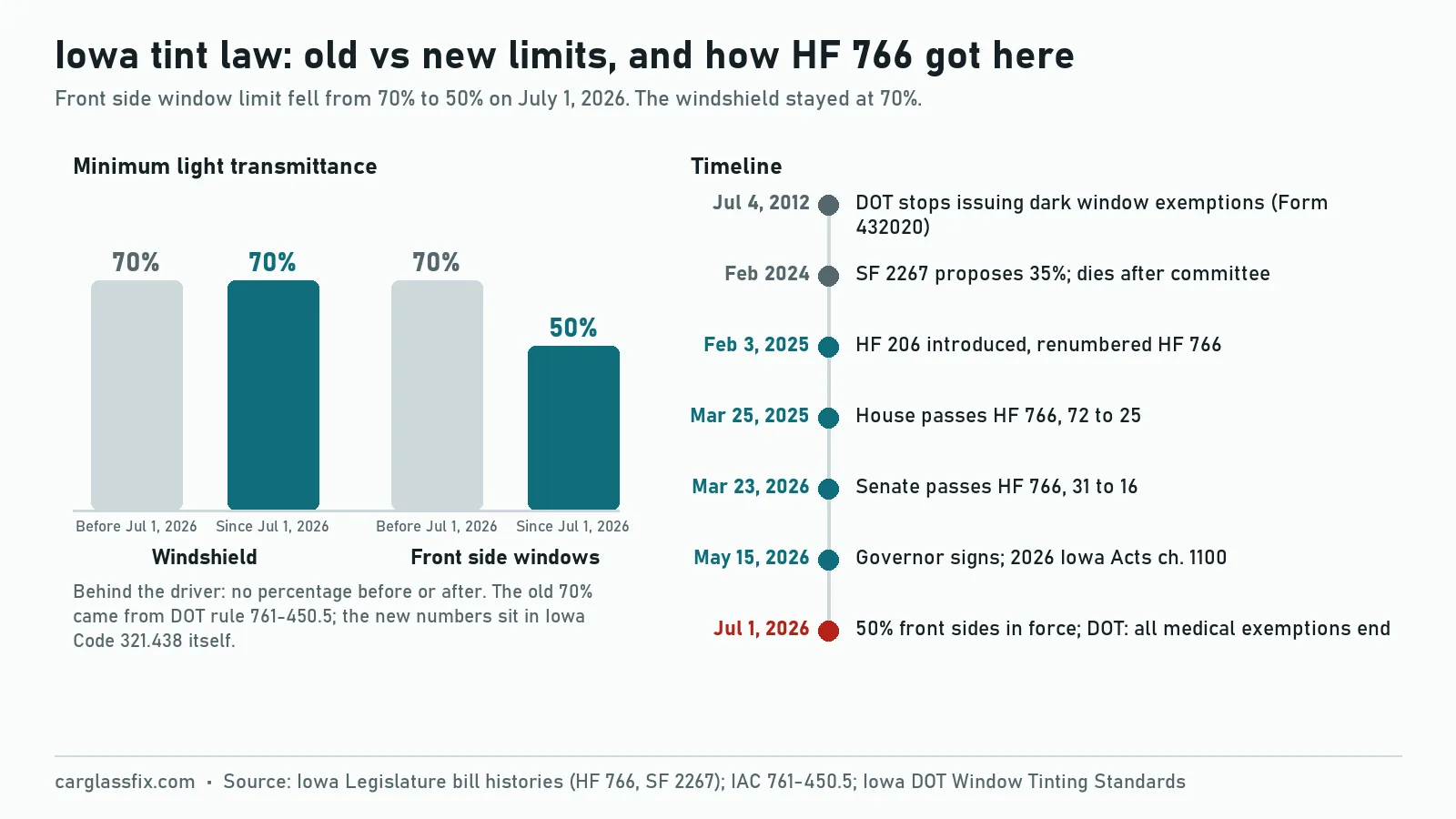
House File 766 lowered the front side window limit from 70% to 50% and wrote both numbers into the statute. Before the Act, 321.438(2) only banned glass that was “excessively dark or reflective” and told the Iowa DOT to set a measurable standard by rule. That rule, Iowa Administrative Code 761-450.5(1), set 70% for the windshield, front side windows and sidewings. HF 766 struck the “excessively dark or reflective” wording, struck the DOT’s rulemaking sentence, and put 70% for the windshield and 50% for the front side windows directly into the Code.
The bill began as HF 206 in 2025 and was renumbered HF 766 in committee. The House passed it on March 25, 2025 by 72 votes to 25, and the Senate on March 23, 2026 by 31 to 16. Governor Kim Reynolds signed it on May 15, 2026, it became 2026 Iowa Acts chapter 1100, and it took effect on July 1, 2026. An earlier Senate bill, SF 2267 of 2024, would have set 35% for the windshield and front side windows; it never reached a floor vote. The Legislative Services Agency’s fiscal note on that bill counted 10,065 violations of 321.438(2) in fiscal year 2023.
Windshield tint in Iowa: 70% for the whole glass, no strip rule
Iowa requires the whole windshield to pass at least 70% of light, and the statute has no exception for a tinted strip at the top. Most states allow a band of film above the AS-1 line or within a set number of inches from the top. Iowa Code 321.438 mentions neither the AS-1 line nor any inch measurement. The 70% figure applies to the front windshield as a unit. A dark visor strip on an Iowa windshield therefore has no statutory basis, even though several tint sites and a Bing AI answer checked for this page say a “non-reflective top strip” is allowed.
In practice, laminated windshield glass absorbs part of the light before any film goes on, so there is very little room for film on it. A clear film that cuts light by only a few points may still push the reading under 70% on some glass. The statute gives no tolerance, so the reading itself decides. For the rules in other states, see is it illegal to have tint on a windshield. The move to 50% leaves room for a light film on the front doors, and none on the windshield.
How Iowa measures tint: the window, not the film
Iowa measures the window as it is on the car, so the film’s rated percentage and the glass are read together. The statute speaks of a windshield or window “that meets a minimum standard of transparency,” which is a property of the finished window. A 50% film on glass that passes 80% ends near 40%, which is under the Iowa limit. The how to measure window tint guide explains the glass-times-film math. Officers read the rolled-up window with a window tint meter.
Several things that other states regulate are absent from Iowa’s statute. There is no numeric reflectance limit; the old “excessively dark or reflective” wording was the only reflectance rule, and HF 766 removed it. There is no banned color, no compliance label, no installer certificate and no tolerance band. The statute also has no mirror condition. Iowa Code 321.437 requires every motor vehicle to carry a mirror that shows the highway 200 feet to the rear, and vans to carry outside mirrors on both sides, but that rule does not depend on rear tint. Pages that say Iowa requires dual mirrors for a dark rear window are reading another state’s law. Try shades on your own car in the window tint simulator before you buy.
Medical exemptions for window tint in Iowa
Iowa no longer grants medical exemptions for darker tint, and the Iowa DOT says exemptions approved in the past are no longer authorized. The DOT’s Window Tinting Standards sheet answers a driver with a light-sensitive condition: “Medical exemptions are not authorized and shall not be granted.” It adds that the old Form 432020 is no longer available and that “dark window exemption forms issued before July 4, 2012, are no longer valid.” Its footer dates the end of previously approved exemptions to July 1, 2026.
The administrative code tells a slightly older story. IAC 761-450.5(2), in the chapter dated April 16, 2025, still says that vehicles with a dark window exemption issued before July 4, 2012 remain subject to the former rule 761-450.7(3). HF 766 removed the DOT’s authority to write tint rules, and the DOT’s 2026 sheet is the later statement, so a pre-2012 paper exemption should not be relied on at a traffic stop. The DOT points drivers with photosensitivity to “nearly transparent UV-blocking window films” instead. A clear UV film that keeps the front side windows at 50% or more, and the windshield at 70% or more, needs no exemption at all.
How much is a tint ticket in Iowa
A tint ticket in Iowa starts with a $70 scheduled fine, and two statutory add-ons bring the usual total to $135.50. Iowa Code 805.8A(3)(ai) lists “Section 321.438 … $70” in the equipment violation schedule. Iowa Code 911.1 adds a crime services surcharge “equal to fifteen percent of the fine,” which is $10.50 on a $70 fine. Iowa Code 602.8106(1) sets court costs in scheduled violation cases at $55 whether or not a court appearance is required. The Legislative Services Agency’s fiscal note confirms the same three parts. The DOT says a ticket “must be addressed through the court system,” so questions about paying or contesting it go to the court named on the citation.
A ticket is not the only consequence. Under Iowa Code 321.101(1)(b), the DOT may suspend a vehicle’s registration when it is “mechanically unfit or unsafe,” and the DOT says law enforcement may send it a suspension request for a tint violation. The DOT then mails a notice with the suspension date and Form 442102, which a law enforcement agency signs once the tint complies.
What to do after an Iowa tint citation or suspension notice
Handle the citation through the court
The DOT says a ticket must be addressed through the court system; the citation names the court and the deadline.
Bring the windows into compliance
Remove or replace film so the front side windows read 50% or more and the windshield 70% or more.
Get Form 442102 certified
If a suspension notice arrives, have a law enforcement agency certify on the form that the tint now complies.
Return the form or appeal within 20 days
The DOT gives 20 days from the notice to return the certified form or to appeal the suspension.
Who the Iowa tint limits do not apply to, and what older pages get wrong
The only exemption written into 321.438(2) is for police. Subsection 2(b) excludes a person driving a vehicle “owned or leased by a federal, state, or local law enforcement agency” when the driving is part of official duties. There is no exemption for out-of-state vehicles, factory privacy glass or commercial trucks in the Iowa statute, and no medical exemption since 2012.
Many pages that rank for Iowa tint law were written before July 2026 and still give 70% for the front side windows. Others add rules Iowa does not have: a tint strip above the AS-1 line, a dual mirror condition, banned red or amber colors, a reflectance ban or a fine range of “$100 to $200.” Each of those is missing from 321.438. Even the DOT’s own standards sheet lists 50% in its bullet points and still says “70% or more” for front side windows in its closing paragraph, and the Code and IAC PDFs on legis.iowa.gov still showed the pre-2026 wording on October 29, 2026. For the limits in other states, see what car window tint is legal.
Iowa’s tint rules changed in 2026 and could change again. Check the current text of Iowa Code 321.438 or the Iowa DOT before you tint. This article is general information, not legal advice.
Frequently asked questions
Is 20% tint legal in Iowa?
No on the front side windows, which must read 50% or more with the film and glass together, and no on the windshield, which must read 70% or more. A 20% film is legal on the side windows behind the driver and on the rear window, where Iowa sets no percentage.
What is the legal window tint in Iowa for trucks and SUVs?
The same as for cars: 50% or more on the front side windows and sidewings, 70% or more on the windshield, and any darkness behind the driver. Iowa Code 321.438 does not separate multipurpose vehicles from passenger cars.
When did the Iowa window tint law change?
House File 766 was signed on May 15, 2026 and took effect on July 1, 2026. It lowered the front side window limit from 70% to 50% and left the windshield at 70%.
What is darker, 35% or 50% tint?
A 35% film is darker because it lets through 35% of visible light against 50%. In Iowa, 35% is too dark for the front side windows, and the window tint percentage chart shows the two shades side by side.
Can I get a medical exemption for tint in Iowa?
No. The Iowa DOT says medical exemptions “are not authorized and shall not be granted,” the old Form 432020 is gone, and exemptions issued before July 4, 2012 are no longer authorized as of July 1, 2026.
Sources
- House File 766, enrolled (91st General Assembly) and 2026 Iowa Acts, chapter 1100 (checked 29 October 2026)
- Iowa Legislature: bill history for HF 766 (checked 29 October 2026)
- Iowa Legislative Services Agency: 2026 Summary of Legislation, HF 766
- Iowa Code 321.438, Windshields and windows (Iowa Code 2026 PDF, pre-amendment wording; checked 29 October 2026)
- Iowa Code 805.8A, Motor vehicle and transportation scheduled violations, 911.1, Crime services surcharge and 602.8106, Fees (checked 29 October 2026)
- Iowa Code 321.101, Suspension or revocation of registration, 321.437, Mirrors and 321.1, Definitions (checked 29 October 2026)
- Iowa Administrative Code 761, chapter 450, Motor vehicle equipment (IAC 4/16/25; checked 29 October 2026)
- Iowa DOT: Iowa Window Tinting Standards (file dated 30 June 2026; archived copy of 9 July 2026 read)
- Iowa Legislative Services Agency: fiscal note on SF 2267 (26 February 2024) and bill history for SF 2267
- KCCI: Gov. Reynolds signs law allowing darker window tint on Iowa vehicles (15 May 2026)

Similar Posts