Best Homemade Windshield Rain Repellent (October 2026)
Senior Automotive Glass Diagnostic Specialist & Master Technician at CarGlassFix · AGSC Master Certified Auto Glass Technician, NGA Certified Installer, I-CAR Automotive Safety Specialist · 12+ Years in Automotive Glazing, Windshield Structural Bonding, ADAS Camera Calibration & Precision Chip Restoration
As an Amazon Associate, CarGlassFix earns from qualifying purchases. The picks below come from the makers’ published specifications, not from our own testing.
The best homemade windshield rain repellent is a thin coat of a car wax whose maker says it is safe on glass, wiped onto a windshield cleaned with 50/50 rubbing alcohol and water; it beads rain for a short time and fades fast, so for longer protection the Rain-X Original Glass Water Repellent and the Gtechniq G1 ClearVision Smart Glass are the store-bought picks, rated by their makers at about 3 months and up to 20,000 miles.
Most kitchen remedies do not repel water at all. Vinegar, rubbing alcohol and baking soda are cleaners, dish soap and shaving cream make water spread, and the viral “homemade Rain-X” recipes rely on silicone oil or even concentrated sulfuric acid.
This page compares the homemade options people actually try, with what automakers, glass-product makers and chemistry sources say about each, then lists nine store-bought repellents for when you want the beading to last. For the step-by-step method, see our guide on how to make car glass water repellent at home.
The picks are based on makers’ specifications and product data, not hands-on testing. We checked each Amazon listing on October 29, 2026 (US delivery, ZIP 10001).
Quick Answer: The Best Homemade Windshield Rain Repellent
A glass-safe car wax over alcohol-cleaned glass is the only homemade option that beads water, and it is short-lived. For lasting repellency, the Rain-X Original Glass Water Repellent takes the top spot because its maker publishes a durability figure, full directions and removal products.
- Rain-X Original Glass Water Repellent (7 fl oz) (Best overall wipe-on repellent): About 3 months per Rain-X; apply above 40°F to exterior glass.
- Gtechniq G1 ClearVision Smart Glass (15 ml) (Best mileage-rated bonded coating): Up to 20,000 miles per Gtechniq, with 3 layers on the windshield.
- SOFT99 Ultra Glaco Windshield Hydrophobic Coating (70 ml) (Best long-life roll-on): 12 months per Soft99; keep the glass dry for 12 hours.
- Aquapel Glass Treatment (4 single-use applicators) (Best single-use applicator): Pre-filled fluorinated treatment; one applicator per average windshield, per the listing.
- GYEON View EVO Ceramic Hydrophobic Windshield Coating (Best for longest stated durability): Up to 24 months on windshields per Gyeon; machine polish first.
- CARPRO FlyBy30 Glass Sealant (20 ml) (Best published water-angle data): 112-degree contact angle; about 4 to 5 months on windshields, per CARPRO.
- SOFT99 Glaco Roll On Large (120 ml) (Best built-in applicator): Felt roll-on rated at about 3 months; Soft99 says water sheds from 28 mph.
- Rain-X 2-in-1 Glass Cleaner and Rain Repellent (23 oz, 2-pack) (Best spray-and-wipe option): Cleans and repels in one pass; Rain-X says allow an hour before rain.
- Invisible Glass Exterior Glass Rain Repellent (8 fl oz, 92482) (Best for a strip-and-treat routine): Spray repellent designed to follow Invisible Glass Glass Stripper prep.
Want to know which kitchen remedies actually work first? Read Homemade Rain Repellents Compared below before you spend anything.
Homemade Rain Repellents Compared
Only one group of household products, waxes and silicones, leaves a water-repellent layer on glass, and automakers warn about both on the windshield. The American Chemistry Council lists carnauba wax, beeswax, paraffin and dimethicone as chemicals added to create a protective layer on surfaces. Everything else on the list cleans the glass or makes water spread.
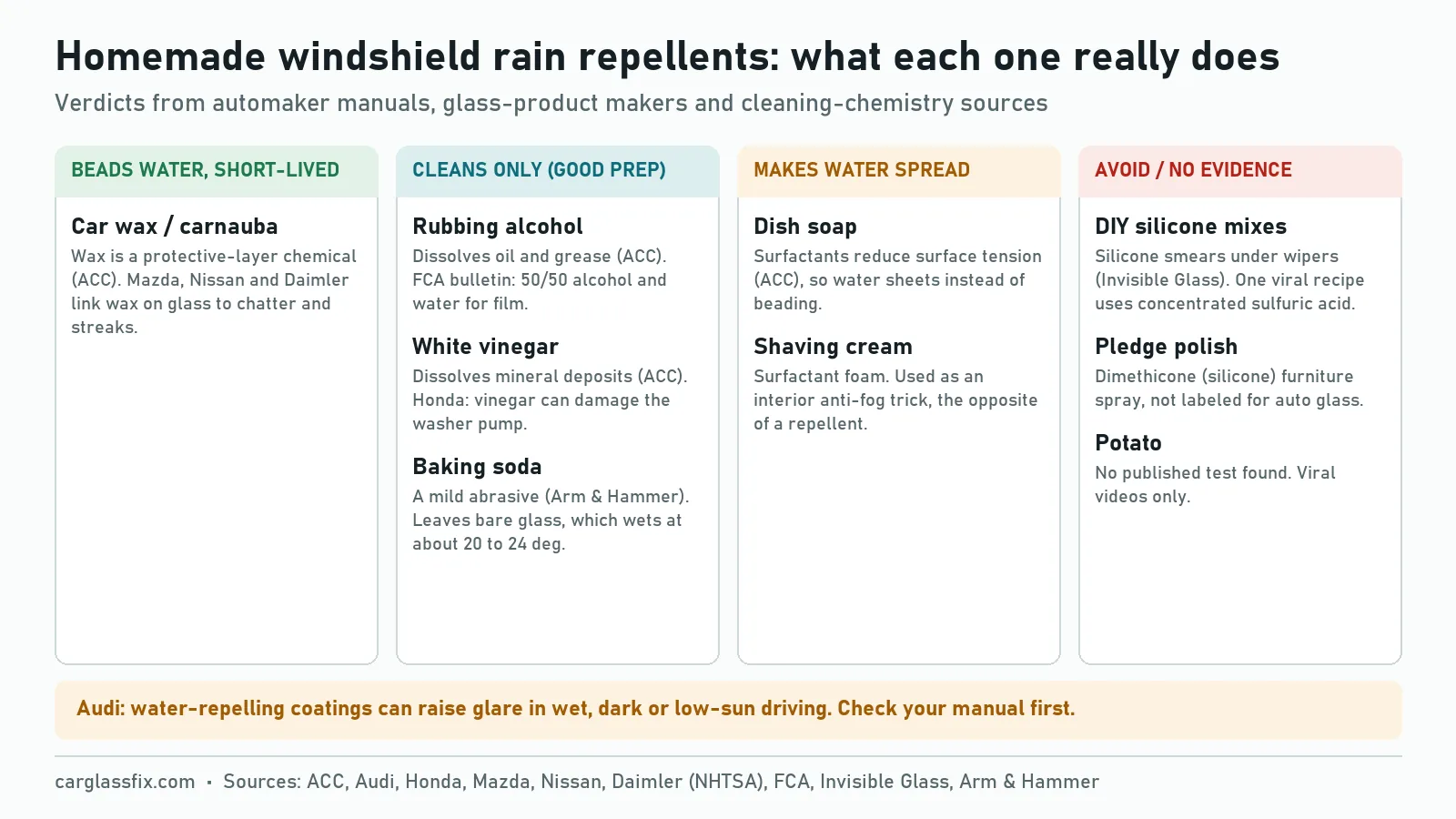
Bare, clean glass is naturally hydrophilic. MIT defines a hydrophobic surface as one where a water droplet’s contact angle is over 90 degrees. A 2024 study led by Eindhoven University of Technology measured untreated glass at about 24 degrees and silane-treated glass at up to about 103 degrees. That is why cleaning alone never makes rain bead.
| Option | What it does | Repels water? | Main risk | Verdict |
|---|---|---|---|---|
| Car wax / carnauba | Leaves a wax layer | Yes, briefly | Wiper chatter, streaks, glare | Use with care |
| Rubbing alcohol (50/50) | Dissolves oil and film | No | Strips existing repellent | Best prep step |
| White vinegar | Dissolves mineral deposits | No | Washer pump damage (Honda) | Pre-clean only |
| Baking soda | Mild abrasive scrub | No | Abrasive on coated glass | Cleaner only |
| Dish soap | Surfactant cleaner | No, spreads water | Removes wax (AAA) | Skip |
| Shaving cream | Surfactant foam | No, spreads water | Smearing outside | Skip |
| DIY silicone / “homemade Rain-X” | Silicone oil film | Yes, unevenly | Smearing; some recipes use sulfuric acid | Avoid |
| Pledge furniture polish | Dimethicone film | Not tested on glass | Silicone smearing, not for auto glass | Avoid |
| Potato | Starch film (claimed) | No evidence | Residue | No evidence |
Car Wax and Carnauba: Beads Water, Briefly
Car wax is the only household product here that makes water bead on glass. Turtle Wax says its Hybrid Solutions Wax & Dry Plus is safe on all exterior surfaces, including glass. Automakers are cautious. Mazda says hot car-wash waxes “have been known to affect the wiper’s ability to clean windows”, Nissan says a chattering blade may mean wax is on the blade or windscreen, and a Mercedes-Benz service document filed with NHTSA traces most squeaking wipers to wax residue. Volvo says never to use car wax on its factory water-repellent glass. Our guide on should you wax car windows covers removal.
Verdict: use with care. Choose a wax whose maker says it is safe on glass, keep it off the camera area, and skip it if your owner’s manual rules out windshield treatments.
Rubbing Alcohol: The Best Prep, Not a Repellent
Rubbing alcohol cleans; it does not repel water. The American Chemistry Council lists isopropyl alcohol as a solvent that breaks up oil and grease. An FCA US service bulletin tells technicians to clean windshield and wiper film with a 50/50 mix of alcohol and water. Tesla’s Model Y service manual warns that unapproved IPA wipes may damage the factory hydrophobic coating on its windshield, which shows alcohol strips water-repellent layers.
Verdict: the best homemade first step before any wax or store-bought repellent, and a way to remove an old one.
White Vinegar: A Mineral Cleaner
Vinegar removes hard-water deposits and leaves nothing behind that repels rain. The American Chemistry Council says acids such as the acetic acid in vinegar dissolve mineral deposits and hard water stains. Honda’s 2026 HR-V manual says a vinegar and water solution can damage the window washer pump, so the CarParts.com recipe that pours vinegar into the reservoir conflicts with that notice. AAA reports that some glass professionals caution that long exposure to liquid vinegar may cause micro pitting. Our guide to clean a windshield with vinegar covers safe ratios.
Verdict: fine as a pre-clean for water spots, wiped on and rinsed. Keep it out of the washer reservoir.
Baking Soda: A Scrub, Not a Coating
Baking soda is a mild abrasive, according to Arm & Hammer, so it scrubs the glass instead of coating it. The viral “no more Rain-X” clips that use baking soda and a damp rag leave clean, bare glass, and bare glass wets at about 20 to 24 degrees. Water may run off a freshly cleaned windshield more evenly, but it will not bead the way it does on a repellent.
Verdict: a cleaner only. Avoid scrubbing glass that already carries a coating you want to keep.
Dish Soap and Shaving Cream: They Make Water Spread
Dish soap and shaving cream work against water beading. The American Chemistry Council says surfactants reduce the surface tension of liquids and names them as the base of dishwashing liquids. Retail ingredient lists for Gillette Foamy Regular include laureth-23 and sodium lauryl sulfate, both surfactants. Lower surface tension lets water flatten into a sheet, which is why shaving cream is passed around as an inside anti-fog trick. AAA notes that dish soap removes car wax.
Verdict: skip both on the outside of the windshield. They do the opposite of a rain repellent.
DIY Silicone and “Homemade Rain-X” Recipes
Silicone mixes do bead water, but they smear and some recipes are hazardous. CarParts.com gives an ethanol recipe with 9 ml of castor or silicone oil and publishes no test data. A recipe covered by Hackaday activates dimethicone with concentrated sulfuric acid, which CDC NIOSH lists as causing eye and skin burns. Invisible Glass says silicone on glass smears under the wipers, and the Mercedes-Benz document links silicone-based washer fluid to squeaking.
Verdict: avoid. A store-bought repellent is made, labeled and tested for car glass by its maker; a kitchen silicone mix is not.
Pledge Furniture Polish
Pledge is a furniture polish, not an automotive glass product. Retail ingredient lists for Pledge Lemon Enhancing aerosol include water, C7-8 isoparaffin and dimethicone. The American Chemistry Council lists dimethicone as a protective-layer chemical, and Invisible Glass warns that silicone on glass smears under the wipers.
Verdict: avoid on the windshield. Use a repellent labeled for exterior car glass.
Potato and Other Viral Hacks
No automaker, glass maker or testing body we found has published a test of rubbing a cut potato on a windshield. The claim lives in short videos and forum posts. The top Facebook answer in today’s Google results for this query tells the poster to buy Rain-X instead.
Verdict: no evidence. Do not rely on it for night or highway visibility.
Where Homemade Treatments Cause Trouble
Homemade layers fail in four places: the wipers, night glare, rubber and trim, and the camera area behind the mirror. Each risk below comes from an automaker or product maker, not from forum reports.
Wiper Chatter and Smearing
Uneven films change the friction between blade and glass. Rain-X says waxes and worn repellent can create a film that causes streaking, smearing, skipping, chattering or squeaking. The Mercedes-Benz document says the windshield is only properly clean when no area of it beads water, and it says to change blades only after that. Tesla’s Model Y manual says windshield treatment fluids can interfere with wiper friction and cause chattering. Our guide to stop windshield wipers from squeaking covers the blade side.
Glare at Night and in Low Sun
Audi tells owners not to treat the windshield with water-repelling coating agents. Its Q3 owner’s manual, as published online, says that in wet, dark or low-sun conditions these coatings can increase glare and the risk of an accident, and can also make the wipers chatter. A smeared wax or silicone layer from a home remedy carries the same risk, because the wipers spread it across your line of sight.
Wiper Rubber, Trim and Plastics
Makers limit where their repellents go. Soft99 says old wipers with damaged rubber may shudder on Glaco and that Glaco is not for headlights, visors or other clear plastics. Rain-X says its 2-in-1 is not for clear plastics or painted surfaces. AAA says vinegar pretreatments and dish soap strip car wax from paint, so wipe overspray off the body.
The Camera and Rain-Sensor Area
Several automakers restrict coatings where a camera or rain sensor looks through the glass. Subaru’s EyeSight supplement says not to use any glass coating agents on the windshield. Toyota says the wipers are still needed in front of the camera even with a glass coating, and Mazda says a water repellent can stop the rain sensor sensing rainfall correctly. Tesla limits hydrophobic coating on the Model Y to side and rear glass. To check your car, see how to tell if your windshield has a camera behind it.
How We Chose These Picks
We chose nine store-bought repellents from the makers’ published directions, safety data sheets and Amazon listings. We did not test them. Each pick had to be made for exterior automotive glass, publish application directions, and be in stock on Amazon for US delivery on October 29, 2026. Where a maker does not state something, the card says “not stated”.
The Score out of 10 and the bars on each card are our editorial weighting of published specifications: the stated durability and its condition, how many steps the directions require, how complete the maker’s directions and warnings are, and which glass the maker allows. They are not test results, and we did not read or count customer reviews.
Comparison Table
Here is the lineup at a glance: photo, product, who it suits, and our editorial score out of 10.
| Photo | Product | Best for | Score | Buy |
|---|---|---|---|---|
 | Rain-X Original Glass Water Repellent (7 fl oz) | Most drivers, all exterior glass | 9.2/10 | Check on Amazon → |
 | Gtechniq G1 ClearVision Smart Glass (15 ml) | Mileage-rated bonded coating | 9.0/10 | Check on Amazon → |
 | SOFT99 Ultra Glaco Windshield Hydrophobic Coating (70 ml) | 12-month roll-on coating | 8.9/10 | Check on Amazon → |
 | Aquapel Glass Treatment (4 single-use applicators) | No-mix, one-step applicator | 8.8/10 | Check on Amazon → |
 | GYEON View EVO Ceramic Hydrophobic Windshield Coating | Longest stated life | 8.7/10 | Check on Amazon → |
 | CARPRO FlyBy30 Glass Sealant (20 ml) | Multi-coat sealant with angle data | 8.6/10 | Check on Amazon → |
 | SOFT99 Glaco Roll On Large (120 ml) | Built-in felt applicator | 8.5/10 | Check on Amazon → |
 | Rain-X 2-in-1 Glass Cleaner and Rain Repellent (23 oz, 2-pack) | Clean and repel in one spray | 8.3/10 | Check on Amazon → |
 | Invisible Glass Exterior Glass Rain Repellent (8 fl oz, 92482) | Pairs with Glass Stripper prep | 8.0/10 | Check on Amazon → |
Scroll sideways on small screens to see every column.
Rain-X Original Glass Water Repellent: Best Overall Wipe-On Repellent
Gtechniq G1 ClearVision Smart Glass: Best Mileage-Rated Bonded Coating
Soft99 Ultra Glaco: Best Long-Life Roll-On
Aquapel Glass Treatment: Best Single-Use Applicator
Gyeon View EVO: Best for Longest Stated Durability
CARPRO FlyBy30: Best Published Water-Angle Data
Soft99 Glaco Roll On Large: Best Built-In Applicator
Rain-X 2-in-1 Glass Cleaner and Rain Repellent: Best Spray-and-Wipe Option
Invisible Glass Rain Repellent 92482: Best for a Strip-and-Treat Routine
How to Choose a Store-Bought Rain Repellent
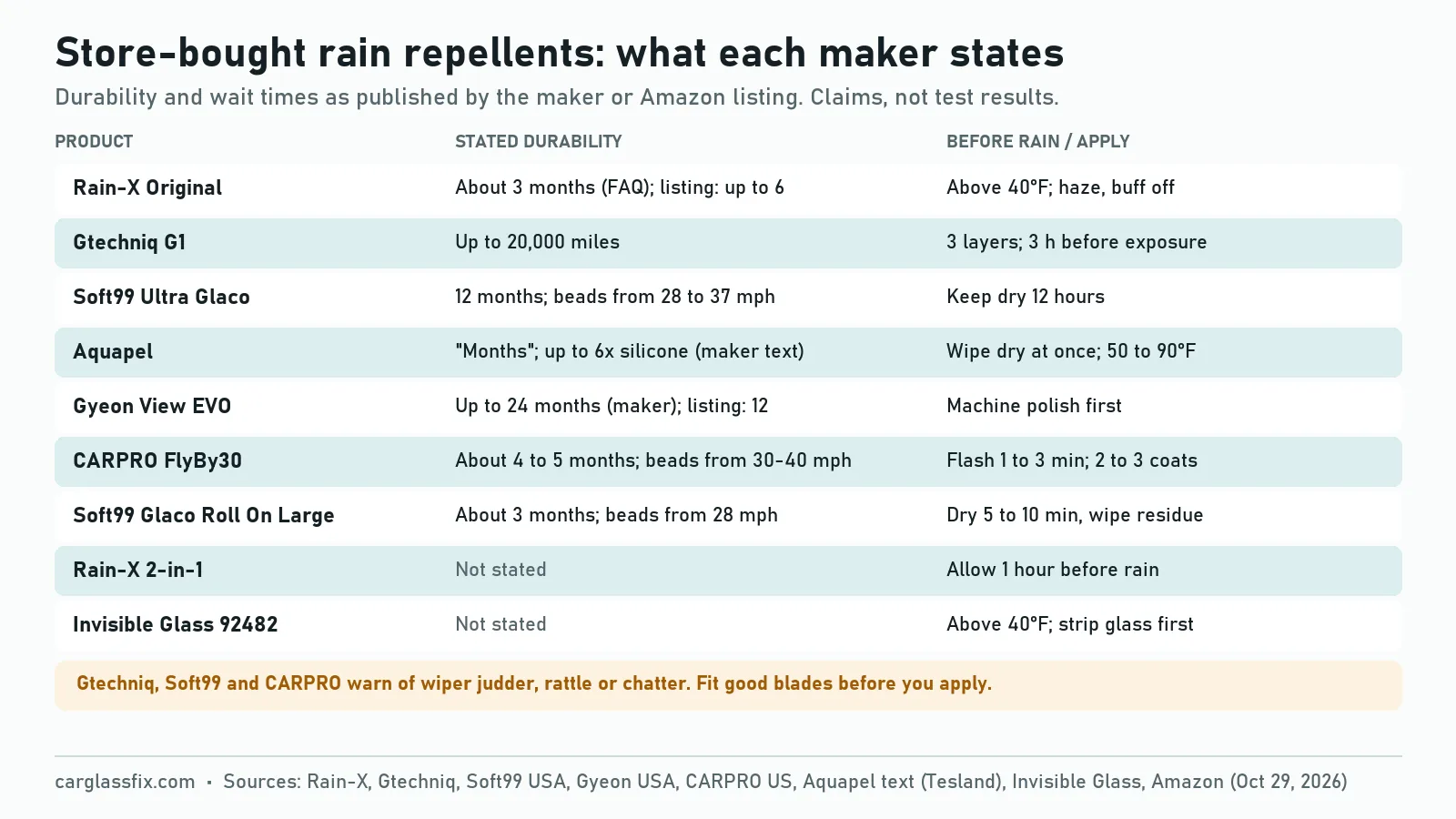
Choose by four checks: whether your owner’s manual allows a windshield treatment, the durability the maker states and its condition, how long the glass must stay dry, and the prep the maker asks for. Every durability figure below is the maker’s or listing’s own claim.
| Product | Type | Stated durability | Wait or limits | Prep |
|---|---|---|---|---|
| Rain-X Original | Wipe-on liquid | About 3 months (FAQ); up to 6 (listing) | Above 40°F; haze, then buff | Clean, dry glass |
| Gtechniq G1 | Bonded coating | Up to 20,000 miles | 3 hours before exposure | G6 clean, G4 polish, 3 layers |
| Soft99 Ultra Glaco | Fluorine-based roll-on | 12 months | Keep dry 12 hours | Glass Compound deep clean |
| Aquapel | Fluorinated applicator | “Months”, no number | 50 to 90°F; wipe dry at once | Clean, dry glass |
| Gyeon View EVO | Ceramic coating | Up to 24 months (maker); 12 (listing) | Not stated on maker page | Q²M GlassPolish by machine |
| CARPRO FlyBy30 | Wipe-on sealant | About 4 to 5 months | Flash 1 to 3 min; 2 to 3 coats | GofX polish, Eraser clean |
| Soft99 Glaco Roll On Large | Silicone roll-on | About 3 months | Dry 5 to 10 min, wipe residue | Clean, dry, uncoated glass |
| Rain-X 2-in-1 | Spray cleaner + repellent | Not stated | 1 hour before rain | Cleans as it goes |
| Invisible Glass 92482 | Spray repellent | Not stated | Above 40°F; cool, shaded glass | Glass Stripper first |
Read the Condition Behind the Number
A durability claim only means something with its condition attached. Gtechniq rates G1 in miles, while Rain-X and Soft99 give months that depend on weather. CarPro says its FlyBy30 repels water drops starting at 30 to 40 mph, and Soft99 gives 28 mph for Glaco, so beading at low city speeds is weaker than on the highway. Our guide on how long glass coatings last explains why a layer stops beading early.
Strip Before You Switch Products
Every maker here starts from bare glass. Soft99 says not to apply Glaco over glass that is already coated, and Invisible Glass sells its Glass Stripper to remove silicone, waxes and old coatings first. Rain-X names Rain-X Xtreme Clean and Soft Scrub for removing its own repellent. Our guide on how to remove hydrophobic coating from a windshield covers the strip step. If you want a bonded ceramic layer instead of a repellent, compare the picks in our best glass coating for car windshield guide.
Who Should NOT Buy a Windshield Rain Repellent
A rain repellent is the wrong purchase for a few drivers. Here is who they are, and what to do instead.
Your Owner’s Manual Says No
Some manuals rule out a windshield treatment. Subaru says no glass coating agents on EyeSight windshields, and Audi says not to treat the windshield with water-repelling coating agents. If your manual says no, treat only the glass it allows, such as side windows and mirrors.
Your Glass Already Has a Factory Coating
Some cars leave the factory with water-repellent glass. Volvo offers an optional water-repellent coating on some windows and says never to use car wax or degreaser on those surfaces. Tesla says unapproved IPA wipes may damage the Model Y’s hydrophobic windshield coating. Follow the automaker’s care instructions instead of adding a second layer.
Your Wipers Are Worn
A repellent will not fix a bad blade. Gtechniq advises replacing worn blades, Soft99 says damaged rubber may shudder, and the Mercedes-Benz document says blades should be replaced twice a year. Fit good blades first, then treat the glass.
You Want to Stop Inside Fog
Exterior repellents do not stop inside fog. Rain-X says its interior anti-fog product applies a hydrophilic coating, the opposite chemistry, and Soft99 says Glaco is not for interior surfaces. Buy an interior anti-fog product for the inside of the glass.
Final Verdict
The best homemade windshield rain repellent is a glass-safe car wax over glass cleaned with 50/50 rubbing alcohol and water, used only where your owner’s manual allows it. Vinegar, baking soda and alcohol are good cleaners, dish soap and shaving cream make water spread, and silicone or Pledge mixes are better left alone.
Want repellency that lasts? Get the Rain-X Original Glass Water Repellent. Rain-X rates it at about 3 months and publishes full directions.
Want a mileage-rated bonded layer? The Gtechniq G1 ClearVision Smart Glass is rated by Gtechniq at up to 20,000 miles, with a 3-layer routine.
Want the longest stated life and can machine polish? Gyeon rates the Gyeon View EVO at up to 24 months on windshields.
Want the simplest one-step job? The Aquapel Glass Treatment comes in pre-filled applicators, one per average windshield, per the listing.
Still unsure if a repellent suits your car? Check the Who Should NOT Buy section above first.
FAQ
What is the best homemade windshield rain repellent?
No kitchen mix is a lasting repellent. The only household products that make water bead are waxes, and a car wax whose maker says it is safe on glass, applied over glass cleaned with 50/50 rubbing alcohol and water, works for a short time. Audi, Mazda and Nissan link wax and repellents on the windshield to chatter, streaks or glare, so check your manual first.
Does baking soda make a windshield repel water?
No. Arm & Hammer describes baking soda as a mild abrasive, so it scrubs the glass clean instead of coating it. Clean bare glass is hydrophilic, with a water contact angle of about 20 to 24 degrees in a 2024 university study, so water spreads on it rather than beading.
Can I use car wax as a windshield rain repellent?
You can, with conditions. Wax beads water, but Mazda says hot car-wash wax can affect the wipers, Nissan says wax on the glass can cause chatter, and Volvo says never to use car wax on its factory water-repellent glass. Use a wax whose maker says it is safe on glass.
Does vinegar repel rain on a windshield?
No. The American Chemistry Council lists acetic acid, the acid in vinegar, as a cleaner that dissolves mineral deposits and hard water stains. It cleans, and it leaves no water-repellent layer. Keep it out of the washer reservoir, because Honda says a vinegar and water solution can damage the washer pump.
Can I put homemade rain repellent in the washer fluid reservoir?
It is safer not to. Honda says to use only commercially available washer fluid and warns that a vinegar and water solution can damage the pump. A Mercedes-Benz service document filed with NHTSA links silicone-based washer fluid to squeaking wipers, and Soft99 says its Glaco coating should not be used with oil-film remover washer fluid.
Is Pledge safe to use on a windshield?
Pledge is not labeled for auto glass. Retail ingredient lists for Pledge Lemon Enhancing aerosol include dimethicone, a silicone, and Invisible Glass says silicone on glass smears under the wipers. Use a product made for exterior automotive glass instead.
What is better than Rain-X for a windshield?
It depends on what you value. Gtechniq rates G1 at up to 20,000 miles, while Rain-X says its Original treatment typically lasts about 3 months. Aquapel’s maker text says it lasts up to 6 times longer than silicone-based products, without a number. All three are made and labeled for exterior car glass.
How do I make my windshield hydrophobic at home?
Strip it to bare glass, then apply a product made for exterior glass and follow its cure time. Gtechniq asks for 3 hours before exposure and Rain-X asks an hour before rain for its 2-in-1. Rubbing alcohol mixed 50/50 with water is the homemade way to strip the glass first.
Sources
- Rain-X Original Glass Water Repellent, directions (checked October 2026)
- Rain-X FAQ (checked October 2026)
- Rain-X Original safety data sheet (Feb 12, 2025) (checked October 2026)
- Rain-X 2-in-1 Glass Cleaner with Rain Repellent, directions (checked October 2026)
- Gtechniq G1 ClearVision Smart Glass (checked October 2026)
- Aquapel Glass Treatment, maker text (Tesland) (checked October 2026)
- Soft99 USA, Glaco Roll On Large (checked October 2026)
- Invisible Glass Rain Repellent, directions (checked October 2026)
- Invisible Glass Glass Stripper (checked October 2026)
- Invisible Glass, water beading vs streaking (checked October 2026)
- CARPRO FlyBy30 Windshield Coating (checked October 2026)
- Soft99 USA, Ultra Glaco (checked October 2026)
- Gyeon USA, Q2 View EVO (checked October 2026)
- Turtle Wax Hybrid Solutions Wax & Dry Plus (checked October 2026)
- American Chemistry Council, Chemistry in Cleaning Products (checked October 2026)
- MIT News, Explained: Hydrophobic and hydrophilic (checked October 2026)
- Khoeini et al., wettability of untreated and silanized glass (arXiv, 2024) (checked October 2026)
- Arm & Hammer, baking soda as a mild abrasive (checked October 2026)
- CDC NIOSH Pocket Guide, sulfuric acid (checked October 2026)
- Hackaday, Make Your Own Rain Repellent (checked October 2026)
- CarParts.com, homemade windshield water repellent recipes (checked October 2026)
- AAA, How to Deice Your Car’s Windshield (checked October 2026)
- Honda 2026 HR-V owner’s manual, washer fluid (checked October 2026)
- Mazda CX-30 owner’s manual, wiper blades (checked October 2026)
- Mazda CX-5 owner’s manual, rain sensor (checked October 2026)
- Nissan Juke owner’s manual, cleaning (Ireland) (checked October 2026)
- Mercedes-Benz service information LI82.30-P-059239 (NHTSA) (checked October 2026)
- FCA US service bulletin 23-037-15 (NHTSA) (checked October 2026)
- Audi Q3 owner’s manual, windshield wipers (online copy) (checked October 2026)
- Subaru EyeSight owner’s manual supplement (checked October 2026)
- Toyota 2026 RAV4 PHEV owner’s manual excerpt (checked October 2026)
- Tesla Model Y owner’s manual, cleaning (checked October 2026)
- Tesla Model Y service manual, forward camera view (checked October 2026)
- Volvo V40 support, water and dirt-repellent coating (checked October 2026)
- Rain-X help center, anti-fog spray (checked October 2026)
- Pledge Lemon Enhancing aerosol, retail ingredient list (checked October 2026)
- Gillette Foamy Regular, retail ingredient list (checked October 2026)

Similar Posts