How to Stop Windshield Wipers From Squeaking (and Chatter)
Senior Automotive Glass Diagnostic Specialist & Master Technician at CarGlassFix · AGSC Master Certified Auto Glass Technician, NGA Certified Installer, I-CAR Automotive Safety Specialist · 12+ Years in Automotive Glazing, Windshield Structural Bonding, ADAS Camera Calibration & Precision Chip Restoration
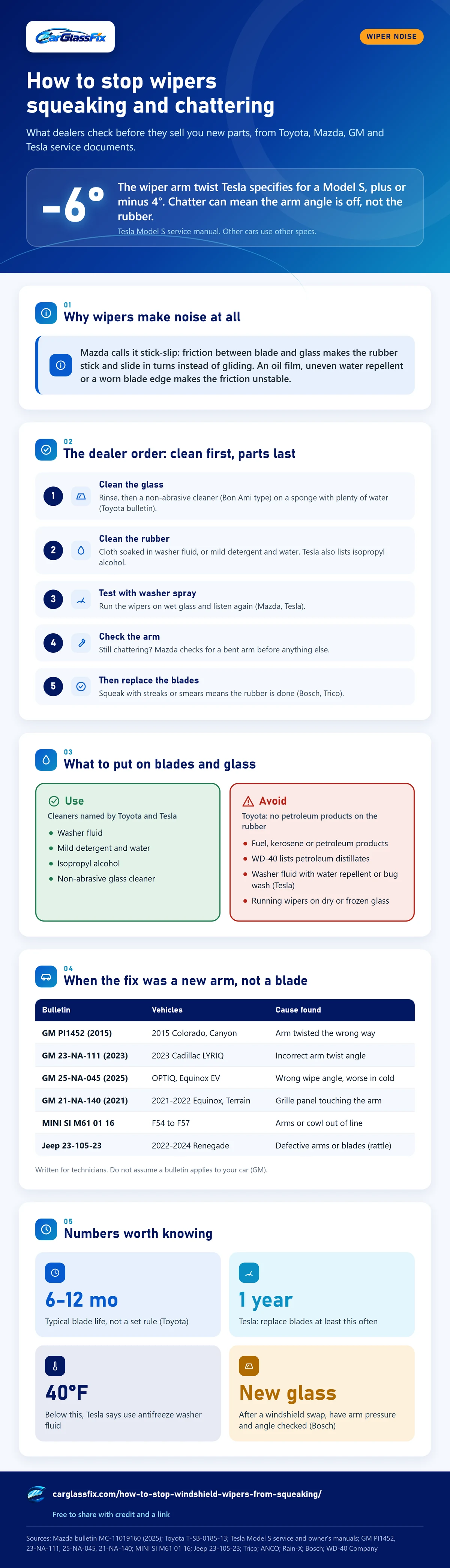
To stop windshield wipers from squeaking, clean the glass and the rubber edges first, then run the wipers only on a wet windshield. Toyota and Mazda dealer bulletins put cleaning ahead of new parts. If the noise remains, replace hardened or worn blades. Chatter that continues on new blades points to a bent or wrongly angled wiper arm.
Why windshield wipers squeak or chatter
Wipers squeak or chatter when the rubber edge grips the glass, slips, and grips again instead of gliding. Mazda calls this the stick-slip phenomenon in a service bulletin covering 2019 to 2025 models. The bulletin says chattering and squeaking noises come from friction between the windshield and the wiper blade.
A healthy blade rides on a thin film of water. Mazda lists three things that make that friction unstable: an oil film on the glass, an uneven water-repellent treatment, and a worn blade edge or peeled blade coating. Each one makes the edge stick in some spots and slide in others.
The rubber edge is also meant to flip over at the end of each stroke. Toyota’s bulletin says heat and time can make the rubber hard and brittle, so it stops turning over. Toyota lists friction noise at the reverse position and at the end of travel among the symptoms of dirty blades or glass.
Squeak, chatter, skip and rattle overlap, but each points to a different part. The next section matches the sound to the likely cause.
Match the noise to its cause
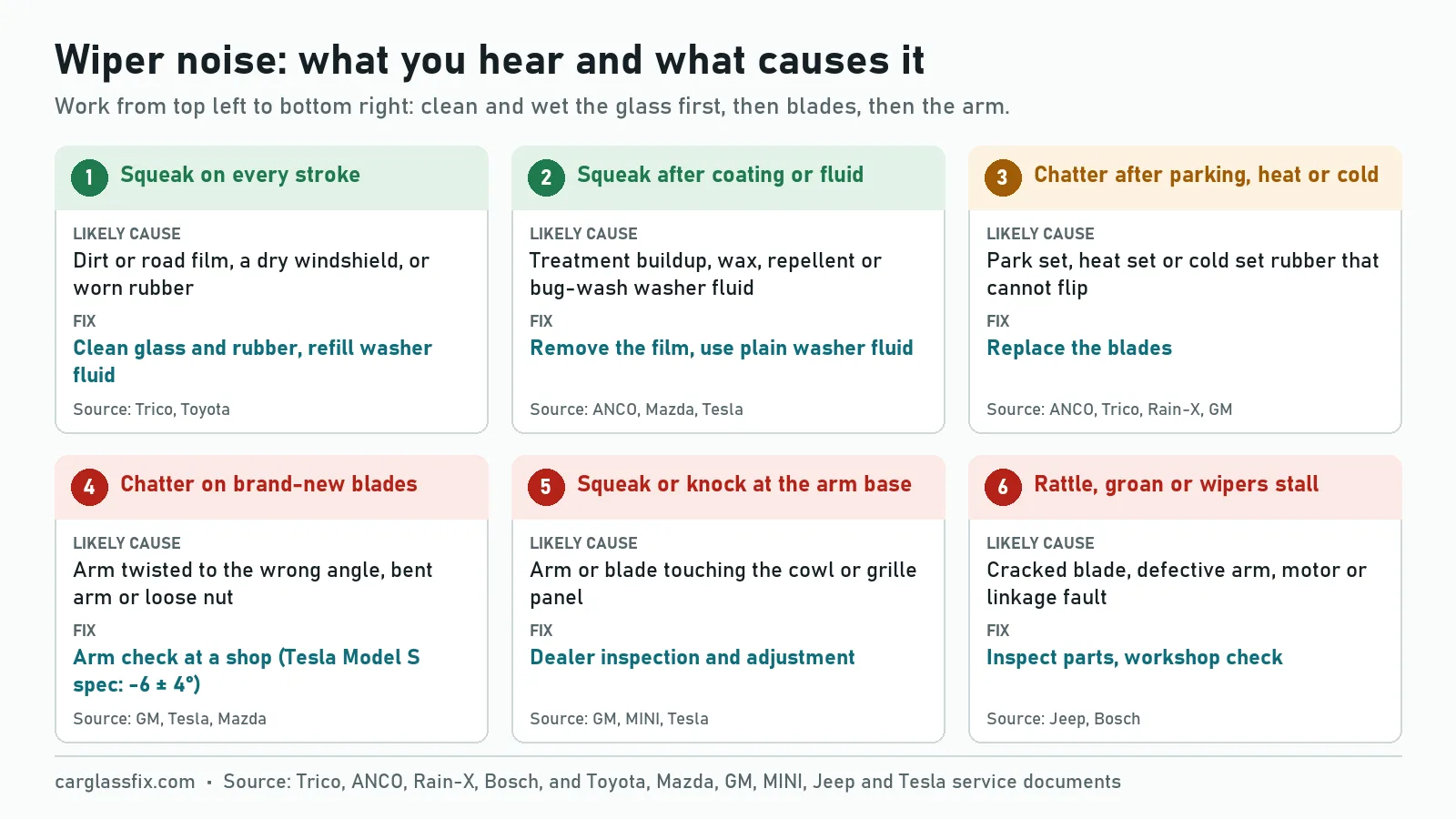
The kind of noise and when it starts narrow the cause faster than any single fix. The diagram and table below combine what blade makers and automakers publish about each symptom.
| What you hear | Most likely cause | Who says so | First fix |
|---|---|---|---|
| Squeak on every stroke | Dirt on the glass, too little washer fluid, or worn rubber | Trico, Toyota | Clean glass and blades, refill washer fluid |
| Squeak or skip right after a glass treatment | Product buildup on the windshield | ANCO, Mazda | Remove the treatment |
| Chatter after the car sat parked | Blade took a curve while idle (park set) | ANCO, Rain-X | Replace the blade |
| Chatter in hot or freezing weather | Heat set or cold set rubber | Trico, GM | Replace with blades suited to the climate |
| Chatter on brand-new blades | Arm twisted to the wrong angle, or bent arm | GM, Tesla, Mazda | Arm check at a shop |
| Squeak or knock near the arm base | Arm or blade touching the cowl or grille panel | GM, MINI, Tesla | Dealer inspection |
| Rattle while wiping | Defective or cracked blade or arm | Jeep, Bosch | Inspect and replace |
Start with the cheapest step in the table and test after each change. Mazda’s repair order works the same way: clean the windshield, fit new blades, and run the wipers with washer fluid. Only chatter that survives those steps leads to an arm check. Note whether the noise comes on the upstroke, the downstroke or both, and whether it started after a car wash, a coating, a cold night or a windshield replacement. That timing points to the right row.
How to stop wipers from squeaking: clean the glass and the blades
Cleaning fixes most squeaks, and dealer procedures do it before they replace any part. Toyota’s 2013 bulletin T-SB-0185-13 tells technicians to finish the inspection and cleaning steps before deciding to replace blades. Mazda’s bulletin also starts with a clean windshield and a retest. The steps below follow Toyota’s and Tesla’s published cleaning methods.
How to clean squeaky windshield wipers
Lift the arms safely
Lift each arm a short distance, or use the service position in the owner’s manual if the wipers park under the hood edge.
Clean the rubber edge
Wipe the rubber with a cloth soaked in washer fluid, mild detergent and water, or isopropyl alcohol until the cloth comes away clean.
Wash the windshield
Rinse the glass with water and scrub it with a non-abrasive cleaner and a sponge, using plenty of water.
Check for film
Look for wax, sap, road film or old coating that still beads or smears on the glass.
Top up washer fluid
Refill the reservoir so the glass is wet whenever the wipers run.
Test on wet glass
Spray the washer and run the wipers on each speed, listening on both strokes.
Toyota warns against fuel, kerosene or petroleum-based products on the rubber. For stubborn film, see how to deep clean a windshield. If the noise stops but the glass streaks, follow the guide on how to fix wiper marks on windshield.
Dry or dirty glass vs worn rubber
A squeak that stops on a soaked windshield is a glass problem, and a squeak that stays after cleaning is usually a rubber problem. Trico lists three causes for squeaks every time the wipers run: debris or grime, a dry windshield from lack of washer fluid, and worn rubber that lets the blade frame touch the glass. Toyota’s car-care page names the same three.
ANCO adds that running wipers on a windshield that is not wet enough causes skipping that creates squeaky wipers. Trico says never to run wipers without fluid on the glass. Light drizzle can leave too little water on the glass for the rubber to glide.
Worn rubber shows itself on inspection. Rain-X lists cracks, tears, missing pieces, stiff rubber and rounded wiping edges. ANCO describes “park set” rubber hardened by sun and temperature swings while the wipers sit idle, and says it chatters and skips. Bosch says a squeaking noise along with streaks means it is time for new blades. Toyota puts typical blade life at 6 to 12 months and says this is not a set rule.
The checklist for how to check windshield wipers for wear covers each sign. Fitting new blades is covered in how to replace windshield wiper blades.
Wiper chatter and skipping: arm angle and twisted arms
Chatter that continues on clean glass with new blades usually means the wiper arm holds the blade at the wrong angle. GM bulletin PI1452 explains that a twisted arm changes the blade angle and makes the rubber element bind during operation. A binding edge skips across the glass instead of turning over at each end of the stroke.
Automaker bulletins show this happens on new cars. Under PI1452, GM replaced the affected arms on 2015 Chevrolet Colorado and GMC Canyon trucks. GM bulletin 23-NA-111 blamed an incorrect twist angle for chatter and scratched glass on the 2023 Cadillac LYRIQ. GM bulletin 25-NA-045 replaced passenger arms on the 2025 OPTIQ and Equinox EV and noted the chatter was worse in cold weather.
The angle is a measured specification. Tesla’s Model S service manual uses a dedicated wiper adjustment tool and sets the arm to -6 degrees, plus or minus 4 degrees, on left-hand-drive cars. Other vehicles use their own specifications. Mazda adds that pulling on or forcing the arms can bend them or loosen the retaining nut. Bosch advises having contact pressure and angle checked after a windshield replacement. The automakers’ fix is a measured adjustment or a new arm, so an arm check belongs with a dealer or glass shop.
Glass coatings, wax and washer fluid additives
A squeak that starts right after a glass treatment, car wash or new washer fluid usually comes from a film on the glass. ANCO says a glass treatment can make wipers squeak or skip and chatter, and advises removing the product if that happens. Mazda’s bulletin lists uneven water-repellent treatment and oil film among the causes of unstable friction.
Car washes and fluids add their own films. Toyota’s bulletin names car wax treatments as a cause of wiper chatter. Tesla’s Model S owner’s manual lists wax spray from car washes and washer fluid with bug or water repellent as contaminants. The same manual says not to add washer fluids that contain water repellent or bug wash, because they can cause streaking, smearing and squeaking or other noises.
A coating does not always cause noise. Mazda points specifically to an uneven layer of water repellent. Removing the film usually means a thorough clean with a non-abrasive cleaner, then a retest on wet glass. If you want a repellent coating, read best hydrophobic coating for car windshield and the vehicle’s owner’s manual before applying one to the windshield.
Should you lubricate squeaky wiper blades?
Lubricant is a last step after cleaning, and the product type matters. Toyota’s bulletin says not to use fuel, kerosene or petroleum-based products to clean rubber wiper inserts. The WD-40 Company states that its Multi-Use Product contains petroleum distillates. Wiping a petroleum product onto the rubber edge can also leave a film on the glass, which is one of the friction causes Mazda lists.
Follow the label of any product sold for wiper rubber, and keep it on the rubber. A lubricant does not repair a hardened edge, a curved blade or a twisted arm. If a blade squeals again after cleaning and treatment, replacement is the fix Trico, ANCO and Bosch point to.
Product choice, application and how to grease the arm pivots are covered in the separate guide on how to lubricate windshield wipers. Tesla notes that ineffective wipers reduce visibility for its windshield cameras, so a smeared wipe area matters more on cars with driver-assistance cameras.
When the noise is not the blade
A squeak, knock or rattle near the base of the arm often comes from the arm, cowl or linkage instead of the rubber. GM bulletin 21-NA-140 traced a passenger-side squeak on 2021 and 2022 Chevrolet Equinox and GMC Terrain models to the air inlet grille panel touching the wiper arm. GM’s fix was a strip of tape under the panel.
MINI’s bulletin for F54 to F57 models blamed noisy or chattering wipers on arms out of adjustment or a misaligned windshield cowl. Tesla’s procedure checks whether the passenger blade strikes the cowl or rests below a mark on the glass, and reinstalls the arm higher if it does. A Jeep bulletin for some 2022 to 2024 Renegade models traced a rattle to defective wipers and replaced arms and blades.
Bosch’s checklist says a fault in the wiper motor or mechanism needs a workshop check. A motor that groans, stalls or will not park is covered in how to test and fix a windshield wiper motor. These bulletins apply only to the listed vehicles, so ask a dealer to check your VIN for open bulletins.
Frequently asked questions
What is the most common cause of squeaky windshield wipers?
Dirt or film on the glass and a windshield that is too dry are the most common causes, according to Trico, Toyota and ANCO. Worn or hardened rubber is the next cause once the glass is clean.
Can you use WD-40 on wiper blades?
Toyota’s service bulletin says not to use petroleum-based products on rubber wiper inserts, and the WD-40 Company says its Multi-Use Product contains petroleum distillates. Clean the blades with washer fluid, mild detergent and water, or isopropyl alcohol instead.
Why do my brand new wiper blades squeak?
New blades squeak when the glass still carries old film or wax, when the blade is the wrong size or connector, or when the arm holds the blade at the wrong angle. Clean the glass first, then have the arm angle checked if chatter continues.
Why do my wipers squeak only when it is raining lightly?
Light rain can leave too little water for the rubber to glide. ANCO says a windshield that is not wet enough causes skipping that creates squeaky wipers, so spray washer fluid to wet the glass.
How do I make my wipers glide smoothly?
Keep the glass free of wax, sap and road film, use plain washer fluid without repellent additives, and replace blades once the rubber hardens. For other wiper faults, see how to fix windshield wipers.
Sources
- Mazda service bulletin on wiper chatter and A-pillar contact (2019 to 2025 models), via NHTSA (checked 25 October 2026)
- Toyota T-SB-0185-13: Wiper Blade Maintenance and Cleaning (December 19, 2013), via NHTSA (checked 25 October 2026)
- GM PI1452: Wiper Blades Skip/Chatter Across Windshield (March 2015), GM 23-NA-111 (July 2023), GM 25-NA-045 (May 2025) and GM 21-NA-140 (June 2021), via NHTSA (checked 25 October 2026)
- MINI SI M61 01 16: Front Windshield Wiper Noises (January 2017), via NHTSA
- Jeep TSB 23-105-23: Windshield Wiper Rattle Noise (October 7, 2023), via NHTSA
- Tesla Model S Service Manual: Wiper Blades – Adjust and Model S Owner’s Manual: Windshield Wiper Blades, Jets and Fluid (checked 25 October 2026)
- Trico: Four Signs You Should Replace Your Wiper Blades, How to Replace Your Windshield Wipers and The Effects of Weather on Wipers
- ANCO: When to Replace Wiper Blades and ANCO FAQ
- Rain-X: Why Do Windshield Wiper Blades Chatter and Wiper Blade Information and Maintenance
- Toyota car tips: How to Change Windshield Wiper Blades
- Bosch: Tips and tricks concerning the maintenance of Bosch wiper blades and Tips and tricks for replacing wiper blades (2024/07)
- WD-40 Company: Myths, Legends and Fun Facts

Similar Posts