How to Disconnect Windshield Wipers: Blade, Arm, Motor
Senior Automotive Glass Diagnostic Specialist & Master Technician at CarGlassFix · AGSC Master Certified Auto Glass Technician, NGA Certified Installer, I-CAR Automotive Safety Specialist · 12+ Years in Automotive Glazing, Windshield Structural Bonding, ADAS Camera Calibration & Precision Chip Restoration
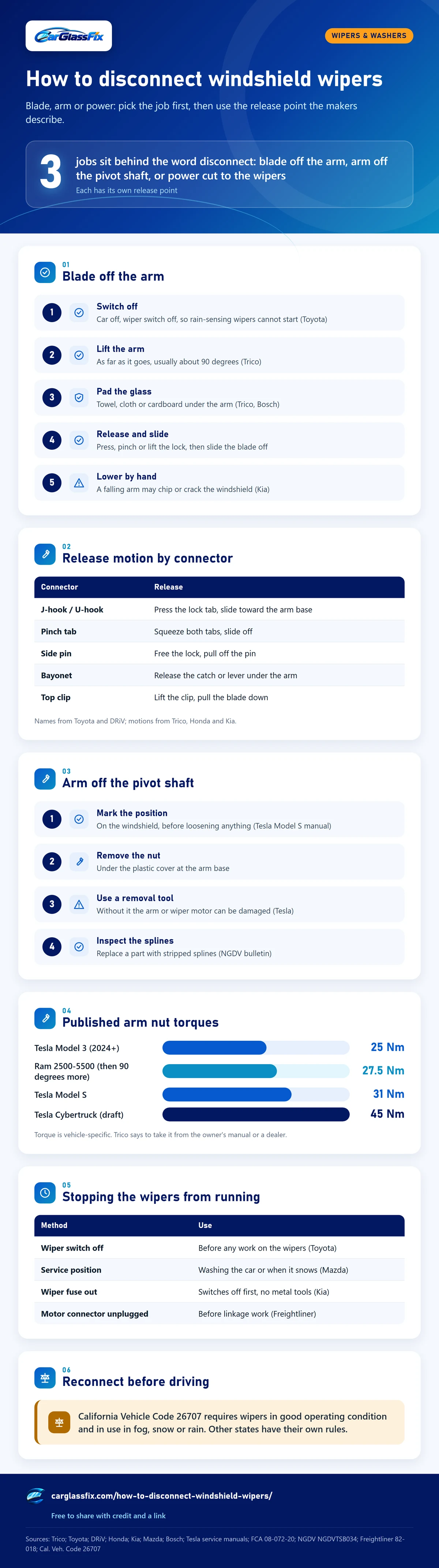
To disconnect windshield wipers, first decide which part has to come off. A wiper blade unclips from the arm at its connector, usually a lock tab on a J-hook. A wiper arm lifts off its pivot shaft after the nut is removed. The wiper motor stops when its service mode, fuse or electrical connector is used.
As an Amazon Associate, CarGlassFix earns from qualifying purchases. Amazon links on this page open a product search on Amazon. They are not products we tested.
What it means to disconnect windshield wipers
Disconnecting windshield wipers means one of three jobs: taking the blade off the arm, taking the arm off its pivot shaft, or cutting power so the wipers cannot run. Each job has its own release point and its own risk. Trico describes the wiper system as three main parts. The wiper arms sit on the glass. A linkage hides under the hood. A DC electric motor, usually near the firewall, drives the linkage. The blade is the rubber-edged part clipped to the end of each arm. Trico says each arm is attached to a threaded pivot shaft and secured with a nut. The table shows which job matches which goal.
| Job | What comes off | Release point | Tools the sources name |
|---|---|---|---|
| Take the blade off | Wiper blade only | Lock tab, pinch tabs, clip or catch at the connector | None on most cars (Toyota); needle-nose pliers for a stubborn tab (Ford) |
| Take the arm off | Arm and blade together | Nut on the pivot shaft, under a plastic cover | Socket, wiper arm removal tool, torque wrench (Tesla, NGDV bulletin) |
| Stop the wipers running | Nothing; power is cut | Wiper switch, service mode, fuse or motor connector | Fuse puller; no metal objects on fuses (Kia) |
This page covers removal only. Fitting new blades is covered in how to replace windshield wiper blades. Blade lengths for your car are in the wiper blade size finder.
How to remove wiper blades from the arm
A wiper blade comes off when the lock on its connector is released and the blade slides off the end of the raised arm. Toyota says the job needs no tools on most cars.
Preparation matters more than the unclipping. Toyota says to turn the car off and set the wipers to off, which matters most with rain-sensing wipers. Some cars park the wipers below the hood edge. Toyota warns against lifting those arms from the retracted position, because they can hit the hood. Automakers publish a service position for this. Honda’s 2024 Integra manual holds the wiper switch at MIST for more than two seconds, within 10 seconds of switching the vehicle off. Kia’s 2023 Sorento Plug-in Hybrid manual allows 20 seconds. Mazda’s 2026 CX-30 manual presses MIST twice within 30 seconds. Honda adds that the arms may be damaged if they are moved manually. Ford’s support page switches the ignition off while the blades stand vertical on the glass. The steps below follow Trico’s guide and those manuals.
How to take a wiper blade off the arm
Switch everything off
Turn the car off and set the wiper switch to off, so rain-sensing wipers cannot start (Toyota).
Use the service position
If the wipers park under the hood edge, raise them with the sequence in the owner’s manual.
Lift the arm
Raise the arm as far as it goes, usually about 90 degrees, until it holds itself up (Trico).
Pad the glass
Lay a towel, cloth or piece of cardboard where the blade normally rests (Trico, Bosch).
Release the lock
Press, pinch or lift the tab, button or clip where the blade meets the arm.
Slide the blade off
On a J-hook, slide the blade down toward the base of the arm until it unhooks (Trico).
Lower the arm by hand
Set the bare arm down on the towel. Mazda says to lower the wipers slowly.
The bare arm is the main hazard. Kia’s manual says a falling arm may chip or crack the windshield. Trico gives the same warning about a metal arm that smacks the glass.
Taking wiper blades off by connector type
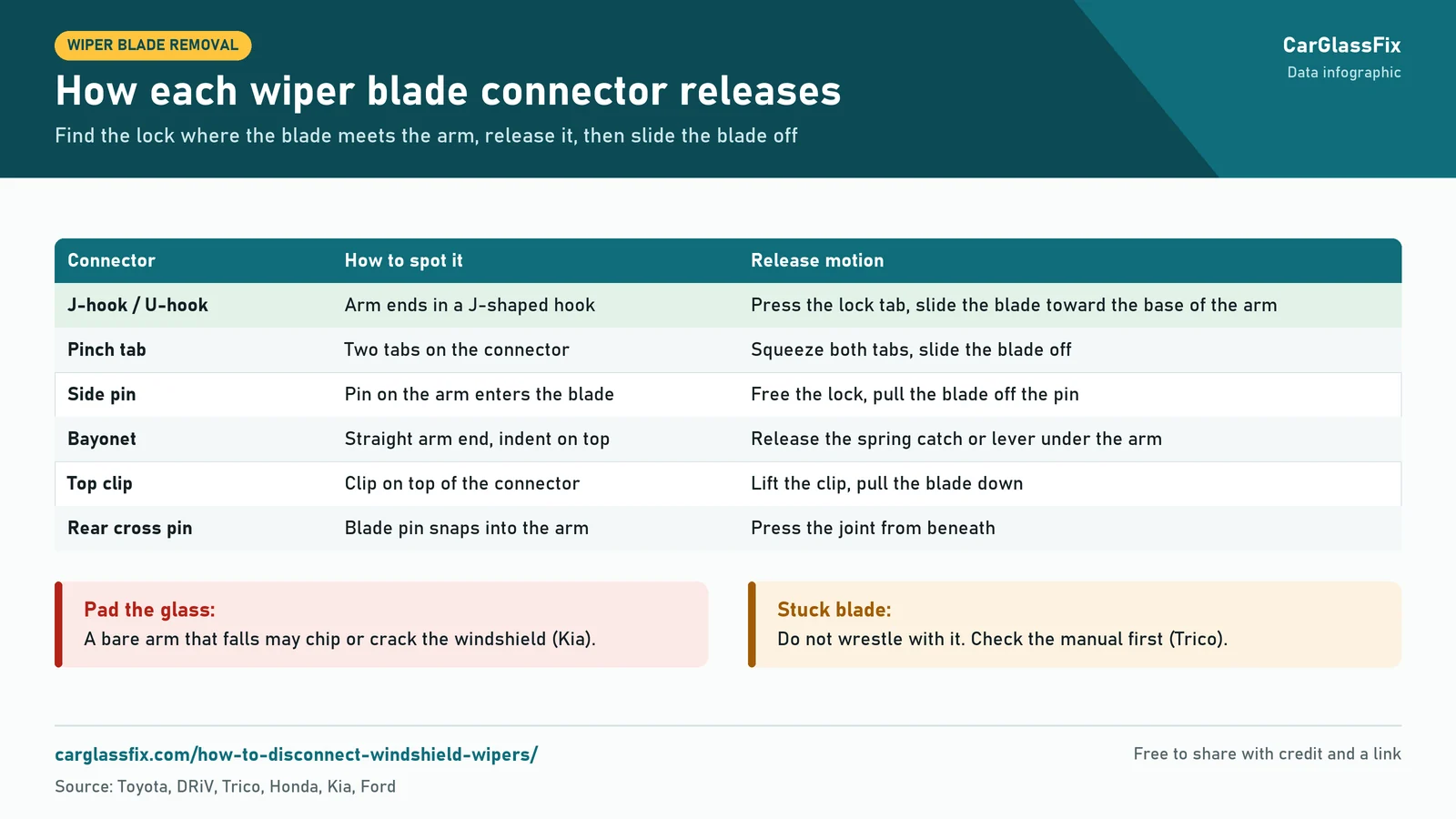
Each connector type releases with its own motion, so identify the connector before pulling on the blade. DRiV, an aftermarket parts maker, calls J-hook, side pin and bayonet the three most common styles. Trico’s rule covers the rest: connectors other than the J-hook have a tab or button to lift or push, and a locking tab must be disengaged first.
J-hook or U-hook
A J-hook blade slides down the arm, toward the pivot, to unhook. Toyota calls the J-hook or U-hook the most common connector. Honda’s Integra manual says to depress the lock tab, then slide the blade off the arm. Ford’s page turns the blade at an angle to the arm, squeezes the lock tab on the bottom of the arm and slides the blade out. DRiV lists hook variants including 7 mm, 9×3 and 9×4.
Pinch tab
A pinch tab blade releases when both tabs are squeezed together. Trico says to pinch the two tabs on the underside and firmly slide the blade off the arm. Toyota describes a second version, the pinch tab button, with an extra locking buttonhole.
Side pin
A side pin blade pulls sideways off a small pin on the arm once its lock is free. Toyota and DRiV describe a pin on the arm that fits a hole in the blade and locks. Trico’s installation text holds the blade at 90 degrees, pushes it onto the pin and rotates it under a tab on the arm. Removal reverses that motion. DRiV lists pin sizes of 3/16 inch, 1/4 inch, 19 mm and 22 mm.
Bayonet
A bayonet blade slides off a straight arm end after its catch is released. DRiV says a small indent on top fits a hole, and a spring catch or lever under the arm locks it.
Top clip and push button
A top-locking blade releases at a clip or button on the upper side of the connector. Kia’s Sorento manual says to lift up the wiper blade clip, then pull the blade assembly down. Trico’s push button text describes a button on the adapter that locks into a hole in the top of the arm, so pressing it frees the blade.
Rear connectors
Rear wipers use other locks. Ford’s rear arm holds a cross pin in a snap fitting. Ford says to press on the joint from beneath, and warns that excessive force can break the arm at the heel.
Trico’s advice for a stuck blade is short: “you shouldn’t have to wrestle with it.” Check the owner’s manual before using force.
How to take a wiper arm off the pivot shaft
A wiper arm comes off after the nut on its pivot shaft is removed and the arm is pulled off the shaft’s splines. Trico notes that a plastic cover often hides this nut.
Tools and order of work
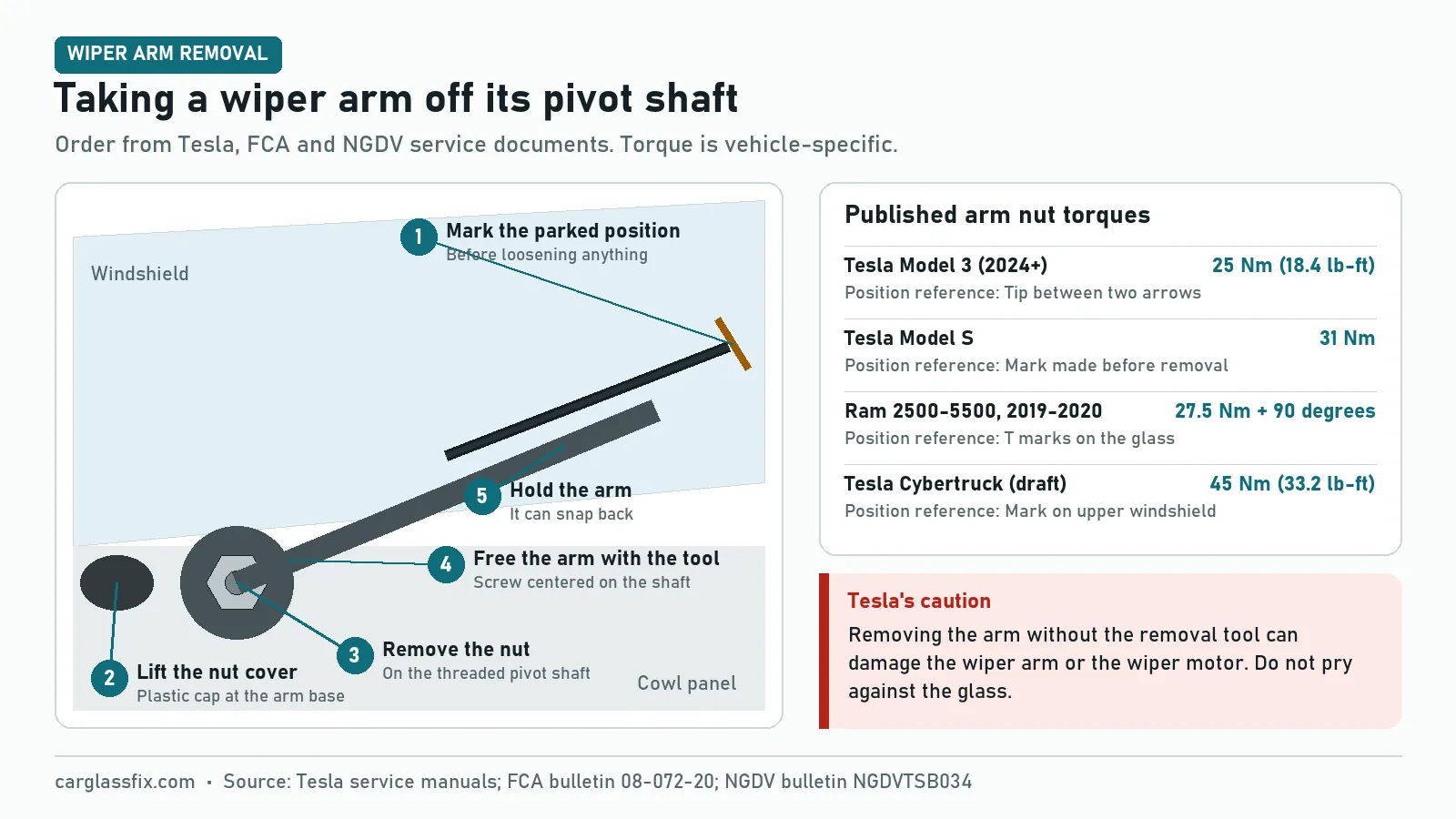
Service documents agree on the order: mark, nut, then puller. Tesla’s Model S service manual turns the wipers off, opens the hood and marks the installed position of the arm on the windshield. The Model S manual then removes the nut and frees the arm with a wiper arm removal tool. Tesla cautions that removing the arm without the tool “can result in damage to the wiper arm or wiper motor.” A Thor Motor Coach repair sheet filed with NHTSA allows channel-lock pliers or a small two-jaw puller. The puller’s fingers hook under the arm head, and the center of the pivot shaft is the leverage point. Parts stores sell a wiper arm puller for this job. Tesla’s draft Cybertruck procedure gives a fallback without the tool: press toward the base of the arm and rock it side to side while lifting. That procedure says never to pry against the glass.
How to remove a wiper arm
Park and switch off
Turn the wiper switch off and let the blades reach the parked position (FCA bulletin 08-072-20).
Mark the position
Mark where the arm or blade sits on the windshield before loosening anything (Tesla Model S manual).
Lift the nut cover
Remove the plastic cap over the nut at the base of the arm.
Remove the nut
Undo the nut on the pivot shaft with a socket. Tesla lists 15 mm on Model 3 and 18 mm on Cybertruck.
Free the arm
Seat the removal tool under the arm, center its screw on the shaft and tighten until the arm releases (Tesla).
Control the spring
Hold the arm so it cannot snap back at its hinge and hit the windshield (NGDV bulletin).
Inspect the splines
Check the splines inside the arm and on the shaft, and replace a part with stripped splines (NGDV bulletin).
Park position and nut torque
The mark matters because the arm can go back on the splines in the wrong position. FCA’s bulletin for 2019-2020 Ram heavy-duty trucks centers each blade on a T mark printed on the windshield. Tesla’s Model 3 manual sets the blade tip between two arrows on the glass. Nut torque is vehicle-specific, as the table shows.
| Vehicle and document | Arm nut torque | Position reference |
|---|---|---|
| Tesla Model 3 (2024+ service manual) | 25 Nm (18.4 lb-ft), 15 mm socket | Blade tip between two arrows on the windshield |
| Tesla Model S (service manual) | 31 Nm | Mark made on the windshield before removal |
| 2019-2020 Ram 2500 to 5500 (FCA bulletin 08-072-20) | 27.5 Nm (20 ft-lb), then a further 90 degree turn | T marks on the windshield |
| Tesla Cybertruck (draft service manual) | 45 Nm (33.2 lb-ft), 18 mm socket, no power tools | Mark on the upper windshield area |
Trico says to get the correct torque from the owner’s manual or a dealer. Some makers also replace hardware. The NGDV bulletin discards the old locknut, and Thor does not recommend reusing its arms after removal. A GM bulletin for the 2018 Buick Enclave removes both arms to reach the pivot shafts, which is covered in how to lubricate windshield wipers.
How to stop windshield wipers from running
Wipers stop running when the switch is off, when a service mode holds them, or when the circuit loses power at the fuse or the motor connector. The right method depends on how long the wipers must stay still.
| Method | What it does | What the source says |
|---|---|---|
| Wiper switch off | Stops normal and rain-sensing wiping | Toyota: set the wipers to off before working on them |
| Service or maintenance position | Parks the arms raised on the glass | Mazda: use it when washing the vehicle or when it snows |
| Remove the wiper fuse | Cuts power to the circuit | Kia: switches off first, no metal tools, same rating when refitted |
| Unplug the motor connector | Stops the motor cycling during linkage work | Freightliner: disconnect it before working on the wiper linkage |
Switch and service position
The switch and the service position are the two methods owner’s manuals give drivers. Mazda’s CX-30 manual says to raise the wipers when washing the vehicle, when it snows, or when replacing the blade rubber. NHTSA closed an investigation of 2024-2025 Kia EV9 wipers in March 2026. Kia’s remedy includes a manual revision that recommends service mode when the vehicle is parked outdoors and snow is forecast. Honda returns the arms by switching the power on and pressing MIST once.
Fuse
Removing the wiper fuse cuts power without touching the motor. Kia’s 2026 owner’s manual places fuse panels in the driver’s side panel bolster and in the engine compartment. Kia says to turn the vehicle and all switches off first. The same manual forbids screwdrivers or other metal objects on fuses. A refitted fuse must have the same rating. Kia notes that the panel label may differ from the equipment fitted, so confirm the fuse in your own manual.
Motor connector
Unplugging the motor’s electrical connector is the method service bulletins use before linkage work. Freightliner’s bulletin 82-018 explains the reason: the motor could cycle if the linkage is forced out of the parked position, “which could result in personal injury.” GM’s recall bulletin 15780A also disconnects the wiper motor connection before the motor cover comes off. If the wipers run by themselves or will not park, the fault needs a diagnosis first. Start with how to fix windshield wipers, then how to test a windshield wiper motor.
Is it safe or legal to drive with the wipers disconnected
Driving with the wipers disconnected is unsafe in rain, snow or fog, and state equipment laws require working wipers. The federal rule, FMVSS 104, applies to vehicle makers. It requires each new passenger car, truck and bus to have a power-driven wiping system with at least two speeds, one of at least 45 cycles per minute. State codes then cover the vehicle in use. California Vehicle Code 26706 requires a self-operating windshield wiper on every motor vehicle with a windshield, except motorcycles. Section 26707 requires wipers to be kept in good operating condition and operated in fog, snow or rain. Commercial trucks and buses fall under 49 CFR 393.78. That rule waives working wipers only while a vehicle is towed in a driveaway-towaway operation.
What automakers tell owners
One recall shows how automakers treat a car that cannot use its wipers. In 2015, GM told owners of certain 2016 Buick Enclave, Chevrolet Traverse and GMC Acadia vehicles not to use the wipers until a motor defect was repaired. GM’s letter said that if weather prevented driving without wipers, the dealer would collect the vehicle. NHTSA’s EV9 summary states the risk plainly: inoperative wipers could reduce driver visibility in bad weather and increase the risk of a crash.
The practical rule follows from those sources. Disconnect the wipers for a repair, a wash or a snowfall while parked, and reconnect them before the car goes back on the road. Laws differ by state, so check your state’s vehicle code or inspection rules. This page is not legal advice.
How to attach wiper blades after removal
A wiper blade attaches by reversing its release: it pushes onto the arm until the lock clicks. Trico says to push a J-hook blade into the arm hook until it locks in place with a click. Honda’s manual slides the new blade onto the arm until it clicks into place. Rain-X says to tug the blade to confirm it is secure. Before refitting an old blade, run through how to check windshield wipers for wear. Trico tells buyers to compare the old and new blades for the same size and attachment design. Lower each arm by hand, then leave the service position as the manual describes. Trico says to clean the windshield and test the wipers with washer fluid, never on dry glass. The full fitting steps for each arm type are in our guide on how to replace windshield wiper blades. If refitted blades chatter, see how to stop windshield wipers from squeaking.
Frequently asked questions
How do I unclip my windshield wipers?
Lift the arm, find the lock where the blade meets the arm, and release it. Trico says a J-hook blade slides down toward the base of the arm, and a pinch tab blade comes off when both tabs are squeezed. Put a towel on the glass first.
How do I switch off windshield wipers that keep running?
Set the wiper switch to off, including the automatic or rain-sensing setting. If the wipers still run or will not park, the fault is electrical, so follow how to fix windshield wipers before pulling a fuse.
How do you remove wiper blades without a J-hook?
Look for tabs, a clip or a catch. Pinch tab blades release when both tabs are squeezed, top clip blades when the clip is lifted (Kia), and bayonet blades when the spring catch or lever under the arm is released (DRiV).
Do I need a puller to remove a wiper arm?
Tesla’s service manuals call for a wiper arm removal tool and warn that removal without it can damage the arm or the wiper motor. A Thor Motor Coach repair sheet allows channel-lock pliers or a small two-jaw puller once the nut is off.
Can you drive with the windshield wipers disconnected?
Not safely in rain, snow or fog. California Vehicle Code 26707, for example, requires wipers in good operating condition and in use in those conditions, and other states have their own rules. Reconnect the wipers before driving.
Sources
- Trico, How to Replace Your Windshield Wipers
- Trico, How Windshield Wipers Work: Components and Mechanisms
- Trico installation text, side pin arm and push button arm
- DRiV, Windshield Wiper Connectors
- Toyota, How to Change Windshield Wiper Blades
- Honda, 2024 Integra owner’s manual, Changing the Wiper Blade
- Kia, 2023 Sorento Plug-in Hybrid owner’s manual, wiper blades
- Kia, 2026 owner’s manual, Fuses
- Mazda, 2026 CX-30 owner’s manual, Raising the Front Windshield Wipers
- Ford, How do I change my Ford’s windshield wiper blades?
- Bosch, Tips and tricks for replacing wiper blades (2024)
- Rain-X, Wiper Blade Information and Maintenance
- Tesla Model S service manual, Wiper Arm LH (Remove and Replace)
- Tesla Model 3 2024+ service manual, Wiper Arm Driver Side (Remove and Replace)
- Tesla Cybertruck service manual (draft), Wiper Arm Windshield (Remove and Install)
- FCA US bulletin 08-072-20, Loose Wiper Arms (July 31, 2020), via NHTSA
- NGDV bulletin NGDVTSB034, Wiper Arm Alignment and Torque (April 2025), NHTSA recall 25V-192
- Thor Motor Coach, windshield wiper inspection and repair instructions (2017), NHTSA recall 17V-555
- GM bulletin 18-NA-003 (January 2018), via NHTSA
- Freightliner service bulletin 82-018, Wiper Motor Repair (August 2019), via NHTSA
- GM recall bulletin 15780A, Windshield Wiper Motor Failure (October 2015), NHTSA recall 15V-609
- NHTSA, PE25-004 closing resume, Kia EV9 windshield wipers (closed March 11, 2026)
- 49 CFR 571.104, FMVSS 104 Windshield wiping and washing systems (checked 2026-11-26)
- 49 CFR 393.78, Windshield wiping and washing systems (checked 2026-11-26)
- California Vehicle Code 26706 and 26707 (checked 2026-11-26)

Similar Posts