Vermont Window Tint Laws: No Film Beside the Driver
Senior Automotive Glass Diagnostic Specialist & Master Technician at CarGlassFix · AGSC Master Certified Auto Glass Technician, NGA Certified Installer, I-CAR Automotive Safety Specialist · 12+ Years in Automotive Glazing, Windshield Structural Bonding, ADAS Camera Calibration & Precision Chip Restoration
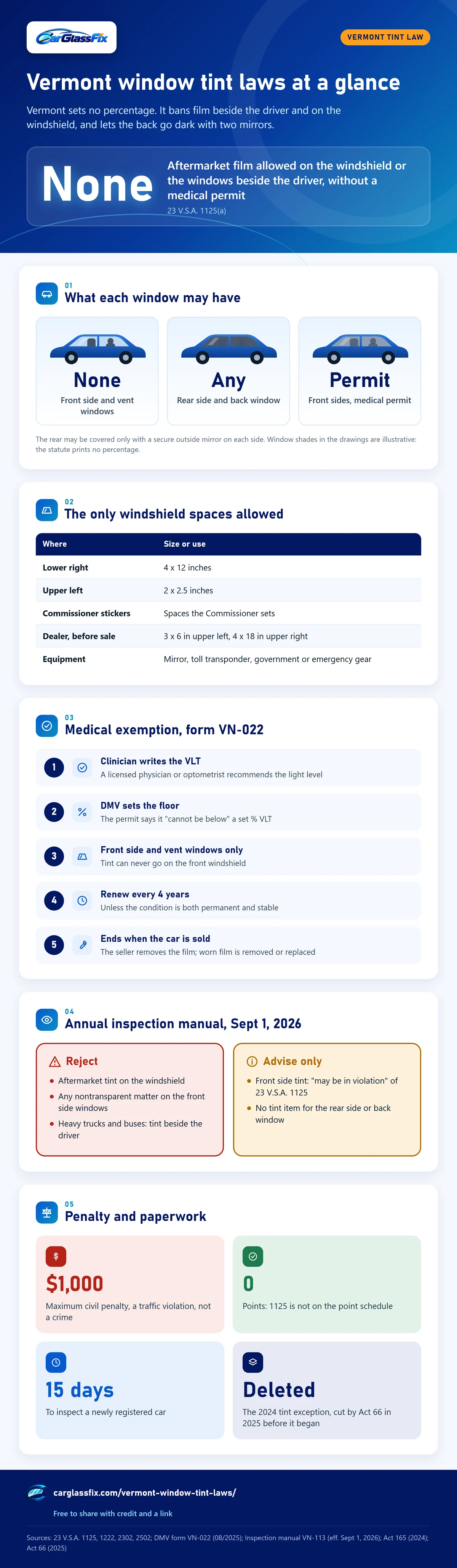
Vermont window tint laws ban aftermarket film on the windshield and on the side windows next to the driver, and the statute sets no legal percentage for them. Rear side windows and the back window may have any darkness if the vehicle has a secure mirror on each side. A medical permit covers the front sides only.
Vermont window tint limits by window
Vermont allows no aftermarket film on the windshield or the front side windows, and any darkness behind the driver with two side mirrors. All of these rules sit in one section, 23 V.S.A. 1125, titled “Obstructing windshields, windows”. The section does not separate sedans from SUVs, vans or pickups, so every column below reads the same. Many states write a percentage for each window. Vermont writes a list of places where material may not go, then a short list of exceptions. Section 1125 also says nothing about reflectivity, banned colors, installer labels or a tolerance, because it never measures the film at all. Those topics simply have no Vermont figure.
| Window | Sedan | SUV, van, pickup |
|---|---|---|
| Windshield | No tint; only the small listed spaces in 1125(b) | Same |
| Front side and vent windows | No film without a DMV medical exemption | Same |
| Rear side windows | Any darkness, with a secure mirror on each side | Same |
| Back window | Any darkness, with a secure mirror on each side | Same |
| Legal percentage (VLT) | None stated | None stated |
| Reflectivity, colors, tolerance | None stated in 1125 | None stated in 1125 |
Why Vermont has no legal tint percentage
Vermont has no legal tint percentage because 1125 bans the material itself on the front glass, whatever its shade. Subsection (a) says a person “shall not operate a motor vehicle” with material or items “painted or adhered on or over” any transparent part of the windshield, vent windows, or side windows “located immediately to the left and right of the operator.” A 70% film and a 5% film are treated alike there.
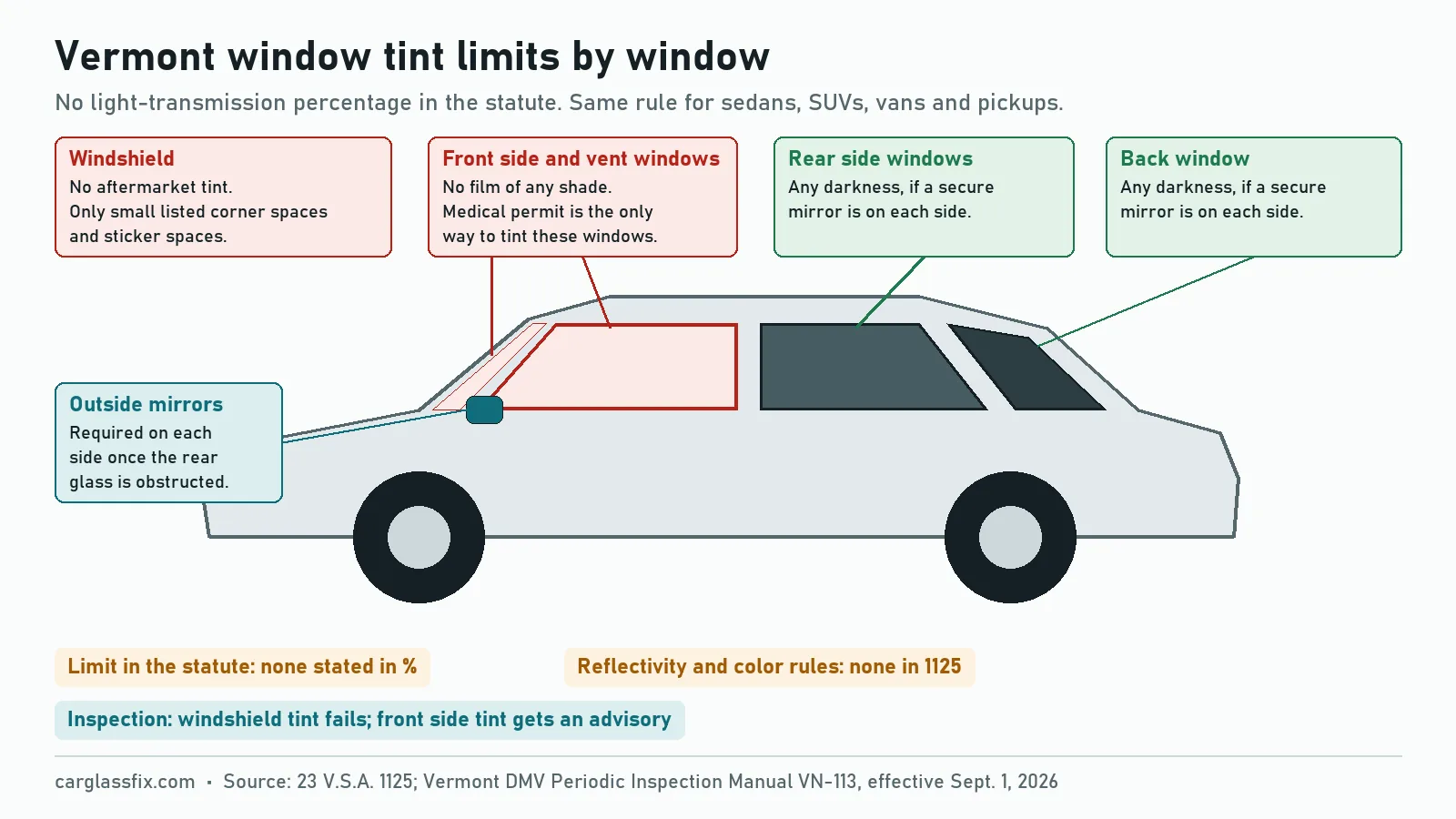
Behind the driver, the wording flips. Subsection (d) says the rear side windows and back window “may be obstructed only if” the vehicle has a securely attached mirror on each side, with a clear view of the road behind and on both sides. The law sets the condition on the mirrors, so film darkness never enters into it. Any shade on our window tint percentage chart is legal back there once both mirrors are in place. A meter reading cannot make front film legal, so how to measure window tint matters here mainly for checking the VLT figure on a medical permit. The section’s hanging-item rule is narrower: hung items count “only when” they materially obstruct the driver’s view.
What is allowed on a Vermont windshield
A Vermont windshield may carry material only in the spaces listed in 1125(b), and the law has no tint strip. Vermont has no AS-1 rule or “top 5 inches” rule, so a shade band above the AS-1 line on a windshield has no statutory exception of its own. The inspection manual is blunter: a station must reject a car if “there is an aftermarket tint applied to the windshield.” A band inside the small corner spaces is not separately addressed, so treat any windshield film as a likely failure. The law for other states differs, as is it illegal to have tint on a windshield explains.
| Allowed space or item | Size or limit | Subsection |
|---|---|---|
| Lower right corner | Up to 4 in high, 12 in long | 1125(b)(1) |
| Stickers required by government rule | Where the Commissioner specifies | 1125(b)(2) |
| Upper left corner | Up to 2 in high, 2.5 in long | 1125(b)(3) |
| Government or emergency responder equipment | Behind the windshield, clear of the controls | 1125(b)(4) |
| Dealer spaces before sale | 3 x 6 in upper left; 4 x 18 in upper right | 1125(b)(5) |
| Rearview mirror or toll transponder | Transponder between roof line and mirror post, or behind the mirror | 1125(b)(6) |
What Act 66 changed in 2025
Act 66 of 2025 cancelled a tint law that had been passed but had not started. In 2024, Act 165, Sec. 14, rewrote 1125 with a new exception for tint whose light transmission was “not less than the level” required under 49 C.F.R. 571.205, the federal glazing standard. NHTSA letters describe that level as 70% in the areas needed for driving visibility. The change was due on July 1, 2026, under Sec. 52(b) of the act.
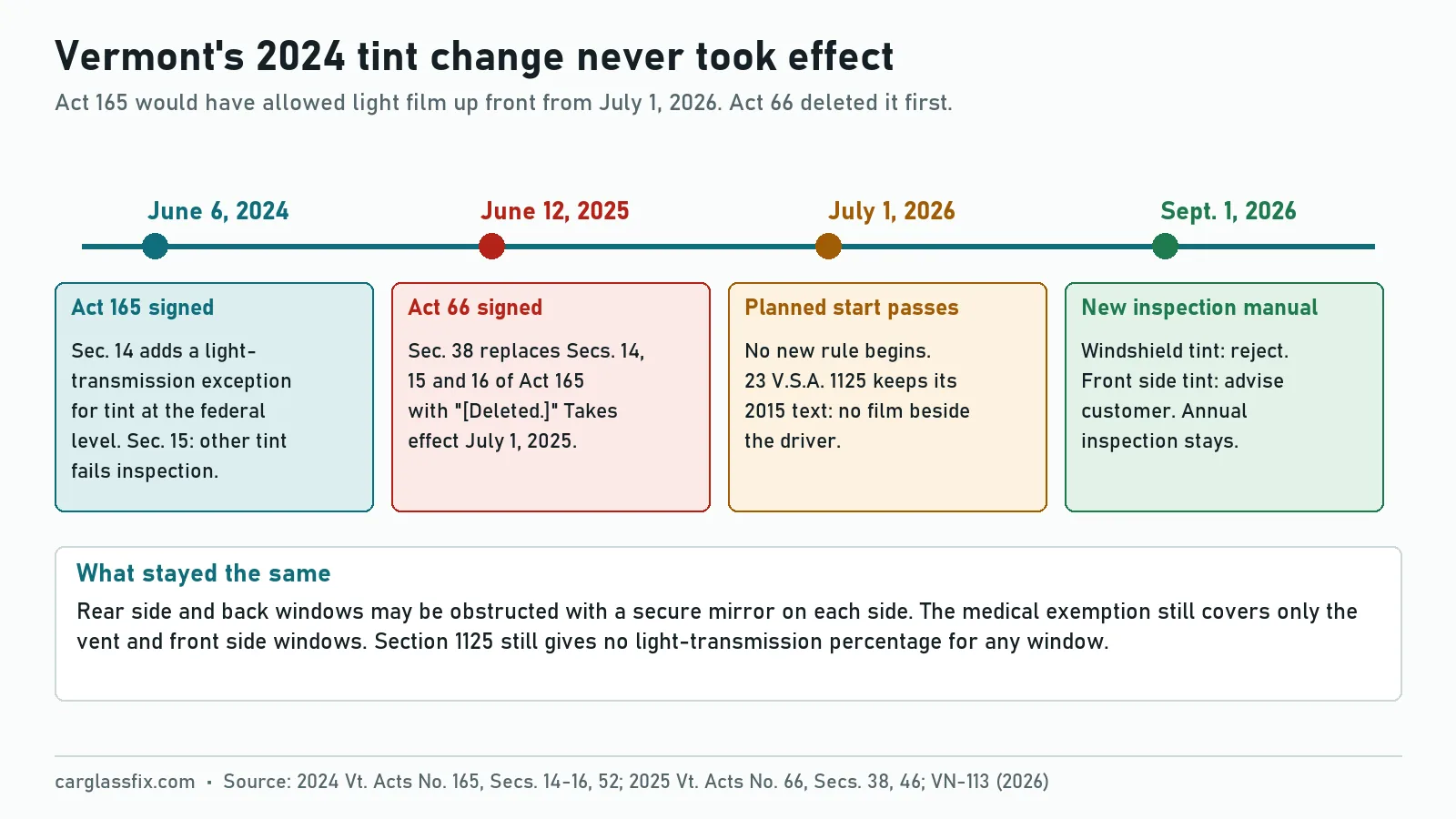
Sec. 15 of Act 165 stated the intent that a vehicle with disallowed tint “shall fail” the annual inspection, and Sec. 16 ordered matching rules and public outreach. Act 66, signed on June 12, 2025, then replaced all three sections in one line each: “[Deleted.]” Sec. 38 took effect on July 1, 2025 under the act’s Sec. 46(d). So nothing started on July 1, 2026. The official 1125 page, updated through the 2026 session, shows a history ending in 2015. Older guides and news stories that predict a 70% front rule or a return of inspection failures describe the deleted text.
Does tint fail the annual Vermont inspection
Windshield tint fails the Vermont inspection, while front side tint on a car or light truck draws only an advisory. Section 1222(a) of Title 23 requires a safety inspection “once each year,” and a bill for two-year inspections became a study in 2026, Vermont Public reported. The rule that matters is the DMV’s Periodic Inspection Manual, VN-113, effective September 1, 2026.
For side windows next to the driver, the Pleasure Car and Light Truck section tells the mechanic to advise the customer that aftermarket tint “may be in violation” of 1125. Two limits apply. The same section still rejects “any nontransparent matter” on those windows, and the manual does not define where very dark film crosses that line. The Heavy Truck and Bus section is stricter: it rejects aftermarket tint on the windshield or the windows beside the driver. Passing inspection also does not make the film legal, because 1125 applies whenever the car is driven. Act 153 of the 2026 session, Sec. 22, told the DMV to fail cars only for an immediate safety risk. For glass damage rules, see will a car pass inspection with a cracked windshield.
Vermont medical exemption for window tint
Vermont’s medical exemption is a DMV permit, requested on form VN-022 and certified by a licensed physician or optometrist. Section 1125(c) lets the Commissioner of Motor Vehicles grant it to a person “required for medical reasons to be shielded from the rays of the sun.” The exemption is limited to the vent windows and the side windows beside the driver. Form VN-022 adds that tint “cannot be applied to the front windshield.” The statute gives no percentage, but the form does the work: the clinician enters a recommended VLT, and the DMV’s approval states the lowest VLT allowed.
How to get a Vermont window tint medical exemption
Complete Section 1 of VN-022
Enter the applicant, the person the exemption is for if different, and up to three vehicles by plate.
Have the clinician complete Section 2
A licensed physician or optometrist gives the diagnosis, a recommended VLT, a permit length and a signed medical necessity declaration.
Mail the form
Send it to Vermont DMV, 120 State Street, Montpelier, Vermont 05603.
Read the approval
The DMV states the term and the VLT your film cannot go below.
Keep the permit in the vehicle
The permit stays in the primary vehicle, a copy goes in each other listed vehicle, and an officer may ask to inspect it.
The term is four years for a temporary condition. Section 1125(c) allows renewal without a new clinician form when a condition was certified as “both permanent and stable,” and the form calls that an indefinite permit. The exemption ends when the vehicle is sold or transferred, and the seller must remove the tint. Film that tears, bubbles or wears so it blocks clear vision must be removed or replaced.
Vermont window tint fines and points
A Vermont tint violation carries a civil penalty of not more than $1,000 under the general traffic rule. Section 1125 states no penalty of its own. Section 2302(c) of Title 23 fills the gap: a traffic law violation “for which no penalty is otherwise provided shall be subject to a penalty of not more than $1,000.00.” Section 2302(b) says a traffic violation “is not a crime and shall be treated as a civil action,” and the Judicial Bureau hears these cases under 4 V.S.A. 1102(b).
That $1,000 is a ceiling, and the amount on an actual ticket can be lower. We found no official schedule that lists a tint amount, so this page gives no typical figure. Section 1125 does not appear in the point schedule in 23 V.S.A. 2502, which does list a separate offense, 1118, obstructing the driver’s view. Section 2302(a)(3) refers to scheduled penalties set under 4 V.S.A. 1102(d), so ask the Judicial Bureau about a specific ticket. An inspection advisory is not a ticket, though the wording in the manual warns the owner that the windows may break the law.
Factory tint, out-of-state cars and used cars
Section 1125 targets material added to the glass, so it reaches film and sprayed coatings more clearly than tint built into the glass. The inspection manual uses the word “aftermarket,” which points the same way, though neither text names factory privacy glass. Clear film is less certain: the statute’s words “material or items” have no exception for clear products, so ask the DMV before fitting one up front.
Section 1125 has no exception for out-of-state vehicles, because it applies to any person operating a motor vehicle. Inspection is different: 1222(a) covers vehicles registered in Vermont, and a newly registered vehicle must be inspected within 15 days. Anyone moving to Vermont with tinted front glass can expect the advisory at that first visit. Removal is covered in how to remove car window tint. To preview a legal rear shade, use the window tint simulator, and compare states in what car window tint is legal.
Vermont tint rules can change in any legislative session. Check the current 23 V.S.A. 1125 or the Vermont DMV before you tint. This article is general information, not legal advice.
Frequently asked questions
What are the legal restrictions on tinting car windows in Vermont?
Vermont bars aftermarket film on the windshield, vent windows and the side windows next to the driver unless the DMV grants a medical exemption. Rear side windows and the back window may be any shade if the vehicle has a secure mirror on each side.
Will tint fail a Vermont inspection?
Aftermarket tint on the windshield fails. On a car or light truck, tint on the windows beside the driver draws an advisory that it may violate 1125, under the manual effective September 1, 2026. Nontransparent matter on those windows is still a rejection.
Is 70% tint legal on front windows in Vermont?
No percentage is legal on the front side windows under 1125, including a light 70% film. The 2024 exception tied to the federal level was deleted by Act 66 before it took effect.
Is 15% or 30% tint darker?
A 15% tint is darker because it lets through less visible light than a 30% tint. In Vermont either shade is legal only behind the driver, with a mirror on each side. See the window tint percentage chart for each shade.
How do I get a medical tint exemption in Vermont?
Have a licensed physician or optometrist complete and sign DMV form VN-022, then mail it to Vermont DMV in Montpelier. Approval covers the listed vehicles’ vent and front side windows, never the windshield.
Sources
- 23 V.S.A. 1125, Obstructing windshields, windows (checked 30 October 2026)
- 23 V.S.A. 1222, Inspection of registered vehicles (checked 30 October 2026)
- 23 V.S.A. 2302, Traffic violation defined and 23 V.S.A. chapter 25, point system (section 2502) (checked 30 October 2026)
- 4 V.S.A. 1102, Judicial Bureau jurisdiction (checked 30 October 2026)
- 2025 Acts and Resolves No. 66, Secs. 38 and 46 and S.123 bill status
- 2024 Acts and Resolves No. 165, Secs. 14 to 16 and 52
- 2025 Acts and Resolves No. 153 (Adj. Sess.), Sec. 22
- Vermont DMV Periodic Inspection Manual, VN-113 (effective 1 September 2026)
- Vermont DMV Window Tint Permit Application, VN-022 (form revision 08/2025)
- 49 C.F.R. 571.205, Glazing materials and NHTSA interpretation letter on Standard No. 205
- Vermont Public: new car inspection rules (21 August 2026)

Similar Posts