Idaho Window Tint Laws: 35% Front, 20% Rear by Window
Senior Automotive Glass Diagnostic Specialist & Master Technician at CarGlassFix · AGSC Master Certified Auto Glass Technician, NGA Certified Installer, I-CAR Automotive Safety Specialist · 12+ Years in Automotive Glazing, Windshield Structural Bonding, ADAS Camera Calibration & Precision Chip Restoration
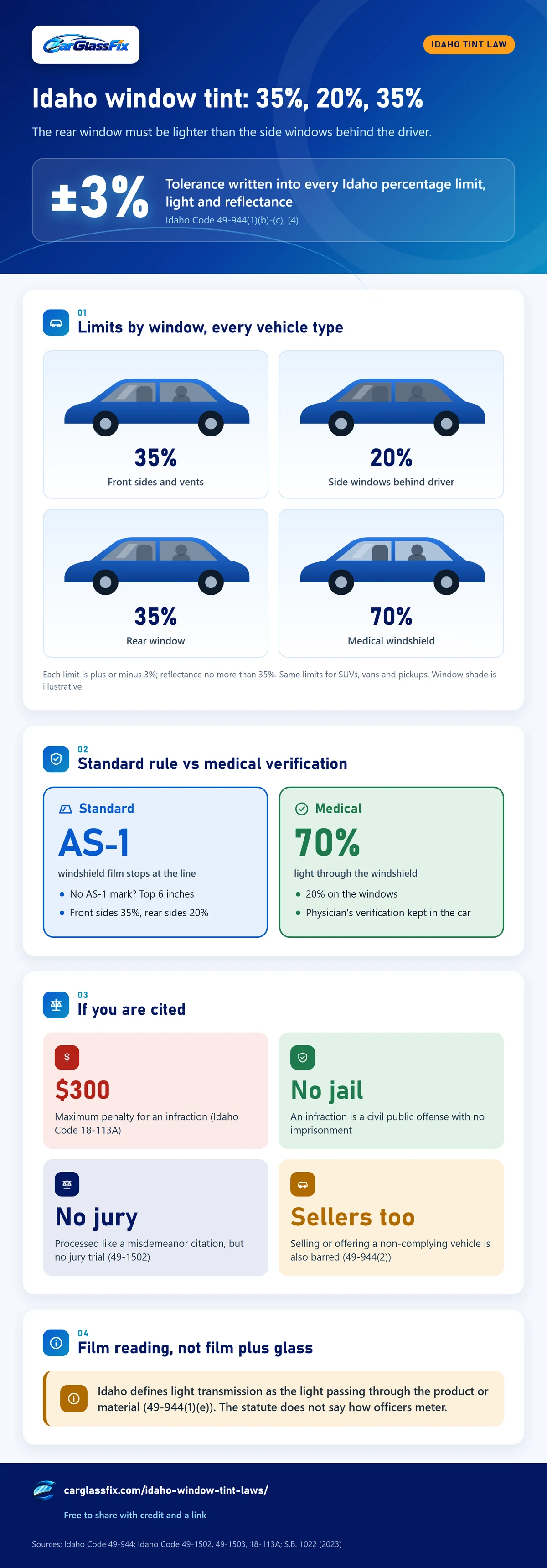
Idaho window tint laws require the front side windows and the rear window to pass at least 35% of light, and the side windows behind the driver at least 20%, each with a 3% tolerance and a 35% reflectance cap. Windshield film must stay above the AS-1 line or the top 6 inches. Trucks and SUVs share these limits.
Idaho window tint limits by window
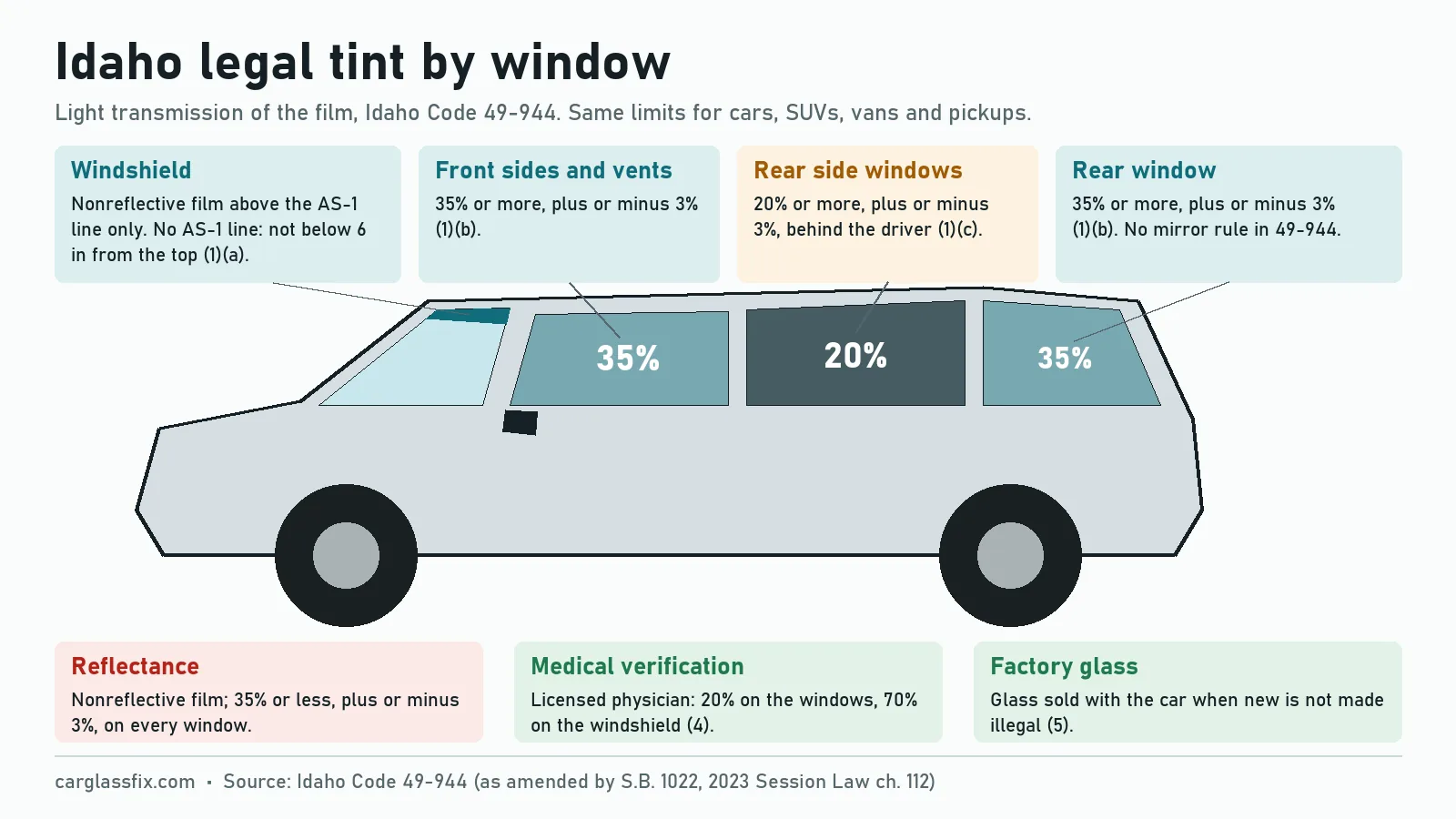
Idaho allows 35% film on the front side windows and the rear window, and 20% film on the side windows behind the driver. The rule is Idaho Code 49-944, which starts by making it unlawful to apply any tint film and then lists what is allowed. Subsection (1)(b) covers the “front side vents, front side windows to the immediate right and left of the driver, and the rear window”. Subsection (1)(c) covers the “side windows to the rear of the driver”. The statute does not split vehicles into passenger cars and multipurpose vehicles. A sedan, an SUV, a minivan and a pickup all follow the same numbers. Idaho also names no banned colors and sets no outside mirror condition for a tinted rear window. Each allowed film must be nonreflective. The what car window tint is legal guide compares these limits with other states.
| Window | Sedan | SUV, van, pickup |
|---|---|---|
| Windshield | Nonreflective film above the AS-1 line only; without an AS-1 line, not below 6 in from the top | Same |
| Front side windows and front vents | 35% light or more, plus or minus 3% | Same |
| Side windows behind the driver | 20% light or more, plus or minus 3% | Same |
| Rear window | 35% light or more, plus or minus 3% | Same |
| Reflectance | 35% or less, plus or minus 3%, on every side and rear window | Same |
| Medical verification | 20% on the windows, 70% on the windshield | Same |
| Factory glass | Never made illegal by 49-944(5) | Same |
How Idaho measures tint: the film, the tolerance and reflectance
Idaho writes its limits for the film itself, not for the film and glass together. Subsection (1)(e) defines light transmission as the share of light “allowed to pass through the product or material”. The product is the tint film or sunscreening device, which (1)(d) describes as material used “in conjunction with approved vehicle glazing materials”.
Many states measure the finished window instead. Factory glass blocks some light on its own, so a window often reads darker than the film box says. The statute does not say how an officer meters a car at a stop. A window tint meter reads the whole window, and our guide on how to measure window tint shows the glass and film math. Every limit carries a tolerance of “plus or minus three percent (3%)”. That margin applies to light transmission and to reflectance alike. The reflectance cap of 35% rules out mirror films on the side and rear glass. Subsection (5) protects glass the car was sold with, so factory privacy glass stays legal even when it reads below 20%.
Windshield tint in Idaho: the AS-1 line or 6 inches
An Idaho windshield may carry nonreflective film only above the AS-1 line. Subsection (1)(a) says film “shall not be applied to the windshield below the AS-1 line”. If no AS-1 line is identifiable, the film may not go below a line 6 inches down from the top and parallel to the exposed windshield. The statute sets no light transmission number for this top strip. It only limits how far down the film reaches and requires it to be nonreflective. The AS-1 line is a mark printed near the upper corners of the glass, and the AS-1 line on a windshield explains how to find it.
Below that line, the normal rule allows no film at all. The one exception is the medical rule in subsection (4), which permits film of at least 70% on the front windshield. Clear films are not treated separately in the statute, so they fall under the same wording. For how other states handle the windshield, read is it illegal to have tint on a windshield.
Idaho medical exemption for window tint
Idaho has no medical tint permit or state form; the proof is written verification from a licensed physician, carried in the vehicle. Subsection (4) covers a vehicle “operated by, or carrying as a passenger” a person who must be protected from sunlight or heat. The medical reason must be “associated with past or current treatment”. With that verification, the film may be as dark as 20% on the windows and 70% on the front windshield, each plus or minus 3%. Reflectance stays capped at 35% plus or minus 3%. The statute names only a licensed physician as the signer. It does not list optometrists, and it gives the Idaho State Police no approval role.
The steps below follow the statute text.
How to use the Idaho medical tint exemption
Ask a licensed physician
The verification must come from a licensed physician (49-944(4)).
Get it in writing
The physician states that the driver or passenger must be protected from sunlight or heat for medical reasons tied to past or current treatment.
Choose film within the medical limits
At least 20% on the windows and 70% on the windshield, each plus or minus 3%, nonreflective, with reflectance of 35% or less.
Keep it in the vehicle
The statute says the written verification “shall be carried in the vehicle”.
What changed in 2023, and what other sites get wrong
The 2023 amendment changed no tint limit; it removed an expired 1992 grandfather clause. Senate Bill 1022, from the Senate Judiciary and Rules Committee, passed the Senate 35-0 and the House 68-0. The governor signed it on March 22, 2023, as Session Law Chapter 112, and it took effect on July 1, 2023. The bill page summary says it removes “provisions regarding violations and compliance”.
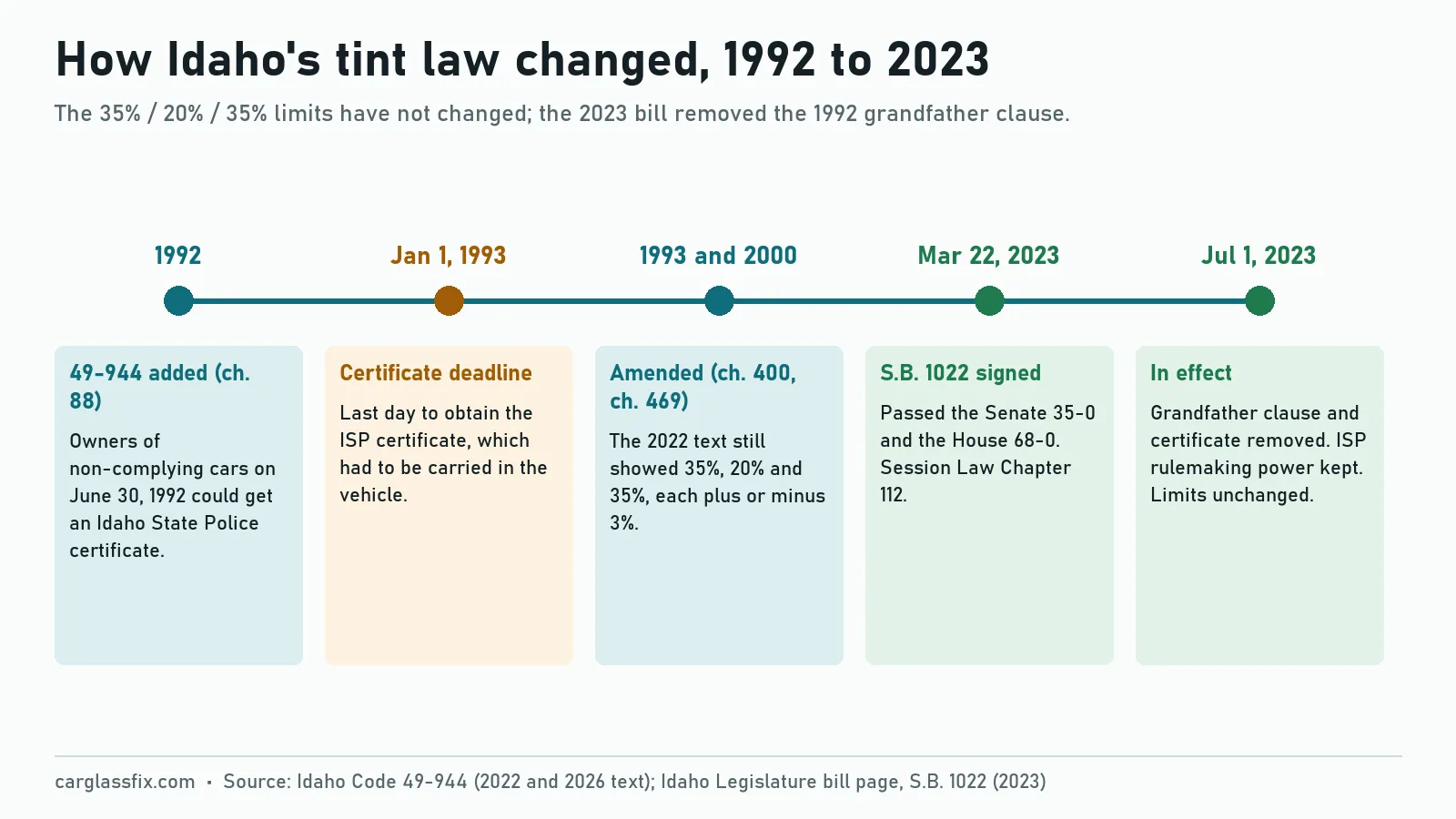
A comparison of the 2022 and 2026 statute text shows what went. Old subsection (3) let owners of non-complying cars on June 30, 1992 obtain an Idaho State Police certificate by January 1, 1993 and carry it. Those certificates no longer protect a car. Several ranking pages also add rules the statute does not contain. A Bing AI answer checked for this page said red and amber are banned and that side mirrors are required with a tinted rear window. Section 49-944 names no colors and no mirror condition. A Facebook answer put the medical windshield level at 75%; the statute says 70%.
Idaho tint ticket: infraction rules and who can be cited
A tint violation in Idaho is an infraction, and it carries no jail time. Subsection (6) says a person convicted under 49-944 “shall be guilty of an infraction”. Idaho Code 49-1502 calls an infraction “a civil public offense” and says there is “no right to a trial by jury”. Idaho Code 18-113A caps the penalty for any infraction at “three hundred dollars ($300)” with “no imprisonment”. The exact amount comes from a fixed schedule in the Idaho Supreme Court Infraction Rules, which 18-113A ties to the amounts in force on January 1, 2014. The rule does not appear in 49-944 itself, so check the citation or the court for the current figure.
The law reaches more people than the driver. Subsection (1) bars any person from installing or applying illegal film. Subsection (2) bars anyone from operating, selling or offering to sell a non-complying vehicle. A 2012 Idaho State Police release said the penalty can be assessed to the driver “as well as the person or place that installed” the tint.
Before you tint a car in Idaho
Pick a film that meets the 35% and 20% limits with room to spare, and keep the windshield strip above the AS-1 line. Idaho’s statute measures the film, so ask the installer which film is going on each window. Darker factory privacy glass on the rear of many SUVs is legal under subsection (5), and film added over it is a separate question the statute does not address. The window tint percentage chart shows how 35% and 20% look side by side. The window tint simulator previews a shade on a car photo before any film is cut.
Limits change at the border. Washington uses 24% measured with the glass, as set out in Washington window tint laws. Oregon adds a film-only rule on top of its 35% limit; see Oregon window tint laws. Rules change with each legislative session. Check the current Idaho Code 49-944 or ask the Idaho State Police before you tint. This article is general information, not legal advice.
Frequently asked questions
Is 20% tint legal in Idaho?
Yes, on the side windows behind the driver, where Idaho Code 49-944(1)(c) allows film of 20% plus or minus 3%. On the front side windows and the rear window, 20% is illegal unless a driver or passenger has written verification from a licensed physician.
Is 20% or 35% tint darker?
A 20% tint is darker, because it lets through 20% of visible light against 35% for the lighter film. In Idaho, 35% is the limit beside the driver and on the rear window.
Are Idaho tint laws different for trucks and SUVs?
No. Section 49-944 sets one set of limits for every motor vehicle: 35% on the front sides and rear window and 20% behind the driver. Factory privacy glass stays legal under subsection (5).
Does Idaho require two side mirrors with a tinted rear window?
No. Section 49-944 has no mirror condition, unlike several other states. The rear window simply needs film of at least 35% plus or minus 3%.
How much is a tint ticket in Idaho?
The statute makes it an infraction, and Idaho Code 18-113A caps any infraction penalty at $300 with no jail. The fixed amount comes from the Idaho Supreme Court Infraction Rules, so check the citation or ask the court for the exact figure.
Sources
- Idaho Code 49-944, Standards for Windshields and Windows of Motor Vehicles (archived official copy of 10 June 2026 read on 29 October 2026; 1 December 2022 copy read for the earlier text)
- Idaho Legislature: Senate Bill 1022 (2023), Session Law Chapter 112 (bill history, checked 29 October 2026)
- Idaho Code 49-1502, Procedure for Processing Infraction Citations and 49-1503, Penalties for Violations (checked 29 October 2026)
- Idaho Code 18-113A, Punishment for Infraction (checked 29 October 2026)
- Idaho State Police: Idaho State Police reminds drivers about tint law (July 2012)

Similar Posts