Oklahoma Window Tint Laws: 25% on Every Window
Senior Automotive Glass Diagnostic Specialist & Master Technician at CarGlassFix · AGSC Master Certified Auto Glass Technician, NGA Certified Installer, I-CAR Automotive Safety Specialist · 12+ Years in Automotive Glazing, Windshield Structural Bonding, ADAS Camera Calibration & Precision Chip Restoration
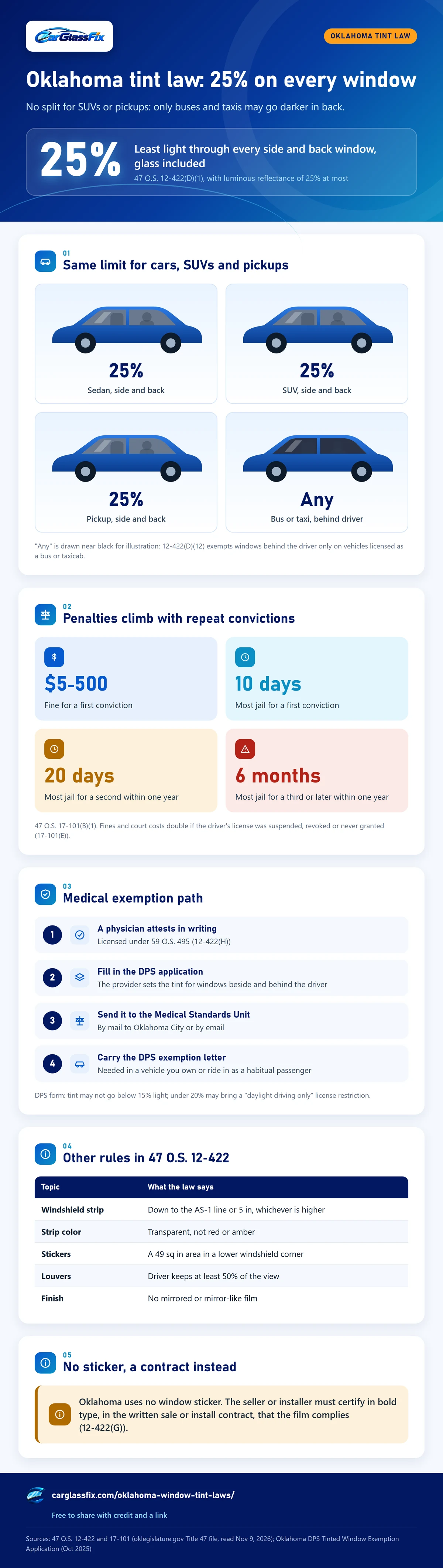
Oklahoma window tint laws require every side window and the rear window to let through at least 25% of light, with film and glass measured together, and to reflect no more than 25%. Sedans, SUVs, vans and pickups follow the same rule. Windshield tint is allowed only as a clear strip above the AS-1 line or the top 5 inches.
Oklahoma window tint limits by window
Oklahoma allows tint down to 25% light transmission on the front side windows, the rear side windows and the rear window, with reflectance capped at 25%. The rule sits in Title 47 of the Oklahoma Statutes, section 12-422. The statute first makes any material on the glass unlawful and then lists exceptions. The main exception covers “side or back windows” whose film and glass together pass at least 25% of light. The statute uses one rule for every passenger vehicle. It names no separate limit for multipurpose vehicles, so a crossover, minivan or pickup follows the same 25% figure as a sedan. A mirrored or mirror-like film is not a legal sunscreening device under the definition in 12-422(A)(1). The table sums up each window.
| Window | Sedan | SUV, van, pickup |
|---|---|---|
| Windshield | Clear (transparent) material in the top strip only, not below the AS-1 line or more than 5 in from the top, whichever is closer to the top; not red or amber | Same |
| Front side windows | 25% light or more, 25% reflectance or less | Same |
| Side windows behind the driver | 25% light or more, 25% reflectance or less | Same |
| Rear window | 25% light or more, 25% reflectance or less | Same |
| Pre-1996 model with two outside mirrors | 10% allowed behind the driver and on the rear window | Same |
| Mirror finish | Not allowed | Not allowed |
| Measured as | Film and glass together | Same |
How Oklahoma measures the 25% limit
Oklahoma measures the finished window, so the 25% limit applies to film and glass together, not to the film alone. Section 12-422 defines a “window” as the glass “including any glazing material, glass coating or sunscreening device”. Light transmission is “the percentage of total light which is allowed to pass through a window”. The limit therefore covers the whole stack an officer’s meter reads.
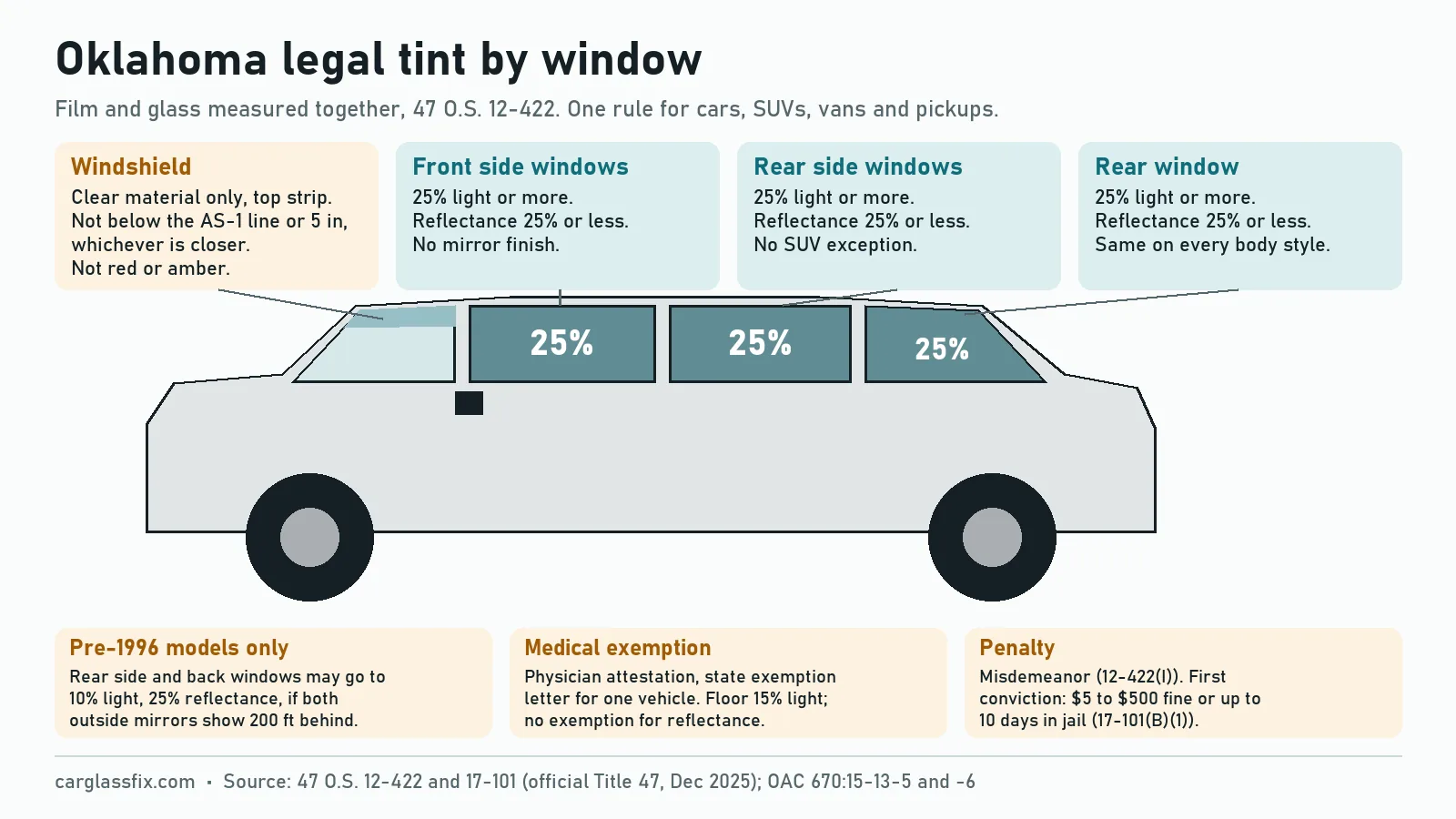
Factory glass already blocks some light before any film goes on. A film sold as 25% will read darker than 25% once it sits on the glass, which can put the window under the limit. Our guide on how to measure window tint shows the glass-times-film math. The window tint percentage chart shows how dark each shade looks. Oklahoma’s statute sets no meter tolerance, unlike Texas or Missouri. Reflectance is measured as the share of light the film throws back outward, and the cap is 25% on every side and back window. A window tint meter gives the net reading of film and glass.
Windshield tint in Oklahoma: the AS-1 line or 5 inches
An Oklahoma windshield may carry only a transparent strip at the very top, ending at the AS-1 line or 5 inches from the top, whichever is closer to the top. That is the wording of 12-422(D)(11). The strip may not be red or amber. The statute sets no darkness figure for the strip, so the test is placement and color. The AS-1 line is a small mark near the top corners of the glass; see the AS-1 line on a windshield to find it.
Below that strip, the statute lists no exception for film. Subsection (B) makes any material on the windshield unlawful unless the section allows it. Subsection (C) bans any transparent material that alters the color or reduces light on the windshield. Some tint shop pages suggest a clear full-windshield film can be legal in Oklahoma; the statute text has no clear-film exception like the one Texas gives. Stickers are allowed in a 49-square-inch area in either lower corner of the windshield, under (D)(5). For other states, read is it illegal to have tint on a windshield.
Do SUVs, vans and older cars get darker tint in Oklahoma?
Modern SUVs, vans and pickups do not get darker tint in Oklahoma; only vehicles built before the 1996 model year, buses and taxicabs have an exception. Several ranking guides say SUVs may go any darkness behind the driver. The statute read for this page contains no such rule. The only body-type exception behind the driver is 12-422(D)(12), for “all windows to the rear of the driver’s seat” in a vehicle licensed as a bus or a taxicab.
The pre-1996 exception is narrow. Under (D)(10), side windows behind the driver and back windows may pass as little as 10% of light, with reflectance still at 25% or less. It applies only to vehicles “manufactured prior to 1996 year models”. The vehicle must also have outside mirrors on both sides that show the driver the highway for at least 200 feet to the rear. A Bing AI answer checked for this page said Oklahoma requires side mirrors whenever the rear window is tinted. The statute ties the mirror condition only to this pre-1996 exception. Vehicles not subject to Oklahoma registration, state or local law enforcement vehicles and implements of husbandry are also outside the section. For how 10% and 25% compare, try the window tint simulator.
Oklahoma medical exemption for window tint
Oklahoma allows darker tint for a medical need through a state exemption letter, backed by a physician’s written attestation. Section 12-422(H) lets the Commissioner of Public Safety issue it for a vehicle that belongs to the person or in which the person is “a habitual passenger”. The rules in Oklahoma Administrative Code 670:15-13 set the details. The minimum is 15% light transmission. The rules allow “no exemption” for reflectance, so the 25% reflectance cap still applies.
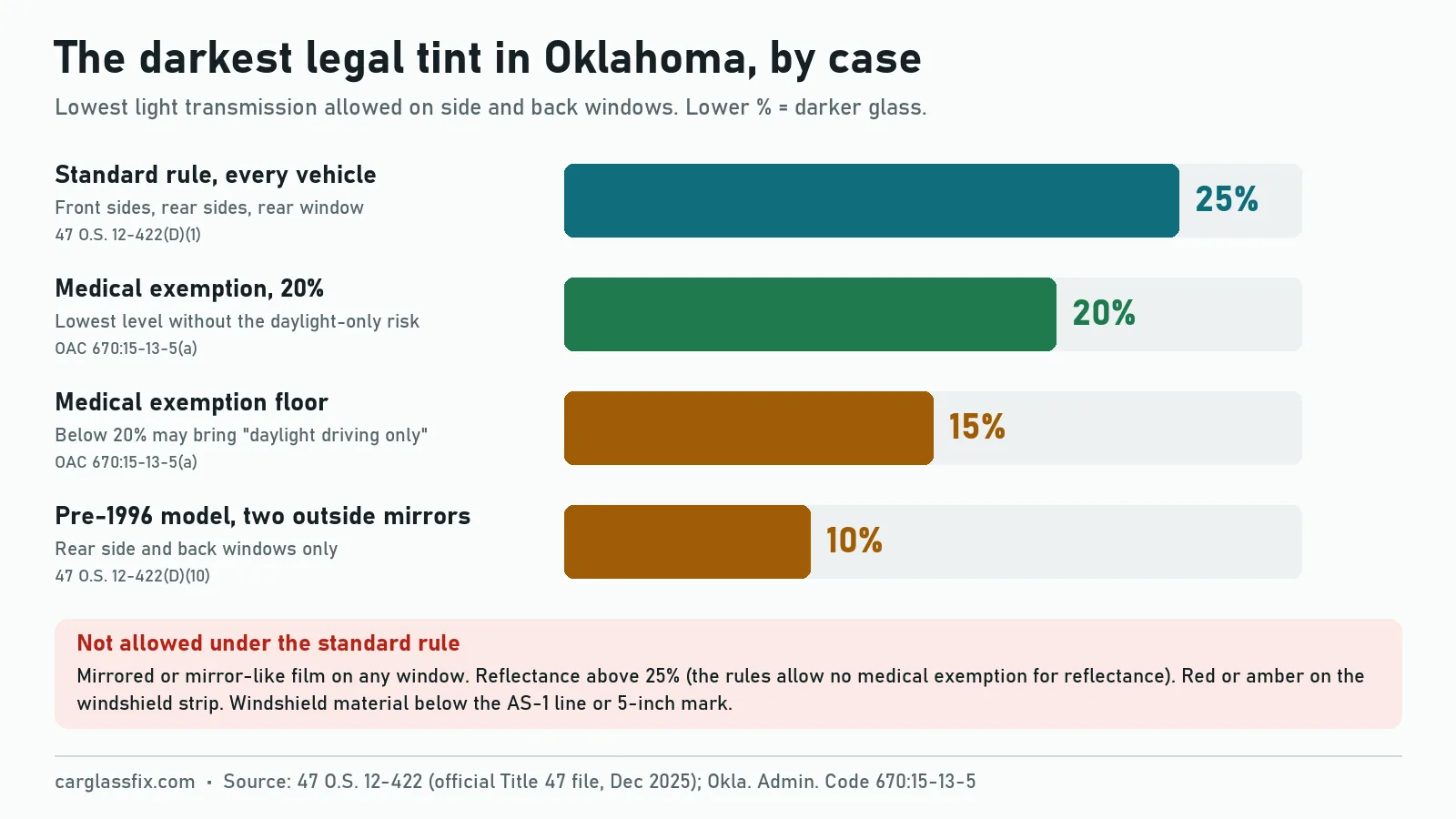
An exemption below 20% “may cause a restriction of ‘daylight driving only'” on the driver license, under 670:15-13-5(a). The letter lists the name, address, vehicle and allowed percentage, and it is valid only for that vehicle. The rules name Service Oklahoma as the issuer, while the current application form, dated October 2025, goes to the Department of Public Safety Medical Standards Unit.
How to apply for an Oklahoma medical tint exemption
Get the DPS form
Download the Tinted Window Exemption Application from the Oklahoma Department of Public Safety and fill in your details and the vehicle’s VIN, year, make, model and tag.
Have your physician complete it
The physician must be licensed under 59 O.S. 495 and must have diagnosed or be treating the condition (OAC 670:15-13-4). The form asks for the tint percentage beside and behind the driver.
Send it to the Medical Standards Unit
The form lists mail to PO Box 53004, Oklahoma City, OK 73152, or email to medicaldesk@dps.ok.gov.
Keep the letter in the vehicle
The letter is not transferable and must be shown to any officer who asks (670:15-13-6). A new vehicle needs a new application.
Oklahoma tint ticket fines and penalties
An Oklahoma tint violation is a misdemeanor punished under 47 O.S. 17-101, with a first-conviction fine of $5 to $500 or up to 10 days in jail. Section 12-422(I) names the offense and points to 17-101 for the penalty. Subsection (B)(1) of 17-101 covers sections 10-101 through 14-121, which includes 12-422. It sets the fine “not less than Five Dollars ($5.00) nor more than Five Hundred Dollars ($500.00)”. A second conviction within one year can bring up to 20 days in jail. A third or later conviction within one year can bring up to six months, or both fine and jail.
Court costs come on top of the fine and differ by court. Subsection (B)(2) lets the district attorney allow a written guilty plea where jail is not mandatory, with the fine and costs paid by remittance. Under 17-101(E), the fine and court costs double if the driver’s privileges were suspended, revoked or never granted at the time. Tint shop and law firm pages quote ranges such as $20 to $100, but none cites a court schedule, so this page uses only the statute. The section names sellers and installers as well as drivers, so a shop that installs illegal film can be charged too.
Installer statement and other Oklahoma tint rules
An Oklahoma tint seller or installer must give a written statement in the sales or installation contract, in bold-face type, that the film meets the law. Section 12-422(G) requires the statement to say the product complies with the reflectivity and transmittance rules. It must also say that installation on the driver’s or passenger’s side window “may be illegal in some states”. Oklahoma requires no window sticker or label, so the contract is the only paper record of the film. A Bing AI answer said film manufacturers must certify tint sold in Oklahoma; the statute puts that duty on the seller or installer.
Louvered materials may not cut the driver’s visibility below 50% on a horizontal plane under 12-422(F). On the rear window, that is judged from the driver’s view through the rearview mirror. Required federal, state or local certificates may go on any window under (E). Mirror-finish films are ruled out by definition; see can you put mirror tint on a car for how other states treat them. To compare Oklahoma with other states, read what car window tint is legal.
Oklahoma tint rules can change with each legislative session. Check the current 47 O.S. 12-422 on the Oklahoma Legislature site, or the Department of Public Safety, before you tint. This article is general information, not legal advice.
Frequently asked questions
What are the window tinting laws in Oklahoma?
Every side window and the rear window must pass at least 25% of light with film and glass together and reflect no more than 25%. The windshield may carry only a clear strip above the AS-1 line or the top 5 inches, and the strip may not be red or amber.
Is 20% tint legal in Oklahoma?
No, not without a medical exemption. A 20% reading is below the 25% minimum on every side window and the rear window; only vehicles built before the 1996 model year with two outside mirrors may go darker behind the driver.
Is 5% tint all around legal in Oklahoma?
No. Even the pre-1996 exception stops at 10%, and the medical exemption floor is 15% under Okla. Admin. Code 670:15-13-5.
Is 35 or 20 tint darker?
A 20% tint is darker because it lets through 20% of visible light, against 35% for the lighter film. In Oklahoma, a 35% film is legal and a 20% film is not. The window tint percentage chart shows both shades side by side.
Can SUVs have darker tint in Oklahoma?
No. Section 12-422 sets the same 25% limit for every vehicle type; only licensed buses and taxicabs are exempt behind the driver’s seat.
Sources
- Oklahoma Statutes Title 47, complete title file: 12-422, Restrictions on use of glass coating materials or sunscreening devices, and 17-101, Misdemeanor violations, Penalties (file dated 31 December 2025; checked 29 October 2026)
- Okla. Admin. Code 670:15-13, Medical Exemption for Tinted Windows and Windshields (effective 25 August 2024; checked 29 October 2026)
- Okla. Admin. Code 260:135-5, Part 13, Medical Exemption for Tinted Windows and Windshields (amended effective 11 September 2023; checked 29 October 2026)
- Oklahoma Department of Public Safety, Medical Standards Unit: Tinted Window Exemption Application (form dated October 2025; checked 29 October 2026)

Similar Posts