Louisiana Window Tint Laws: 25% Front Sides Since 2025
Senior Automotive Glass Diagnostic Specialist & Master Technician at CarGlassFix · AGSC Master Certified Auto Glass Technician, NGA Certified Installer, I-CAR Automotive Safety Specialist · 12+ Years in Automotive Glazing, Windshield Structural Bonding, ADAS Camera Calibration & Precision Chip Restoration
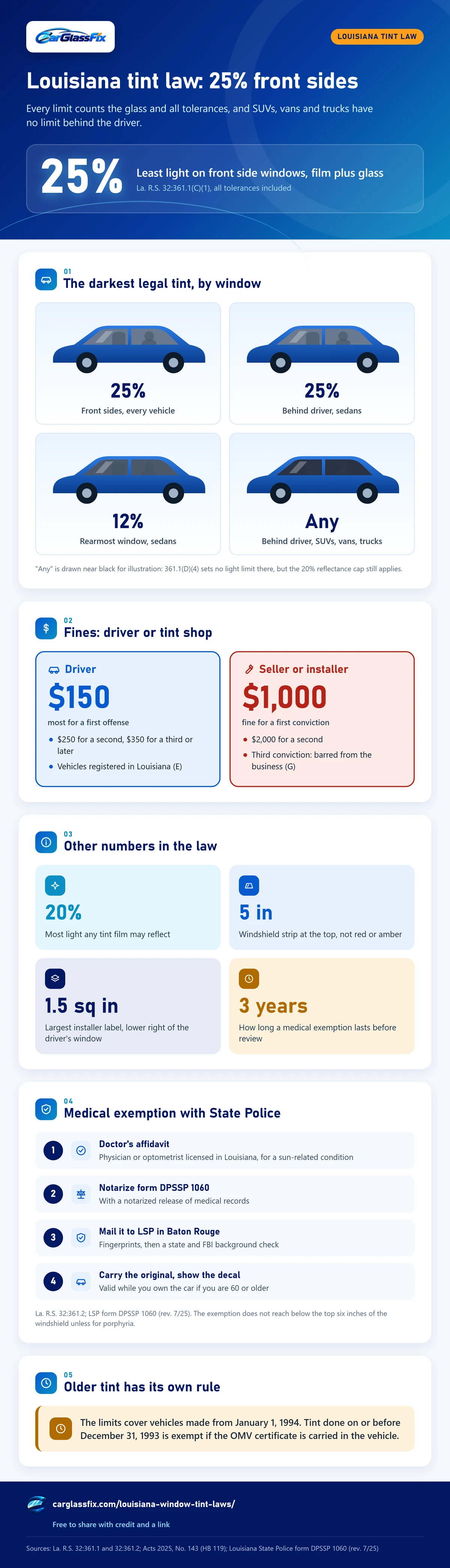
Louisiana window tint laws require at least 25% light transmission on the front side windows and on the side windows behind the driver, and 12% on the rearmost windows, with film and glass measured together. SUVs, vans and pickups have no limit behind the driver. The windshield may carry only a transparent strip in the top 5 inches.
Louisiana window tint limits by window
Louisiana allows 25% light transmission on both pairs of side windows and 12% on the rearmost windows of a car. The rule is La. R.S. 32:361.1, last amended by Act 143 of 2025. The statute first bans any material that “alters the color or reduces the light transmission” of the windshield or front side windows. It then lists exceptions, and a sun screening device must fit one of them. The first exception sets the three percentages. Subsection D(4) removes the light limit for windows behind the driver on trucks, buses, trailers, motor homes and multipurpose passenger vehicles. The inspection rule, LAC 55:III.813, names SUVs in the same exception. That covers most SUVs, vans and pickups. The 20% reflectance cap still applies to those windows.
| Window | Sedan | SUV, van, pickup |
|---|---|---|
| Windshield | Transparent strip in the top 5 in only; not red or amber | Same |
| Front side windows | 25% light or more | 25% light or more |
| Side windows behind the driver | 25% light or more | Any darkness |
| Rearmost windows | 12% light or more | Any darkness |
| Reflectance | 20% or less on every film | 20% or less on every film |
| Measured as | Film and glass together, no extra tolerance | Same |
How Louisiana measures the 25% and 12% limits
Louisiana measures the finished window, film and glass together, so the legal figure is the meter reading, not the number on the film box. The statute defines light transmission as light passing through “the product or material, including any glazing material”. Each limit is written as “all tolerances included”, so the statute gives no extra margin above or below the figure.
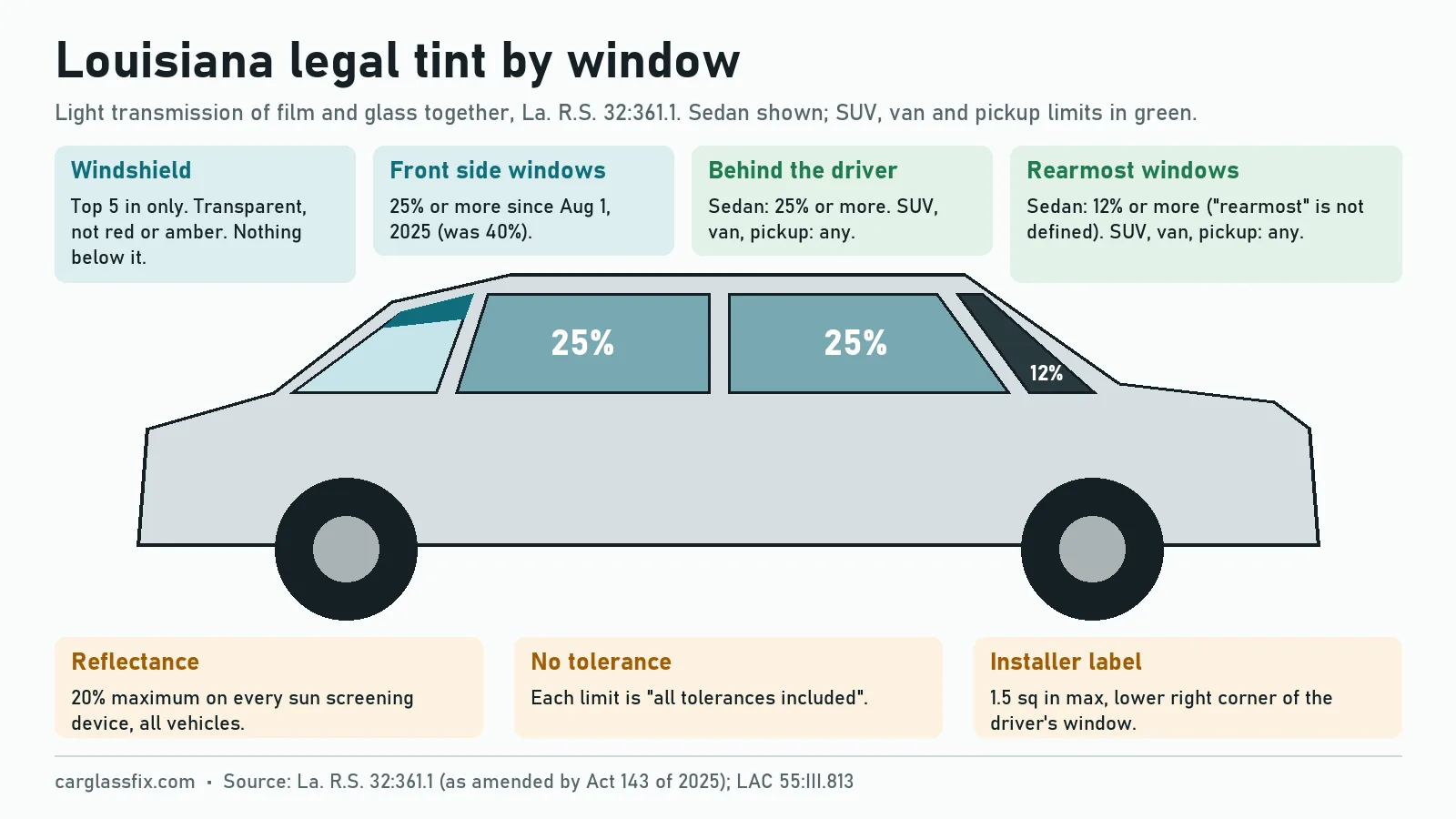
Factory glass already blocks some light, so a film sold as 25% reads darker once it is on the window. A tint shop owner told WBRZ that a window reading 40% on the meter can take a 35% film and still read above 25%. Our how to measure window tint guide explains the glass-times-film math. The inspection rule says light transmission is checked “using only an approved tint meter”; see the window tint meter page for how those readings work. Reflectance is capped at 20% on every sun screening device, which rules out most mirror films.
Windshield tint in Louisiana: the top 5 inches
A Louisiana windshield may carry only a transparent material, not red or amber, in a strip no more than 5 inches down from the top. That is the exception in R.S. 32:361.1(C)(2). Below that strip, the statute bans any material that changes the color or cuts the light of the windshield. Louisiana measures the strip in inches and does not use the AS-1 line. Some ranking pages, and the Bing AI answer checked for this page, say Louisiana allows tint down to the AS-1 line, but the statute never mentions it. The AS-1 line on a windshield matters in states such as Texas, not here.
The inspection rule repeats the 5-inch limit and adds a second one. A vehicle with a medical or security exemption may have the strip reach 6 inches from the top. Under R.S. 32:361.2(D), a medical exemption reaches below those 6 inches only for a patient with light-sensitive porphyria, and only when the physician or optometrist authorizes it. Other states handle the windshield differently; see is it illegal to have tint on a windshield.
Act 143 of 2025: front side windows went from 40% to 25%
Louisiana lowered its front side window limit from 40% to 25% light transmission on August 1, 2025. The change came through Act 143 of the 2025 session, House Bill 119, sponsored by Rep. Daryl Deshotel. The Louisiana Illuminator reported that the side windows behind the driver were already at 25% and the rear at 12%, so only the front sides changed. Many tint shop and law pages still show 40% for the front sides, and one top Google result did on the day this page was checked.
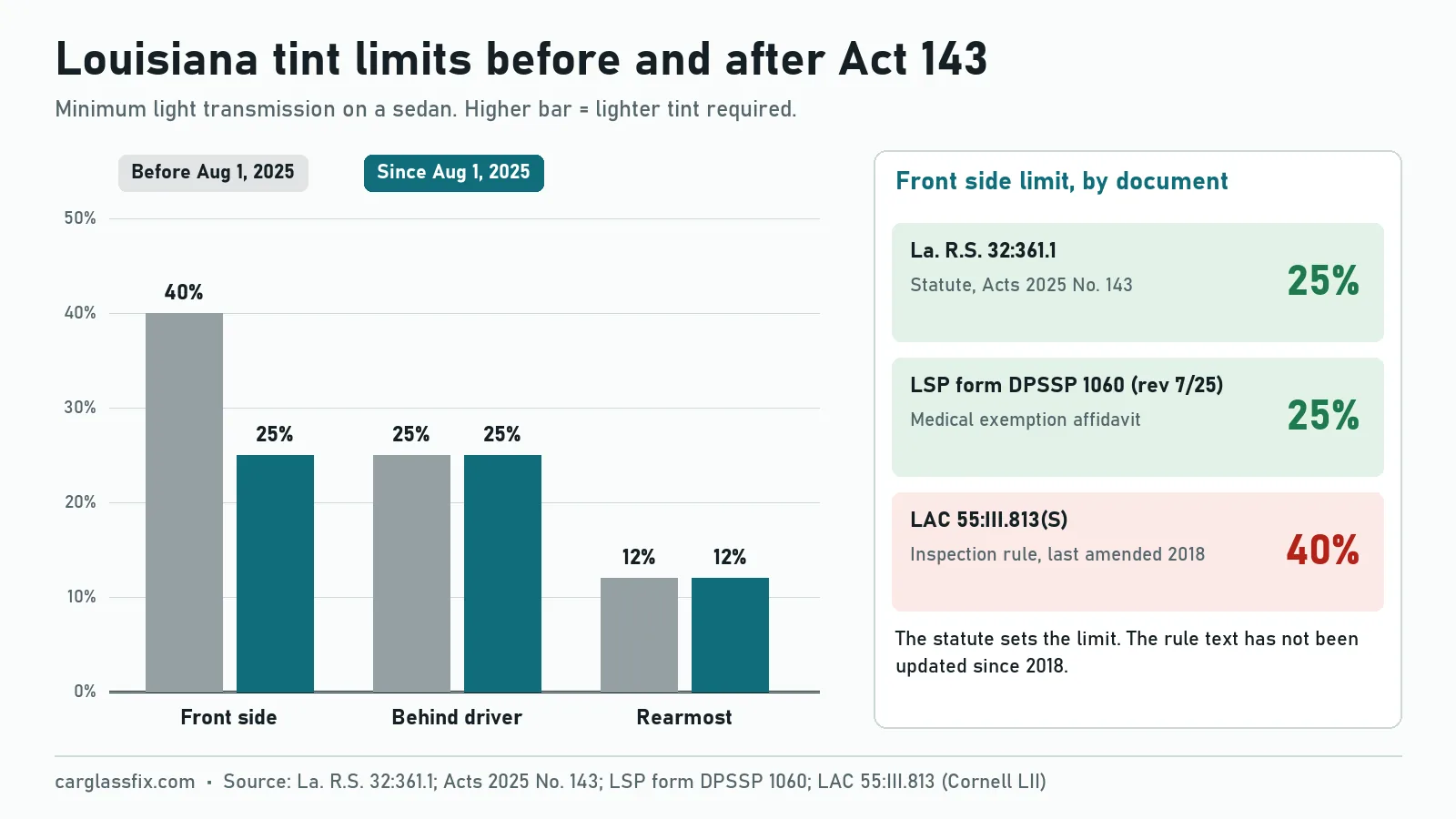
One official document has not caught up. The motor vehicle inspection rule, LAC 55:III.813(S), still says front side windows “must have at least 40 percent light transmission”. Its history note shows no amendment after September 2018. The State Police medical exemption form, revised in July 2025, already states 25% for the front side windows. The statute sets the legal limit. If an inspection station applies the older rule text, ask the station or the Louisiana State Police which figure it uses.
Louisiana medical exemption for window tint
Louisiana grants a medical tint exemption through the Louisiana State Police, based on an affidavit signed by a Louisiana-licensed optometrist or physician. R.S. 32:361.2 says the condition must involve “the effects of the sun” and must be a recognized ICD-9-CM condition. The State Police form DPSSP 1060 lists albinism, lupus and porphyria, with a space for other conditions. For photophobia, the doctor must explain why sunglasses are not enough and why the tint will not affect night driving. People convicted of a violent crime or a drug offense are not eligible.
How to get a Louisiana medical tint exemption
Have the doctor complete the affidavit
A Louisiana-licensed physician or optometrist fills in page 2 of form DPSSP 1060 with the diagnosed condition.
Sign it before a notary
The State Police instructions say the affidavit must be completed and notarized before it is submitted.
Mail it to the State Police
Send it to Louisiana State Police, Medical Tint Exemptions, PO Box 66614 A-26, Baton Rouge, LA 70896.
Complete the fingerprint check
The State Police mail instructions for booking a fingerprint and background check appointment.
Receive the exemption and decal
An officer from the nearest troop issues it. The rule says a red exemption certificate goes above the inspection sticker.
The form says the exemption is non-transferable and expires three years from issue. It stays valid for as long as the owner keeps the vehicle if the owner is 60 or older, and the statute gives the same lifetime validity for light-sensitive porphyria. Keep the original in the vehicle at all times.
Louisiana tint tickets, fines and the inspection sticker
A Louisiana tint ticket can carry a fine of up to $150 for a first offense, $250 for a second and $350 for a third or later offense. Those caps are in R.S. 32:361.1(E), which says the driver “shall be fined not more than” each amount. That subsection covers a motor vehicle “registered in this state”. News reports that describe a flat $150 fine leave out that the statute sets a maximum. A seller, installer, manufacturer or distributor who breaks the law faces $1,000 for a first offense, $2,000 for a second, and a ban from the business after a third conviction (subsection G).
Tint is also checked at the safety inspection. The inspection rule tells stations to check light transmission with an approved tint meter, to look for the installer label, and to reject tint that covers the high-mount brake light. The label may be no larger than 1.5 square inches. It carries the installer’s name and city and sits on the lower right corner of the driver’s side window. The same rule bans vehicle wraps on any glass. For other inspection items, read will a car pass inspection with a cracked windshield.
Vehicles and tint the Louisiana limits do not cover
The Louisiana limits do not apply to publicly owned law enforcement vehicles, to vehicles with a medical or security exemption, or to some older tint. Subsection C(4) exempts public law enforcement vehicles and vehicles the Department of Wildlife and Fisheries uses for enforcement. R.S. 32:361.3 creates a security exemption on a Department of Public Safety form, with the same criminal history check. The inspection rule names private investigators, bail enforcement agents, railroad police, sworn peace officers and public officials as eligible groups.
Tint applied on or before December 31, 1993, under the law of that time, is exempt if the owner has a certificate from the Office of Motor Vehicles and carries it in the vehicle. Subsection H applies the section to vehicles made on or after January 1, 1994. Before you pick a shade, compare looks in the window tint percentage chart and the window tint simulator. Neighbouring tint laws in Texas leave the rear side windows unlimited, and what car window tint is legal compares every state.
Louisiana tint rules can change with each legislative session. Check the current R.S. 32:361.1 on the Louisiana Legislature site or ask the Louisiana State Police before you tint. This article is general information, not legal advice.
Frequently asked questions
Is 20% tint legal in Louisiana?
A 20% reading is illegal on a sedan’s side windows, which must pass at least 25% with the glass, and legal on its rearmost windows, where the floor is 12%. On an SUV, van or pickup, 20% is legal on every window behind the driver.
Is 5% tint all around legal in Louisiana?
No. A 5% film is below the 25% front side limit on every vehicle and below the sedan limits behind the driver. Only the windows behind the driver on trucks, SUVs, vans and other multipurpose vehicles may be that dark.
How much is a tint ticket in Louisiana?
The statute caps the fine at $150 for a first offense, $250 for a second and $350 for a third or later offense.
Did Louisiana pass a new tint law?
Yes. Act 143 of 2025 (House Bill 119) lowered the front side window limit from 40% to 25% light transmission, effective August 1, 2025. The rear side and rear limits stayed at 25% and 12%.
Can I get a window tint exemption in Louisiana?
Yes, for a sun-related medical condition. Submit the notarized State Police affidavit signed by a Louisiana-licensed physician or optometrist and pass a fingerprint background check. The exemption is reviewed every three years in most cases.
Sources
- La. R.S. 32:361.1, View outward or inward through windshield or windows; obscuring prohibited (Louisiana State Legislature; text read 29 October 2026 from the archived official page, history through Acts 2025, No. 143)
- La. R.S. 32:361.2, Medical exemption (Louisiana State Legislature; checked 29 October 2026)
- La. R.S. 32:361.3, Security exemption (Louisiana State Legislature; checked 29 October 2026)
- LAC 55:III.813, Required Equipment (motor vehicle inspection) (Cornell LII copy; checked 29 October 2026)
- Louisiana State Police, Window Tint Medical Exemption Affidavit, form DPSSP 1060 (rev. 7/25), with instructions (checked 29 October 2026)
- Louisiana State Police, Forms (medical and security window tint exemption forms)
- Louisiana Illuminator via KSLA, Louisiana vehicles can have darker window tints starting Aug. 1 (26 July 2025)
- WBRZ, Louisiana loosens window tint laws for front side windows (28 July 2025)

Similar Posts